Every unfilled role costs your business $500 per day in lost productivity. For scaling SMEs, hiring delays can derail growth, overburden teams, and result in missed opportunities. With top candidates accepting offers within just 10 days, a slow process leaves you with fewer options and higher costs.
This guide breaks down how to reduce time-to-hire without sacrificing quality. Key takeaways include:
- Track key metrics like time-to-hire, time-to-fill, and cost-per-hire to pinpoint delays.
- Streamline your hiring funnel with structured processes and clear accountability.
- Leverage technology like ATS, automated scheduling, and AI tools to save time.
- Focus on role clarity to attract better candidates and avoid mismatches.
- Set SLAs for hiring stages to keep the process moving and reduce bottlenecks.
The result? Faster hires, lower costs, and a hiring process that aligns with your growth goals. Whether you’re hiring 5 roles or 50, the strategies here ensure you can scale efficiently. If internal resources are stretched, consider an embedded recruiter to manage hiring end-to-end and reclaim over 80 hours per month in admin time.
Keep reading for a step-by-step breakdown of how to fix slow hiring and build a scalable recruitment function.
How to reduce time to hire for software engineers in Half Using AI & Automation
sbb-itb-a23bd6a
The Financial and Operational Cost of Slow Hiring
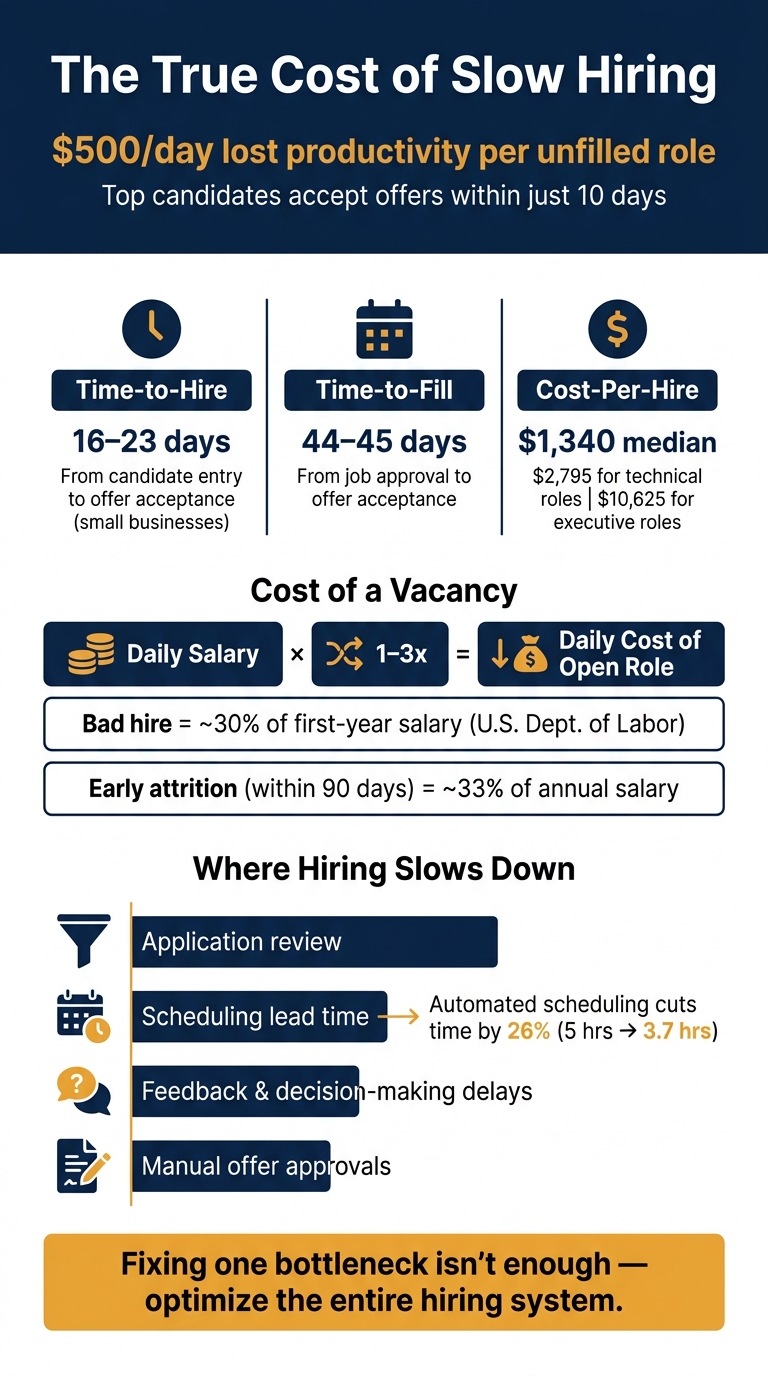
The True Cost of Slow Hiring: Key Metrics for Scaling SMEs
Reducing time-to-hire does more than speed up growth – it also eliminates hidden expenses that quietly drain your budget. When a role remains unfilled, the cost is measurable: every day it stays open costs 1x to 3x the daily salary of that position in lost productivity and overtime expenses [5]. Multiply that by multiple vacancies, and the financial impact scales quickly across your business.
Key Hiring Metrics to Track
To truly understand the health of your hiring process, focus on three critical metrics:
- Time-to-hire: This measures the days from when a candidate enters your pipeline to when they accept an offer. For small businesses, this typically falls between 16–23 days [4].
- Time-to-fill: This broader metric tracks the entire process – from job approval to offer acceptance – and averages 44–45 days [4].
- Cost-per-hire (CPH): This captures all expenses tied to making a hire, including recruiter time and job board fees. The median CPH is $1,340, but it spikes to $2,795 for technical roles and hits $10,625 for executive-level positions [4].
By tracking these metrics together, you’ll uncover where time and money are being lost – and which roles are driving up costs the most. This insight is key to understanding the true impact of unfilled positions.
How to Calculate the Cost of an Open Role
Calculating the financial impact of a vacancy is straightforward: multiply the role’s daily salary by 1–3x for each unfilled day. This reflects lost productivity and additional overtime costs as your current team shoulders the extra workload [5]. But the real cost doesn’t stop there – burnout from this added strain can lead to further turnover, compounding expenses.
"A bad hire costs roughly 30% of the employee’s first-year salary." – U.S. Department of Labor [5]
Replacing an employee who leaves within their first 90 days can cost about 33% of their annual salary [6]. So, while rushing through a hire might seem like a quick fix, it often doubles the expense. For smaller teams, this financial hit can be especially damaging, making fractional recruitment services for SMEs a cost-effective alternative to traditional hiring.
Common Bottlenecks That Slow Down Hiring
Understanding where delays occur in your hiring process is vital. These delays are rarely caused by one major issue; instead, they stem from several smaller inefficiencies that pile up [1]. The most common bottlenecks include:
- Application review: Time spent sifting through resumes.
- Scheduling lead time: Coordinating interviews often takes longer than it should.
- Feedback and decision-making: Misalignment among interviewers can stall progress.
- Offer approvals: Manual approval chains involving HR, finance, and leadership can add unnecessary days to the process.
For example, automated scheduling tools can reduce the average scheduling time by 26%, cutting it from 5 hours to 3.7 hours [1]. On the other hand, delays in feedback or misaligned decisions can slow the pipeline significantly. Similarly, manual offer approvals can stretch the timeline, leaving candidates waiting – and exploring other opportunities.
"Hiring performance is driven by how well the system operates as a whole." – Joel Westmark, Ashby [1]
The bottom line? Fixing one isolated issue won’t transform your hiring process. To see real results, you need to identify where your pipeline slows down and address those pain points systematically. By doing so, you’ll create a hiring process that’s faster, more efficient, and better aligned with your business goals. See how other companies achieved these results in our embedded recruitment case studies.
How to Design a Hiring Process That Scales
To keep up with growth, your hiring process needs structure, clarity, and accountability. Without these, delays multiply as your team expands. A well-designed process ensures hiring remains fast and effective, no matter how much your business grows.
Simplifying the Hiring Funnel
The best hiring funnels aren’t complicated – they’re purposeful. Every stage should have a clear goal and deliver specific outcomes. Before posting a job, bring your team together – HR, hiring managers, department heads, and finance – and agree on what the role needs to achieve. This alignment upfront avoids the back-and-forth that often slows decisions later on [7].
Consistency is key. Use shared evaluation scorecards so every interviewer assesses candidates against the same criteria. This reduces internal disagreements and keeps the process moving.
Another area to streamline is the transition from hiring to onboarding. Automate workflows to trigger pre-boarding tasks as soon as a candidate accepts the offer. Clearly define who owns the offer extension to avoid confusion. This eliminates the common gap between "yes" and the new hire’s first day [7].
Assigning Clear Ownership in the Hiring Process
Even with a streamlined funnel, unclear accountability can create bottlenecks. When no one is responsible for moving candidates forward, positions remain unfilled longer than necessary.
Assign specific roles to prevent delays. Designate a process owner who is accountable for the overall hiring outcome, distinct from a process manager who handles daily coordination [8]. The process owner focuses on strategy and performance monitoring, while the process manager ensures operational tasks stay on track. In smaller teams, one person might wear both hats, but it’s crucial to outline each responsibility clearly.
"A process owner is a designated authority who assumes accountability for a particular process within an organization." – SixSigma.us [8]
Document responsibilities for each stage – screening, scheduling, interviewing, and offer approval – and set clear turnaround times. This clarity reduces handoff delays and keeps the pipeline moving.
Writing Job Descriptions That Work
A well-defined role is the foundation of an efficient hiring process. Vague job descriptions attract unqualified applicants, wasting your team’s time on unsuitable candidates.
Start by defining success and the key competencies required for the role [9]. Focus on 4–6 essential skills directly tied to business outcomes, and include clear disqualifiers. This approach helps candidates self-select and ensures interviewers are aligned.
"Most hiring ‘problems’ are actually role-definition problems." – Silvia Rad, Growee [9]
The impact is measurable: structured job briefs lead to a 24% faster time-to-offer on average [9]. For senior roles, which already take 37% longer to fill than junior positions [1], precision is non-negotiable. It’s the difference between a smooth process and one that stalls before it even begins.
These foundational steps pave the way for integrating technology and other advanced hiring strategies effectively. For many SMEs, this includes leveraging flexible embedded recruitment to scale without the overhead of traditional agencies.
Strategies to Cut Time-to-Hire
Once you’ve got a structured hiring process and well-defined roles, the next challenge is eliminating delays at every stage. Contrary to popular belief, speed and quality can go hand-in-hand – with the right tools and a disciplined approach.
Using Technology and Automation in Hiring
One of the simplest ways to save time is by cutting out manual tasks. Automated scheduling tools like Calendly are a prime example. They let candidates book interviews based on real-time availability, reducing median confirmation times by 26% – from 5 hours to just 3.7 hours [1].
"Automated scheduling methods are 26% faster than manual scheduling, highlighting one of the largest areas RecOps teams can drive efficiency with tooling." – Ashby 2026 Talent Trends Report [1]
Another game-changer is an Applicant Tracking System (ATS). It centralizes your hiring pipeline, automates communications, and flags bottlenecks before they become bigger issues. For businesses hiring 15–30 people at once, a full tech stack – ATS, AI screening, compliance tools – costs around $400–$700/month [3]. For smaller-scale hiring (5–8 roles), a simpler setup using tools like Indeed, Calendly, and FirstHR costs about $98–$200/month [3].
AI notetakers are another underutilized tool. By automating note-taking during interviews, they speed up feedback submission. Scorecards are 9% more likely to be submitted within five hours and 6% more likely within 24 hours [1]. These small improvements add up, especially when managing multiple open roles.
Sourcing and Screening Candidates More Effectively
Posting job ads across dozens of boards often creates more noise than results. Instead, focus on 2–3 key platforms tailored to the role. For instance, Indeed works well for operational roles, while LinkedIn is ideal for professional and technical positions [3]. For high-growth tech firms, embedded IT recruitment can further accelerate the sourcing of specialized talent. Pair this with AI-powered sponsored postings on platforms like Indeed ($5–$15/day) [3] to target qualified candidates more efficiently.
Before going public, tap into your referral network. Referred candidates pass initial screens at a rate of 52%, compared to 35% for general applicants [1], making them a high-quality source for most small and medium-sized enterprises (SMEs).
For incoming applications, knockout questions can filter candidates at the top of the funnel. Adding 3–5 mandatory questions to your application form ensures only qualified candidates move forward – no manual review needed [3]. This keeps your team focused on the right talent.
"Speed retains rigor when it cuts only unnecessary delays." – FirstHR [3]
With a refined candidate pool, the next step is to streamline the interview and offer process.
Moving Faster Through Interviews and Offers
The biggest hiring delays often occur in the gaps between interview stages. Structured interview loops with clear objectives for each round prevent repetitive discussions. On average, business candidates complete their interview loops in 14 days, while technical candidates take 18 days [1]. Reducing downtime between stages is where you can save the most time.
Setting clear Service Level Agreements (SLAs) ensures accountability and keeps the process moving:
| Hiring Stage | Target Turnaround |
|---|---|
| New applicant review | Under 24 hours |
| Interview feedback submission | Under 24 hours |
| Final debrief after last round | Under 48 hours |
| Offer sent after decision | Same day |
To avoid delays from groupthink, have interviewers submit scorecards independently before any debrief. This matters more than you might think – around 38% of scorecard pairs show a point difference that can sway decisions [1].
Finally, set clear expectations with candidates during the interview process. Discuss compensation, competing offers, and any potential deal-breakers early on. Once a decision is made, send the offer the same day using a pre-approved template. Waiting too long can cost you top talent – candidate NPS scores drop sharply from a median of 9 for offers sent within one day to just 3 after 50 days [1]. Speed matters, not just for your timeline but for securing the best candidates.
Building a Hiring Function That Keeps Up With Growth
To keep up with rapid growth, your hiring process needs to do more than just move quickly – it must stay efficient and adaptable. For scaling SMEs, the challenge lies in maintaining a recruitment function that consistently delivers results while reducing time-to-hire. Here’s how to measure, refine, and align your hiring process to sustain speed and efficiency as your business grows.
Tracking Hiring Metrics and Spotting Gaps
To ensure your hiring process remains efficient, focus on tracking key metrics that highlight potential delays:
| Metric | What It Measures | Target Benchmark |
|---|---|---|
| Time to First Fill | Predictability and speed of the hiring process | 25–40 days for high-volume sprints [3] |
| 90-Day Retention | Quality of hire and onboarding success | 85%+ (below 80% signals a process issue) [3] |
| Offer Acceptance Rate | Competitiveness and speed of offers | 80%+ [3] |
| Application-to-Interview Rate | Sourcing and screening effectiveness | 15–25% [3] |
| Internal Fill Rate | Success of internal mobility programs | Higher = stronger internal talent strategy [10] |
Metrics like Time to First Fill tend to stabilise once your company reaches 100 employees, but keep in mind that technical roles often take 15 extra days, while senior positions can take 37% longer than junior ones [1]. Using a single benchmark across all roles can mask these nuances, so segmenting metrics by role type is crucial for an accurate view of performance.
"Time to Hire is shaped by many small delays across the process versus a single bottleneck." – Ashby 2026 Talent Trends Report [1]
Connecting Recruitment to Business Milestones
Your hiring strategy should align with major business milestones, such as product launches, funding rounds, or new client contracts. Misaligned recruitment timelines can create significant delays. To avoid this, work backwards from key events. For example, if an engineering team must be fully operational by Q3 and technical roles require 15 extra days to fill, aim to open these positions by mid-Q2. Acknowledging the complexity of certain roles early on ensures all stakeholders remain aligned and avoids last-minute hiring scrambles.
By syncing recruitment timelines with business goals, you create a more predictable and proactive hiring process.
Building a Feedback Loop Into Your Hiring Process
Successful scaling relies on treating recruitment as a continuous improvement cycle. Each hire provides data that can refine the next round. Conducting quarterly reviews can help identify where candidates drop off with a recruitment health check, measure the time spent at each stage, and assess whether new hires are staying beyond the 90-day mark. If retention falls below 80%, it’s a clear signal to revisit role expectations versus the reality of the job [3].
Candidate feedback and internal scorecard completion rates also offer valuable insights into your process. As organisations grow, scorecard completion rates typically improve – from 49% in teams with fewer than 25 employees to 72% in those with 500+ employees [1]. Low completion rates often point to gaps in process discipline, not candidate quality.
"Process discipline directly impacts both data quality and candidate experience, particularly in areas like feedback and archiving." – Ashby 2026 Talent Trends Report [1]
When internal resources are stretched thin, embedding a dedicated recruiter can help maintain structure, improve visibility, and ensure your hiring stays on track. Rent a Recruiter specializes in working with high-growth SMEs to build scalable recruitment functions. By embedding dedicated recruitment support, companies can save over 80 hours each month on hiring admin and cut recruitment costs by up to 70% compared to traditional models. This approach ensures a consistent, efficient hiring process while reinforcing continuous improvement.
Conclusion and Next Steps
Key Takeaways for Scaling SMEs
Slow hiring goes beyond being just an HR issue – it directly affects growth. Every day a critical position remains unfilled, your team is stretched thinner, revenue opportunities are missed, and 70% of candidates lose interest. The reality is, top talent often accepts offers within just 10 days.
The strategies outlined here boil down to a few essential actions: clearly define your hiring funnel, assign ownership at each stage, leverage technology to reduce admin time, and track metrics to identify delays. Research from McKinsey shows that businesses aligning workforce planning with strategic goals are 1.5x more likely to achieve their growth targets. Why? Because they have the right people in the right roles when it matters most.
Not sure where to begin? Start small: focus on one high-priority role, eliminate one unnecessary step in the process, and monitor the impact over the next 30 days. This approach can uncover bottlenecks more effectively than prolonged analysis.
Work With Rent a Recruiter to Hire Faster
If structural challenges continue to slow down your hiring, it might be time to bring in external expertise. When internal fixes fall short, the right partner can bridge the gap.
Rent a Recruiter places experienced recruiters directly into your team within days. These embedded recruiters manage the entire hiring process, providing the structure and consistency your team needs. Clients often see up to 70% savings on hiring costs compared to traditional commission-based recruitment models, while reclaiming over 80 hours per month previously spent on internal hiring and admin tasks. Whether you’re scaling after securing funding, entering a new market, or handling a sudden surge in hiring needs, this tailored support is designed to match your pace of growth.
"Partnering with Rent a Recruiter has been a great investment for our organisation. Their seamless integration of the Talent Subscription model has revolutionised our recruitment processes and our candidate experience." – Marisa Goss, Director of Human Resources, Sheldon College [2]
Take the first step towards faster, more efficient hiring. Book a free 30-minute strategy call at rentarecruiter.com to discuss your hiring challenges and get a clear plan tailored to your needs.
FAQs
What’s the fastest way to find our biggest hiring bottleneck?
To pinpoint the biggest slowdown in your hiring process, take a close look at where delays tend to pile up. Common culprits include lengthy application reviews, trouble coordinating interview schedules, delays in providing feedback, and slow offer approvals.
Dive into metrics like how long candidates spend in each stage and their overall wait times. Once you’ve identified the problem areas, focus on solutions: automate repetitive tasks, simplify review processes, or tighten up scheduling and decision-making. These steps can help you speed things up and keep the process moving smoothly.
How do we set hiring SLAs without sacrificing quality?
To establish hiring SLAs that maintain quality, start by setting specific, measurable timelines for each step in the recruitment process. For example, aim to review resumes within 48-72 hours and provide interview feedback within 1-2 business days. Share these expectations clearly with all stakeholders, ensuring everyone is aligned.
Begin with realistic goals, such as a 14-day SLA, to balance speed with thorough evaluation. Use dashboards to track progress, spot delays, and address bottlenecks early. This approach helps create a smoother, more efficient hiring process without sacrificing the quality of your hires.
When should we use an embedded recruiter like Rent a Recruiter?
Using an embedded recruiter like Rent a Recruiter is a smart move when your company needs to ramp up hiring fast, align recruitment efforts with your team’s culture, or navigate periods of rapid growth. This approach works particularly well during high-volume hiring or market expansion, especially if your internal resources are stretched thin.
An embedded recruiter can help you reduce time-to-hire, deliver a better candidate experience, and cut costs – all while ensuring your hiring strategy stays aligned with your overall business goals.