
If your stakeholders are not aligned before a search starts, hiring gets slower, costlier, and harder to control.
I see the same pattern again and again in scaling companies across SaaS, Technology, IT, Fintech, Engineering, Security, Insurance, and Professional Services. The fix is simple: one decision owner, one written brief, shared scorecards, and fixed feedback deadlines. When that discipline is missing, roles drift, shortlists get rejected, offers stall, and time-to-fill can slip from 60 days to 90 days, costing you 30 extra days of lost output.
A few numbers make the commercial case clear:
- Teams with strong stakeholder partnership hit business goals 79% of the time, versus 36% for weaker partnership
- High-performing recruitment teams are 3x more likely to use a documented hiring process with clear accountability
- Better process balance makes top recruitment teams 4x more likely to get stakeholder input without slowing decisions
- If your team lacks hiring capacity, embedded recruitment can help hold structure, pace, and ownership in place
- Many scaling companies also cut recruitment spend by up to 70% versus agency fees and save 80+ hours per month in internal hiring admin, which you can estimate with this ROI calculator
If you want hiring to move with less delay and less rework, this is what matters most.
- Set one final decision owner
- Agree success outcomes before outreach begins
- Lock salary range and approval path upfront
- Use shared scorecards for every interviewer
- Put 24 to 48 hour deadlines on feedback and decisions
That is the core of the article, and it is where hiring performance starts to change.
Webinar 9: Navigating true stakeholder management in talent acquisition
sbb-itb-a23bd6a
Who needs to align before hiring starts
Before outreach starts, map each decision to one owner.
Core stakeholders and their responsibilities
Most hires involve a small group of people. Each person needs a clear lane before outreach begins. If that does not happen, hiring slows down fast. You can learn how our model works to prevent these bottlenecks. You get mixed signals, late-stage disagreements, and wasted interview time.
| Stakeholder | Core Responsibility | Decision Authority |
|---|---|---|
| Hiring Manager | Defines role scope and success outcomes | Final Selection: Final say on candidate selection |
| Recruiter / Talent Lead | Owns sourcing and process; advises on market fit and compliance | Process Owner: Owns the end-to-end hiring process |
| Finance / Compensation | Sets and approves compensation parameters and budget alignment | Budget Approval: Approves compensation bands and budget before the search begins |
| Leadership Sponsor | Ensures the role aligns with business strategy and growth goals | Sponsor: Approves headcount and resolves escalations |
| Cross-functional Partner | Provides technical or departmental input at defined interview stages | Advisor: Provides structured feedback only |
Cross-functional partners should join at set stages, not at every decision point. That keeps the process tighter and cuts down on noise.
Assign one decision owner
Every role needs one decision owner. In most cases, that is the hiring manager. They hold final authority on candidate selection.
Finance approves compensation. The recruiter owns sourcing and process. Everyone else advises at pre-agreed stages.
This matters for one simple reason: if ownership is fuzzy, hiring drifts. The usual fallout shows up in the brief, the feedback loop, or the approval timeline. That means more back-and-forth, more delays, and a harder path to getting the right hire over the line.
Where stakeholder alignment usually fails
Once stakeholders are named and owners are set, the next risk is process drift.
Unclear briefs, shifting scope, and no agreed success criteria
Most hiring problems start before a single candidate is contacted.
Intake meetings get skipped, or they turn into scattered Slack messages, half-formed notes, and side conversations. The result is simple: no shared brief. When that happens, the role starts to shift without clear sign-off, and small gaps begin to spread through the process.
Sometimes the brief exists on paper, but the team still is not aligned. The hiring manager and recruiter end up judging people against two different versions of the same role. By the later interview stages, that mismatch gets expensive, as seen in our embedded recruitment case studies. If alignment breaks down here, a 60-day time-to-fill target can slide to 90 days, which means 30 extra days of lost productivity [5].
Before outreach starts, stakeholders need to agree on what the hire must deliver in the first 6 to 12 months, not just a list of skills. That is the point. You are not only hiring for background. You are hiring for outcomes.
If that conversation has not happened, the brief is not ready.
Conflicting feedback and undefined approval timelines
If the brief is weak, the interview process usually makes things worse.
Once interviews begin, another failure point shows up: vague feedback. Comments like "didn’t feel senior enough" or "did not add evidence of fit" do not give recruiters anything useful to act on. There is no clear signal, no way to recalibrate the search, and no clean path to better shortlists.
Without structured criteria, decisions drift toward opinion, job titles, or seniority instead of evidence. And if senior stakeholders were not part of the kickoff, late-stage friction is almost guaranteed. New requirements appear halfway through the process, approvals slow down, and momentum drops.
Even good feedback can fail when no one has agreed on decision timelines. That is where hiring teams get stuck. If there is no clear deadline for feedback, and no agreed final sign-off owner, the process turns into delays, reminders, and repeated follow-ups.
High-quality candidates do not wait. Silence looks like disorganisation. And in a tight market, that costs you hires.
The fix is not complex, but it does need discipline:
- A tighter kickoff
- Shared scorecards
- Clear decision dates
A practical process to improve stakeholder alignment
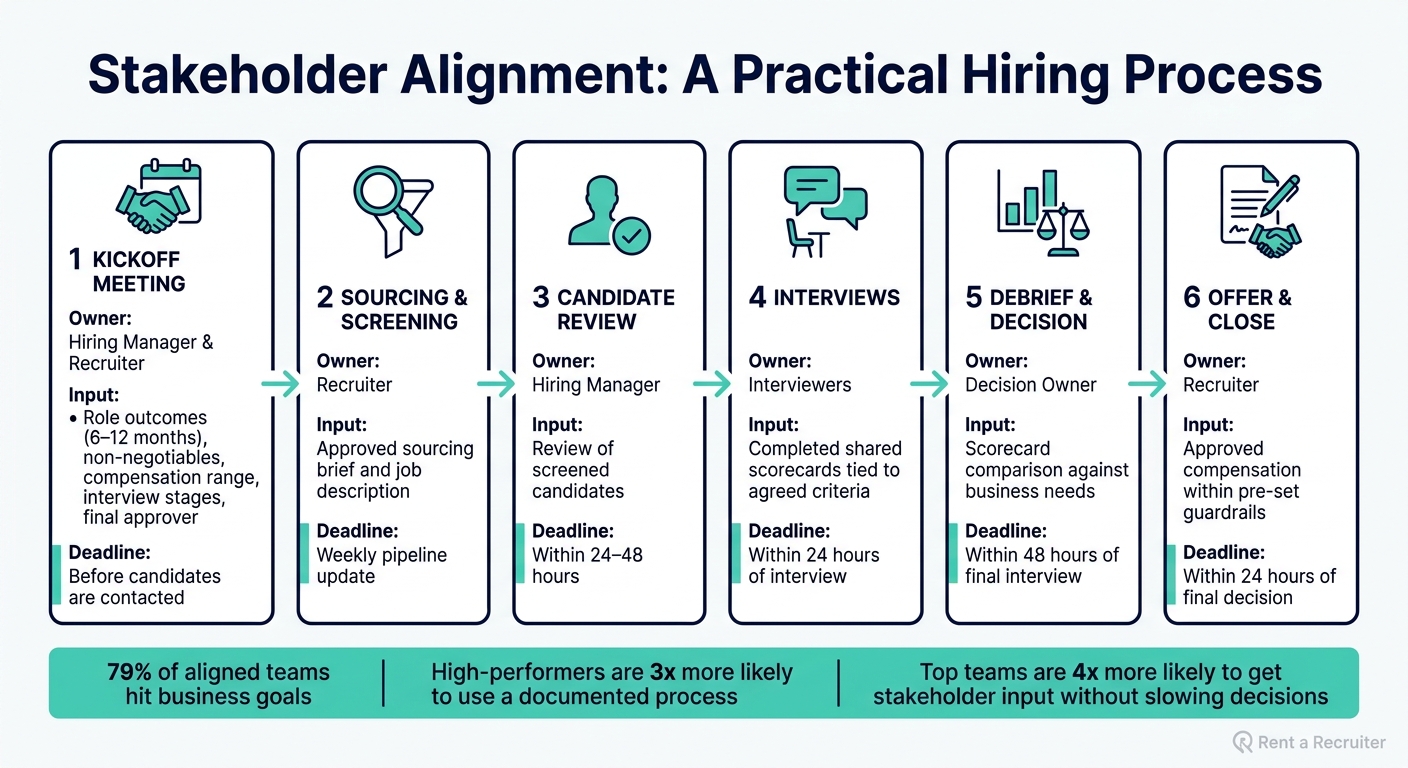
Stakeholder Alignment in Recruitment: The 5-Step Hiring Process
Once the brief is set and feedback issues are on the table, you need a simple rhythm that keeps the search on track. Keep it fixed: kickoff, scorecards, weekly check-ins, and clear deadlines.
Run a structured kickoff before candidates are contacted
Do not start sourcing until a 45 to 60 minute intake meeting has taken place with all decision makers in the room [2][4][5]. A focused intake meeting removes most avoidable hiring friction [3].
This meeting turns a vague brief into a written hiring agreement. It should cover six points:
- Why the role exists right now
- What success looks like at 6 and 12 months
- Non-negotiables vs. flexibles
- The agreed salary range in U.S. dollars
- Who interviews, and what each stage assesses
- Who has final sign-off
If even one of those six is missing, the brief is not ready. Outreach should not begin.
Use shared scorecards and documented criteria
Scorecards stop interview feedback from drifting into personal opinion. They keep every stakeholder assessing the same candidate against the same criteria.
Once the kickoff is done, each interviewer should use the same scorecard, tied straight back to the outcomes agreed in that first meeting. That changes the debrief. Instead of trading views, the team compares scores against the same standards.
High-performing recruitment organisations are 3x more likely to have a formalised, documented process with clear accountability [1].
Set weekly check-ins and decision deadlines
Weekly check-ins keep feedback and approvals moving. Without them, delays creep in fast, and good candidates drop out.
Use this operating model to keep each stage moving:
| Stage | Owner | Input Needed | Deadline |
|---|---|---|---|
| Kickoff Meeting | Hiring Manager & Recruiter | Role outcomes (6 to 12 months), non-negotiables, $ compensation range, interview stages, final approver | Before candidates are contacted |
| Sourcing & Screening | Recruiter | Approved sourcing brief and job description | Weekly pipeline update |
| Candidate Review | Hiring Manager | Review of screened candidates | Within 24 to 48 hours |
| Interviews | Interviewers | Completed shared scorecards tied to agreed criteria | Within 24 hours of interview |
| Debrief and decision | Decision Owner | Scorecard comparison against business needs | Within 48 hours of final interview |
| Offer & Close | Recruiter | Approved compensation within pre-set $ guardrails | Within 24 hours of final decision For technical roles, specialized embedded IT recruitment can further accelerate these timelines. |
Capture each decision in one shared log. This should show why each candidate moved forward or was rejected. It gives the recruiter a clear signal when sourcing needs to shift, and it stops the same disagreements from coming back later in the process.
Shared SLAs keep each stakeholder accountable for their part.
Keep the process light, repeatable, and accountable.
Recruitment outcomes and next steps
What better alignment delivers for scaling companies
When alignment is built in from the start, hiring moves faster. Shortlists get better. Fewer roles drift or stall.
Why does that happen? Because decisions happen sooner, ownership is clear, and you avoid the late changes that drag the whole process off course.
For scaling companies, the business impact is simple:
- Fewer stalled roles
- Faster decisions
- Less time spent reopening the brief
Shared scorecards and structured intake also make candidate reviews more consistent. High-performing recruitment organisations are 4x more likely to have a process that balances stakeholder input without slowing decisions [1].
How embedded recruitment support strengthens alignment
When your internal team doesn’t have the time to keep that discipline in place, embedded support closes the gap. Once capacity gets stretched, process slips fast. Feedback slows down. Owners get blurred. Deadlines start to move.
An embedded recruiter keeps the process on track from kickoff to offer. That means structured intake, shared scorecards, clear owners, and stakeholders held to agreed SLAs.
Rent a Recruiter places experienced recruiters directly into your team, often within days, to manage hiring end-to-end with structure, visibility, and consistency. The fixed monthly model gives you predictable cost, which matters when headcount plans are moving fast.
Companies often cut hiring costs by up to 70% compared with different recruitment models like commission-based agencies. They also save over 80 hours per month in internal hiring and admin time.
Conclusion and call to action
The next step is to make that structure part of how your team hires every time.
Stakeholder alignment has a direct effect on speed, cost, and hiring quality. Define one decision owner. Get alignment before the search starts. Standardise how candidates are assessed. Put deadlines on every stage.
Those steps remove a lot of the friction that makes hiring slow, expensive, and hard to predict.
If your team is scaling and internal capacity is stretched, see how Rent a Recruiter can help or use the free Recruitment Health Check to benchmark your process.
FAQs
Who should be the decision owner?
Appoint one lead decision-maker to own the search and keep hiring moving.
Other stakeholders can still give input, but one clear owner for the final call cuts bottlenecks, avoids confusion, and closes accountability gaps.
Before the search starts, document who has final authority and who is there in an advisory role. That sets expectations early and helps you avoid delays caused by waiting for full consensus.
In practice, this means fewer stalled approvals, less back-and-forth, and a faster path to hire.
What should a hiring brief include?
A strong hiring brief should be locked in during a kickoff meeting, so everyone is aligned before candidates are approached.
This matters more than most teams think. If the brief is vague, hiring slows down, interviews drift, and your team wastes time reviewing people who were never a fit in the first place.
The brief should cover:
- the role’s purpose
- the business problem it solves
- success metrics at 6, 12, and 24 months
- non-negotiable day-one skills
- trade-offs for qualities that can be built over time
- decision-making authority
- the hiring timeline
- growth-related goals
In plain terms, you need more than a job description. You need a shared view of why this role exists, what good looks like, and what you’re willing to compromise on.
That clarity helps you move faster, cut wasted interview time, and make better hiring calls.
How do scorecards speed up hiring?
Scorecards speed up hiring because they define what "good" looks like before the search starts. Your recruiter and hiring team work from the same success criteria. You also get clear agreement on must-haves versus nice-to-haves, which cuts down subjective debate and stops role drift halfway through the search.
They also make feedback faster and more consistent. When hiring managers give structured, scored feedback within set SLAs, such as 48 hours, you remove bottlenecks and keep interview processes moving.