If hiring volume goes up but your team does not, recruitment turns into a growth problem fast.
I’d sum it up like this: AI recruitment marketing helps you cut admin, improve applicant quality, and make hiring easier to control as demand grows. For SMEs in SaaS, tech, fintech, engineering, security, insurance, and professional services, that means lower cost per hire, less time lost internally, and fewer delays on roles tied to revenue.
A few numbers make the case clear:
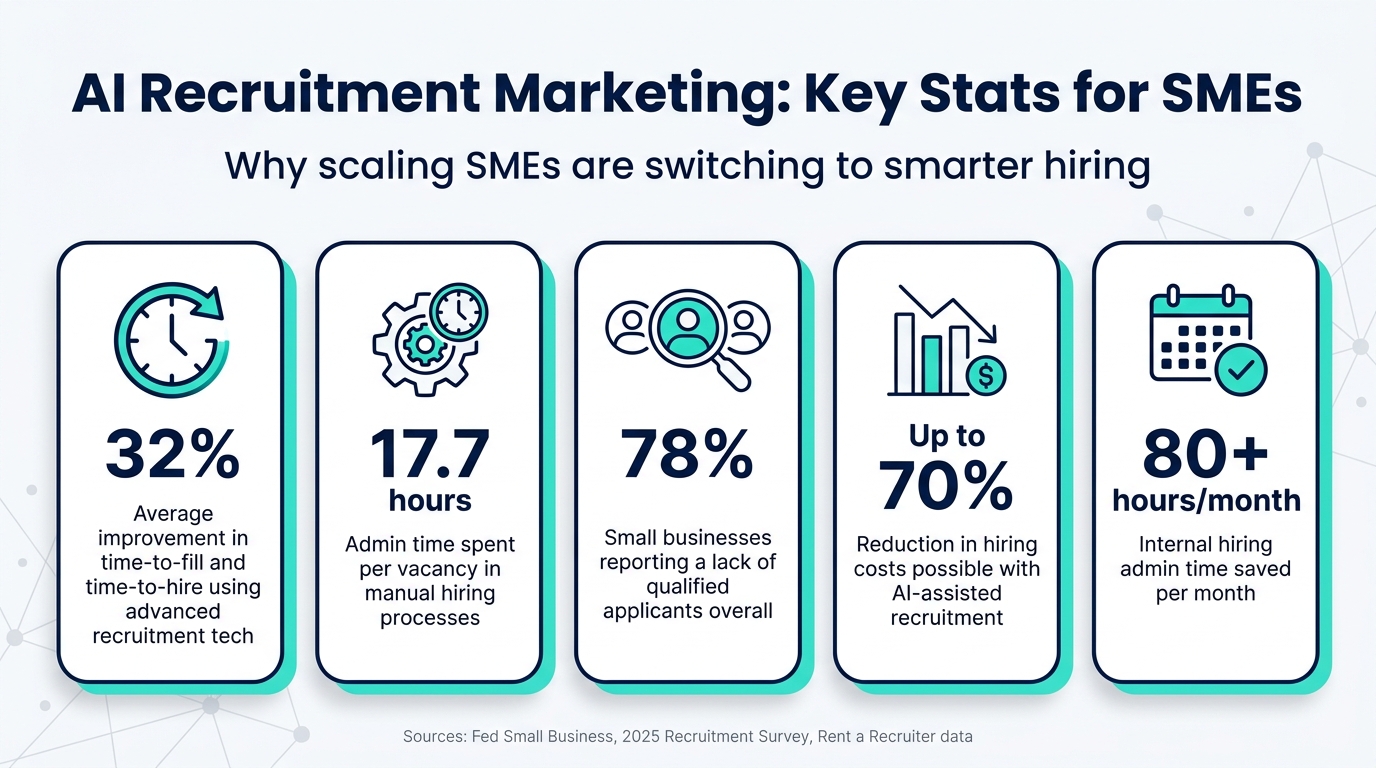
- 32% better time-to-fill and time-to-hire for teams using advanced recruitment tech
- 17.7 hours per vacancy spent on admin work in manual hiring processes
- 56% of small businesses say applicants lack role-specific skills or experience
- 78% say there is a lack of qualified applicants overall
- Companies using Rent a Recruiter can cut hiring costs by up to 70% and save 80+ hours per month in internal hiring admin time
If you are hiring across multiple roles and your process is still manual, the issue usually is not demand. It is workflow, visibility, and follow-up. That is where AI recruitment marketing, paired with the right delivery model such as embedded recruitment, starts to pay off.
Below, I break down where the cost shows up, what AI can fix, and what to look for if you want a hiring setup that scales without adding more internal strain.
AI Recruitment Marketing: Key Stats SMEs Need to Know
What Small Businesses Need To Know About AI Hiring In 2026
sbb-itb-a23bd6a
The Hiring Problems AI Recruitment Marketing Solves
Most SME hiring issues don’t start with low demand. They start with gaps in your recruitment process.
AI recruitment marketing helps fix three of the biggest ones: poor applicant quality, wasted recruiter time, and weak hiring visibility.
High Application Volume, Low Candidate Quality
Posting roles on one or two big, general job boards can bring in applications fast. But more applications doesn’t mean better applications.
According to Fed Small Business data, 56% of small businesses that found hiring difficult said applicants lacked role-specific skills or experience, and 78% cited a lack of qualified applicants overall.[2] That means broad job ad reach often creates activity without giving you enough strong-fit people to interview.
The cost shows up fast. Hiring managers lose hours screening resumes that never turn into hires. Your ad spend gets burned on clicks from people who aren’t actively looking, don’t meet the bar, or simply don’t fit the role.
And once that happens, the strain doesn’t stop at sourcing. It spills into every manual step after that.
Manual Hiring Tasks Drain Time and Budget
Recruitment admin eats more time than most founders expect. A 2025 survey found that recruiters spend an average of 17.7 hours per vacancy on administrative work alone, roughly two full workdays per hire.[4] That includes 3.6 hours reviewing applications, 2.5 hours scheduling interviews, and 3 hours logging interview feedback.[4]
For an SME, that’s time pulled away from work that drives revenue. If your team is already stretched, hiring admin becomes a hidden cost. Then follow-up starts slipping, candidate drop-off climbs, and roles stay open longer than planned.
In plain terms, manual hiring slows growth and adds cost.
The strain gets heavier when the business starts hiring across multiple roles at once.
Poor Data and Process Breakdowns During Growth Periods
Many SMEs don’t have clear visibility into source quality, cost per hire, or where candidates are dropping out of the funnel. Without that, budget decisions become reactive. Weak channels keep getting funded because no one can see what is, or isn’t, working.
For a growing SME hiring for several roles at the same time, interview scheduling, feedback collection, and approvals pile up across every open role. Without a process that can handle that load, each new hire adds more friction.[3]
That’s where AI recruitment marketing starts to matter most. It helps you cut waste, save team time, and make hiring decisions based on data instead of guesswork.
How AI Recruitment Marketing Improves Hiring Results
AI recruitment marketing closes common hiring gaps by automating sourcing, follow-up, and reporting. For scaling teams, the upside shows up in three places that hit business results fast: targeting, follow-up, and reporting.
Automated Job Distribution and Smarter Targeting
At the top of the funnel, AI helps you get in front of better-fit people. A lot of poor applications come from broad job posting, weak targeting, and too much manual distribution. AI recruitment marketing fixes that by automating where roles are posted and improving candidate matching, so your openings reach more relevant candidates from day one.
That has a direct impact on hiring speed. Organizations using advanced recruitment technologies report an average 32% improvement in both time-to-fill and time-to-hire[1]. For an SME trying to fill revenue-driving or business-critical roles, that kind of lift can mean less delay, less admin, and fewer stalled projects.
AI-Assisted Messaging and Candidate Follow-Up
Slow follow-up costs teams good candidates. It also eats up recruiter time. In many SMEs, this is where the process starts to slip, not because the team lacks intent, but because manual follow-up takes too much time.
AI tools help by automating routine candidate communication and repetitive admin work, so recruiters can reply faster without handling every touchpoint by hand.
Automated job description generation can keep employer brand language more consistent across roles. AI chat assistants can also guide candidates through the application journey 24/7 and deal with repetitive back-and-forth[1].
The business case is simple: faster responses, less manual effort, and fewer drop-offs caused by delay.
Real-Time Reporting That Supports Better Hiring Decisions
It also gives SMEs better data to work with. Too many hiring decisions still rely on incomplete information, last month’s numbers, scattered feedback, or gut feel. That’s risky when headcount plans are tied to growth.
AI-powered platforms replace that with real-time hiring data on source quality, speed, and drop-off. You get a clearer view of which channels bring in qualified candidates and where people are leaving the funnel[1].
That visibility makes it easier to spot what’s working, cut what’s not, and build a hiring process you can repeat as the business grows. Better reporting doesn’t just help recruitment teams. It helps leaders make sharper spending and hiring calls.
Those gains only matter when the platform and workflow are built for scale.
What SMEs Should Look for in an AI Recruitment Marketing Setup
Once the upside is clear, the next step is simple: what does a setup that works actually need?
Getting results from AI recruitment marketing is not about buying the platform with the longest feature list. It comes down to three things: the right tools, a clear workflow, and clear ownership.
Core Platform Capabilities That Support Growth Hiring
Look for tools that connect sourcing, screening, interview scheduling, and reporting in one workflow. When those parts sit in separate systems, you get more handoffs, more admin, and less control.
What you want is one connected hiring workflow that links sourcing, screening, interviewing, and reporting from start to finish.
For scaling SMEs, that usually means:
- Automated candidate matching
- AI that guides candidates through applications and follow-up
- Built-in analytics to track cost-per-hire and time-to-hire
That kind of setup does more than tidy up the process. It helps you hire with better speed, lower admin load, and clearer data on what’s working.
Why Process Design Matters as Much as the Technology
Technology only works when the hiring process is clear first. A strong platform will not fix a broken process. It will just make the problem move faster.
Before you roll out any AI recruitment marketing setup, define your candidate profiles, set clear campaign goals, and rate your recruitment process to map who owns each stage of the funnel.
If screening criteria are not written down, AI matching can bring in the wrong people. If nobody owns follow-up, automated messages will not stop candidates from slipping through the cracks. Technology amplifies the process you already have, good or bad.
Where Rent a Recruiter Fits for Scaling Companies
For SMEs that need both the tech stack and the delivery layer, Rent a Recruiter fills that gap.
The best setup is not software on its own. It is software paired with a team that can run the process day to day, with consistency and accountability. Rent a Recruiter places experienced recruiters inside your team and manages hiring end to end, so process design and execution sit alongside the technology, not off to the side.
The commercial case is clear. Companies working with Rent a Recruiter can cut hiring costs by up to 70% and save over 80 hours per month in internal hiring and admin time.
Conclusion: Build a More Predictable Hiring Engine
AI recruitment marketing gives SMEs a more predictable hiring process.
Put it all together, and hiring becomes less reactive and more controlled when growth picks up. Better candidate targeting, less manual admin, stronger employer messaging, and clearer visibility into which channels work all help you build a hiring engine you can trust under pressure.
Organizations using advanced recruitment technologies report an average 32% improvement in time-to-fill and time-to-hire [1]. For lean teams scaling fast, that kind of gain matters. Less delay means lower hiring drag, less time lost internally, and fewer missed growth targets.
But results come from workflow, not software alone. The biggest win comes when sourcing, screening, interviewing, and onboarding are connected in one talent acquisition workflow.
Rent a Recruiter embeds experienced recruiters into your team, manages hiring end to end, and brings structure to growth hiring. Book a call to see how end-to-end recruiter support could work for your team.
FAQs
How does AI improve applicant quality?
AI can improve applicant quality by moving beyond rigid manual keyword filters and using semantic matching that reads the context of a resume, not just the words on the page. That shift can increase matching precision by 15% to 25%.
For hiring teams, that matters because bad filtering wastes time at the top of the funnel. Strong people get missed, weak matches slip through, and your team ends up doing extra screening work that adds little value.
By focusing on measurable skills and structured data, AI filters out unqualified profiles more effectively. That gives recruiters more time for the work that actually changes hiring outcomes, like final interviews and culture fit assessment. The result is stronger shortlists and, in many cases, a 50% improvement in quality-of-hire metrics.
What hiring tasks can AI automate?
AI can take a lot of admin off your team’s plate, especially the repetitive hiring work that slows recruiters down.
That includes:
- resume screening and applicant ranking
- candidate sourcing from your ATS/CRM and external profiles
- interview scheduling and onboarding admin
It can also help with recruitment marketing. AI can draft SEO-optimised job posts, distribute them across channels, and write personalised outreach, follow-ups, and status updates.
That said, you still need human review where it counts. Recruiters should check final shortlists and make the key hiring decisions. That’s the part that protects quality, reduces risk, and keeps your hiring bar in your control.
What should SMEs set up before using AI?
Before using AI in recruitment, SMEs need to get the basics right first. If your data is messy, your hiring process is loose, or your team treats AI output as fact, you’ll get poor results at scale.
Start with your ATS. Clean out duplicate records, standardise job titles, and line up your skills and location taxonomy. If the input is messy, the output will be too. This step saves time later and cuts down on poor matches, reporting issues, and manual rework.
Next, tighten your intake process. Be clear on success criteria, must-haves, and the outcomes the hire needs to deliver. That gives recruiters and hiring managers a shared view of what "good" looks like. It also helps AI tools work from a sharper brief, which can improve shortlist quality and reduce wasted time.
Then put guardrails in place. Recruiters should be trained to review AI output with care, not wave it through. Shortlisting and final decisions should stay human-led. AI can support judgement, but it should not replace it. That matters for hiring quality, risk control, and trust across the business.