
If your hiring funnel keeps producing the same profiles, the issue is often your process, not the market.
I’d sum it up like this: apprenticeships help SMEs reach more people, cut dependence on degree-led screening, and build a lower-cost path into hard-to-fill roles. The upside is commercial. U.S. registered apprenticeships have shown a median 44.3% ROI, or $1.44 back for every $1 spent, and many employers recover most programme costs while apprentices are still in seat.
At a practical level, the SMEs getting better results tend to do three things:
- Drop degree filters for entry-level roles that can be learned on the job
- Source talent outside referral loops, through schools, workforce partners, and community groups
- Use structured assessment and support, so more people start well and stay long enough to finish
For CEOs, CFOs, and hiring leaders, the point is simple: a more open apprenticeship model can improve pipeline quality, retention, and hiring control at the same time. Here’s what matters most if you want that outcome.
I’d keep the focus on one thing throughout: who gets into your funnel, how they’re assessed, and what keeps them in the programme long enough to make the numbers work.
Employers: Diversify your workforce with apprenticeships
sbb-itb-a23bd6a
What research shows about how SMEs attract diverse apprentices
Diverse apprenticeship cohorts do not happen by default. They come from deliberate choices in recruiting, screening, and support.
The biggest drop-off happens before screening even starts.
Common barriers that limit diversity in apprenticeship pipelines
One of the main issues is how SMEs set up hiring in the first place. Word-of-mouth recruiting often leads employers back to the same networks, which can mirror the makeup of the current team. Degree and credential requirements can shut people out too, even when the work can be learned on the job.
For smaller firms, the problem can stack up fast. Apprenticeships may have low visibility in underrepresented communities. Employer brand reach is often limited. And when there is no in-house recruiting capacity, the applicant pool can narrow long before anyone reviews applications.[13][3][11][8][12][7]
Programs that widen access tend to remove these filters early, not later.
What SMEs that succeed at this do differently
SMEs that bring in more diverse apprentice cohorts usually change the front end of hiring. They swap degree filters for skills-first hiring strategies. Then they assess people through practical tasks, aptitude tests, or structured interviews with consistent scoring, rather than relying on résumés alone.
They also go beyond job boards and internal referrals. That often means working with community colleges, high schools, workforce boards, and community-based organisations. On top of that, inclusive job posts and early support, such as mentoring, clear onboarding, and help with transport or caregiving, can improve both access and completion.[8][10][12][4][14][16]
For hiring leaders, that matters because a broader funnel is only useful if people can actually get through it.
Case study summary: sector, challenge, approach, and outcome
These tactics show up clearly in employer case studies.
| Sector | Main Diversity Challenge | Recruitment Approach | Measurable Outcome |
|---|---|---|---|
| Software / technology (Catalyte, Baltimore) | Low representation of African American developers in local tech talent pipelines[10][15] | Skills-first aptitude assessments instead of degree requirements; targeted outreach to diverse communities[10] | 14% of program participants identified as African American in one cohort[10] |
| Manufacturing SMEs (CareerWise "Equity First") | Limited participation of women and students of color in technical roles[14][3] | Joined a structured apprenticeship initiative; DEI training; school partnerships; defined career pathways[14] | Increased participation of women and students of color across program cohorts[14][3] |
| Public-sector IT (Urban Technology Project, Philadelphia) | Underrepresentation of minorities and disadvantaged youth in IT roles[15] | Work-based training through the public school system; targeted to inner-city youth; structured mentoring[15] | Higher female and minority participation than typical U.S. apprenticeship cohorts[15] |
What stands out is pretty simple. The employers getting better results are not waiting for a more diverse pipeline to appear. They are changing how the pipeline is built. That has a direct impact on who applies, who gets assessed fairly, and who stays long enough to complete the programme.
How to Design an Apprenticeship Program That Widens Access
Research points to three design choices that help widen access: broader entry criteria, wider sourcing, and structured selection. In practice, that comes down to three things, who can apply, where they hear about the role, and how you assess them.
Broaden Entry Criteria Beyond Degrees and Prior Experience
Write the role around skills, not credentials. For most apprenticeship roles, what matters is aptitude, motivation, and the ability to learn, not a four-year degree or a specific past job title.[8][12]
Build the role profile around the work the apprentice will actually do, such as interpreting technical drawings, working accurately with data, and collaborating in small teams. Equivalent experience, including military service or frontline work, should count too. Say that plainly, so people from non-traditional backgrounds can see the role is open to them.[6][19]
Be clear about what the apprenticeship includes. Spell out the hourly pay, such as $18 to $22 per hour, note that pay rises over time, and show the progression milestones. If tuition or certification support is included, put that in writing. That level of detail matters for candidates from lower-income backgrounds and first-generation college students.[8][12]
Use Recruitment Channels That Reach Beyond Referrals
Word-of-mouth hiring often repeats the same workforce patterns, so SMEs need to widen outreach on purpose.[22][23] That means using schools, community colleges, workforce boards, and community groups.
One manufacturer partnered with a community college to build a paid, tuition-free apprenticeship academy for high school graduates with no prior industry experience.[17][18]
For SMEs, that matters because these partnerships can become repeatable candidate sources. You get a steadier flow of applicants without needing a big internal recruiting team.[21][13]
Once you widen the funnel, the screening process needs to stay just as structured.
Apply Structured Selection Methods
Use structured screening, not résumé impressions, to compare candidates fairly.[6][19]
A short, job-related work sample gives you direct performance data across a mixed applicant pool.[12][18][13] Pair that with standardized interview questions tied to core competencies, such as problem solving, teamwork, reliability, and learning ability. Then use a simple scorecard with defined criteria for scoring responses. That setup cuts down on gut-feel decisions and makes side-by-side comparison much easier.[6][19][20]
Structured hiring also helps when you’re working with community partners and workforce boards. You can show that hiring decisions are based on open, job-related criteria, not informal judgment.[8][12][20][13]
What Improves Apprentice Retention and Program ROI
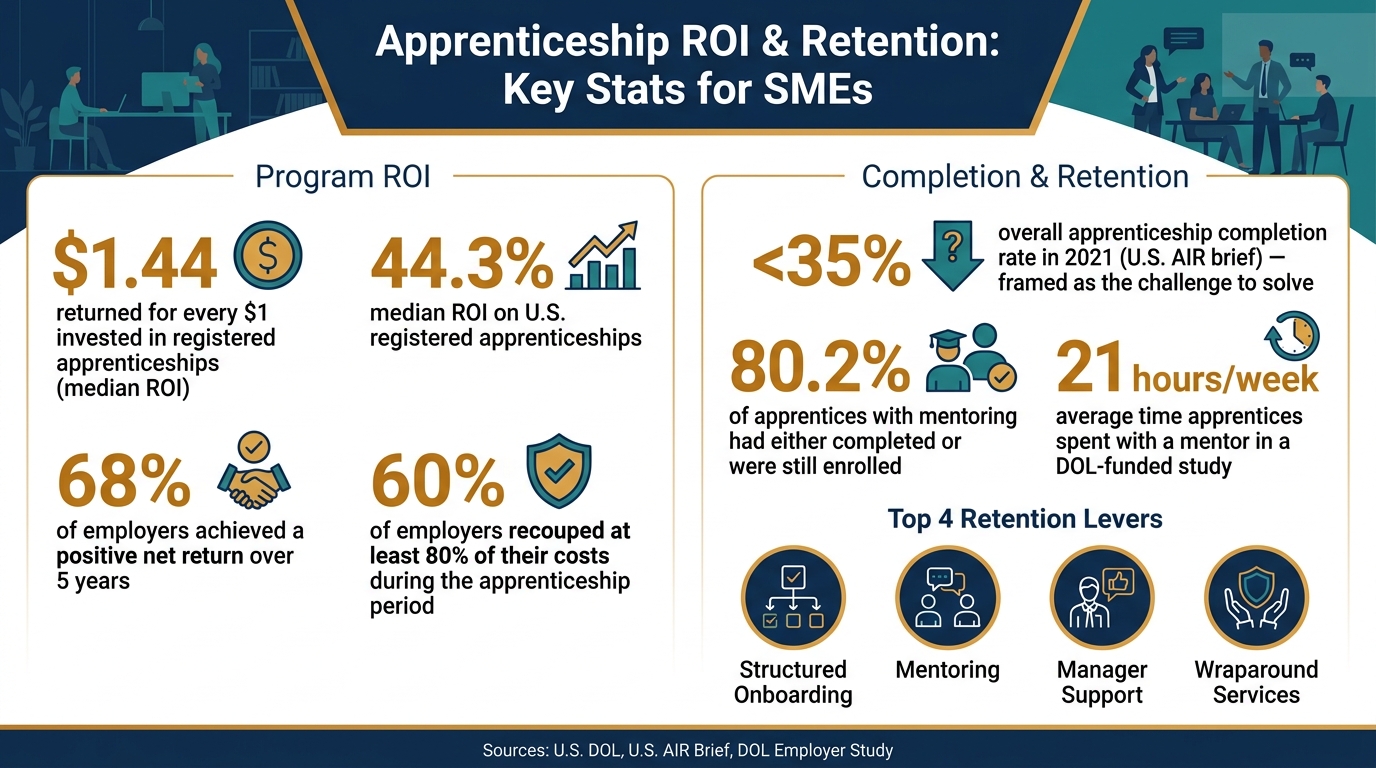
Apprenticeship ROI & Retention: Key Stats for SMEs
Bringing in diverse apprentices is only the start. Completion is what makes the program pay back. A U.S. AIR brief found overall completion rates were below 35% in 2021.[28] For SMEs, that matters. Every early exit adds replacement hiring costs, slows team output, and makes it harder to justify running the program again. This is why many firms leverage embedded recruitment benefits to stabilize their talent pipeline.
The research points to four main levers: structured onboarding, mentoring, manager support, and wraparound services.
Onboarding, Mentoring, and Manager Support That Increase Completion Rates
The first 4 to 12 months are where most drop-off happens.[30][31] If an apprentice is going to leave, it often happens in that stretch. That makes early structure a business issue, not just an HR one.
Start with a short written training plan. Map the skills the apprentice needs to build, the milestones they need to hit, and how on-the-job work connects to off-site learning.[24][26] Keep it simple. If people cannot see what good looks like, they drift.
Then add a buddy or mentor from day one. That early support helps deal with confusion, isolation, and small issues before they turn into exits.[24][25][3]
Mentoring has a strong record. A DOL-funded study found apprentices averaged 21 hours a week with a mentor, and 80.2% had either completed or were still enrolled.[1] Across policy reviews, mentoring and pastoral care beat purely financial incentives as retention tools.[30][32] For underrepresented apprentices, one mentor who can answer both technical and workplace questions can cut early exits.[25][27][3]
Mentors help apprentices settle in. Managers shape what happens after that. If feedback is patchy or expectations are unclear, apprentices are more likely to leave early, especially those from underrepresented groups.[2][9][3] Monthly check-ins, clear milestone goals, and a simple route for escalating problems can make a big difference.[24][26]
Practical Supports That Remove Avoidable Barriers to Success
A lot of early exits have little to do with job performance. In one study, personal or family problems drove most early exits, followed by transportation, child care, and equipment gaps.[1][29]
That matters for ROI. If someone leaves because they cannot get to work or manage care at home, the loss lands on your hiring budget all the same.
Most SMEs do not need to build these supports on their own. The U.S. Department of Labor lists transportation assistance, child care support, and mentoring programs as retention supports in its workforce guidance.[29] States have also pointed to peer networks and mental health resources as part of strong retention strategies for apprentices with their own support needs.[20]
In practice, many SMEs work with nonprofits, training providers, or public agencies to deliver these wraparound services. That helps keep direct costs down while protecting completion rates.[3]
Flexible scheduling is another useful lever, especially for adult learners and apprentices with caregiving duties. SMEs that offer predictable hours, allow apprentices to attend instruction during paid work time, or adjust schedules during training-heavy phases tend to see lower unplanned absenteeism and better program continuity.[2][26][9] The key is to pair flexibility with clear expectations.
When those barriers come down, completion goes up, and the numbers start to look much better. A DOL employer study found the median return on investment was $1.44 for every $1 invested in registered apprenticeships, with 68% of employers getting a positive net return over five years.[33][34] During the apprenticeship period itself, 60% of employers recouped at least 80% of their costs.[34]
How Scaling SMEs Can Run Apprenticeship Hiring Consistently
Scaling apprenticeship hiring takes a repeatable system, not just one good first cohort. If you want hiring volume to grow without losing process quality or diversity, consistency has to be built in from the start. The main issue usually isn’t intent. It’s execution.
The Operating Model: Capacity, Process Visibility, and Partner Coordination
Run every cohort through the same four steps: role scoping, outreach, screening, and reporting.
Role scoping starts with plain-language job descriptions and no degree filter. Outreach planning should set weekly targets across schools, workforce boards, community groups, and online channels. Screening should use the same competencies, the same interview questions, and the same scoring rubric for every applicant. That’s especially important when candidates don’t have standard credentials on paper.
Track applicant diversity, source of hire, conversion rates, completion rate, and 6 to 12 month retention. Looking at results cohort by cohort shows which sourcing and selection changes are opening access, and which ones are just noise. The U.S. Department of Labor’s Apprentice Population Dashboard gives interactive benchmarking data by sex, race, ethnicity, age, veteran status, and disability. For SMEs building their own tracking, it’s a useful reference point.[5][35]
Clear ownership matters too. When roles and handoffs are vague, process quality slips as hiring volume rises. Hiring managers should own role requirements and final selection. Recruitment leads should manage outreach, candidate communication, and scheduling. Training providers, local colleges, community groups, and workforce agencies should all be briefed on the target profile, start dates, and selection criteria, so each cohort runs the same way.
An embedded recruiter can handle outreach, screening, scheduling, and offer management for each cohort.
Key Takeaways and Next Steps for Hiring Leaders
Apprenticeship programs produce real results when they’re built with intent, backed properly, and measured against business outcomes. But those numbers don’t appear by magic. They depend on having the right operating structure in place, not just good intentions.
If you’re weighing apprenticeships, start with the roles. Look at which hard-to-fill entry-level jobs could be served by an apprenticeship pipeline. Then map whether that approach could give you broader reach at a lower cost. After that, take a hard look at capacity. Can your team source, screen, and coordinate candidates across multiple cohorts without process drift?
If the answer is no, that isn’t a reason to pause. It’s a sign to look at what embedded recruitment support could add.
FAQs
Which roles work best for apprenticeships?
Apprenticeships work best for early-career roles where core strengths like learning agility, teamwork, ownership, and customer focus matter more than degrees or past job titles.
For SMEs, that means hiring based on skills, not credentials.
A simple way to do this is to group roles into broad areas such as technical, operations, or sales. That keeps your success measures tied to the work itself, not to paper qualifications that may have little link to on-the-job performance.
The business upside is clear: you widen your talent pool, cut out weak screening criteria, and assess people against what the role actually needs. That usually leads to better-fit hires and less wasted time in the process.
How long does it take to see ROI?
SMEs can see measurable progress from diversity talent mapping within 30 days. If you’re tackling a specific hiring issue, like improving screening, results can show up in as little as one month.
Standardising your hiring process can deliver immediate operational gains and cut hiring costs by up to 70%. The bigger commercial upside, like stronger profitability and better productivity, tends to come from sticking with inclusive hiring practices over time.
What should SMEs track in each cohort?
Track each cohort’s funnel and outcomes by demographic group, including:
- Candidate pool diversity at application
- Pass-through and selection rates at each stage
- Offer acceptance rates and longer-term retention or next-year outcomes
This gives you a clear view of where hiring outcomes start to shift. If diversity is strong at application but drops later in the process, that’s a signal worth looking at. If offer acceptance is lower for one group, or retention falls off after year one, the issue may sit well beyond sourcing.
You should also gather candidate feedback at the end of the process to confirm whether it felt fair and equitable. Numbers show you what happened. Feedback helps you understand why.
For CEOs, CFOs, and HR leaders, this matters because better visibility leads to better hiring decisions. It helps you spot friction early, cut wasted hiring spend, and build a process that holds up as the business scales.