Hiring is one of the biggest challenges for SMEs – and getting it wrong can cost you thousands. With labor costs consuming up to 70% of expenses and bad hires costing up to 30% of an employee’s first-year salary, recruitment mistakes aren’t just costly – they’re risky. Traditional hiring methods often fall short, leaving SMEs struggling with slow processes, high costs, and unqualified candidates.
Here’s the solution: flexible recruitment models. These approaches help SMEs save money, hire faster, and adjust hiring efforts to match business needs. For example, companies using embedded recruitment save up to 70% compared to agency fees, while reducing time-to-hire by weeks.
Key Takeaways:
- Save 30%–70% on recruitment costs with flexible models compared to agency fees.
- Reduce administrative time by 80+ hours per month with tools like ATS and embedded recruiters.
- Shorten time-to-hire to 15–20 business days, improving offer acceptance rates.
- Recruitment solutions tailored for SMEs include embedded recruitment, contract staffing, and one-off placements.
Flexible recruitment isn’t just about filling roles – it’s about building a hiring process that supports growth, protects revenue, and delivers results. Let’s explore how these solutions work and why they’re reshaping hiring for scaling businesses.
Flexible Recruitment Solutions: Cost Savings and Efficiency Benefits for SMEs
Recruitment Efficiency: Tools and Strategies from Industry Experts
sbb-itb-a23bd6a
Talent Acquisition Challenges for SMEs
Building a team while scaling a business is no small feat. For SMEs in fast-moving sectors like SaaS, fintech, and professional services, recruitment often becomes the bottleneck that determines whether goals are met or missed. The statistics are telling: 76% of recruiters cite finding the "right" candidate as their biggest challenge in 2026 [3], while 63% of hiring professionals report facing talent shortages [3]. These hurdles don’t just slow hiring – they can lead to missed revenue, delayed launches, and burned-out teams.
Managing Growth with Limited Resources
For SMEs, the recruitment challenge is compounded by limited resources during growth phases. Time, in particular, is a scarce commodity. Founders and small teams often juggle everything themselves – sifting through resumes, coordinating interviews across time zones, and crafting job descriptions. This administrative load drags out timelines and inflates costs.
While AI tools promise efficiency, they can also flood teams with unqualified applications, creating more work. The answer isn’t just more tech – it’s smarter processes. For instance, targeted knock-out questions in applications can weed out unsuitable candidates early. Automating repetitive tasks like resume parsing and interview scheduling with an Applicant Tracking System (ATS) can save hours, allowing teams to focus on deeper evaluations like problem-solving skills and alignment with company values.
Attracting Skilled Talent in Competitive Markets
Another major hurdle is reaching skilled candidates in a competitive hiring landscape. With 70% of the global workforce not actively looking for new roles [3], SMEs need proactive strategies to stand out. Employer branding plays a pivotal role here, especially since 75% of candidates would reject an offer from a company with a poor reputation [3].
While SMEs may not offer the perks of larger firms, they can highlight what makes them special: opportunities for meaningful impact, direct collaboration with leadership, and authentic flexibility. Offering remote work can also widen the talent pool, and using multi-channel sourcing – like niche job boards, LinkedIn outreach, and referral programs – ensures SMEs connect with talent where it matters.
Shortening Time-to-Hire During Growth Phases
In today’s candidate-driven market, speed is crucial. Top candidates often juggle multiple offers, and the company that moves fastest usually wins. For SMEs, aiming for a 15 to 20 business day time-to-hire [4] – well below the 30 to 45 days typical for larger organizations [4] – can result in higher offer acceptance rates and fewer dropouts.
Take Unique, for example – a company scaling across Berlin, Zurich, New York, London, and Singapore. They tackled this challenge through an embedded recruitment model, conducting 291 interviews in just a few months, leading to 17 offers and 10 successful hires [1]. Their success came from streamlining a five-stage process (application screening, phone screen, skills assessment, team interview, and offer), automating scheduling, and ensuring clear communication between hiring managers and recruiters. By aligning hiring plans with quarterly business priorities rather than sticking to rigid annual budgets, they kept recruitment agile and aligned with growth needs. Every unfilled role represents lost potential, and their approach shows how efficient hiring processes can drive SME success.
Flexible Recruitment Solutions by Rent a Recruiter
Scaling businesses need recruitment options that align with their unique hiring challenges. Rent a Recruiter offers three tailored solutions: embedded recruitment for ongoing hiring needs, contract staffing for short-term demands, and one-off placements for critical roles. These models move away from traditional percentage-based agency fees, offering transparent pricing that gives businesses more control over their budgets while maintaining hiring efficiency.
Embedded Recruitment: Dedicated Hiring Expertise Within Your Team
Embedded recruitment places a Talent Acquisition Specialist directly into your team. This dedicated recruiter handles everything from sourcing and screening to coordinating interviews and providing detailed reports – all while representing your company’s tone and values. Unlike traditional agencies managing multiple clients, this recruiter focuses exclusively on your hiring goals and long-term strategy.
The service operates on a straightforward monthly subscription, avoiding placement fees, commissions, or hidden costs. Businesses typically save 30% to 70% compared to traditional agency fees [5][6] and reclaim around 80 hours per month in administrative tasks [5]. Better yet, onboarding is quick – your recruiter can start sourcing candidates within five to seven days.
Take Kingspan, for instance. Over seven months, Senior HR Officer Amy Joy McConville used the embedded model to fill 37 roles, saving the company $130,000 compared to traditional agency costs [5]. Karen Woulfe, HR Manager at Mastertech, shared her experience:
"We have a personal recruiter assigned to our company who works closely with our HR manager. We now only receive top quality CVs that lead to interviews and job placement" [6].
This flexible model allows businesses to scale recruitment efforts up or down – or even pause them entirely – depending on their current needs. For situations requiring immediate hires, contract staffing might be the better option.
Contract Staffing: Quick Solutions for Temporary Gaps
When immediate hiring is a priority, contract staffing offers a fast and effective solution. This option connects you with pre-vetted professionals for short-term needs, such as covering maternity leave, managing seasonal demand, or completing project-based work [2][6]. Engagements typically begin within a week, with pricing based on the scope and volume of the requirement rather than relying on traditional agency markups.
This approach ensures you maintain delivery capacity during peak periods without committing to long-term salary expenses – a critical advantage in uncertain economic times [1]. It also aligns with the shift many businesses are making from rigid annual headcount plans to more dynamic, quarterly workforce reviews. Before opening a role, it’s worth considering the commercial outcomes it supports and the impact of delaying the hire.
One-Off Placements: Pinpointing Talent for Key Roles
For high-stakes positions, one-off placements offer a focused recruitment service. Whether it’s a leadership role or a niche technical position, this approach prioritizes finding top-tier candidates who align with your company’s strategic goals. By leveraging proactive market mapping and targeted outreach, this service ensures you connect with the right talent for long-term success [2][6].
This model isn’t about simply filling a vacancy; it’s about securing individuals who can drive your business forward. Whether your need is immediate or highly specialized, Rent a Recruiter’s tailored solutions deliver the right support for your hiring challenges.
Technology and Tools for Flexible Recruitment
Technology plays a crucial role in speeding up hiring and simplifying processes for teams with limited resources. By replacing outdated spreadsheets and endless email threads, modern recruitment tools automate repetitive tasks, broaden the search beyond local markets, and enable smarter, data-based decisions. All of this happens without adding unnecessary complexity, setting the stage for solutions like ATS (Applicant Tracking Systems) that refine every step of recruitment.
Applicant Tracking Systems for Better Efficiency
Staying agile in recruitment requires the right technology, and an ATS is at the heart of this approach. These systems centralize critical tasks like job postings, resume parsing, and gathering candidate feedback. Features such as multi-channel job posting and automated resume parsing save time by eliminating manual data entry and ensuring openings reach a wider audience. Considering that small business owners often spend up to 30 hours over two months hiring a single employee [8], tools like these are a game-changer.
ATS platforms also streamline communication with automated templates and calendar integrations, enabling candidates to self-schedule interviews. The results speak for themselves: 94% of recruiters report smoother hiring processes after adopting an ATS [16, 19], and 66% of small businesses have reduced their time-to-hire by at least a week [7].
Visual pipeline tools, such as drag-and-drop boards, make it easy to track candidates through stages like Applied, Screened, Interviewed, and Offered. Yiorgos Boudouris, Head of People and Talent at Tiny Mile, highlights the value of these systems:
"People underestimate how long it takes to hire… If you’re recruiting in addition to all of your other duties, an ATS helps so, so much" [9].
ATS pricing varies widely, starting at approximately $30 per month for basic plans and reaching around $189 per month for more advanced options like BreezyHR [17, 25].
Remote Hiring to Expand Talent Pools
Technology isn’t just about efficiency – it also removes geographic barriers. Remote hiring tools address two major challenges: accessing talent beyond local limits and cutting overhead costs. Remote job postings attract 2.5 times more applicants compared to traditional on-site roles [10], giving smaller businesses access to a much broader pool of candidates. Platforms like We Work Remotely and Himalayas allow recruiters to filter applicants by time zone overlap, ensuring smooth collaboration for distributed teams.
Asynchronous video tools, such as Willo, let candidates record interview responses on their schedule, giving recruiters the flexibility to review them when convenient. For international hires, Employer of Record platforms like Borderless AI handle payroll and compliance across 170+ countries, with pricing starting at $49 per contractor per month [10].
The shift toward remote work isn’t temporary. By 2026, 74% of U.S. businesses are expected to operate with hybrid or fully remote models [10]. Companies with structured remote onboarding programs also see 58% higher retention rates after three years [11]. These tools do more than expand your reach – they enable scalable, cost-efficient recruitment processes. From AI-driven screening to automated scheduling, they help businesses of all sizes compete for top talent, no matter their location or resources.
Business Impact of Flexible Recruitment Solutions
For small and medium-sized enterprises (SMEs) juggling limited resources, shifting from traditional recruitment methods to flexible solutions doesn’t just cut costs – it speeds up hiring and supports growth. These benefits translate into better cost management, increased efficiency, and the ability to scale operations – all crucial for businesses operating on tight budgets.
Cost Savings vs. Traditional Recruitment Agencies
Traditional recruitment agencies often charge commissions based on a candidate’s annual salary, which can lead to unpredictable expenses. These costs tend to spike during growth periods, precisely when businesses are most financially stretched. Flexible recruitment models, on the other hand, offer predictable pricing – whether through fixed monthly rates or flat fees – often reducing costs by 30% to 70% compared to agency commissions [2].
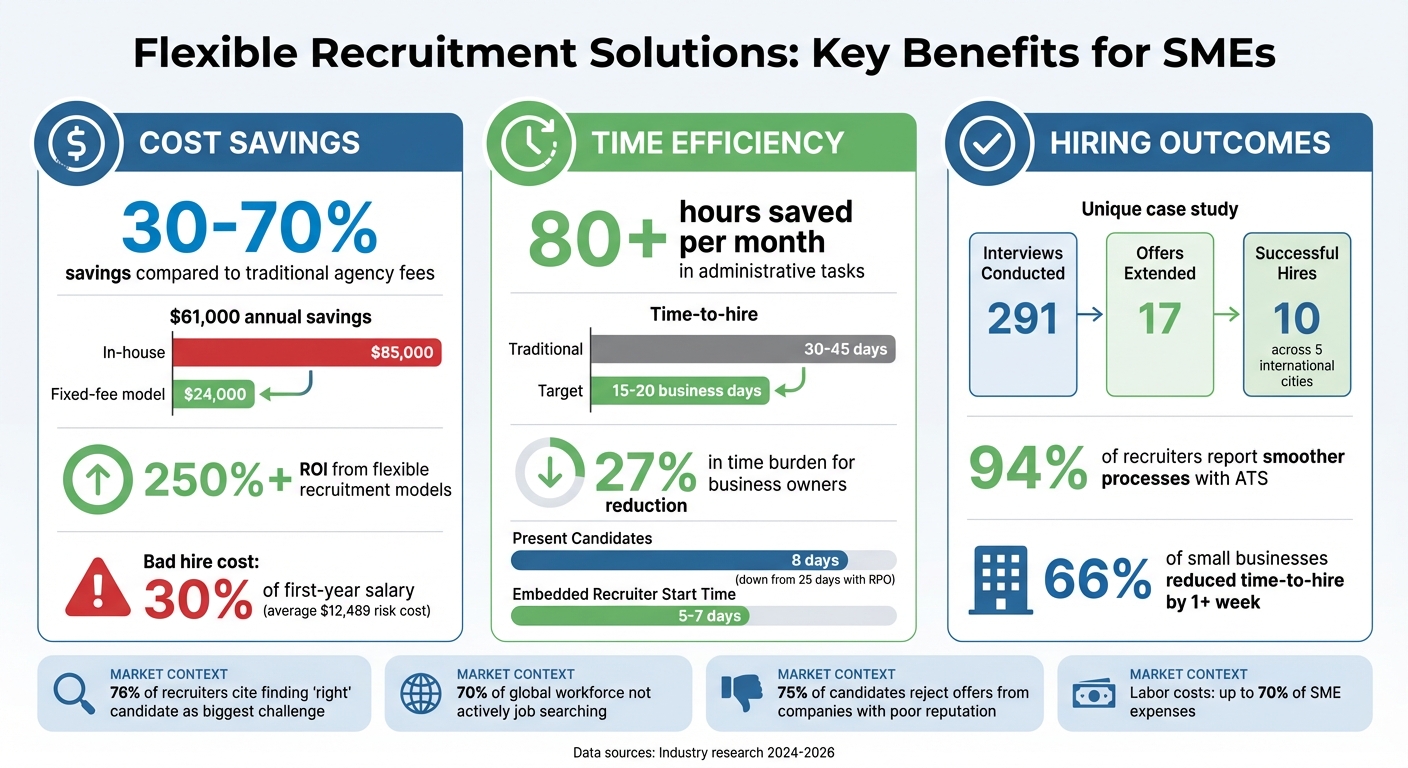
Consider the cost of hiring an internal recruiter. Once you factor in salary, benefits, and technology, the annual expense ranges from $60,000 to $128,000 [12]. For SMEs with fluctuating hiring needs, this fixed cost can be hard to justify. In one example, an in-house recruitment setup costing $85,000 annually was compared to a fixed-fee model priced at $24,000. The result? A savings of $61,000 and a return on investment (ROI) exceeding 250% [12].
"We now only receive top-quality CVs that lead to interviews and job placement. It’s as simple as that." – Karen Woulfe, HR Manager, Mastertech [2]
The financial impact of avoiding a bad hire is also significant. A poor hiring decision can cost a business up to 30% of the employee’s first-year salary, with risk costs alone averaging $12,489 [12].
Faster Hiring and Reduced Administrative Time
Beyond cost savings, flexible recruitment models significantly speed up hiring and cut down on administrative tasks. In competitive markets, time is everything. The average small business owner spends around 30 hours over two months hiring just one person [8]. That’s valuable time that could be directed toward growing the business. Outsourced recruitment services can reduce this time burden by 27%, freeing internal teams to focus on core operations [12].
Tasks like talent mapping, pre-employment checks, and post-offer follow-ups are streamlined, saving companies over 80 hours per month in hiring-related admin [13]. For example, embedded recruiters can start within five days, delivering immediate support without the long-term costs of a permanent hire [1]. Companies using Recruitment Process Outsourcing (RPO) have reported reducing the time to present candidates from 25 days to just 8 days [12].
A case in point: In 2024, Unique adopted an embedded recruitment model to manage hiring across cities like Berlin, Zurich, New York, London, and Singapore. Within a few months, the embedded recruiter facilitated 291 interviews, delivered 17 offers, and secured 10 international hires [1].
"The flexibility of Rent a Recruiter’s service exceeded our expectations. We greatly valued the data and insights they provided, which drove key strategic decisions." – Neil Spellman, Senior Recruiter, Nitro [2]
Scalability for Long-Term Growth
Once cost and time efficiencies are addressed, flexible recruitment solutions provide a foundation for sustainable, scalable growth. Unlike traditional models that lock businesses into fixed costs, these solutions allow hiring support to expand or contract based on actual demand. This adaptability is particularly valuable during uncertain economic periods [2].
In fact, companies with agile workforce strategies are 1.5 times more likely to outperform their competitors [14]. By aligning talent strategies with business priorities, organizations can navigate economic volatility more effectively. Moving from static annual headcount plans to quarterly reviews, for instance, allows SMEs to adjust hiring needs as market conditions shift [1].
Flexible recruitment also opens doors to specialized expertise that may not be feasible to hire full-time. Fractional or consulting arrangements can help fill critical skill gaps in areas like artificial intelligence, skilled trades, or other niche fields – especially important as 77% of HR professionals report challenges in recruiting for full-time roles [14].
Lastly, fixed monthly pricing provides the financial predictability needed for long-term planning while maintaining operational flexibility. Companies using RPO are 40% more likely to build a strong talent pipeline [12], treating workforce planning as an ongoing business strategy rather than a reactive process.
Conclusion and Next Steps
Flexible recruitment offers a smarter, faster way for SMEs to meet their hiring needs. By stepping away from rigid annual plans and costly agency fees, businesses can adapt their hiring support as needs evolve. The key is to treat recruitment as an ongoing, strategic function.
Key Takeaways for SME Recruitment
Think about capability, not just headcount. Before opening a role, ask yourself: what capability does this hire bring to the table? Whether it’s enhancing AI expertise, improving customer retention, or boosting delivery capacity, focus on the impact rather than the title. Test the urgency of each role – if leaving it unfilled for three months doesn’t disrupt critical processes, you might be addressing a structural issue rather than a true talent gap.
Make hiring decisions strategically. In tight financial conditions, prioritize roles that protect revenue or ensure delivery before considering leadership or expansion hires. Swap annual hiring plans for quarterly reviews. This lets you adjust priorities in step with market changes, keeping your hiring aligned with business goals.
Use embedded recruitment for quick results. Unlike traditional agencies, embedded recruiters become part of your team within just five days, dedicating their full attention to your needs. This approach not only saves time and money but also brings focus and efficiency to your recruitment efforts.
Getting Started with Rent a Recruiter
Ready to put these strategies into practice? Start with a free SME Recruitment Health Check to evaluate how you’re performing in areas like employer branding, candidate experience, and diversity. This tailored report pinpoints where you might be losing top talent and offers actionable improvements [2].
Next, schedule a 30-minute strategy call to explore flexible options that fit your needs. Whether you’re looking for embedded recruitment for ongoing support, contract staffing for short-term gaps, or one-off placements for critical roles, a recruitment specialist will guide you through the process. Many embedded recruiters can start in as little as five days, giving you immediate capacity without the burden of long-term payroll commitments [1].
Take control of your hiring today and set the stage for tomorrow’s growth.
FAQs
Which flexible recruitment model is best for my current hiring needs?
When deciding on the right approach, it all comes down to your hiring goals and resources. If you’re looking for a scalable, long-term solution, embedded recruitment might be the way to go. This model places a recruiter directly within your team, ensuring they understand your business and can manage hiring from start to finish.
For short-term challenges, on-demand staffing offers flexibility without locking you into extended commitments. Meanwhile, if you’re filling specialized or high-impact roles, a one-off placement model can be effective.
You can also strike a balance by combining your in-house team with external recruitment experts. This approach gives you the adaptability and strength to handle changing hiring demands.
How quickly can an embedded recruiter start delivering qualified candidates?
An embedded recruiter can start delivering qualified candidates within 48 hours of getting started. They provide a carefully selected "Hotlist" of passive, high-potential talent, giving your hiring process a jumpstart.
What should I set up internally (ATS, process, hiring team) before scaling hiring?
Before you ramp up hiring, make sure your internal systems are ready to handle growth efficiently. Start with a strong applicant tracking system (ATS) to streamline candidate management and automate repetitive tasks. Create a structured hiring process to avoid delays and provide a seamless experience for candidates. Finally, assemble a capable hiring team that’s aligned with your business goals, ensuring your recruitment efforts are both scalable and forward-thinking.