
If no one owns each step of hiring, you pay for it in lost time, missed hires, and agency fees that can hit $30,000 to $45,000 on a single $150,000 hire.
I’d put it simply: clear TA role ownership cuts delays, lowers admin load, and gives you more control over hiring spend. In scaling companies, the issue is rarely just candidate supply. It is handoffs, approvals, scheduling, and unclear decision rights. When those are fixed, you get shorter time-to-fill, fewer drop-offs, and better visibility into headcount plans. For more insights on optimizing your hiring strategy, visit our recruitment blog.
Here’s the short version:
- TA leaders own headcount planning, essential recruitment metrics, and team direction.
- Recruiters own req delivery from intake to offer.
- Sourcers build outbound pipelines and pass qualified talent to recruiters.
- Coordinators own scheduling, interview logistics, and ATS updates.
- Hiring managers, HR, and finance must have named approval points and reply windows.
- SLAs matter. Feedback delays can add about 20 days to a search.
- Process discipline matters more than adding more tools.
- If hiring demand jumps, Rent a Recruiter or an embedded recruiter can add delivery capacity without adding full-time TA headcount.
For CEOs, CFOs, HR leaders, and TA leads, the point is simple: define ownership early, track handoffs weekly, and split roles when hiring volume starts to strain the team.
HR Recruiter Roles & Responsibilities: The Ultimate 2025 Talent Acquisition Guide!
sbb-itb-a23bd6a
Talent acquisition team structure
Most scaling companies need a lean TA setup tied to hiring volume. Clear role ownership cuts bottlenecks, but only when every handoff is spelled out.
Core roles: TA leader, recruiter, sourcer, and recruiting coordinator
Four roles sit at the base of a working TA team. Each owns a clear part of the hiring process.
The TA leader owns hiring strategy, headcount planning with finance and HR, employer brand priorities, and funnel reporting to leadership, including time-to-fill, cost-per-hire, and offer acceptance rate.
The recruiter owns each requisition from intake to offer. That includes hiring manager meetings, job posting, screening, interview management, and closing.
The sourcer owns outbound pipelines, market mapping, Boolean searches, and passive candidate outreach. Once a candidate is qualified, they hand off to the recruiter.
The recruiting coordinator owns scheduling, interview logistics, candidate communication, and ATS hygiene. That includes scheduling across time zones, confirmation emails, rescheduling, and status updates.
How ownership shifts as hiring volume grows
As hiring volume climbs, one recruiter cannot keep owning sourcing, screening, scheduling, and reporting without friction. They become the bottleneck.
Usually, outbound sourcing is the first thing to slip, because interviews feel more urgent. Then the knock-on effect starts. Candidates wait too long between stages, and drop-off goes up.
The numbers support that point. Recruiters were spending roughly 35% to 40% of their time on scheduling and coordination alone before that work moved into a dedicated role.[3] Hiring demand often grows faster than TA headcount, and that gap creates cost fast, in lost recruiter time, slower hiring, and missed hires.
If hiring spikes are temporary, adding permanent headcount is not always the best move. In that case, embedding experienced recruiters can make more sense. Rent a Recruiter places recruiters inside your team within days and manages hiring end to end.
Role ownership table: key handoffs and when to add each role
| Role | Primary Ownership | Not Responsible For | Main Handoffs | When to Add |
|---|---|---|---|---|
| TA Leader | Hiring strategy, headcount planning, funnel reporting | Day-to-day scheduling, individual screens | To recruiters for role execution; to HR/finance for salary bands | From the start, once TA is a dedicated function |
| Recruiter | Intake, screening, interview management, offers | Compensation policy, final headcount approvals | To sourcer for outbound support; to coordinator for scheduling; to HR for offer letters | When you have a steady requisition load and repeat hiring needs |
| Sourcer | Outbound pipelines, market mapping, passive candidate outreach | Hiring decisions, offers | To recruiter at an agreed qualified-lead stage | When recruiters manage 15 to 20+ active roles or inbound quality is too low |
| Recruiting Coordinator | Scheduling, ATS hygiene, candidate logistics | Interview content, selection decisions | To hiring managers and recruiters for evaluation | When each recruiter handles 10 to 15+ interviews per week or scheduling delays are climbing |
Once ownership is clear, the next step is to map handoffs across planning, execution, and reporting.
Role responsibilities by function
Organising TA work by workflow instead of job title makes ownership much clearer. That matters even more in lean teams, where one person often wears several hats. In practice, the work usually falls into three core workflows: planning and role design, pipeline execution, and reporting and process hygiene. The role table above shows who leads each area. For more templates and guides, visit our recruitment resources. This section turns that into day-to-day responsibilities.
Planning and role design: workforce planning, job intake, and scorecards
TA runs intake, job briefs, and scorecards. Hiring leaders define the role scope and what success looks like over the next 6 to 12 months. Finance signs off on headcount and salary bands. TA then turns those inputs into requisition dates and target time-to-fill by role.
A strong intake meeting should produce a role brief that includes the business context, must-have and nice-to-have skills, salary range in USD, location rules, remote policy, and the interview panel. TA should then build the scorecard from that brief, usually with 4 to 6 competencies, behavioural anchors, and a 1-to-4 scale. Hiring managers confirm the final competencies and performance standards. Store the scorecard in the ATS so interviewers submit scores before debriefs.
Pipeline execution: sourcing, screening, interviews, candidate communication, and offers
Sourcers build the pipeline. Recruiters move it forward through outreach, screening, and interview coordination. Hiring managers own technical assessments, panel decisions, and final selection. TA runs debriefs and records the decision in the ATS.
TA also owns candidate updates, while HR handles post-offer onboarding communication. The recruiter and HR or compensation partner own offer construction, approvals, negotiation, and closing. These handoffs matter. If ownership is fuzzy, challenges in recruitment like hiring speed slips and admin piles up.
Structured scorecards and clear handoffs between TA and hiring managers help keep time-to-fill under control. That’s not just process for process’s sake. Survey data shows 35% of recruiters cite candidate evaluation as their most time-consuming task.[7]
Reporting and process hygiene: ATS data, funnel metrics, and service levels
ATS hygiene has a direct effect on forecasting and cost per hire. Recruiters lead stage movements, source tagging, and disposition notes. Coordinators handle interview scheduling details and status changes for completed interviews. Hiring managers and interviewers submit feedback scores in the ATS after each interview. HR and compensation record offer details, offer status, and start dates.
Disciplined ATS workflows, including automated screening, real-time feedback tracking, and standardised stages, are linked to 20% to 30% reductions in time-to-hire and fewer dropped candidates.[8][6] The TA leader or recruiting ops lead should own the dashboard, with visibility into:
- Active reqs per recruiter
- Stage conversion
- Time in stage
- Offer acceptance
Review it weekly with recruiters and monthly with leadership. When a metric spikes, the dashboard shows where the bottleneck sits before it starts missing hiring targets.
Hiring manager and stakeholder handoffs
Once roles are clear, the next choke point is handoff speed. Most hiring delays show up between steps: budget approval, interview feedback, and offer sign-off. If you want hiring to move, you need clear ownership and fixed response windows.
In SMEs, one person often owns hiring, budget, and approval. Name the person, not just the title. If your matrix says "leadership" and that means one person wearing three hats, approvals will slow down. Delays in shortlist review, interview feedback, and offer approval can add roughly 20 days to a search, turning a 30-day process into a 50-day one.[9] That kind of drift costs time, stretches team capacity, and puts good candidates at risk.
The fix is simple: pre-agreed SLAs and ATS tracking. Set shortlist review within 2 business days, interview feedback within 24 to 48 hours, and offer decisions within 2 to 3 business days after the final interview.[9][11] When those timelines are agreed at the start and tracked in the ATS, delays are easier to spot and easier to escalate before a candidate drops out.
Responsibility matrix: approvals, feedback, selection, and offers
Use this matrix to remove confusion across approvals, feedback, selection, and offers. It shows who owns each decision and where each step should move next.
| Hiring Step | Accountable | Responsible | Consulted | Informed |
|---|---|---|---|---|
| Requisition approval | Executive sponsor; finance lead | Hiring manager (business case); TA (market data) | HR (role level, title, policy) | TA (to open the role and start sourcing) |
| Intake alignment | Hiring manager (success criteria) | TA (runs meeting, documents requirements) | HR (pay equity, DEI, policy) | Interviewers; executive sponsor (critical roles) |
| Interview feedback deadlines | Hiring manager (team’s feedback) | Interviewers (submit scores); TA (track and escalate) | HR (bias or quality issues) | Executive sponsor (repeated SLA misses) |
| Final selection recommendation | Hiring manager (hire/no-hire decision) | TA (presents scorecards, data, risk flags) | Interviewers; HR (culture fit, risk) | Executive sponsor (senior or critical roles) |
| Compensation input | Compensation/HR (band, pay equity); finance lead (budget) | TA (aligns candidate expectations to approved range) | Hiring manager (non-cash elements, role scope) | Executive sponsor (exception cases only) |
| Offer approval | HR/compensation (compliance); executive sponsor (exceptions) | TA (drafts offer, manages candidate communication) | Finance (total cost); hiring manager (start date, details) | Hiring manager; relevant leaders (once the offer is sent and accepted) |
One practical rule matters here: compensation alignment should happen before the first interview, not after the final one. If HR and finance confirm the salary band during intake, TA can set candidate expectations early and flag any gap before it turns into a late-stage negotiation. That saves time, cuts wasted interview effort, and protects offer acceptance rates.
For SMEs where one person sits in multiple columns in this matrix, for example a founder acting as hiring manager, business lead, and budget owner, call that out clearly. TA needs to know exactly who to contact, when to escalate, and who can give the final yes.[10]
Operating model and scaling plan for efficient recruitment
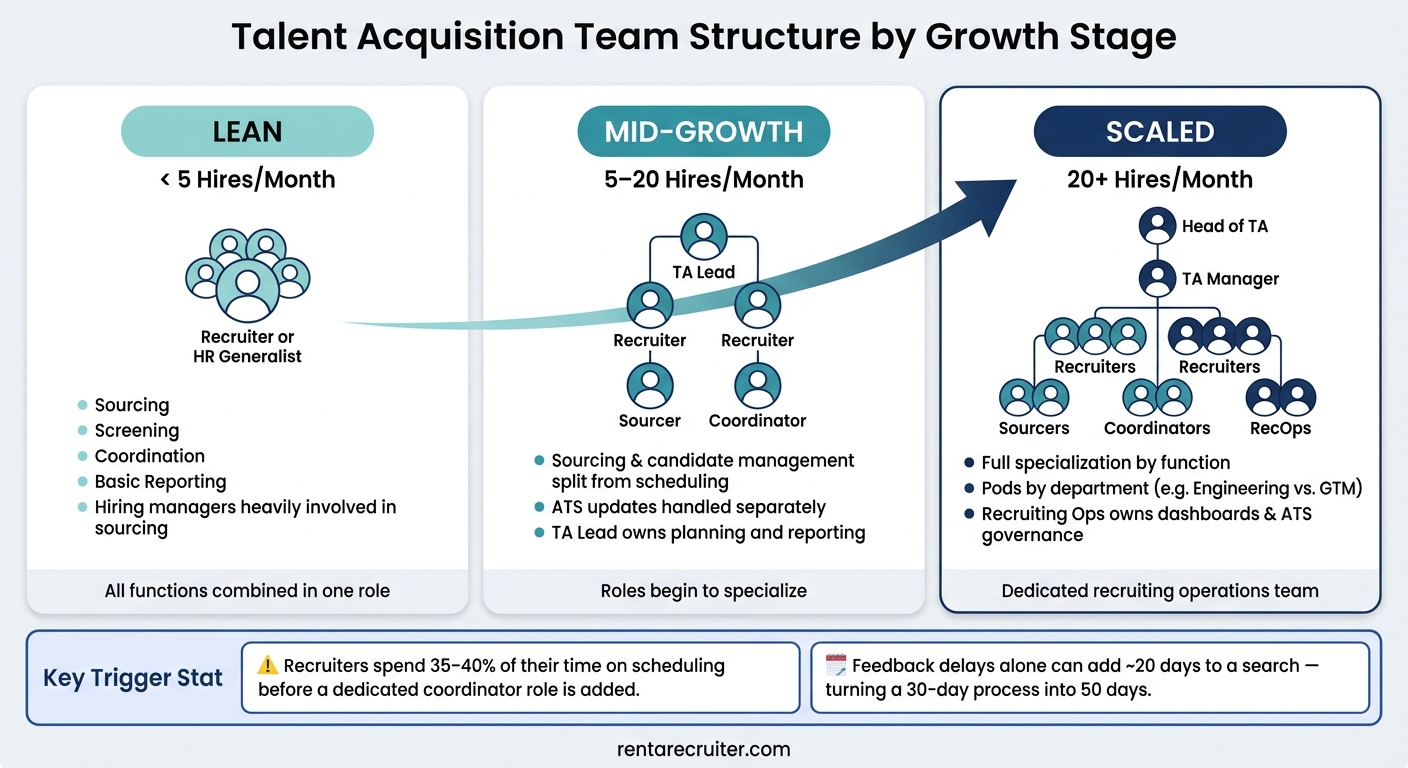
Talent Acquisition Team Structure by Growth Stage
Process habits that improve efficiency: intake meetings, structured interviews, ATS hygiene, and dashboards
Clear role definitions only help when your team follows the same process every time. If those habits slip, ownership gets fuzzy fast and hiring slows down.
Four habits tend to have the biggest effect.
- Intake meetings should happen within 24 to 48 hours of opening each new role. Keep them to 30 to 45 minutes. Use that time to align on must-haves, compensation band in USD, interview panel, and timeline.[13][14]
- Structured interview kits give each interviewer the same questions, competencies, and scoring rubrics. That makes feedback easier to compare and keeps decisions tied to evidence, not gut feel.[14][1]
- ATS hygiene means every candidate is logged and every stage is up to date. Coordinators or ops should run a weekly audit of stale records so the pipeline stays clean.[2][12]
- A weekly dashboard should show open roles, stage flow, time-in-stage, and SLA compliance. That helps you spot stalled handoffs before a small delay turns into a hiring problem.[2][13][15]
Process discipline matters more than new software.
When these habits are in place, you can divide work based on hiring volume, not guesswork.
Team structure by growth stage: lean, mid-growth, and scaled TA setups
When one person owns too many parts of the process, the function needs to split. The trigger should be hiring volume. If volume rises and the team shape stays the same, bottlenecks usually follow. The table below shows how responsibilities shift as hiring demand grows and which roles to add first.[12][5]
| Growth Stage | Monthly Hires | Core Team | Responsibilities Combined or Split |
|---|---|---|---|
| Lean | <5/month | 1 recruiter or HR generalist | Sourcing, screening, coordination, and basic reporting all combined; hiring managers heavily involved in sourcing |
| Mid-growth | 5–20/month | TA lead, 2–3 recruiters, 1 sourcer, 1 coordinator | Sourcing and candidate management split from scheduling and ATS updates; TA lead owns planning and reporting |
| Scaled | 20+/month | Head of TA, TA manager, 4–6 recruiters, multiple sourcers/coordinators, RecOps forming | Full specialization; pods by function, for example engineering vs. go-to-market; recruiting operations owns dashboards and ATS governance |
If your team is sitting above those thresholds on a steady basis, that’s the point to split roles or add support through fractional recruitment services.[5][4]
Conclusion: define ownership, remove bottlenecks, and build hiring capacity
Clear ownership, steady process habits, and the right team shape keep hiring moving. Start with a simple audit of your handoffs. Map who touches each stage of the funnel and where decisions get stuck. Then assign ownership by function with a responsibility matrix, set SLAs for feedback and approvals, and track them through your ATS and weekly dashboard.
If your team is dealing with a post-funding hiring spike, launching a new product, or taking on more roles than your team can handle, Rent a Recruiter places experienced recruiters inside your team within days. An embedded recruiter can add immediate hiring capacity while keeping your process consistent.
Book a Call to talk through your current operating model.
FAQs
When should you split TA roles?
Split talent acquisition roles when admin work and hiring volume start slowing your team down.
A simple rule works well here. Add a coordinator when a recruiter is spending more than 25% of their time on scheduling and ATS admin. That time is better spent moving hires forward, not chasing calendars or cleaning up systems.
Add a sourcer when a recruiter is handling 15+ open requisitions or spending more than 60% of their time on top-of-funnel work. If one person is trying to source, screen, schedule, and manage stakeholders all at once, speed usually drops and quality can slip.
In most cases, this kind of role split starts to pay off once you’re hiring more than 50 people a year or managing 20 to 30 active roles. At that point, specialization tends to save time, cut friction, and keep hiring output steady.
What if one person covers multiple TA functions?
That person is basically doing a bit of everything.
That’s common in early-stage companies. But once one person is trying to manage sourcing, screening, stakeholder management, scheduling, and process design all at once, things start to creak.
You can get away with it for a period. As hiring volume climbs, though, it often creates bottlenecks, burnout, and gaps in the process.
That’s usually the point where splitting responsibilities makes business sense. It gives you more capacity, saves time across the hiring team, and helps you keep quality steady as demand grows.
Which hiring handoffs cause the most delays?
The biggest delays tend to show up when nobody clearly owns the next step, or when approvals just sit there untouched.
The usual problem spots are interview scheduling and logistics, feedback and decision handoffs, and offer approvals waiting for sign-off.
In day-to-day hiring, the two bottlenecks you’ll see most often are scheduling overload and slow hiring manager feedback between stages.
That matters because small delays stack up fast. A missed feedback window or a slow approval can drag out time-to-hire, eat into team capacity, and put good candidates at risk of dropping out.