We recommend subscription recruitment when recurring hiring needs call for a fixed monthly budget and less internal admin. Before committing, map your expected hires over the next 6 to 12 months and compare the total fee with agency spending and your team’s hiring hours.
You pay for defined recruiter capacity, not guaranteed hires. Your team keeps hiring decisions, while the recruiter handles agreed sourcing, screening, and coordination work.
Rent a Recruiter reports up to 70% lower hiring costs versus commission-based models and more than 80 internal hours saved per month. These are provider-reported figures, not independently verified or guaranteed results.
Our advice: <u>check the scope, workload limits, and exit terms</u> before signing. Then track costs, hiring times, and hours saved to see whether a subscription fits your business better than support for a single search.
Hiring Problems That Slow SME Growth
In many SMEs, managers or part-time HR staff handle hiring alongside their main jobs. Recruiting competes with the work that drives revenue. When hiring stalls, delivery, sales, and customer work can stall too.
Tight budgets restrict sourcing options. Low employer visibility means candidates need answers to basic questions before they apply. These pressures become harder to manage when a role calls for specialist skills.
Specialist Skills Gaps and Candidate Requirements
More applicants do not always mean more qualified people. In June 2025, 36% of small-business owners reported openings they could not fill.[4]
Roles in technology, SaaS, fintech, engineering, and professional services may need technical, regulatory, or client-service knowledge that generalist hiring teams struggle to assess. The difficulty varies by role, seniority, and location. For your business, an unfilled role can delay revenue, delivery, or expansion.
Smaller employers may also struggle to match larger companies’ wages and benefits. That makes clear pay information and flexibility important.[3] Before advertising, benchmark pay by role and location. State the salary, benefits, bonus or equity eligibility, and work format upfront. Be realistic about development opportunities and access to leadership.
Even with suitable candidates in the pipeline, a slow or unclear process can lose them.
Hiring Delays and Their Business Costs
Vague job descriptions, excessive requirements, job-board-only sourcing, and slow or inconsistent decisions all hold up hiring. Before starting a search, separate must-have skills from preferences, agree on an interview scorecard, appoint one decision-maker, and set feedback deadlines.
| Hiring constraint | Likely business effect |
|---|---|
| Limited recruiting capacity and inconsistent processes | Delayed hires, lost candidates, and less manager time for core work |
| Unpredictable demand | Hiring bottlenecks that delay growth plans |
| Specialist skills shortages | Missed project milestones |
| Hiring costs | Delayed approvals or fewer approved hires |
Measure vacancy costs, including delayed output, overtime or contractor spending, and managers’ recruiting hours.
Then check where candidates stall. Too few qualified applicants can point to sourcing problems or unrealistic requirements. Repeated offer declines can signal a mismatch in pay, flexibility, or the role itself.
Subscription recruitment changes how you resource and manage these hiring pressures.
sbb-itb-a23bd6a
How Subscription Recruitment Works
Subscription Recruitment vs. Per-Placement Fees
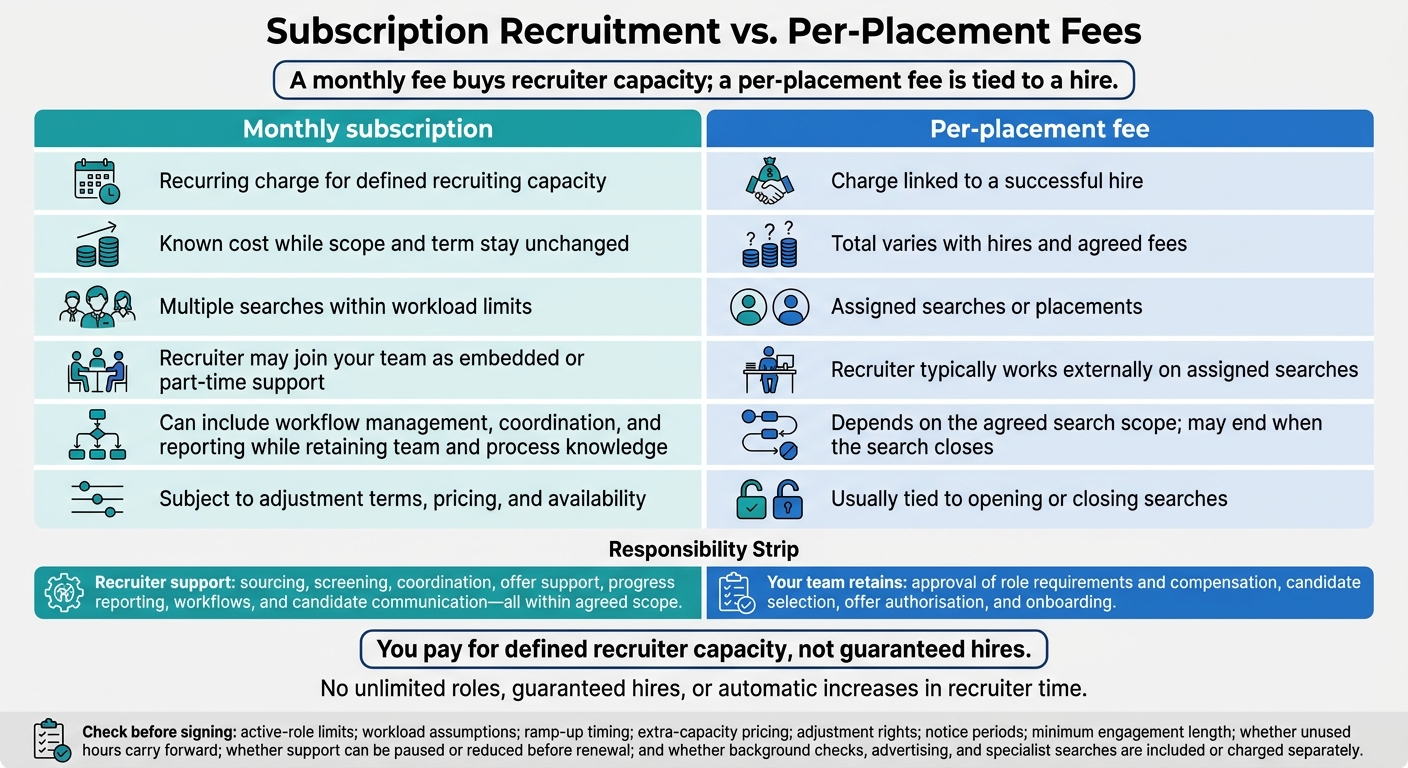
Subscription recruitment gives you dedicated recruiter time for a fixed monthly fee, while you keep hiring control in-house. You buy time and agree on the work covered, giving founders hiring support without pulling their focus away from the business.
Your agreement defines scope, deliverables, and capacity limits. It does not include unlimited roles, guaranteed hires, or automatic increases in recruiter time.
What an Embedded Recruiter Does
An embedded recruiter handles sourcing, screening, and coordination bottlenecks within your systems and agreed scope. They support offers, report progress, and standardise workflows and candidate communication. Hiring becomes a repeatable process rather than a series of ad hoc admin tasks.
You spend less time on admin without handing over hiring decisions. Your team still approves role requirements and compensation, selects candidates, authorises offers, and handles onboarding.
Check whether background checks, advertising, and specialist searches are included in the fee or charged separately.
Monthly Fees vs. Per-Placement Fees
A monthly fee buys recruiter capacity; a per-placement fee is tied to a hire. One specialist vacancy may need less continuing support than hiring across several departments.
| Comparison point | Monthly subscription | Per-placement fee |
|---|---|---|
| Fee structure | Recurring charge for defined recruiting capacity | Charge linked to a successful hire |
| Budget predictability | Known cost while scope and term stay unchanged | Total varies with hires and agreed fees |
| Roles supported | Multiple searches within workload limits | Assigned searches or placements |
| Deployment | Recruiter may join your team as embedded or part-time support | Recruiter typically works externally on assigned searches |
| Process ownership | Can include workflow management, coordination, and reporting while retaining team and process knowledge | Depends on the agreed search scope; may end when the search closes |
| Capacity changes | Subject to adjustment terms, pricing, and availability | Usually tied to opening or closing searches |
When hiring volume changes, your contract terms matter as much as the recruiter’s output. They determine how you can adjust support and what that adjustment costs.
Changing Capacity as Hiring Needs Shift
Funding, launches, and expansion can change how much hiring support you need. Hiring as you scale may call for more recruiter time or broader role coverage. A slowdown may mean you need less support. Neither change is automatic.
Before signing, confirm active-role limits, workload assumptions, ramp-up timing, extra-capacity pricing, adjustment rights, notice periods, and minimum engagement length. Ask whether unused hours carry forward and whether you can pause or reduce support before renewal.
Measuring Results and Assessing Rent a Recruiter
Track Hiring Costs, Hours, and Progress
Once recruiting capacity is in place, check whether it reduces hiring time, costs, and your team’s workload. Set a 3-6-month baseline, then review monthly results by role, department, and hiring difficulty.
Track cost per hire, time to hire, time to fill, offer acceptance rate, and internal recruiting and administrative hours. Keep definitions consistent: time to hire runs from approval to accepted offer; time to fill runs from approval to start date.
Keep provider fees separate from advertising, software, background checks, and onboarding costs. Compare the monthly fee against your previous 6 to 12 months of agency fees, advertising, contractor costs, and internal recruiting overhead. This helps you assess budget predictability, not just cost per hire.
Review progress weekly. Give every stalled role an owner and a clear next action.
Rent a Recruiter reports that its embedded model can cut hiring costs by up to 70% compared with commission-based models and save more than 80 internal hiring and administrative hours per month.[1][2] These are provider-reported figures, not independently verified or guaranteed results. Test them against your own costs, workload, and hiring mix.
How Rent a Recruiter Supports Your Team
Use the same metrics to assess whether your embedded recruiter provides consistent hiring support.
Rent a Recruiter says it places experienced recruiters within client teams within days. Actual deployment timing depends on role complexity, hiring volume, onboarding requirements, and client readiness.
Check whether its workflows and pipeline reporting show progress, bottlenecks, and who owns each action. Before agreeing on outcomes, confirm the scope, success metrics, reporting frequency, escalation procedures, and who owns the relationship.
Match the Service to Your Hiring Needs
Use your results to decide whether you need sustained recruiting capacity, temporary personnel, or help with a single search. Choose the model that fits your hiring problem, rather than relying on the service name.
| Service | Hiring need | Best fit |
|---|---|---|
| Embedded Recruitment | Sustained recruiting capacity and recurring openings | Monthly subscription for dedicated recruiter capacity |
| Contract Staffing | Temporary workforce gaps or project staffing | Temporary or contract personnel support, not recruiting-process capacity |
| One-Off Placements | Individual key hires or isolated specialist searches | Placement-focused search |
Conclusion: Is Subscription Recruitment Right for Your SME?
The final test is fit. Predictable fees and dedicated recruiting capacity can help you manage recurring hiring pressure. But a single, straightforward hire usually doesn’t justify a subscription.
Before you commit, check five inputs: hiring volume, timeline, role complexity, internal capacity, and contract length. Compare your expected hires with your budget and the time your team has available.
Book a Call with Rent a Recruiter to assess whether regular support would remove a recurring hiring bottleneck. Review your potential savings by requesting a tailored cost assessment. Any estimate depends on your hiring volume and current recruiting costs.
FAQs
How many hires would justify a subscription for my SME?
For SMEs making 10 to 24 hires a year, a subscription or embedded recruitment model is generally the most cost-effective choice. A fixed monthly fee makes budgeting more predictable than per-placement agency fees.
If you make fewer than 10 hires a year, pay-per-hire models are generally a better fit. If you consistently make more than 25 hires a year, an in-house recruitment team may offer the lowest cost.
What happens if my recruiter makes no hires?
Your flat monthly subscription covers dedicated recruitment support, not a fee for each hire. Your Talent Acquisition Specialist works as part of your team, bringing consistent support, structure, and visibility to your hiring process.
If your hiring plans change, you can scale services up or down or adjust your subscription terms at any time to match your business needs.
How is my candidate data protected?
When you partner with Rent a Recruiter, you keep full ownership and control of your candidate data. Our embedded recruiters work directly in your company’s systems and applicant tracking system (ATS), keeping information securely stored under your management.
You retain access to your talent pool and the relationships built throughout hiring, with full visibility and long-term data security.