Before you book a panel interview, agree on the questions, assessment roles, scoring rules, and schedule. I recommend treating these as one workflow to reduce repeated work, limit delays, and give your hiring team a clear basis for decisions.
The four steps are:
- Create a structured interview plan: Use the same core questions to compare candidates against the role.
- Assign assessment areas and panel roles: Give each interviewer a clear remit to prevent overlap and missed questions.
- Agree on scoring before interviews: Use a shared 1-5 scale and independent ratings to keep decisions tied to recorded answers.
- Manage scheduling and communication: Name one scheduling owner to reduce calendar confusion and rescheduling work.
Start with your biggest bottleneck. The aim is <u>less time coordinating and more control over hiring decisions</u>, without adding unnecessary panel members or meetings.
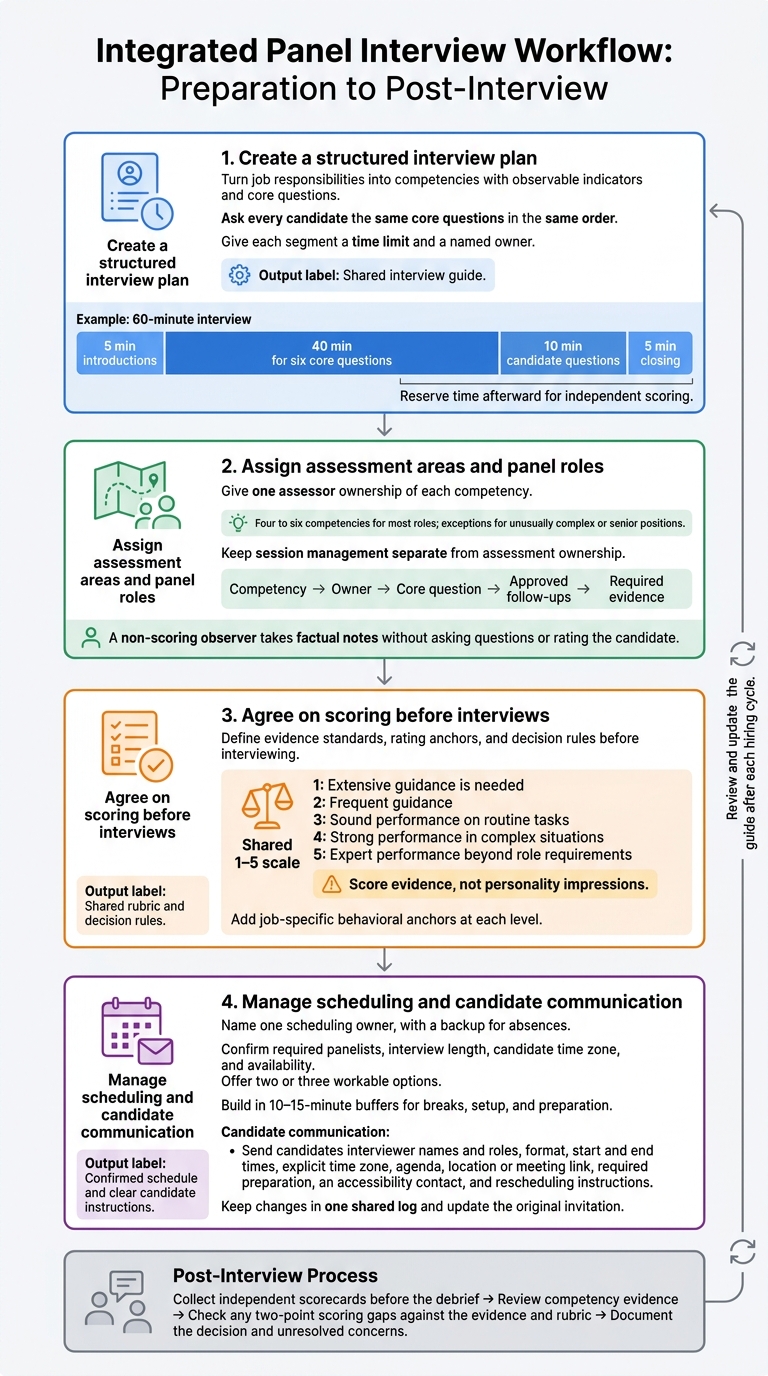
Panel Interview Coordination: 4-Step Workflow
1. Create a Structured Interview Plan
Start with an updated, performance-based job description. Turn each key responsibility into a competency with observable indicators, then link it to one core question in a shared interview guide. OPM identifies job-related competency questions as a core factor in interview validity, reliability, and agreement among interviewers.[1][8]
Ask every candidate the same core questions in the same order. Allow only predefined clarifications about actions and results, without adding competencies or changing the standard, alongside required accommodations.
Give each interview segment a time limit and a named owner.
For a 60-minute interview, use 5 minutes for introductions, 40 minutes for six core questions, 10 minutes for candidate questions, and 5 minutes for closing; reserve time afterward for independent scoring.[6]
Assign one process coordinator to keep the panel working from the shared guide. They manage timing, transitions, duplicate questions, and scorecard collection. Brief panelists on the guide, scoring rules, note-taking standards, and prohibited topics. Store the approved guide, evidence notes, and decision rationale together to keep ownership and records clear.[7]
The trade-off is more preparation and upkeep. In return, a shared plan supports more consistent panel decisions, fewer repeated questions, and clearer ownership, especially in high-volume hiring, regulated settings, and searches involving embedded recruitment teams or multiple panels.[1][5]
Review the guide after each hiring cycle. Use a documented process to update approved questions, then assign roles and ownership for each competency.
sbb-itb-a23bd6a
2. Assign Assessment Areas and Panel Roles
Give one assessor ownership of each competency so your panel knows who assesses what. The U.S. Office of Personnel Management recommends assessing four to six competencies for most roles, with exceptions for unusually complex or senior positions. Assign each area to the interviewer best placed to assess it.[5][8]
Keep session management separate from assessment ownership. The lead facilitator opens and closes the interview, introduces panelists and their focus areas, and stops any one interviewer from dominating. Technical or functional assessors evaluate role-specific expertise. A teamwork assessor covers teamwork and stakeholder communication where the role requires it. A non-scoring observer takes factual notes without asking questions or rating the candidate, leaving assessors free to focus on responses.[2][8][10]
Create an assessment map that connects each competency to its owner, core question, approved follow-ups, and the evidence you need. Set the assessment order and agree who hands over to whom. Other panelists can contribute observations, but clear ownership helps keep scoring consistent.[8][9]
Avoid using “culture fit” as an assessment area. Assess observable behaviors instead: resolving conflict, explaining decisions, sharing responsibility, or communicating unfavorable news. Record actions and results, not whether someone seems similar to your panelists.[8][11]
Clear roles improve coverage and accountability, but specialists can take too narrow a view. Use shared competency definitions and review all the evidence so unclear standards or one dominant voice do not skew the hiring decision.[9][10] Before interviews begin, align the panel on scoring.
3. Agree on Scoring Before Interviews
Once panel roles are assigned, agree on the scoring rubric before interviews begin. Define what evidence supports each score and apply the same standard to every candidate. Weight competencies equally unless one matters more to the role.
Use a consistent 1-5 scale: 1 means extensive guidance is needed; 2 means frequent guidance; 3 means sound performance on routine tasks; 4 means strong performance in complex situations; and 5 means expert performance beyond role requirements. Add job-specific behavioral anchors at each level. These should guide scoring, not serve as model answers.
Record actions, decisions, and results, then map that evidence directly to a score. Score evidence, not personality impressions. Require independent ratings before discussion so senior voices don’t steer the panel’s scores.
Document the decision rule upfront: the required overall average, minimum scores for must-have competencies, and how the panel will resolve disagreements. During the debrief, check any two-point gaps against the evidence and rubric. Set a discussion time limit and an escalation path for differences that remain unresolved.
This reduces groupthink, brings disagreements into view, and helps your team make more consistent hiring decisions. It also takes time to prepare, train panel members, and document evidence. Weak rubrics can make subjective judgments look objective, while forced consensus can delay decisions. With scoring agreed, the next coordination task is keeping interviews on schedule and candidates informed.
4. Manage Scheduling and Candidate Communication
Scheduling puts your interview plan, panel roles, and scoring process into practice. Give one person ownership of scheduling, with a backup for absences. Before offering times, confirm required panelists, interview length, and the candidate’s time zone and availability. Offer two or three workable options. Assign qualified substitutes for key panelists rather than adding extra people just in case.
Build in 10-15-minute buffers for breaks, setup, and preparation, as SHRM recommends. Check room access, meeting links, captions, and permissions in advance.[12] Once the time is confirmed, send invitations. Give panelists the agenda, candidate materials, assignments, and evaluation forms several business days ahead when possible so they have time to prepare.
Send the candidate a confirmation with interviewer names and roles, interview format, start and end times, an explicit time zone, agenda, location or meeting link, and required preparation. Include a confidential accessibility contact and instructions for rescheduling through the scheduling owner.
Keep changes in one shared log, update the original invitation, and notify everyone affected. Make clear whether a substitute will attend. For multi-stage hiring, state the current stage and the next update date, or rate your recruitment process to identify further efficiency gaps.
The next section compares this strategy with the other three on effort, control, and candidate experience.
Compare the 4 Strategies
Use this comparison to target your biggest hiring coordination problem, whether that’s inconsistent assessments, unclear responsibilities, or scheduling delays.
| Strategy | Main coordination goal | Preparation effort | Scoring consistency | Scheduling complexity | Candidate experience | Scalability | Primary drawback | Best use case |
|---|---|---|---|---|---|---|---|---|
| Create a structured interview plan | Standardize questions, interview sequence, and required evidence | High | High; makes candidate evidence comparable | Moderate | High; gives candidates a predictable process | High with reusable interview guides | Requires upfront design and job analysis | Repeatable or high-stakes hiring |
| Assign assessment areas and panel roles | Cover competencies without repeating questions | Moderate | Moderate to high; reduces gaps in evidence | Moderate to high | High; keeps interviews organized | High with reusable role templates | Unclear ownership can leave gaps or make assessments too narrow | Cross-functional panels with separate assessment responsibilities |
| Agree on scoring before interviews | Align rating anchors, thresholds, and decision rules | Moderate | Very high; gives interviewers shared evidence standards | Low to moderate | Moderate to high; supports fairer decisions that you can explain | High with standardized rating anchors | Rigid rubrics may discourage useful follow-up questions | High-volume, competitive, or bias-sensitive hiring |
| Manage scheduling and candidate communication | Reduce delays, confusion, rescheduling, and no-shows | Moderate | Little direct effect on scoring; strong indirect effect on process flow | Moderate to high | Very high; speed and clarity shape candidate perceptions | Moderate to high | Larger panels still face calendar conflicts | Distributed teams or urgent hiring |
These ratings are relative, not numeric. Each strategy addresses a different weakness, so compare its strongest effects with its limits before committing your team’s time.
Adding interviewers brings more perspectives, but it also makes finding a shared time harder. Focus your effort on the weakest link in your process: planning, roles, scoring, or scheduling.
Conclusion: Put the 4 Strategies into Practice
Use the comparison above to put the four strategies into one workflow for your next open role. Agree on the interview plan, panel roles, and scoring before interviews begin. Schedule interviews and debriefs as separate events, brief your panelists, and send candidates the agenda, duration, and panelist names.
Collect independent scorecards before the debrief. Then review each competency, compare evidence, resolve scoring gaps, and document the decision, including any unresolved concerns. Record what needs to change for the next hiring cycle, or rate your recruitment to identify other hidden strategy gaps.
If your team needs coordination support, Rent a Recruiter can manage scheduling, panel coordination, documentation, and hiring administration. The hiring manager still owns the decision and quality standard.
FAQs
How many interviewers should be on my panel?
Keep your core panel to one to three relevant interviewers, plus the hiring manager and the recruiter coordinating the process [1]. Give each interviewer specific questions to ask, and have everyone score independently before the group debrief [2].
How can I calibrate panelists’ scoring before interviews?
Run a structured training session with shared behavioral anchors so panelists apply the same scoring standards. Give them three to five labeled sample responses per competency to score independently. Then compare scores and discuss any differences of two or more points.
Use that discussion to align how panelists read the rubric. Scores should reflect observable evidence, not gut instinct or seniority. If particular rating levels repeatedly cause confusion or disagreement, update the rubric to support more consistent hiring decisions.
How can I measure whether panel coordination is improving?
Track interviewer score spreads, scorecard completion rates, feedback turnaround times, interview turnaround time, and interviewer hours per hire. These metrics help you spot delays, inconsistent assessments, and wasted time in your hiring process [1][2][3].
Each quarter, compare these metrics against 6-month or 12-month employee retention and performance data. If interview scores don’t align with employee success, refine the competencies you assess and recalibrate interviewers so their assessments better match the role’s requirements [2][4].