We recommend diverse interview panels with shared questions and scoring rules, not more interviewers by default. Different job-related perspectives can challenge assumptions, but research supports structured interviews more strongly than panel diversity alone.
For your team, that means assigning clear assessment roles, collecting independent scores before discussion, and removing duplicate interviews. Track scoring consistency, shortlist breadth, interviewer hours, cost per hire, and time to fill to check whether changes improve hiring without adding delays.
Below, we explain how to build that process and measure what changes, without assuming panel diversity caused every result.
6. Diverse Interview Panels
sbb-itb-a23bd6a
How Diverse Panels Can Improve Hiring Decisions
When one interviewer no longer controls the decision, mixed panels can challenge vague “fit” judgments and review a broader range of evidence.
Panel diversity brings together job-related perspectives across functions, seniority levels, career paths, and lived experience. Identity does not define perspective, and no panelist should represent an entire group. A hiring manager, future peer, and cross-functional partner may spot different evidence of relevant skills, helping your team question assumptions about unfamiliar employers or career paths.
The stronger evidence supports interview structure, not panel diversity alone. A 1998 synthesis found that structured interviews correlated more strongly with job performance than unstructured interviews (.51 vs .38)[1]. Research on panel diversity is less conclusive. Results may reflect the broader hiring process rather than panel makeup alone.[2]
Replace Team-Fit Guesses With Job-Related Criteria
Turn “fit” into observable behaviors: handling conflicting priorities, disagreeing constructively, and explaining complex issues to customers. Ask what the candidate did, why they did it, and what happened.
Strong ratings need specific evidence, not familiarity, polish, or a recognizable employer. Apply the same standard across backgrounds, employers, and career paths so your shortlist reflects the skills the role needs.
Hypothetical SaaS hiring example: For a customer-success manager role, one candidate brings renewal experience from a well-known software company; another brings experience managing business customers, reducing escalations, and creating onboarding processes at a regional logistics company. Customer-success and technical panelists assess both against the same criteria: customer communication, technical judgment, retention, and prioritization. The logistics candidate earns credit only for evidence that meets those standards – not simply for having a different background. This approach helps prevent familiar-employer bias from shrinking the shortlist.
Why Diverse Panels Still Need Structure
Ask panelists to record provisional ratings before discussing candidates. Compare the evidence only after every score is recorded, and have the chair draw attention to evidence that challenges the leading view.
Shared questions and scoring anchors make different viewpoints comparable. They also give your team a clearer record of why a hiring decision was made. The table shows likely effects, not guaranteed outcomes or equal treatment.
| Panel approach | Scoring consistency | Breadth of evidence | Decision transparency | Likely limitations |
|---|---|---|---|---|
| Homogeneous, unstructured | Uneven ratings | Narrower evidence review | Unclear rationale | Bias and dominant voices remain |
| Diverse, unstructured | Incompatible ratings | Broader evidence review | Discussion without clear rationale | Hierarchy, groupthink, conflicting standards |
| Diverse, structured | Comparable scores through shared questions and anchors | Complementary job-related perspectives | Recorded evidence and disagreements | Preparation, training, interviewer time; residual bias |
Set Up a Structured Interview Panel
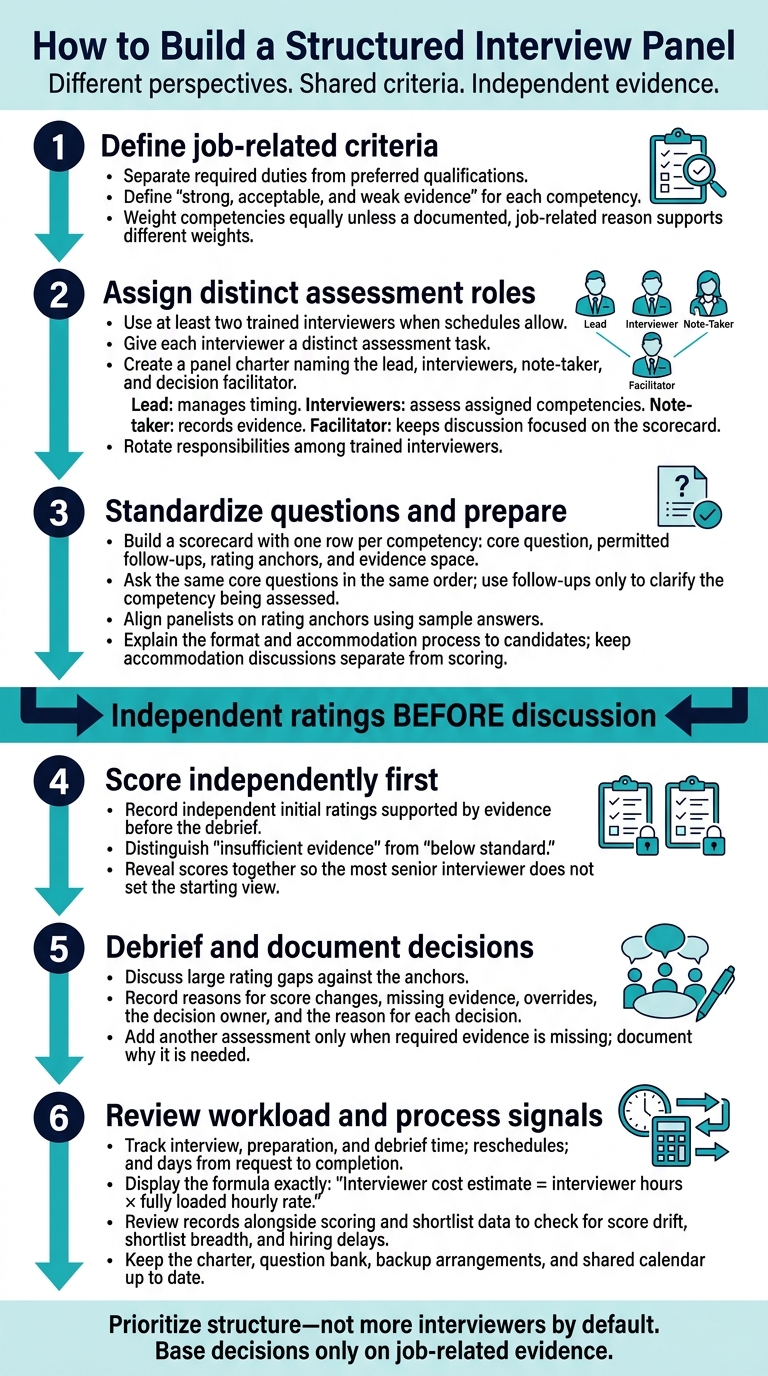
How to Build a Structured Interview Panel
Give your panel a repeatable workflow that keeps decisions tied to job requirements and makes interviewer time easier to plan.
Set Hiring Criteria and Assign Panel Roles
Before sourcing, define the job criteria and assign each interviewer a distinct part of the role. Separate required duties from preferred qualifications, and define strong, acceptable, and weak evidence for each competency. Weight competencies equally unless you have a documented, job-related reason to do otherwise.[6] Use at least two trained interviewers when schedules allow.[5] Base decisions only on job-related evidence.
Create a short panel charter that names the lead, interviewers, note-taker, and decision facilitator. This helps reduce uneven scoring and keeps shortlist decisions tied to the criteria.
The lead manages timing. Interviewers assess their assigned competencies. The note-taker records evidence, while the facilitator keeps discussion focused on the scorecard. Rotate these responsibilities among trained interviewers to share the workload and build team capability.
Use Standard Questions and Independent Scores
Use the same interview structure so you can compare evidence across panelists.
Build a scorecard with one row per competency, including the core question, permitted follow-ups, rating anchors, and space for evidence. Ask the same core questions in the same order. Use follow-ups only to clarify the competency being assessed.
Before interviews begin, align panelists on the rating anchors using sample answers. Explain the interview format and accommodation process to candidates.[3][4] Keep accommodation discussions separate from scoring, and apply the same job-related standards to everyone.
Require independent initial ratings supported by evidence before the debrief. Make a clear distinction between insufficient evidence and below standard.
Reveal scores together so the most senior interviewer does not set the starting view. Discuss large rating gaps against the anchors, and record the reasons for any score changes.
Record Decisions and Plan Interviewer Capacity
Use panel records to check scoring consistency and identify delays in the hiring process.
Record missing evidence, overrides, the decision owner, and the reason for each decision. Add another assessment only when required evidence is missing, and document why it is needed. Keep the charter, question bank, backup arrangements, and shared calendar up to date.
Track time spent on interviews, preparation, and debriefs, along with reschedules and days from request to completion. Estimate the cost as interviewer hours × fully loaded hourly rate.
Review these records alongside scoring and shortlist data. Check whether the panel is reducing score drift, broadening shortlists, and keeping hiring moving.
As hiring demand grows, Rent a Recruiter can coordinate scheduling, maintain structured workflows, and give you a clearer view of the process.
Measure Hiring Quality, Time, and Cost
Once your panel is structured, check whether it improves hiring decisions, not just documents them.
Track scoring consistency, hiring speed, cost, and outcomes. Compare like-for-like roles before and after panel changes to test whether diverse panels improve results, rather than just process discipline.
Give each metric an owner. Record its data source, denominator, and reporting window, along with the counts behind each rate or average. Report actual changes, not assumed gains.
Keep definitions consistent across reporting cycles so you measure performance changes, not changes in reporting.
| Metric | Baseline period | Follow-up period | Change | Interpretation |
|---|---|---|---|---|
| Median time to fill: requisition approval to accepted offer | Median calendar days before change | Median calendar days after change | Difference in days | Check approval, sourcing, and market shifts |
| Average score spread | Average range before change | Average range after change | Difference in rating points | Confirm less disagreement reflects evidence, not conformity |
| Offer rate | Baseline | Follow-up | Percentage-point difference | Check applicant quality, sourcing, and criteria |
| Cost per hire | Total recruiting costs ÷ hires | Total recruiting costs ÷ hires | Difference in U.S. dollars | Check hiring volume and cost components |
| 90-day retention | Retained hires ÷ cohort hires who reached 90 days | Retained hires ÷ cohort hires who reached 90 days | Percentage-point difference | Check onboarding, management, pay, and workload |
Track Scoring Patterns and Shortlist Breadth
Review scores by criterion, not just overall averages. Investigate disagreement rather than rewarding matching ratings.
Use only voluntary demographic data. Report it in aggregate, suppress small groups, and never use targets to decide individual candidates. Representation data can help you spot drop-offs at specific stages. It should not rank candidates, and it does not prove that your process is unbiased.
| Metric | Calculation | Review frequency | Warning signal | Corrective action |
|---|---|---|---|---|
| Score spread by criterion | Median, range, and interquartile range by competency | Monthly or each hiring cycle | Scores cluster at one end of the scale | Check evidence against rating anchors |
| Panelist disagreement | Score spread within each candidate; each panelist’s deviation from the panel median | Monthly or quarterly | Repeated large gaps or unusually identical scores | Check observations, rubric use, and conformity |
| Post-discussion score changes | Final minus initial score; percentage changed | Each debrief | Scores repeatedly move toward the senior panelist | Check whether changes cite new evidence |
| Shortlist representation | Aggregate counts and percentages at each stage | Monthly or quarterly | Sharp drop at one stage | Review sourcing, screening, and criteria |
| Stage advancement | Candidates advancing ÷ candidates entering that stage | Monthly or quarterly | Unexplained differences across comparable groups | Audit stage requirements and records |
When you see a drop at one stage, start by reviewing the evidence and rules used there.
Track Hiring Results and Interview Costs
Next, check whether panel changes affect speed, cost, and retention.
Use the same time-to-fill definition in every report. Count preparation, interviews, debriefs, and written evaluations in interviewer hours. Cost per hire should include internal and external recruiting costs for the reporting period: allocated recruiting and interviewer time, advertising, tools, assessments, background checks, travel, and referral payments. Avoid double-counting.[7]
Keep offer rate and acceptance rate separate. Offer rate is offers divided by candidates reaching the offer decision. Acceptance rate is accepted offers divided by offers made.
Compare scorecard completeness with repeated interviews, rescheduled or duplicated sessions, late reversals, and reopened roles. This helps you check where incomplete records may accompany extra work or delayed decisions.
Survey candidates after the process about clarity, respect, accessibility, and their opportunity to demonstrate skills. Ask hiring managers about evidence quality and administrative workload. Report the survey scale and response rate, not just the average.
Apply the retention formula above at both 90 days and 12 months, counting only hires who have reached each milestone. Pair retention with reliable, role-specific performance measures collected at consistent intervals, such as productivity milestones or quality scores.[8]
Treat satisfaction and retention as supporting signals. Survey responses may reflect expectations, courtesy, compensation, or the hiring outcome itself. Retention can also reflect pay, management, workload, location, reorganization, or external opportunities.
Review Results and Test One Change at a Time
Review process metrics monthly for high-volume hiring and quarterly for lower volumes. Assess retention only when each cohort reaches the relevant milestone.
Check whether scoring gaps come from different evidence or inconsistent rubric use. Then test one targeted change across several comparable hiring cycles.
For example, test different rating anchors while keeping other steps stable where possible.
Report requisition, candidate, offer, and hire counts. When samples are small, combine comparable cycles and label findings as directional. Log changes in compensation, recruiter capacity, sourcing, and market conditions. Describe results as associated with the panel change, not as proof that panel diversity caused them.
Conclusion: Pair Varied Perspectives With Consistent Assessment
If your metrics show uneven scoring or narrow shortlists, use the panel to fix the process, not add more opinions. Mixed panels need the same criteria, questions, and scoring anchors. This keeps different perspectives focused on job-related evidence rather than subjective team-fit judgments.[9]
Interview Panel Launch Checklist
Use this checklist to set a repeatable standard for every panel.
- Criteria and people: Document required competencies and separate requirements from preferences. Choose interviewers with different job-relevant perspectives and give each person clear responsibilities.
- Questions and access: Use core questions tied to the role. Limit follow-ups to documented, job-relevant clarifications, not subjective fit judgments.[9] Share the process in advance and arrange reasonable accommodations when needed.[4]
- Scoring and decisions: Define behavioral scoring anchors to reduce uneven ratings. Require independent ratings and written evidence before discussion. Record decisions, dissenting views, and process exceptions.
- Review and capacity: Assign an owner and schedule reviews. Track scoring consistency, shortlist breadth, hiring outcomes, and interviewer hours to see whether shortlists broaden without adding delays.
Check that broader shortlists still meet job-related standards and that panel workloads stay within your team’s capacity. Give each panelist a defined assessment task, and remove duplicate sessions before adding more interviewers.
Get Help With Your Hiring Process
Rent a Recruiter offers embedded recruitment support to add hiring capacity and bring structure and consistency to your process. Book a Call to review process gaps and assess whether support fits your team.
FAQs
How can a small team build a diverse interview panel?
Rotate panel members to include different genders, ethnicities, and backgrounds. This helps your team spot blind spots and assess applicants from several perspectives. Share interview duties evenly so employees from underrepresented groups aren’t asked to sit on every panel.
Give each panel member a clear focus, such as technical depth, team fit, or communication. Use a standardized scorecard so everyone records evidence-based feedback rather than relying on gut instinct.
What if panelists still disagree after reviewing the evidence?
Focus the debrief on the largest scoring gaps, not averages. Check each discrepancy against the rubric and behavioral evidence. Establish whether panelists read the scoring anchors differently or missed a candidate’s response.
If disagreement remains, follow the escalation path in your hiring process. Document the final decision and its rationale, along with any unresolved concerns, to support accountability and consistent decisions in future hiring cycles.
How long should we track results before changing our process?
Start with a six-week pilot across one or two job families to gather data and test your scorecard. Track time-to-hire, stage conversion, and the spread of interviewer scores monthly to see where hiring slows or assessments differ.
After a few months of active hiring, use patterns in scores and debrief notes to refine your questions or scoring rubrics. Each quarter, review hiring consistency alongside retention and performance data to check whether your process supports better hiring outcomes.