AI sourcing should cut the time and cost of finding qualified tech candidates, not just fill your database. I recommend starting with one role, clear hiring criteria, and recruiter approval before outreach or candidate decisions.
Your pilot should test whether AI can:
- Find relevant skills across approved job boards, talent pools, and public profiles.
- Reduce manual searching without adding data cleanup or duplicate messages.
- Turn more searches into qualified conversations, interviews, and hires.
Measure recruiter hours, days to a qualified slate, and cost per qualified candidate, including time spent checking AI output. The article’s illustrative figures show sourcing time falling from 12 to 7 days, not a promised result.
My starting rule: <u>test one role before scaling</u>. Here’s how to set up the search, keep recruiters in control, and check whether the results justify the spend.
Set Role Requirements and Choose Candidate Sources
Create a Role Scorecard Before Searching
Build a one-page scorecard with three to seven business outcomes for the first 6–12 months. Separate must-have skills from those you can teach. Define responsibility through observable work, such as running production services or leading architecture, rather than vague judgments about fit or fixed years-of-experience cutoffs.
Weight each criterion, give it a job-related reason, and specify the evidence AI must find. Every proposed match should show both supporting evidence and missing information. An unexplained match score is not enough.
Include the approved U.S. salary range, bonus and equity details, location, time-zone overlap, on-call duties, and consistently applied work-authorization requirements.
Search Job Boards, Talent Pools, and Public Profiles
Use the scorecard to search the highest-yield sources first. Start with a plain-language description of the work. Then refine your search with Boolean terms and structured filters for location, compensation, availability, and responsibility level.
Include related titles and transferable skills, but don’t treat them as identical qualifications. Search retained ATS and CRM records for past applicants, too. Assess their evidence against the current scorecard rather than carrying forward an old rejection. Search coverage depends on tool features, integrations, and permissions.[4]
| Source | Candidate coverage | Skill evidence | Data age | Limitations and recruiter checks |
|---|---|---|---|---|
| Job boards and resume databases | Active candidates and searchable resume pools | Skills, employment history, applications | Varies by last update | Watch for duplicates and outdated details; verify availability, chronology, and contact permission |
| ATS and CRM talent pools | Past applicants, referrals, previous prospects | Interview notes, assessments, applications | Depends on record maintenance | Notes may be old or subjective; check retention, recontact permission, and current qualifications |
| Professional profiles | Broader passive-candidate discovery | Self-reported roles and projects | Employment details may lag | Check platform terms, recency, and material claims |
| Portfolios and public repositories | Candidates with visible technical work | Code, documentation, case studies, contributions | Project and activity dates offer clues | Verify authorship, relevance, and production context; not all work is public |
After gathering candidates, check that each record is current, has usable contact details, and has the required permissions.
Check Data Quality and Source Permissions
Before outreach, check for duplicates, employment dates, missing or conflicting skills, contact accuracy, prior contact, and opt-outs. Record the source of each field and when it was collected.
Track usable-profile rate and duplicate rate to see which sources save recruiter time and which create more cleanup.
Public access does not mean contact permission. Check platform terms and applicable privacy rules before copying, enriching, storing, or contacting profiles. Maintain retention and deletion schedules, role-based access, and correction procedures.
Review vendor data sources and model-training practices. Pause integrations where permissions are unclear. LinkedIn, for example, prohibits unauthorized scraping or copying of profile data.[1][2][3]
sbb-itb-a23bd6a
Check Skill Matches and Control Outreach
Separate Skill Evidence From AI Assumptions
Once source data is clean, use AI to rank candidates by evidence. Validate each match before outreach. Treat rankings as an outreach queue, not a hiring shortlist, with a clear explanation of what supports each match and what the AI has assumed.
| Evidence category | What it supports | Limitations and recruiter checks |
|---|---|---|
| Verified evidence | Skills, responsibilities, and outcomes supported by assessments, reviewed work, references, or employment checks | Check candidate claims for depth, recency, and ownership. Confirm the evidence is genuine and establish its scope. Employment verification alone does not prove technical skill. |
| AI inferences | Possible transferable skills or levels of responsibility | Treat these as hypotheses. Require supporting evidence before approving or rejecting a match. |
| Weak signals | Keywords, repository activity alone, profile presentation, and similar job titles | These do not prove skill depth. Review the underlying work rather than rewarding visibility or presentation. |
Record missing evidence as unknown, not unqualified. Confidentiality restrictions and private code can leave strong engineers with little public evidence. Use consistent questions about production ownership, architecture decisions, testing, and outcomes to assess candidates whose backgrounds fall outside standard career paths.
Set Outreach Triggers and Follow-Up Limits
Start outreach only when there is an evidence-backed scorecard match, a past applicant eligible for recontact, or expressed interest. This helps lean hiring teams move fast without handing decisions to automation. For organizations needing additional support, recruitment on demand provides the necessary scale to manage these workflows. Prioritize match evidence, skill scarcity, prior engagement, and role urgency.
Require recruiter approval for the first message and any draft with major edits. Verify professional details and remove unsupported personalization. Set both a contact cap and a campaign period:
One initial message and no more than two follow-ups within a defined campaign period.
Share contact history to prevent duplicate messages. A reply should stop automated follow-ups and route the conversation to a recruiter. Stop outreach after an opt-out or negative response.
Track replies and qualified conversations, not message volume. Keep a clear record of every automated step so recruiters can review what happened.
Keep Recruiters Accountable for Candidate Decisions
Before accepting or rejecting an AI-recommended match, recruiters should run a brief audit. Check the match rationale, supporting evidence, inferred skills, gaps, and conflicts. Record the job-related reason for the decision and any override.
Review excluded profiles monthly for missed matches and uneven outcomes where lawful. This gives your team a way to spot qualified people the workflow may have missed.
Have legal counsel review applicable AI policy requirements regarding U.S. employment, privacy, automated-decision, and communications rules, including accommodation requirements. Test whether the workflow filters out qualified candidates who could perform the essential functions with reasonable accommodation.[5][6][7][8]
Test AI Sourcing and Measure Results
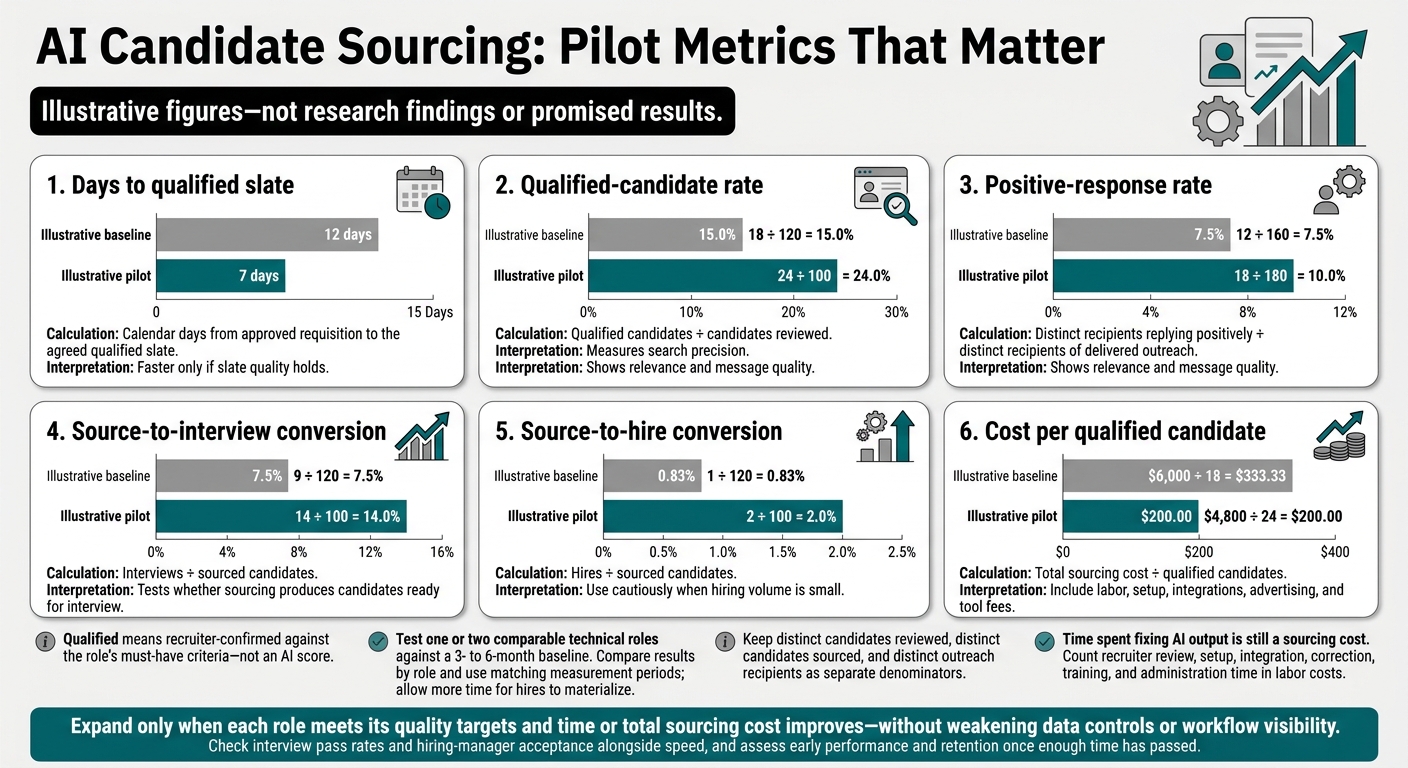
AI Candidate Sourcing: Pilot Metrics That Matter
Once your sourcing rules are in place, run a pilot to check whether the stack saves time without reducing recruiter control.
Test AI sourcing on one or two comparable technical roles against a 3- to 6-month baseline. Track recruiter hours, tool and advertising costs, candidates reviewed, qualified candidates, interviews, hires, days to qualified slate, and hiring-manager satisfaction with slate quality.
Keep the scorecard, compensation range, location or work-authorization requirements, and interview standards consistent. Compare results by role. A blended average can hide poor results on specialist searches.[9][10]
Use the pilot to check that search, recruiter review, and ATS logging work together.
Connect AI Sourcing to Your Hiring Workflow
Test approved job boards, talent pools, ATS/CRM records, and permitted public profiles. Trace 10 to 20 candidates from discovery to disposition. Confirm that recruiters can approve, edit, pause, or reject outreach before it goes out.
Check search quality, outreach control, and record visibility in practice. Your ATS or CRM should show evidence links, search criteria, match explanations, contact history, recruiter notes, consent status, ownership, and disposition reasons.
Include retention, deletion, and suppression rules in acceptance testing. Review integration failures and missing records weekly.[13]
Measure Sourcing Speed, Quality, and Cost
Qualified means recruiter-confirmed against the role’s must-have criteria, not an AI score.
Set each denominator before testing: distinct candidates reviewed, distinct candidates sourced, and distinct outreach recipients. Compare matching measurement periods, and allow more time for hires to materialize. Use the illustrative figures below to check whether sourcing quality and hiring results improve while recruiter controls stay effective.[9][10]
| Metric | Calculation | Illustrative baseline | Illustrative pilot | Interpretation |
|---|---|---|---|---|
| Days to qualified slate | Calendar days from approved requisition to the agreed qualified slate | 12 days | 7 days | Faster only if slate quality holds |
| Qualified-candidate rate | Qualified candidates ÷ candidates reviewed | 18 ÷ 120 = 15.0% | 24 ÷ 100 = 24.0% | Measures search precision |
| Positive-response rate | Distinct recipients replying positively ÷ distinct recipients of delivered outreach | 12 ÷ 160 = 7.5% | 18 ÷ 180 = 10.0% | Shows relevance and message quality |
| Source-to-interview conversion | Interviews ÷ sourced candidates | 9 ÷ 120 = 7.5% | 14 ÷ 100 = 14.0% | Tests whether sourcing produces candidates ready for interview |
| Source-to-hire conversion | Hires ÷ sourced candidates | 1 ÷ 120 = 0.83% | 2 ÷ 100 = 2.0% | Use cautiously when hiring volume is small |
| Cost per qualified candidate | Total sourcing cost ÷ qualified candidates | $6,000 ÷ 18 = $333.33 | $4,800 ÷ 24 = $200.00 | Include labor, setup, integrations, advertising, and tool fees |
Count recruiter review, setup, integration, correction, training, and administration time in labor costs. Time spent fixing AI output is still a sourcing cost.
Check interview pass rates and hiring-manager acceptance alongside speed. Assess early performance and retention once enough time has passed. Expand only when each role meets its quality targets and time or total sourcing cost improves, without weakening data controls or workflow visibility.[9][10]
Add Recruiter Support When Capacity Is Limited
If the pilot exposes capacity bottlenecks, add embedded recruiter support rather than expanding the workflow too soon.
When your recruiters cannot review AI output fast enough, embedded recruiters can handle sourcing, screening, coordination, and AI quality checks. This helps small and medium-sized enterprise teams maintain hiring quality during volume spikes.
Set deliverables, ATS access, reporting cadence, quality targets, and an exit plan before work starts.[11][12]
Conclusion: Start With a Measured Sourcing Pilot
Use the pilot results to decide whether to expand. AI should improve hiring progress and support recruiter judgment, not produce more profiles or outreach. Keep clear scorecards, approved sources, verified evidence, controlled outreach, and recruiter-owned decisions in place.
Choose one repeatable tech role, record baseline metrics, assign one owner, and set a review point, such as four weeks or 100 reviewed profiles. Measure progress through qualified candidates, interviews, and hires.[14][15]
If speed or quality falls short, add support before scaling. If capacity is tight, Rent a Recruiter can provide embedded recruiter support within your approved rules and review schedule. Expand only when results justify it, while protecting candidate quality, privacy, and recruiter oversight.
FAQs
How can we validate AI-inferred technical skills?
Treat AI output as a starting point, not proof of fit. Give reviewers shared, competency-based scorecards to check skills against project evidence, such as architecture decisions or incident responses. Don’t rely on titles, keywords, or polished profiles.
Run periodic 30-to-90-day pilots. Have human reviewers score candidates independently, then compare their scores with AI recommendations. Resolve differences and adjust quality thresholds. Keep manual screening alongside AI so you don’t miss candidates the system may filter out.
How can we detect bias in AI sourcing?
Test quarterly using sample profiles and compare selection-rate ratios across candidate groups. A ratio below 80% signals potential adverse impact that needs investigation.
Audit screening rules and rankings for unexplained exclusions, including proxies such as schools or employment gaps. Keep criteria tied to job-related skills, not irrelevant personal characteristics.
Keep people involved in hiring decisions. Use objective, skills-based scorecards to check AI shortlists, and investigate why strong applicants rank lower than expected.
When is our AI sourcing pilot ready to scale?
Scale only when efficiency, quality, and net cost meet your thresholds against your pre-AI baseline, such as 15%-20% gains in key metrics. Resolve all critical issues before expanding.
Your recruiting lead must coordinate a final review. Finance validates costs, HR and legal confirm fair treatment and compliance, and IT verifies security and integration stability.
Expand one role family at a time, keeping all controls and human review processes in place.