Interview scheduling slows hiring when decisions, calendars, and handoffs lack clear owners. My advice: fix those gaps before paying for more tools or recruiter support. While AI-powered recruitment tools can help, they won’t fix broken processes. Start with four changes that cut coordination work and keep hiring decisions moving:
- Approvals: Give each decision one owner, a backup, and a deadline.
- Calendars: Reserve interview blocks and name backup interviewers.
- Stages: Agree on assessments and feedback deadlines before booking.
- Handoffs: Track every next step, owner, and due date in one shared workflow.
Measure time to confirm and <u>time until the interview</u> separately. A booking confirmed in hours still leaves your role unfilled if the panel cannot meet for weeks.
I would start with one stalled role, fix its biggest delay, rate your recruitment process to find gaps, and track results before rolling the changes across your hiring pipeline.
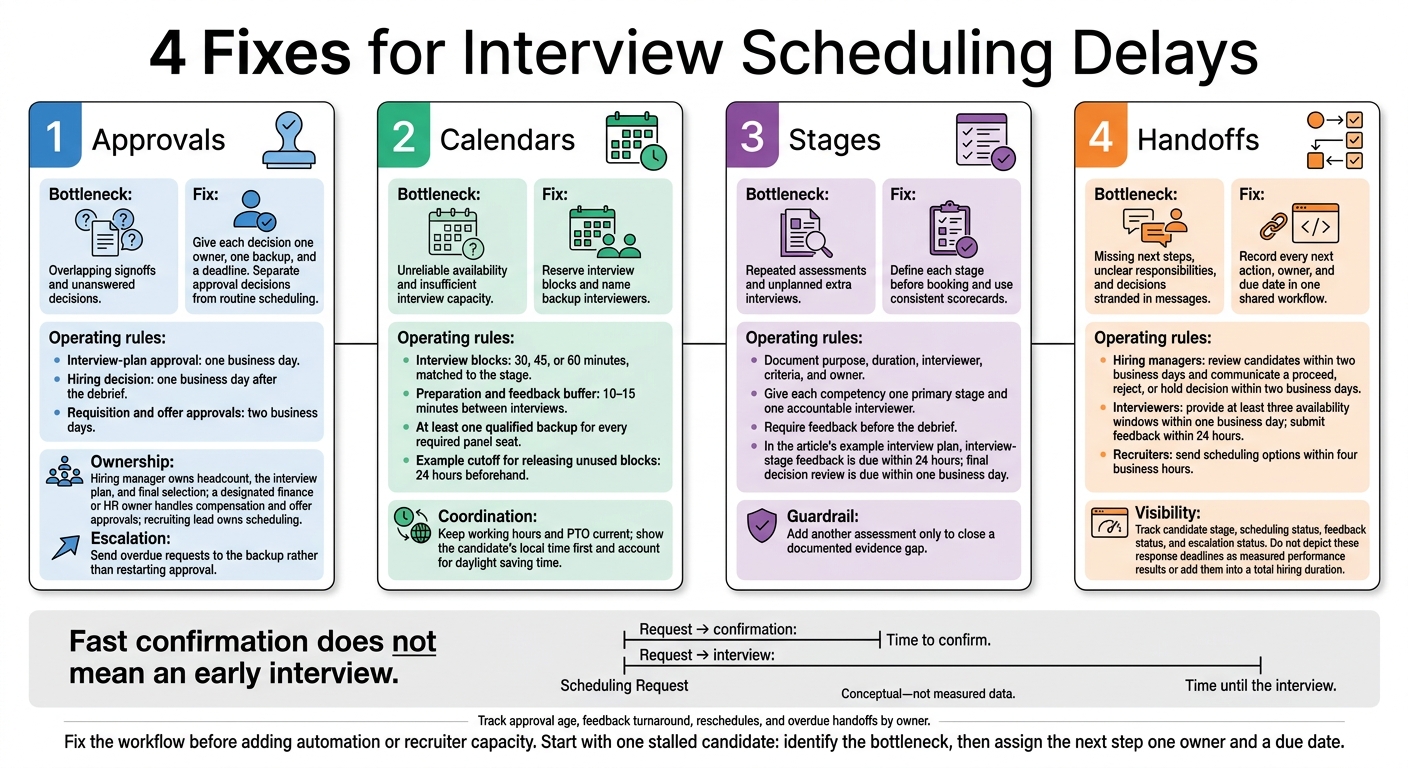
4 Fixes for Interview Scheduling Delays
Too Many Approvers Hold Up Interviews
Interview scheduling slows when approval and booking responsibilities overlap. Candidates share their availability, but interviews still stall while leaders approve the same plan, recruiters chase replies, or conflicting instructions lead to rescheduling.
Separate approval decisions from scheduling. Keep headcount, compensation, and offers under documented approval. Let recruiting book interviews within the approved plan.
Set Approval Rules and Deadlines
Give each decision one owner and one backup. Send overdue requests to the backup rather than restarting approval.
The hiring manager owns headcount, the interview plan, and final selection. A designated finance or HR owner handles compensation and offer approvals. The recruiting lead owns scheduling.
Once the plan is approved, recruiters should be able to book stages, send reminders, resolve calendar conflicts, and use approved interviewer backups without seeking approval again. This keeps routine booking from taking up leadership time.
Set clear response deadlines before recruiting starts:
- Interview-plan approval: one business day.
- Hiring decision: one business day after the debrief.
- Requisition and offer approvals: two business days.
Record each approval trigger, deadline, and escalation path in one shared workflow.
Identify Approval Delays and Their Owners
Review open and recently filled roles for duplicate signoffs and missing owners. Use the patterns below to distinguish approval delays from a lack of interview capacity.
| Scheduling Symptom | Approval Failure | Process Fix | Accountable Owner |
|---|---|---|---|
| Unchanged interview plans still need multiple signoffs | Approval rights overlap or are unclear | Approve one reusable plan at intake; reopen only for material changes | Hiring manager / recruiting lead |
| Nobody knows who can authorize a change | Decision authority is undocumented | Publish an approval matrix with an owner and backup for each decision | Recruiting lead |
| An approval remains unanswered | No deadline or escalation path exists | Set a response deadline and escalation path | Decision owner |
| Recruiters cannot verify whether approval happened | Decisions sit in email or chat | Record the decision, timestamp, and conditions in the shared workflow | Decision owner |
Track approval age by owner before expanding interviewer availability. Measure the time from request to logged decision separately from candidate stage time. That shows whether hiring is waiting on a decision or needs more interview capacity.
sbb-itb-a23bd6a
Poor Calendar Habits Reduce Interview Availability
Once approvals are set, calendar discipline determines whether interviews get booked on time.
Outdated calendars make availability unreliable. Without reserved interview time, recruiters must negotiate every booking. Specialists shared across roles can then become hiring bottlenecks.
Reserve Interview Time and Name Backups
Ask hiring managers to protect recurring 30-, 45-, or 60-minute interview blocks matched to each stage. Add 10-15 minutes between interviews for preparation and feedback.[6] Set a clear cutoff for releasing unused blocks, such as 24 hours beforehand.
Keep working hours, PTO, and meeting changes up to date. Assign at least one qualified backup for every required panel seat, and brief them on the assessment and scorecard. This gives recruiters an alternative when an interviewer becomes unavailable.
Candidate messages and invites should include the date, start time, end time, and time zone. Store each interviewer’s time zone and working hours, display the candidate’s local time first, and account for daylight saving time.[2][4] Check that availability overlaps before sending options.
For panel interviews, confirm the full interview plan at intake and find one shared window for all required participants.[5]
Track Available Interview Capacity
Use one shared view of interview capacity so recruiters can book without chasing updates. Record the role, stage, interview duration, required interviewer or panel, primary and backup participants, next available slot, and time zone. Include open blocks, confirmed interviews, cancellations, reschedules, and feedback deadlines.[3]
Review capacity weekly by interviewer and role to spot shared bottlenecks and uncover hidden issues before they delay hiring.
| Area | Manual calendar coordination | Standard capacity process |
|---|---|---|
| Calendar control | Recruiters repeatedly request availability | Hiring managers reserve blocks; recruiters book within them and handle exceptions |
| Availability | Open time may hide conflicts or outdated holds | Up-to-date calendars show working hours and protected interview time |
| Rescheduling | Each cancellation starts another negotiation | Agreed backups and replacement-slot rules help recruiters rebook |
| Visibility | Availability sits across separate messages | One tracker shows open blocks, demand, and next available slots |
Measure both request-to-confirmation time and request-to-interview time. Fast confirmation offers little help if the interview is still days away.
Compare median scheduling time, interview block utilization, and reschedule rates over four to six weeks. Automation can coordinate available slots, but it cannot create interviewer capacity.
Even with open blocks, unclear stages can still force rework.
Unclear Interview Stages Cause Rework
Even when interviewers have time available, unclear stages delay hiring. Scheduling happens one interview at a time. Interviewers repeat assessments, then request another conversation because nobody assessed a key competency. Each extra meeting adds candidate waiting time and interviewer hours, without necessarily improving the decision.
Define Each Stage Before Scheduling
Before inviting candidates, document each stage’s purpose, duration, interviewer, criteria, and owner. Give each competency one primary stage and one accountable interviewer. Assess it again only to close a documented evidence gap.
Set pass criteria upfront so candidates advance based on evidence, not an interviewer’s preference for another meeting.
Once the plan is set, schedule the full interview loop. Keep only checkpoints that affect the decision, such as reviewing a work sample before advancing. Tell candidates how many rounds to expect, what each covers, how to prepare, and when you’ll make a decision.
Use Scorecards and Set Feedback Deadlines
Clear stages need consistent scoring rules. Give each assessment a short scorecard with job-related criteria, rating definitions, evidence notes, and an advance, hold, or reject recommendation. Require feedback before the debrief. Standardized scorecards improve rating consistency.[7]
| Interview Stage | Objective | Interviewer Role | Duration | Scorecard Criteria | Feedback Deadline |
|---|---|---|---|---|---|
| Recruiter screen | Confirm interest, work authorization, compensation alignment, and logistics | Recruiter | 30 minutes | Motivation, communication, location or schedule fit, required eligibility | Within 24 hours |
| Skills assessment | Evaluate job-related technical or functional competency through a work sample | Subject-matter expert | 60 minutes | Accuracy, reasoning, approach | Within 24 hours |
| Collaboration interview | Assess collaboration and stakeholder communication | Cross-functional partner | 45 minutes | Listening, clarity, conflict handling | Within 24 hours |
| Hiring-manager interview | Assess ownership, prioritization, and role-specific judgment | Hiring manager | 45 minutes | Prioritization, decision quality, relevant impact | Within 24 hours |
| Final decision review | Resolve evidence gaps and make the hiring decision | Hiring manager and decision owner | 30 minutes | Evidence across criteria, remaining risks, recommendation | Within 1 business day |
Assign an owner to chase overdue scorecards and escalate missed deadlines. Track feedback turnaround, time in each stage, unplanned rounds, and interviewer hours per hire.
Record why each extra interview was added and whether it changed the decision. If the same evidence gap keeps prompting extra rounds, redesign the stage rather than adding another meeting that slows hiring.
Poor Recruiter-Manager Coordination Delays Handoffs
Clear hiring stages won’t prevent delays if recruiters and managers miss handoffs. Recruiters handle candidate scheduling. Hiring managers set priorities, secure interviewer participation, and make hiring decisions.
When those inputs arrive late, unanswered requests build up across open roles, and ownership gets blurred. Agree on responsibilities and deadlines before scheduling starts to keep roles moving.
Agree on Scheduling Rules at Intake
Confirm the role priority, interview plan, panel members and backups, final decision maker, target hire date, candidate availability rules, and escalation path before scheduling begins. Separate process ownership from decision ownership: recruiters coordinate the work; managers provide the decisions that move it forward.[9][10][12]
Set clear response deadlines:
- Hiring managers: review candidates within two business days and communicate a proceed, reject, or hold decision within two business days.
- Interviewers: provide at least three availability windows within one business day and submit feedback within 24 hours.
- Recruiters: send scheduling options within four business hours.
Give every scheduling-critical handoff an owner and a due date. Agree when a missed deadline allows the recruiter to escalate to the department head after one business day or activate a backup interviewer after two business days.[10][12]
Track Candidate Handoffs in One Place
Use an applicant tracking system (ATS) or Recruitment as a Service workflow to record each candidate’s stage, next action, owner, and deadline. Include interviewer assignments, scheduling status, feedback status, and escalation status.
Don’t leave pending decisions in chat. Log when the scheduling request was created, availability was received, the interview was confirmed, and feedback was submitted. These timestamps show where time is being lost.[8][14]
| Activity | Recruiter | Hiring manager | Interviewer | Approver |
|---|---|---|---|---|
| Confirm interview plan | Coordinate | Accountable | Consulted | Informed |
| Provide interview availability | Track | Escalate gaps | Responsible | Informed |
| Schedule candidate | Responsible | Consulted | Consulted | Informed |
| Submit interview feedback | Follow up | Review | Responsible | Informed |
| Make hiring recommendation | Facilitate | Accountable | Consulted | Informed |
Review stalled candidates and aging requisitions weekly. For each overdue handoff, record the current stage, last completed action, next owner, deadline, reason for delay, recovery action, and escalation date.[9][11]
Track request-to-confirmation time, feedback turnaround, overdue handoffs by owner, and aging by stage. Break down results by manager, role priority, and interview stage to pinpoint delays that extend hiring timelines.[12][13]
Apply Scheduling Fixes Across Open Roles
Roll Out Changes and Measure Delays
Once you’ve identified the bottlenecks, apply the fixes across every open role. Set the same hiring rules before scheduling starts, and carry the approved calendar setup into each new requisition. Use one workflow to enforce the rules, not to replace clear ownership or interviewer capacity.
Start with a baseline drawn from four weeks of history. Test the changes on one or two roles for two weeks, then expand. Keep candidates already in progress on their confirmed schedules unless a stage is missing or a change is needed for equitable treatment or compliance.
Review results weekly using fixed definitions. Pinpoint whether approvals, calendars, stages, or handoffs cause delays. Track median time to schedule, lead time to interview, feedback turnaround, reschedules, cancellations, and approval ageing. Record who requested each change.[3][1] Faster confirmation alone doesn’t solve delays if interviews still sit days into the future.
Add Recruiter Support When Teams Reach Capacity
If hiring still stalls after rollout, check your team’s capacity. Add recruiter support when the process is fixed but hiring volume exceeds what the team can handle. Assess candidate volume, interview hours, coordination workload, and overdue actions, not just the number of open requisitions.[15]
Extra recruiter capacity can ease coordination overload. An interviewer shortage still needs protected calendar time.
Rent a Recruiter can embed recruiters into your team when internal capacity is tight.
Conclusion: Fix Approvals, Calendars, Stages, and Handoffs
Cut approval delays, reserve interview time, define stages upfront, and simplify handoffs so scheduling doesn’t hold up your hiring pipeline.
Fix the workflow before adding automation or recruiter capacity. Neither can make an interview panel available or move a decision forward when no one owns it.
Start with one stalled candidate. Find the bottleneck, then give the next step one owner and a due date.
FAQs
How do I identify our biggest scheduling bottleneck?
Track business days spent at each hiring stage: headcount request to approval, screening to first interview, final interview to decision, and decision to offer sent. Any stage that consistently takes longer than 48 to 72 hours is likely a primary bottleneck.
Compare your total hiring cycle with industry benchmarks, including the U.S. median time-to-fill of 45 days, to see where your process may be falling behind.
How can we speed up interviews without rushing decisions?
Cut repetition, not steps. Keep interviews to three or four stages, each with a clear purpose: a recruiter screen, a hiring manager interview, and a structured assessment or panel.
Use standardized interview kits and shared scorecards covering four to six job-related competencies. This keeps feedback consistent and helps you avoid extra rounds that repeat earlier discussions.
Require feedback within 24 to 48 hours. Use self-scheduling tools to cut back-and-forth and reduce time spent coordinating interviews.
When should we add recruiter support instead of automation?
Use automation for repetitive admin: interview scheduling, status updates, application acknowledgments, and data entry. Free up your team’s time while keeping hiring decisions human.
When hiring demand exceeds your team’s capacity, add embedded recruiter support. Slipping process discipline, slower feedback, and longer hiring timelines can point to a capacity bottleneck, not just a workflow problem. Rent a Recruiter places experienced recruiters inside your team to manage hiring end to end.