
Recruitment costs can spiral fast if you don’t understand the numbers. Many companies overspend by 40–60% because they haven’t compared hiring models properly. So, what’s the smarter choice for scaling businesses: recruitment vendors or in-house teams?
Here’s the breakdown:
- Recruitment vendors charge per hire (20–30% of a candidate’s salary), which adds up quickly, especially for high volumes. They’re great for niche roles or short-term spikes but lack control and long-term efficiency.
- In-house teams come with fixed costs – recruiter salaries, tools, and software – but become more cost-effective as hiring needs grow. However, they require upfront investment and can struggle with fluctuating demand.
- Embedded recruitment offers a middle ground: a recruiter embedded in your team for a flat monthly fee, combining the expertise of vendors with the control of in-house teams.
The key takeaway? If you’re hiring fewer than 10 roles annually, vendors might work. But for 15+ hires per year, in-house or embedded recruitment can save you up to 70% on costs.
Quick Comparison
| Model | Cost Structure | Best For | Challenges |
|---|---|---|---|
| Recruitment Vendors | Per hire (20–30% of salary) | Niche roles, short bursts | High costs, less control |
| In-House Teams | Fixed (salaries + tools) | High-volume hiring | Upfront investment |
| Embedded Recruitment | Flat monthly fee ($15–25k) | Scaling with flexibility | Requires internal setup |
Ready to cut recruitment costs without sacrificing quality? Explore embedded recruitment to see how it works.
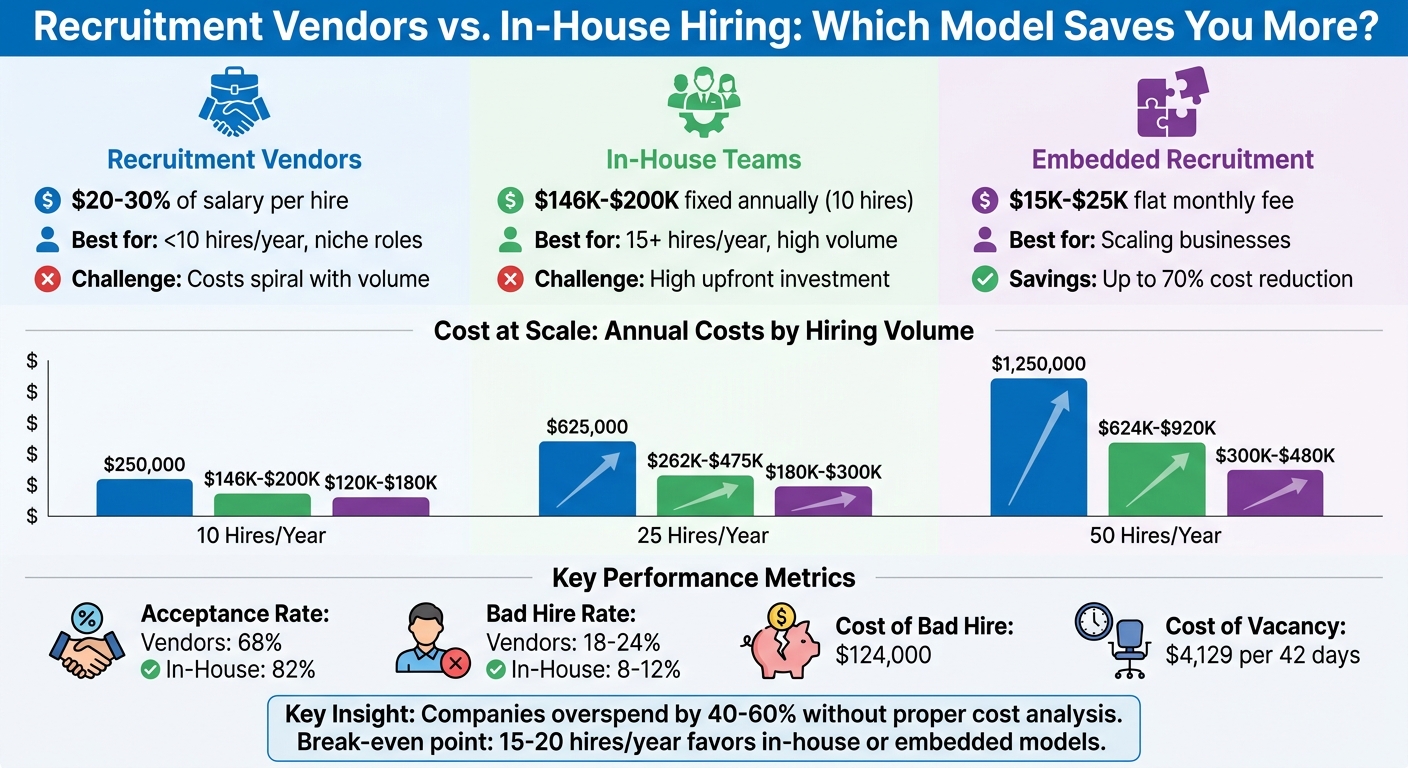
Recruitment Cost Comparison: Vendors vs In-House vs Embedded Models
Direct Costs: Recruitment Vendors vs. In-House Hiring
Recruitment Vendor Fees
Contingency recruitment agencies typically charge between 20–30% of a candidate’s base salary per hire [1]. For example, filling a $100,000 position would result in fees of $20,000–$30,000. When it comes to specialised roles, fees can climb to 25–40% of the annual salary [4]. Retained search firms operate differently, charging 25–35% of first-year compensation, split into three payments [1]. Recruitment-as-a-Service (RaaS) providers, on the other hand, offer a flat monthly fee ranging from $15,000–$25,000, which covers both recruiter expertise and technology [1].
In-House Hiring Costs
Building an internal recruitment team involves a different cost structure. The fully loaded cost of an in-house recruiter falls between $106,000 and $175,000 per year [1]. On top of that, technology expenses – such as applicant tracking systems (ATS), LinkedIn Recruiter licenses, and assessment tools – can add anywhere from $40,000 to over $100,000 annually [1]. Operational costs, like job board postings (ranging from $100–$500 each) and background checks (between $50–$200 per candidate), further contribute to the total [1]. Unlike vendor fees, these are largely fixed costs, meaning they don’t scale directly with the number of hires. This makes in-house recruitment more efficient as hiring volumes increase.
Cost Comparison Table
The fundamental difference between these models lies in how costs scale. Vendor fees increase with each hire, while in-house recruitment involves fixed overheads that spread out as hiring demand grows.
| Hiring Volume | Contingent Agencies (25% Fee) | In-House Team (Salaries + Tools) | RaaS (Flat Fee Model) |
|---|---|---|---|
| 10 Hires/Year | $250,000 | $146,000 – $200,000 | $120,000 – $180,000 |
| 25 Hires/Year | $625,000 | $262,000 – $475,000 | $180,000 – $300,000 |
| 50 Hires/Year | $1,250,000 | $624,000 – $920,000 | $300,000 – $480,000 |
For example, if your company needs to fill 25 roles annually, working with contingency agencies could cost $625,000. In contrast, an in-house setup – consisting of two recruiters and the required technology – would range between $262,000 and $475,000. Scaling up to 50 hires per year, an internal team with four recruiters and a Director of Talent Acquisition might cost between $624,000 and $920,000, compared to $1,250,000 for agency fees. Meanwhile, the RaaS model usually offers more predictable costs, ranging from $300,000 to $480,000 for 50 hires [1].
Key takeaway: Vendor fees grow with every hire, while in-house recruitment relies on fixed costs that become more economical as hiring needs increase. This makes internal teams a better long-term option for companies with consistent and high hiring demand.
sbb-itb-a23bd6a
Indirect and Hidden Costs in Recruitment
In-House Recruitment Overheads
Hiring in-house comes with more than just visible expenses like salaries and software. There are hidden costs that can significantly impact your budget. For instance, inefficient hiring processes mean managers often spend 15–25 hours per hire instead of the optimal 6–10 hours. At a fully loaded rate of $72 per hour (based on a $150,000 annual salary), this adds up to an extra $1,080–$1,800 per hire [1].
Recruiter turnover is another overlooked cost. With an average recruiter tenure of just 2.8 years, losing a recruiter can lead to 3–6 months of lost productivity while you backfill the role and rebuild internal knowledge [1]. Additionally, in-house teams often face uneven workloads – being underutilized during quiet periods but overwhelmed during hiring spikes. This imbalance can leave critical roles unfilled when they’re needed most.
There’s also the cost-of-vacancy to consider. Each unfilled position can cost your business about $4,129 over a 42-day period [2]. For revenue-generating roles, that number jumps to $7,000–$10,000 per month [2]. For example, if a software engineer role remains vacant for 56 days, the productivity loss alone could cost around $60,606 [2].
While in-house recruitment inefficiencies can be costly, outsourcing to vendors has its own set of hidden drawbacks.
Vendor-Related Drawbacks
Contingency recruitment agencies may seem like a quick fix, but they come with hidden inefficiencies. Their lower acceptance rates (68% compared to 82% for in-house teams) and higher bad hire rates (18–24% compared to 8–12%) mean more vacancies and rehiring costs [1]. With the cost of a bad hire estimated at $124,000 – factoring in lost productivity and rehiring expenses – these differences can quickly inflate your recruitment spend.
Working with multiple agencies also creates logistical challenges. Internal teams often waste time resolving duplicate candidate submissions or disputes over candidate ownership [1]. Plus, agencies typically retain candidate data, preventing companies from building their own talent pipelines. This forces businesses to start from scratch with each hiring cycle, losing valuable market insights along the way.
These inefficiencies, combined with the hidden costs, can make vendor solutions far more expensive than they initially appear.
Scenario-Based Cost Comparisons
When you dig into the numbers, the financial gaps between recruitment models become clear. At higher hiring volumes, in-house recruitment consistently proves more cost-effective than contingent agencies. The inefficiencies baked into vendor models – like bad hire rates and coordination issues – only amplify total costs. This highlights the financial benefits of investing in a strong, well-structured in-house recruitment team.
In-House vs Recruitment Agency – Which is Best for Your Business? Pros and Cons explained
Pros and Cons: Recruitment Vendors vs. In-House Teams
Building on the cost comparisons, let’s explore the non-financial upsides and downsides of each hiring approach.
Advantages and Disadvantages of Vendors
Recruitment vendors offer unmatched flexibility. They can quickly ramp up during hiring spikes – whether for seasonal demands or rapid scaling – and scale back just as easily during slower periods. This adaptability removes the need to maintain fixed staffing costs when hiring slows. Vendors also bring specialized expertise, access to niche talent pools, and advanced sourcing tools that many companies might not invest in themselves.
But there’s a catch: the cost. Traditional agencies often charge 20–30% of a candidate’s base salary, which adds up fast when hiring at scale [1]. Another drawback is brand control. External recruiters may focus on closing roles quickly to earn their commission, sometimes at the expense of your employer brand. As Joel Carias, Founder & CEO of Alivio Search Partners, explains:
"Agencies optimize for speed and their commission, not your brand" [1].
Additionally, with vendors, you usually don’t retain ownership of candidate pipelines or hiring data once the partnership ends. This means starting from scratch every hiring cycle.
Now, let’s compare in-house talent vs recruitment agencies from a structural perspective.
Strengths and Weaknesses of In-House Teams
In-house teams shine when it comes to cultural alignment and control. They’re deeply embedded in your company’s values, ensuring candidates experience a consistent and authentic representation of your brand. This alignment often leads to better long-term hires. Plus, all candidate data and insights stay within your systems, helping you build a talent pipeline for future hiring needs.
However, maintaining an internal team comes with high fixed costs. A small team of two recruiters can cost between $262,000 and $475,000 annually when you include salaries, benefits, and recruitment tools [1]. Capacity is another challenge – internal teams may struggle to keep up during hiring surges and may be underutilized during quieter periods. As Carias points out:
"In-house recruiters often experience overload during peaks and underuse during lulls. Neither model adapts to your actual needs" [1].
There’s also the risk of turnover, which can disrupt workflows and lead to a loss of institutional knowledge.
Comparison Table of Pros and Cons
Here’s a quick side-by-side comparison to help you weigh your options:
| Factor | Recruitment Vendors | In-House Teams |
|---|---|---|
| Cost Structure | Variable; high per hire (20–30% of salary) | Fixed; high overhead regardless of volume |
| Scalability | High; quick ramp-up and scale-down | Low; limited by headcount |
| Speed | Fast for niche roles | Moderate; depends on workload |
| Brand Control | Low; commission-focused | High; authentic representation |
| Quality | Strong for specialized roles | Superior cultural alignment |
| Data Ownership | None after contract ends | Full ownership |
| Acceptance Rate | 68% [1] | 82% [1] |
Choosing the Right Recruitment Model
Your recruitment strategy should reflect your hiring needs, growth plans, and budget. Joel Carias, CEO of Alivio Search Partners, highlights a key issue: many companies overspend on recruitment by 40–60% because they fail to analyze the actual costs [1].
Key Cost Management Insights
Start by calculating your break-even point. If you’re hiring fewer than 10 people annually, contingent agencies or a single recruiter might work. But once you hit 15–20 hires per year, in-house recruitment teams often become more cost-efficient, even with fixed costs exceeding $200,000 annually – whether you’re actively hiring or not [1][3].
Don’t overlook the hidden costs of vacancies. Long internal hiring processes can be costly. For instance, an 8+ week timeline can rack up higher soft costs compared to an external vendor completing the process in just 3–6 weeks [3].
These considerations highlight the importance of exploring recruitment models that balance flexibility with predictable costs.
Why Embedded Recruitment Fits SMEs
Embedded recruitment bridges the gap between traditional agencies and in-house teams. It offers scalable, predictable support without the hefty price tags of agencies or the rigidity of internal setups. For a flat monthly fee – typically between $15,000 and $25,000 – you get dedicated recruiters who integrate seamlessly with your team [1].
With Rent a Recruiter, experienced recruiters join your team in just days, managing the entire hiring process while ensuring you retain control over candidate pipelines and data. This approach can cut hiring costs by up to 70% and save over 80 hours per month compared to commission-based models. Plus, it scales with your needs, avoiding the fixed overhead of full-time salaries and the per-hire fees that make agencies unsustainable for scaling businesses.
Next Steps: Streamline Recruitment
Once you’ve clarified your costs and chosen the right model, it’s time to refine your hiring process. Tyler Scott from WorkRocket puts it best:
"The core question isn’t just ‘can we fill the role?’ but ‘how fast, how well, and at what cost can we fill this role?’" [2]
Curious about how much you could save? Book a call with Rent a Recruiter to explore your potential cost savings and design a recruitment model tailored to your growth goals.
FAQs
How do I calculate my hiring break-even point?
To figure out your hiring break-even point, start by comparing the total costs of various hiring options – whether that’s in-house recruiting, traditional agencies, or recruitment-as-a-service. Factor in fixed costs like recruiter salaries or platform subscriptions, alongside variable costs such as per-hire fees. Then, calculate the number of hires needed for these costs to balance out. This gives you clarity on when one approach becomes more cost-efficient, allowing you to fine-tune your recruitment strategy for maximum impact.
What hidden costs should I consider beyond recruiter fees and salaries?
Hidden costs in recruitment often stretch far beyond recruiter fees and salaries. These can include subscriptions for job boards, the cost of an applicant tracking system (ATS), and resources spent on onboarding, training, and administrative tasks.
Then there’s the time your team spends on sourcing and screening candidates – a drain on productivity that’s easy to underestimate. Delays in onboarding and prolonged vacancies can also lead to lost productivity, impacting your bottom line.
And let’s not forget the indirect costs. Hiring mistakes, high turnover rates, and the need for re-hiring or re-training can quietly but significantly inflate your recruitment expenses over time. These hidden factors can make what seems like a straightforward process far more costly than expected.
How is embedded recruitment different from an agency or in-house team?
Embedded recruitment places a recruiter directly within your team, fully immersed in your company’s culture and processes. This approach stands apart from traditional agencies, which typically charge 17%–25% of a hire’s annual salary. Instead, embedded recruitment provides a fixed, predictable cost structure. Compared to maintaining in-house recruitment teams with fixed salaries and benefits, this model offers flexibility and can cut hiring costs by as much as 70%.