
Hiring for SMEs can quickly become expensive, with costs ranging from $3,000 to $8,000 per hire. If a hire leaves within 90 days, these costs can double. The challenge isn’t just job postings but also the time founders and managers spend on hiring, agency fees, and the risks of bad hires.
Here’s how you can reduce hiring costs without compromising quality:
- Tighten job briefs: Clear, specific descriptions save time by attracting the right candidates.
- Leverage employee referrals: Referral hires are faster to onboard and more likely to stay.
- Build a talent pipeline: Maintain a pool of pre-screened candidates to avoid starting from scratch each time.
- Streamline interviews: Limit rounds to save time and avoid losing candidates to competitors.
- Improve job ads: Write clear ads with salary ranges to attract better applicants.
- Use structured screening tools: Automate repetitive tasks to reduce costs and errors.
- Standardize onboarding: A clear onboarding plan reduces early turnover.
- Lower turnover in key roles: Focus on retaining talent to avoid re-hiring costs.
- Flexible recruitment support: Use external recruiters during hiring spikes to save time and money.
- Track cost per hire: Identify inefficiencies and improve processes over time.
Key takeaway: By simplifying processes, reducing inefficiencies, and focusing on retention, SMEs can cut hiring costs significantly while maintaining high-quality hires. For scaling companies, strategies like embedded recruitment can save up to 70% compared to traditional agency fees. Learn more about embedded recruitment here.
Ways to Reduce Hiring Costs (What Most Companies Overlook)
sbb-itb-a23bd6a
Why Hiring Costs Climb Fast in SMEs
When SMEs think about hiring costs, they often focus on job posting fees. But those fees are just the surface. The real costs are deeper, and they add up fast.
Agency fees are a major factor. Recruitment agencies typically charge 15%–25% of a new hire’s first-year salary [1][3]. For a $60,000 position, this translates to $9,000–$15,000 per hire. If your SME is filling three or four roles annually, these fees can quickly eat into your budget, but you can calculate potential savings by comparing models.
Next comes internal managerial time. Hiring takes effort – about 20–30 hours per hire for tasks like reviewing resumes, scheduling interviews, and making decisions [1]. As FirstHR explains:
"Small businesses do not pay for an ATS… The trade-off: every dollar saved on tools and staff is replaced by founder time, which is harder to quantify but equally expensive." [1]
This combination of external and internal costs becomes even more painful when hiring drags on.
Slow hiring processes amplify the problem. Every week a role stays open, the business loses output while existing staff take on extra work. Delays also mean top candidates often accept offers from faster-moving competitors, forcing you to restart the process – adding more time and cost.
And then there’s the risk of a bad hire. Research shows that 20% of new hires leave within the first 45 days [3]. When this happens, the business pays the recruitment cost all over again, plus 33% of the departing employee’s annual salary in replacement costs [1]. For a $50,000 role, that’s an extra $16,500 on top of the initial spend [1].
Understanding these hidden costs is essential to adopting smarter hiring models that offer more efficiency.
1. Tighten the Job Brief Before You Post
A well-crafted job brief is the cornerstone of efficient hiring, helping you avoid unnecessary costs and wasted time with fractional recruitment services for SMEs.
Many hiring challenges begin long before resumes start rolling in. A poorly defined job brief tends to attract unsuitable applicants, leading to more time spent screening, longer interview processes, and a greater risk of hiring the wrong person.
"A clear and accurate description will help to secure the right candidates and save unqualified applicants from applying… it saves you time in screening, which lowers the total cost." – Allsorter [6]
The solution? Be specific. Outline 5–7 key tasks the candidate will handle weekly and define 3–5 must-have skills – not a wish list. Include a salary range and clearly distinguish between essential and preferred qualifications. This approach filters out mismatched candidates early, saving valuable time [6].
Remember, your most expensive resource is the time spent by founders and managers. A vague job brief drives up this cost by overwhelming your pipeline with unsuitable candidates. As FirstHR notes:
"The largest controllable cost for most small businesses is… founder time… You reduce founder time by standardizing the hiring process: write one job description template." [1]
Create a reusable job description template paired with a scoring rubric. Use it for every role you hire. This small, upfront effort streamlines your hiring process, reduces early turnover risks, and ensures you’re investing your time where it matters most [1].
2. Use Employee Referrals
Tap into your team’s network to find pre-vetted talent. When employees refer someone they know, you’re essentially getting candidates who have already passed an initial credibility check, saving valuable screening time.
The cost? A referral bonus typically ranges from $500 to $2,000 per successful hire. Compare that to the $9,000 to $15,000 you’d pay in agency fees for a $60,000 role. Plus, referred candidates are 55% faster to hire and stay with the company 70% longer than those sourced through other methods [3].
"The highest-ROI recruitment strategy for small businesses is employee referrals." – FirstHR [3]
How to Keep It Simple
Many companies overcomplicate referral programs, which can discourage participation. All you really need to start is a name and an email address – long forms or formal processes aren’t necessary. Share the job description with your team, ask them to think about their network, and check back a week later.
To keep things fair and effective, implement a 90-day bonus rule: employees receive their referral bonus only after the new hire completes 90 days. This encourages the referring employee to help their contact settle in and succeed [3].
This no-fuss approach saves time and ensures the program delivers real results.
The Long-Term Payoff
When done right, referral programs can drive consistent hiring success. For teams of 5 to 50 people, referrals can account for 30–45% of all hires if the program is actively promoted [3]. Simple strategies like reminding employees whenever a new role opens, offering small milestone rewards (e.g., a $100–$200 bonus when a referral reaches the interview stage), and publicly recognizing successful referrals can boost participation. With this structured approach, referral hires can jump from 10% to 40–50% within a year [3].
One overlooked yet powerful tactic? Founders posting open roles on their personal LinkedIn profiles. These posts often get 5 to 10 times more visibility than company page updates, sparking organic referrals from their professional networks – at no extra cost [3].
3. Build a Reusable Talent Pipeline
Many small to mid-sized businesses (SMEs) only post job ads when a role opens up. While this might seem practical, it’s actually an expensive way to hire. Each new search racks up job board fees, takes hours of screening unfamiliar candidates, and often leads to rushed decisions – decisions that can result in costly mis-hires. A talent pipeline flips this approach by creating a pool of pre-screened candidates, so you don’t have to start from scratch every time. This proactive strategy not only reduces sourcing costs but also complements earlier hiring efforts.
One often overlooked resource for building your pipeline is your “silver medalists.” These are candidates who made it to the final stages of a previous hiring process but didn’t get the offer. They’re already vetted, have shown interest in your company, and re-engaging with them requires minimal effort. By tapping into this group, you extend the benefits of referral programs and keep potential hires connected to your business [9].
The Cost and Long-Term Payoff
Did you know the average cost-per-hire in the U.S. is $4,129 [5]? That’s a lot, especially when you’re starting from scratch every time. A well-maintained talent pipeline can significantly cut these costs. For example, using an Applicant Tracking System (ATS) to manage and automate your pipeline can reduce time-to-hire by up to 40% and lower cost-per-hire by 35% [5]. Companies that actively maintain a talent network and invest in their employer brand spend 43% less per hire compared to those that don’t [10]. Over time, this leads to faster hires, better cultural alignment, and less pressure to settle for the first available candidate.
How to Get Started
Start simple. Tag strong candidates in your current system – even a shared spreadsheet works as a temporary solution. When reconnecting with past candidates, make it personal. Reference your previous interaction to show you value their time. For instance, mentioning a past conversation about their skills or career goals can make your outreach far more effective than a generic email [9].
If you’re ready to take it up a notch, consider investing in an affordable ATS. Tools like JuggleHire, priced at just $19/month, can help you automate follow-ups, track candidate progress, and keep your pipeline organized – all without needing a full HR team [5].
4. Cut Down Interview Rounds
Adding more interview rounds doesn’t guarantee better hires. For SMEs, it often means higher costs and wasted time. Each extra round pulls founders or managers away from critical, revenue-driving responsibilities. On average, founders spend 20–30 hours interviewing for a single role, with their time costing between $1,000 and $3,000 per hire [1].
The Cost Impact
Dragging out the interview process can cause you to lose top candidates to faster-moving competitors. A streamlined process keeps strong candidates engaged and avoids the expense of restarting your search from scratch.
How to Implement It
For most SME roles, a simple two-round process works well:
- Round 1: A 20-minute phone screen to cover the basics – salary expectations, availability, and interest.
- Round 2: A 45–60 minute structured interview focused on assessing skills and fit.
For technical or creative roles, skip an additional interview in favor of a paid work sample. A 1–2 hour task that mirrors actual job responsibilities is often more revealing. Paying candidates $50–$150 for their time shows respect and attracts serious talent [3].
"The founder cannot spend 20 hours per hire on a multi-stage pipeline with panel interviews and committee reviews. The process needs to produce good results in 8 to 12 hours per hire." – FirstHR [11]
This approach not only saves time but also lays the foundation for tracking costs effectively in talent acquisition strategies.
Keeping Quality High
Structured interviews are key to maintaining quality while speeding up the process. When every candidate answers the same 5–7 behavioral questions, scored on a 1–5 rubric, you double your ability to predict job performance compared to unstructured chats [11].
Use scorecards to review candidates within 48 hours, and aim to make a verbal offer within 24 hours of the final interview. This quick decision-making gives you an edge over larger companies, which typically take 4–8 weeks to complete their hiring processes [3].
5. Write Better Job Ads and Career Pages
The Cost Impact
A poorly crafted job ad doesn’t just waste time – it drains money. Vague descriptions attract the wrong talent, leaving you sifting through mismatched applications while the right candidates look elsewhere. With the average cost-per-hire in the U.S. sitting around $4,800 [2] and time-to-hire stretching between 42 and 44 days [2], every extra week a role stays vacant adds to productivity losses and pressures your team. Worse, ineffective ads often lead SMEs to repeatedly pay for job board renewals or "boosts", piling on unnecessary expenses [2].
How to Implement It
The fix? Straightforward adjustments can make a world of difference. Drop unnecessary degree requirements and redundant "preferred skills" – focus instead on skills that directly tie to job performance. Be specific. For instance, say, "manage 15–20 client accounts" instead of the overly broad "strong communication skills required" [3].
Always include salary ranges. Transparent pay details help filter out candidates with mismatched expectations before they even apply [2]. Considering that top talent is typically off the market in 10 to 14 days [2], a streamlined application process – free of excessive form fields – can make or break your chances of securing the best fit.
"Specificity is a competitive advantage because every other company is posting vague descriptions." – FirstHR [3]
This approach doesn’t just attract qualified candidates; it also strengthens your employer brand, aligning perfectly with earlier cost-saving strategies.
Long-Term Benefits
Beyond cutting down screening time, well-written job ads and career pages lay the foundation for an employer brand that draws in talent consistently. Showcasing real team testimonials and offering clear salary information builds trust with potential candidates, including those who weren’t actively job hunting [4][12].
"A strong employer brand attracts candidates without requiring expensive advertising or recruiter fees." – Jen Dewar, JobScore [4]
For SMEs, even a handful of positive reviews on platforms like Indeed or Glassdoor can make a difference. On the flip side, having no reviews at all could quietly cost you offer acceptances [3]. By refining your job ads and career pages, you not only reduce hiring expenses but also create a long-term strategy to consistently bring in top talent.
6. Use Structured Screening Tools
Structured screening tools can transform your hiring process by automating repetitive tasks, saving time, and reducing costs.
The Cost Impact
Did you know manual hiring processes cost around $375 per hire? Switching to ATS-supported methods cuts that down to $225, saving $150 per hire [5]. For a company hiring 20 people annually, that’s an extra $3,000 in your budget – without compromising on the quality of hires.
How to Implement It
Cloud-based applicant tracking systems (ATS) simplify tasks like filtering applications, communicating with candidates, and scheduling interviews. With some platforms starting at just $19/month [5], the savings quickly outweigh the costs, even for companies with modest hiring needs.
"Smart recruitment isn’t just about spending less; it’s about spending wisely." – Zakir Hossen, Founder, JuggleHire [5]
Another effective step is to incorporate video interviews as an initial screening phase. These help cut travel and logistics expenses, assess communication skills, and evaluate alignment with your company’s values – all before committing to full interview rounds. Pair video interviews with standardized screening questions to ensure every candidate is assessed fairly. This reduces the chance of bias and helps avoid the expense of a poor hiring decision [5][6].
This approach doesn’t just trim costs – it creates a smoother, more efficient hiring process.
Long-Term Benefits
Beyond immediate savings, structured screening tools provide valuable data. They reveal which job boards deliver the best candidates, highlight bottlenecks in your hiring pipeline, and track trends in your cost-per-hire [6][7]. Armed with this insight, you can stop wasting money on underperforming channels and focus on what works.
| Metric | Manual Process | With ATS/Screening Tools | Impact |
|---|---|---|---|
| Time per Hire | 15 hours | 9 hours | 40% reduction [5] |
| Cost per Hire | $375 | $225 | $150 savings [5] |
| Sourcing Cost | High (job boards) | Low (social/referrals) | 75% lower [5] |
| Candidate Quality | Variable | Standardized/data-driven | Higher consistency [5][6] |
7. Standardize Your Onboarding Process
For many SMEs, onboarding often gets overlooked, leading to unnecessary expenses. Here’s the reality: only 12% of employees strongly agree that their company does onboarding well [1]. The impact? A hire who leaves within 90 days can cost 33% of their annual salary. For a $50,000 role, that’s a hit of $16,500 to $19,000. Compare that to just $2,100 when you have a structured onboarding process in place [1].
"Reducing recruitment costs starts with fixing onboarding, not finding cheaper job boards." – FirstHR [1]
The solution? Make onboarding consistent and efficient.
How to Implement It
You don’t need a large HR team to standardize onboarding. Start with a 30/60/90-day plan that works across roles, giving new hires clear goals from the beginning. Automate compliance tasks like I-9s, W-4s, and distributing employee handbooks. Using e-signature tools eliminates manual errors and avoids fines that can range from $252 to $2,507 per missed deadline [1].
Equip new hires with a ready-to-go hardware and software kit so they can hit the ground running on Day 1. There are affordable onboarding platforms and embedded recruitment solutions tailored for SMEs, often costing between $50 and $100 per month [1]. This small investment can save you the massive expense of replacing a failed hire.
Long-Term Benefits
A well-structured onboarding process doesn’t just cut costs – it speeds up productivity. New employees typically operate at just 25% capacity in their first month [13], and it can take up to a year for them to reach full productivity [13]. By setting milestones and scheduling regular manager check-ins at Day 7, 30, 60, and 90, you give hires the support they need to succeed faster. This reduces early turnover and keeps productivity losses to a minimum during those critical first months.
8. Lower Turnover in Key Roles
Keeping turnover low in critical roles is one of the smartest ways for SMEs to cut hiring costs. Retaining your top talent saves money and avoids the disruption that comes with replacing key employees. Every time someone leaves, you’re not just dealing with recruitment expenses – you’re also losing productivity and creating ripple effects across your team.
Cost Impact
Replacing an employee can cost 33% of their annual salary [1]. For a role earning $45,000, that’s about $15,000 in replacement costs. On top of that, hiring externally often means paying 18–20% more in salary compared to promoting internally [2]. These costs add up quickly, especially for smaller businesses working with tight budgets.
Practical Steps to Reduce Turnover
You don’t need a massive HR team to lower turnover. Start by tracking your 90-day retention rate – if it’s under 80%, it’s time to dig into your processes. Look at role clarity, screening, and onboarding to spot areas for improvement [2]. An anonymous employee survey can also reveal disengagement triggers, while benchmarking your compensation against market rates ensures you stay competitive.
Another effective approach? Focus on internal mobility. Build a skills inventory to identify employees who could step into new roles, reducing your reliance on external hiring. This strategy complements structured screening and onboarding efforts, creating a more stable workforce.
Long-Term Benefits
These strategies don’t just save money in the short term – they create lasting advantages:
"The most effective way to reduce total recruitment costs is not to find cheaper candidates. It is to keep the candidates you already found." – FirstHR [1]
SMEs are uniquely positioned to excel at retention. Many employees leave big companies searching for autonomy, flexibility, and the chance to make a direct impact – qualities that smaller businesses often deliver. Building a strong employer brand can lower turnover by as much as 28% [5]. And remember, your brand isn’t just about marketing; it’s shaped by everyday experiences. Flexible work options, clear career progression, and regular check-ins with managers remind employees why they joined your team in the first place.
To further control costs, consider flexible recruitment support during periods of high hiring demand.
9. Bring in Flexible Recruitment Support During Hiring Spikes
When your business hits a growth surge, it can overwhelm your hiring resources and drive up recruitment costs. Traditional agency fees, often as high as 25% of a hire’s first-year salary, can be tough to justify – especially for SMEs working with tight budgets.
Cost Impact
Every day a position remains unfilled costs your business between $1,000 and $5,000. On top of that, internal leaders often spend countless hours managing the hiring process, further increasing the overall expense [1]. Flexible recruitment support offers a practical solution to bridge these gaps efficiently.
Ease of Implementation
One of the biggest advantages of flexible recruitment support is how quickly it can be rolled out. Instead of committing to a full-time recruiter or building an entire HR function, you can bring in fractional recruitment support only when you need it. For instance, Rent a Recruiter can embed seasoned recruiters into your team within days, taking charge of the entire hiring process during busy periods without adding long-term overheads. This approach often cuts hiring costs by up to 70% compared to traditional agency models and saves over 80 hours per month in internal hiring and admin tasks. It’s a focused, cost-effective way to handle recruitment spikes while maintaining control over your processes.
Long-Term Benefits
The value of flexible recruitment support goes beyond immediate cost savings. By embedding a recruiter to manage sourcing, screening, and scheduling with standardized tools, your team gains a structured hiring process that lasts well after the engagement ends. This helps establish a consistent and efficient recruitment framework, even during periods of high demand.
"For specialized roles or high-level positions, recruitment agencies with specific expertise might still be the best option. The key is to use them judiciously and only when necessary." – Zakir Hossen, JuggleHire [5]
Flexible recruitment support works best when used strategically. Deploy it during genuine hiring surges, for hard-to-fill roles, or when your internal team is stretched too thin. Pair this with strong internal referral programs and structured recruitment processes to keep costs manageable while meeting your hiring goals.
10. Track Cost Per Hire and Find the Bottlenecks
Most small and medium-sized businesses (SMEs) have a general idea of what hiring costs them, but few take the time to measure it accurately. Without tracking, it’s impossible to identify areas of overspending or inefficiency.
Cost Breakdown
In the U.S., the average cost per hire is about $4,800, but for SMEs with 5–50 employees, this number can range from $3,000 to $8,000 per hire when factoring in indirect costs like the time spent by founders and managers [1]. Edie Goldberg, Chair-elect of the SHRM Foundation, breaks it down further:
"Of those costs, I would say 30 percent to 40 percent are hard costs, and the other 60 percent are soft costs." [8]
The "soft costs", such as the time spent by internal teams, often make up the majority of the expense.
How to Start Tracking
Understanding your hiring costs is just the beginning. Setting up a simple tracking system can help pinpoint areas where you’re overspending. You don’t need expensive software to do this. For SMEs making 5–15 hires a year, a spreadsheet is often enough. Record details like the role, hiring dates, sourcing channels, total cost, and 90-day retention rates [1].
Review this data every quarter to identify patterns. Are certain job boards costing more than they’re worth? Which roles are taking the longest to fill? Where in the process are candidates dropping out? Answering these questions can highlight inefficiencies that need fixing.
As FirstHR notes:
"Measuring creates awareness, which creates improvement. Companies that track CPH reduce it by 10–15% within 12 months." [1]
Why It Pays Off
By tracking and analyzing your cost per hire, you gain more than just cost control – you also improve your entire hiring process. You’ll identify the sourcing channels delivering the best candidates, uncover delays in your interview process, and spot issues like early turnover that drive up costs unnecessarily.
Pete Newsome, President of 4 Corner Resources, puts it perfectly:
"The cheapest hire you’ll ever make is the one you never have to replace." [2]
To get started, use this simple formula: (Total Internal Recruiting Costs + Total External Recruiting Costs) ÷ Total Number of Hires [1][8]. Add in the value of your team’s time at their hourly rate, and you’ll have a clear baseline to work from. With this insight, you can focus on reducing inefficiencies and making smarter hiring decisions.
Comparison Table
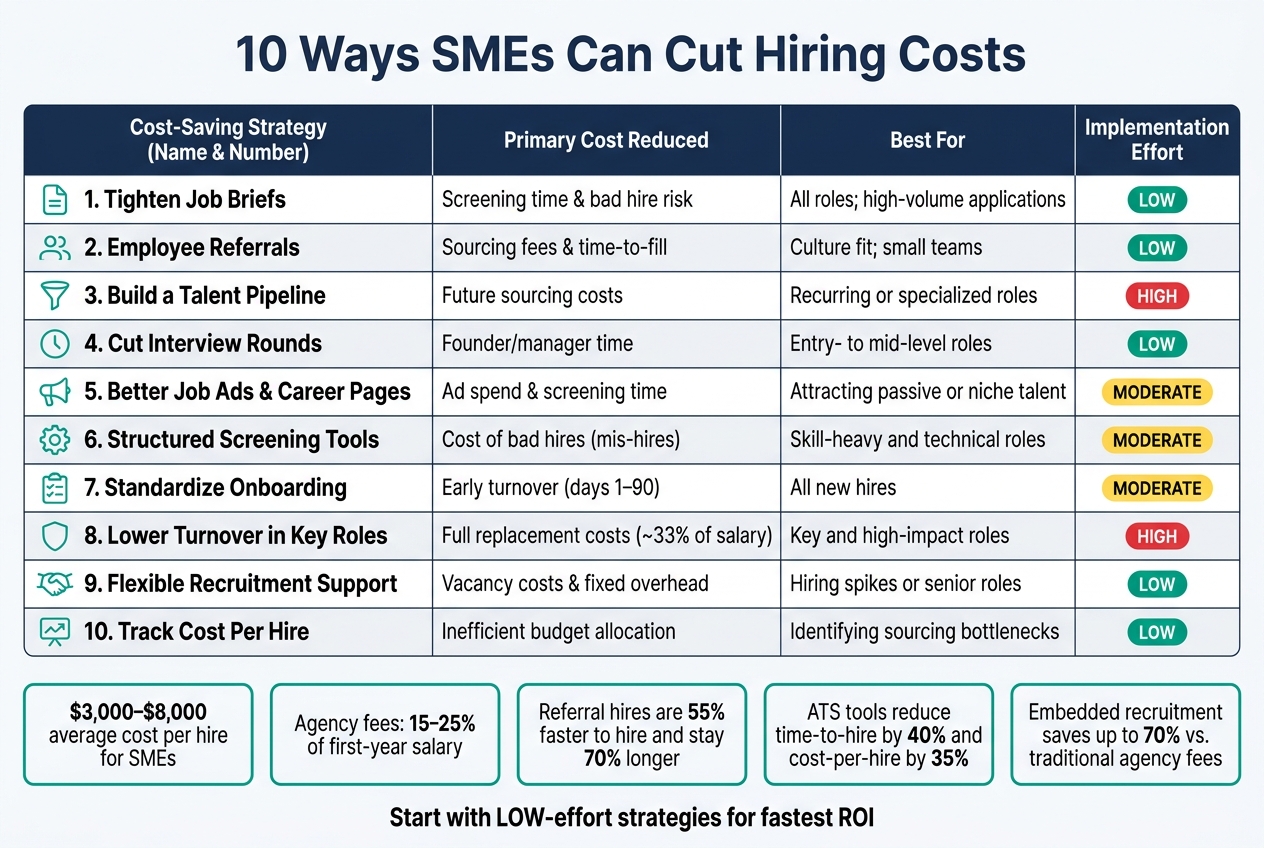
10 Ways SMEs Can Cut Hiring Costs: Strategy Comparison Guide
The table below summarizes 10 recruitment strategies, focusing on cost reductions, target roles, and the effort required to implement them. It’s designed to help SMEs streamline hiring while keeping overheads low.
| Cost-Saving Method | Primary Cost Reduced | Best For | Implementation Effort |
|---|---|---|---|
| 1. Tighten Job Briefs | Screening time & bad hire risk | All roles; high-volume applications | Low (Process change) |
| 2. Employee Referrals | Sourcing fees & time-to-fill | Culture fit; small teams | Low (Set a $500–$2,000 bonus policy) |
| 3. Talent Pipeline | Future sourcing costs | Recurring or specialized roles | High (Ongoing candidate nurturing) |
| 4. Cut Interview Rounds | Founder/manager time | Entry- to mid-level roles | Low (Process change) |
| 5. Better Job Ads & Career Pages | Ad spend & screening time | Attracting passive or niche talent | Moderate (Copywriting & content) |
| 6. Structured Screening | Cost of bad hires (mis-hires) | Skill-heavy and technical roles | Moderate (Create rubrics & scorecards) |
| 7. Standardize Onboarding | Early turnover (days 1–90) | All new hires | Moderate (One-time setup) |
| 8. Lower Turnover | Full replacement costs (≈33% of salary) | Key and high-impact roles | High (Culture & management investment) |
| 9. Flexible Recruitment Support | Vacancy costs & fixed overhead | Hiring spikes or senior roles | Low (Outsourced support) |
| 10. Track Cost Per Hire | Inefficient budget allocation | Identifying sourcing bottlenecks | Low (Spreadsheet-based) |
For SMEs, the most immediate savings come from low-effort, high-impact strategies like employee referrals, tightening job briefs, and tracking cost per hire. These require minimal investment but can significantly reduce hiring costs. For example, launching a referral program with a modest bonus policy or improving job briefs can be done quickly and deliver fast results.
If your company has fewer than 15 hires annually, focus on these simpler methods first. Adjusting your interview process, creating a referral program, or refining your job ads can often be completed in just a few days. Meanwhile, strategies like building a talent pipeline or reducing turnover provide greater long-term savings but require sustained effort.
Start by identifying your biggest hiring pain points – whether it’s screening inefficiencies, in-house talent vs recruitment agencies costs, or frequent turnover. Then, implement two or three strategies that directly address these challenges. Over time, you can layer in additional approaches to further optimise your recruitment process.
When to Bring in a Recruitment Partner to Control Costs
While improving in-house recruitment is essential, there are times when bringing in external expertise makes more sense – especially if costs are climbing due to unfilled roles or sudden hiring demands.
Time is a key indicator. If a position stays open for more than 60 days, the cost of leaving it vacant – from lost productivity to delayed projects – can outweigh the fixed cost of external recruitment support. A good strategy is to try direct sourcing first. But if a role isn’t filled within that 60-day window, it’s time to bring in help.
Hiring surges are another clear signal. Closing a funding round, launching a product, or needing to hire quickly can overwhelm your internal team. In these cases, the opportunity cost of pulling leaders or founders away from core business activities often exceeds the cost of external support.
Rent a Recruiter provides a cost-effective solution for these scenarios. Instead of paying traditional agency fees of 15% to 25% of a hire’s first-year salary – which could mean $9,000 to $15,000 for a $60,000 role – Rent a Recruiter embeds a skilled recruiter into your team for a fixed fee. This approach can cut hiring costs by up to 70% and save over 80 hours per month in administrative work and internal hiring tasks.
This model is particularly effective for post-funding scale-ups, periods of rapid growth, or teams where founders are still handling recruitment. It ensures you can reduce inefficiencies, allocate resources wisely, and step in with external support when in-house recruitment becomes more expensive than outsourcing.
Conclusion
Hiring smarter always saves money. By improving targeting, speeding up processes, and focusing on retention, SMEs can consistently reduce recruitment costs while maintaining quality hires. These steps highlight the value of a well-organized, forward-thinking hiring strategy.
Early turnover is a budget killer. Addressing onboarding and reducing early attrition delivers far better returns than any savings on job board fees. Every tip in this guide is designed to help you lower costs without cutting corners. Retaining great talent is far less expensive than starting the hiring process from scratch repeatedly.
Many SMEs can see big gains by optimising your hiring process. Simple steps like refining job descriptions, standardizing interviews, building a talent pipeline, and monitoring cost-per-hire can drive meaningful change over time. As Jen Dewar from JobScore wisely states:
"Reducing recruitment costs doesn’t mean cutting corners or compromising on talent quality. It’s about creating a more efficient, effective hiring process." [4]
FAQs
What should I include in a strong job brief?
A strong job brief is your chance to set the tone for the role and draw in the right candidates. To do this effectively, make sure it includes the essentials: clear responsibilities, required skills, and qualifications. Beyond the basics, highlight what makes your company stand out – your culture, values, and what drives your team.
Keep the "4 P’s of Recruiting" in mind: People, Passion, Purpose, and Products. These elements help ensure you’re connecting with candidates who align with your mission and are genuinely motivated by what your company offers.
The payoff? A well-thought-out job brief leads to better-quality applicants, saving you both time and money in the hiring process.
Which hiring metric should I track first?
The cost per hire is a crucial metric for tracking recruitment expenses. It breaks down the total cost of bringing a new employee on board, offering insights into where your money is going. By keeping an eye on this number, small and medium-sized businesses can fine-tune their hiring processes, allocate budgets more effectively, and identify ways to cut unnecessary costs. This data-driven approach ensures smarter spending and better hiring outcomes.
When should I bring in an embedded recruiter?
You should think about adding an embedded recruiter to your team when your business is experiencing rapid growth, rolling out a new product, or dealing with a sudden spike in hiring demands. They can boost your hiring capacity, take charge of the entire recruitment process, and introduce much-needed structure and consistency. This approach works particularly well for achieving short-term hiring targets or creating a recruitment function that grows alongside your business.