
In SaaS hiring, speed and quality often feel like opposing forces. But here’s the truth: you don’t have to choose between them. The right hiring framework can deliver both.
Scaling companies face two major risks: waiting too long and losing top talent to faster competitors, or hiring too quickly and making costly mistakes. A bad hire in sales or engineering can cost 3–5x their annual salary, while top candidates are off the market in just 7–10 days.
To avoid these pitfalls, here are five proven strategies to help you hire faster without lowering standards:
- Simplify your process: Cut unnecessary steps, use AI tools, and reduce friction to save time and keep candidates engaged.
- Structured interviews: Replace gut-feel decisions with a consistent framework to predict job performance more accurately.
- Pre-hire assessments: Screen candidates earlier with quick technical tasks or video interviews to focus on the best fits.
- Align stakeholders early: Define success upfront, set clear scorecards, and eliminate delays caused by indecision.
- Use embedded recruitment: Bring in dedicated recruiters who integrate with your team, saving up to 70% on hiring costs.
These strategies aren’t just about hiring faster – they’re about making better decisions while keeping costs under control.
1. Streamline the Hiring Process
SaaS companies often face sluggish hiring processes due to unnecessary friction – extra interviews, delayed feedback, clunky applications, and approval bottlenecks. The solution isn’t to compromise on quality; it’s to remove steps that don’t add value.
Start by identifying where delays occur. Measure "time in stage" to see exactly where candidates are getting stuck. Is scheduling interviews the issue? Are feedback loops too slow? Does offer approval drag on? Once you know the problem, tackle it directly. Implement Service Level Agreements (SLAs), like requiring hiring managers to give feedback within 24–48 hours, to keep things moving without sacrificing standards [5].
Speed Impact
Simplifying your process has a direct effect on candidate retention. About 60% of candidates abandon lengthy or confusing applications [5][6]. Streamlining job postings and offering features like one-click apply or LinkedIn autofill can increase the number of qualified applicants who complete the process. On the backend, AI tools can handle tasks like resume screening and interview scheduling, cutting time-to-hire by 25% or more [6].
Quality Impact
Streamlining doesn’t mean lowering the bar. In fact, eliminating redundant interview rounds can improve hiring decisions. A shorter, more focused process keeps candidates engaged and reduces distractions during evaluations. As one industry expert put it:
"Hiring velocity and hiring quality are not opposing goals. They are two sides of the same strategy." – TalentAlly [6]
Best Use Case
This approach is ideal for high-volume hiring efforts – for example, scaling your SDR team after securing funding or hiring multiple engineers at once. It’s also critical when you’re losing candidates to faster-moving competitors. If your offer acceptance rate has dipped below 70%, it’s a clear sign your process has too much friction and needs reworking [4].
sbb-itb-a23bd6a
2. Use Structured Interviews
Unstructured interviews often lead to delays and inconsistent hiring decisions. When interviewers rely on different questions and "gut feel", it becomes harder to reach a consensus, increasing the likelihood of a poor hire. Structured interviews solve this by introducing consistency and clarity.
Start by defining clear hiring criteria, creating a scorecard, and asking all candidates the same core questions. This shared framework eliminates subjective debates after interviews and ensures everyone evaluates candidates with the same standards.
"Relying on intuition often leads to inconsistent decisions and hiring delays. Instead of subjective interviews, implement structured interviews supported by a sales hiring scorecard." – Oakstone International [3]
Speed Impact
Pre-defined scorecards streamline decision-making by removing the back-and-forth that slows down the process. When interviewers know what a strong answer looks like in advance, post-interview debriefs take minutes, not hours. Adding a 24-hour deadline for feedback ensures scorecards are submitted promptly, keeping top candidates engaged and avoiding unnecessary delays [7].
"More interview rounds rarely produce more certainty. What they reliably produce is more elapsed time, more candidate drop-off, and more organizational friction." – GENTY recruitment [7]
By sticking to structured interviews, you also reduce the temptation to add extra interview rounds, which often do little more than extend timelines.
Quality Impact
Structured interviews are nearly twice as effective as unstructured ones at predicting job performance. Why? They focus on competency-based questions and job-specific scenarios [5]. For example, an Account Executive might perform a mock sales demo, while a Senior Engineer could tackle a live system design exercise. This approach ensures you’re testing skills that matter most for the role, rather than being swayed by charisma or surface-level traits.
It also helps avoid the "charm trap", where strong communicators are hired despite lacking the ability to deliver measurable results [1].
Best Use Case
Structured interviews are particularly impactful for SaaS GTM and technical roles, where the cost of a bad hire can be staggering. In SaaS, for instance, a poor engineering hire can cost up to 3x their annual salary once you factor in wasted onboarding time and fixing subpar work [4]. They’re also invaluable when multiple hiring managers are involved, as standardized criteria keep everyone aligned on what "great" looks like – no matter who’s in the room.
This approach not only improves hiring speed but also aligns perfectly with other strategies to boost quality and reduce the risks of a bad hire.
3. Add Pre-Hire Assessments
Pre-hire assessments build on the foundation of structured interviews by refining your candidate pipeline even further. While structured interviews assess those already in your process, pre-hire assessments act as an early filter, ensuring your team spends time only on candidates with proven potential.
To maximize efficiency, place these assessments at the very start of the hiring funnel. A brief technical task or a one-way video screen can quickly identify candidates who have the skills to back up their CV. Considering that top SaaS talent is often off the market within 7–10 days [6][4], wasting time on unsuitable applicants is simply not an option.
"By measuring a candidate’s personality, cognitive ability, and future potential upfront, you get a clear, objective picture of fit before investing hours in interviews." – McQuaig [8]
Speed Impact
Pre-hire assessments can significantly reduce time-to-hire by cutting out unnecessary interview rounds with unqualified candidates. Tools powered by AI can streamline early screening, reducing hiring timelines by over 25% [6]. Asynchronous formats, like one-way video interviews or take-home tasks, further eliminate delays caused by scheduling conflicts. To keep candidates engaged, it’s wise to limit take-home tasks to no more than two hours. Anything longer risks losing strong candidates who may drop out of the process.
Quality Impact
Assessments don’t just save time; they improve hiring accuracy by replacing subjective judgments with objective data. Predictive hiring tools have been shown to enhance the quality of hires by over 20% while speeding up decisions [6]. For instance, a 15-minute mock discovery call for SaaS sales roles can reveal how well a candidate pitches and handles objections – far more insightful than reviewing a resume. Similarly, live coding sessions for engineering candidates provide a real-time look at problem-solving skills, offering clarity that a LinkedIn profile simply can’t match.
"By aligning candidate traits with role requirements, assessments speed up hiring while increasing accuracy." – Kris Leblanc, McQuaig [8]
Best Use Case
Pre-hire assessments are particularly effective in two scenarios: high-volume roles, where quick triaging is essential, and specialized technical or GTM roles, where specific skills are critical. The table below outlines the most effective assessment types based on purpose:
| Assessment Type | Best For | Speed Impact | Quality Impact |
|---|---|---|---|
| One-Way Video Interview | Communication, personality, early fit | High | Medium |
| Technical Take-Home Task | Engineering, product roles | Medium | High |
| Mock Sales Call | AE, SDR, GTM roles | Medium | High |
| Behavioral Assessment | Cultural fit, long-term retention | Medium | High |
The aim isn’t to add more steps to your process – it’s to prioritize the right steps upfront. This ensures that later interview rounds are more focused, faster, and lead to confident hiring decisions.
4. Align Stakeholders Early
Hiring delays often stem from indecision rather than sourcing challenges. When hiring managers, HR, and senior leaders fail to define what "great" looks like before starting the search, the process gets bogged down. Aligning stakeholders from the outset not only speeds up decisions but also improves the quality of hires. Pair this with structured interviews and a clear hiring strategy, and you’ll see the difference.
"Hiring delays often begin because ‘what good looks like’ is unclear. Teams jump into sourcing before aligning on what a real successful profile looks like." – Oakstone International [3]
Start with a pre-hiring kickoff. Use this time to document must-haves – like SaaS experience, deal size expertise, or work location preferences (remote vs. in-office). Define success for the first 6–12 months and create a shared evaluation scorecard. When everyone assesses candidates using the same criteria, debriefs become quicker, and decisions are made with confidence.
Speed Impact
Early alignment tackles two common bottlenecks in SaaS hiring. The first is the founder bottleneck, where CEOs or CTOs personally review every candidate without clear benchmarks, dragging out timelines [4]. The second occurs when compensation and equity packages haven’t been pre-approved, delaying offers. This is risky, as top technical talent often gets snapped up within 7–10 days [4].
Quality Impact
Without alignment, vague and subjective rejections become a problem [4]. A shared scorecard tied to measurable outcomes – like quota attainment or relevant SaaS experience – keeps interviewers focused on what predicts success. This matters because a bad hire in a revenue-driving GTM role can cost 3–5 times the annual salary when you factor in lost revenue and onboarding time [3]. Getting everyone aligned early ensures faster, more confident decisions later.
Best Use Case
This approach is particularly important for Series A and Series B SaaS startups moving from founder-led hiring to building specialised teams. At this stage, informal hiring processes often lead to misalignment. Setting Service Level Agreements (SLAs) for stakeholder feedback – for instance, requiring feedback within 24–48 hours after interviews – keeps the process moving and prevents losing top candidates to competitors [5].
Here’s a quick summary of key alignment actions:
| Alignment Action | Speed Impact | Quality Impact |
|---|---|---|
| Success metrics (6–12 months) | Faster screening; fewer "maybe" candidates | Better accuracy in predicting long-term success |
| Pre-approved compensation/equity | Offers sent within 24 hours of final interviews | Reduces risk of losing top talent |
| Shared evaluation scorecard | Faster debriefs; avoids endless debates | Reduces bias; ensures consistent evaluations |
| Stakeholder SLAs (24–48 hr feedback) | Prevents delays between interviews and offers | Improves candidate experience; boosts employer brand |
5. Use Embedded Recruitment Services like Rent a Recruiter
Balancing speed with quality in hiring can be a challenge, especially for SaaS startups aiming to scale. Even with well-structured processes, aligned stakeholders, and thorough assessments, many companies simply don’t have the internal recruiting capacity to keep up with demand. This is where an embedded recruitment service becomes a game-changer.
Rent a Recruiter places experienced recruiters directly into your team within days. These recruiters fully integrate into your systems – whether that’s Slack, email, or your ATS – and focus exclusively on your hiring goals. Unlike traditional agencies that charge 15–25% of a hire’s first-year salary, this model operates on a flat monthly fee. The result? You save up to 70% on hiring costs compared to commission-based models and reclaim over 80 hours per month in internal hiring admin [9].
Speed Impact
Hiring top talent in SaaS often comes down to timing. In-demand technical and GTM professionals are typically off the market within 7–10 days [4]. Embedded recruiters work proactively, targeting passive candidates and keeping your pipeline full before hiring becomes urgent. With flexible engagement options – spanning 3, 6, or 12 months – you can scale your hiring efforts without committing to permanent headcount [9].
Quality Impact
Embedded recruiters don’t just focus on filling roles; they manage the entire hiring process. From defining your Employer Value Proposition (EVP) and designing interview frameworks to ensuring a seamless candidate experience and supporting onboarding, they handle it all [4]. This approach eliminates the fragmented handoffs that often lead to poor hires. Moreover, their incentives are tied to retention and long-term fit, not just quick placements.
"Because incentives are aligned around long-term outcomes, embedded models focus on quality, speed and retention rather than quick placements." – Ross Summers, Founder and Talent Acquisition Leader [9]
By aligning their efforts with your business goals, embedded recruiters deliver hires that are built to thrive within your team.
Best Use Case
This model is particularly effective for SaaS startups that are scaling post-Series A or Series B. If you’re hiring across multiple roles but lack the internal infrastructure to manage it, an embedded recruiter can make all the difference. It’s especially valuable when the founding team becomes a bottleneck or when internal networks have been fully tapped – typically as the company grows beyond 20 employees [9].
Instead of scrambling to fill roles as gaps arise, an embedded recruiter helps you establish a predictable and repeatable hiring process. This ensures you can scale quickly without compromising on quality, keeping your growth trajectory on track.
Comparison Table
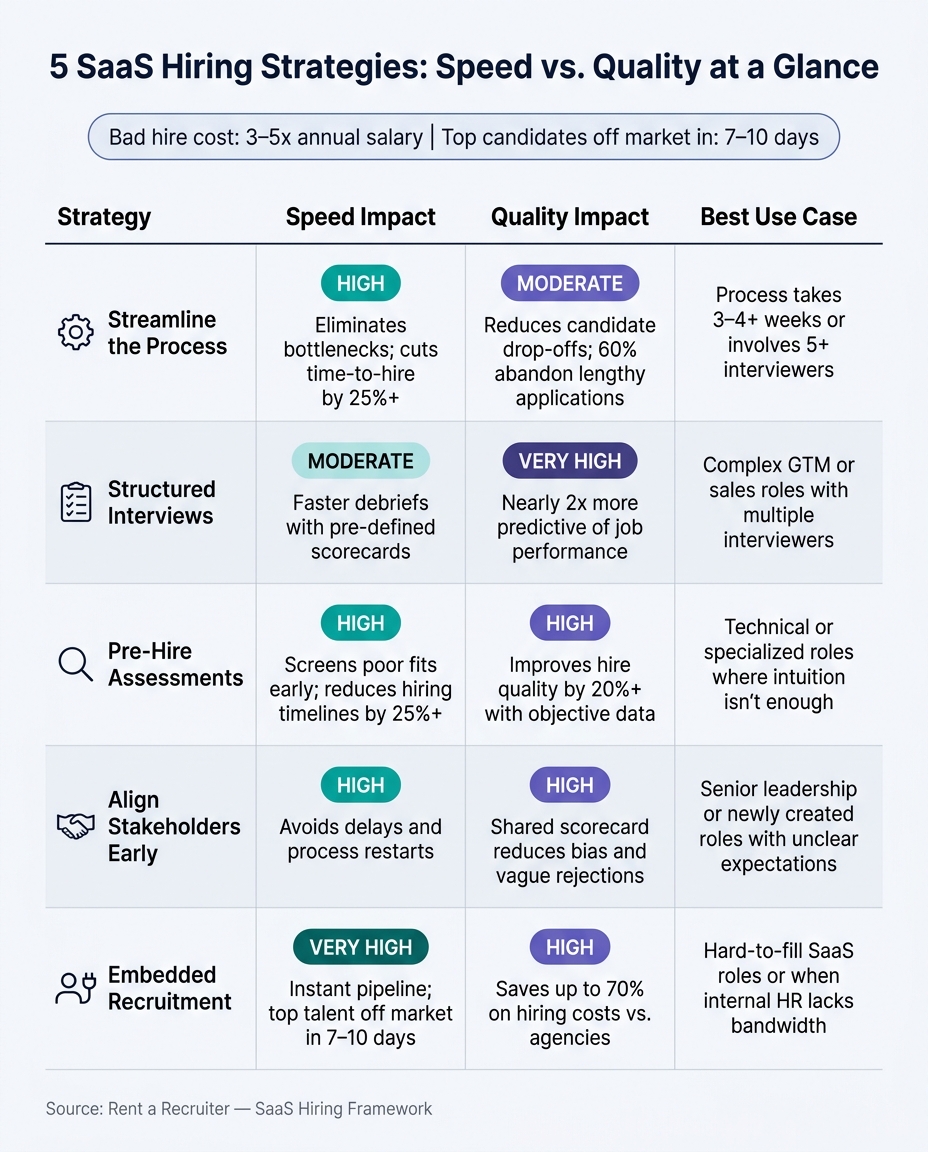
5 SaaS Hiring Strategies: Speed vs. Quality Comparison
Not every hiring strategy suits every situation. The table below breaks down how different approaches impact speed, quality, and their ideal use cases, helping you decide the best fit for your hiring needs.
| Strategy | Speed Impact | Quality Impact | Best Use Case |
|---|---|---|---|
| Streamline the Process | High – eliminates bottlenecks and redundant steps | Moderate – reduces candidate drop-offs | When your process takes longer than 3–4 weeks or involves 5+ interviewers |
| Structured Interviews | Moderate – enables quicker, objective comparisons | Very High – nearly twice as predictive of job performance [5] | Complex sales or go-to-market roles requiring multiple interviewers and high stakes |
| Pre-Hire Assessments | High – screens out poor fits early, saving time on interviews | High – provides objective data on skills and fit | Technical or specialized roles where intuition alone isn’t enough |
| Align Stakeholders Early | High – avoids delays or restarts later in the process | High – ensures a shared understanding of what "great" looks like | Senior leadership positions or newly created roles with unclear expectations |
| Embedded Recruitment | Very High – gives instant access to pre-vetted candidates | High – connects with top talent not actively job hunting | Hard-to-fill SaaS roles or when internal HR lacks bandwidth or networks |
Each of these strategies has its strengths. Streamlining processes and aligning stakeholders are quick to implement, delivering fast results at a low cost. Structured interviews and pre-hire assessments need more upfront work – like creating scorecards or selecting tools – but they significantly boost hire quality. Embedded recruitment offers the fastest path to specialised talent with minimal effort from your team, making it ideal when resources are stretched.
Balancing speed and quality is essential for growing SaaS companies. These strategies aren’t exclusive; many high-growth teams use a mix based on the urgency of the role, its complexity, and internal capacity.
Conclusion
In SaaS hiring, speed and quality go hand in hand. The five strategies outlined here prove that the fastest teams aren’t rushing – they’re eliminating unnecessary delays while maintaining high standards.
With top technical candidates off the market in just 7–10 days [2], and the cost of a bad sales hire reaching 3–5 times their annual salary when you factor in lost revenue and onboarding expenses [3], optimising your hiring process isn’t optional – it’s a business imperative.
Whether it’s simplifying interview stages, using scorecards to ensure consistency, or leveraging embedded recruitment for expert support, the objective remains the same: create a hiring process that fuels your growth instead of slowing it down. Companies that take a strategic approach to hiring set themselves up for predictable, sustainable scaling.
FAQs
How many interview rounds should a SaaS company run?
The right number of interview rounds for a SaaS company strikes a balance between evaluating candidates thoroughly and maintaining hiring speed. A streamlined approach is essential – dragging out the process with excessive rounds can slow hiring and hinder growth. Focus on creating an efficient yet comprehensive process that assesses candidates effectively while keeping delays to a minimum. This ensures you meet your hiring goals without compromising on quality or momentum.
What’s the fastest way to screen candidates without lowering the bar?
To evaluate candidates efficiently without sacrificing quality, implement a structured approach. Pinpoint common bottlenecks, such as scheduling conflicts, and address them using automation tools. Establish clear SLAs for providing interview feedback, and refine job descriptions and applications to eliminate unnecessary steps. These methods ensure you maintain rigorous standards while accelerating the hiring process.
When should we use an embedded recruiter like Rent a Recruiter?
When your SaaS company is in a phase of rapid growth – whether it’s following a funding round, a major product launch, or a sudden increase in hiring needs – traditional recruitment methods can struggle to keep up. That’s where an embedded recruiter like Rent a Recruiter becomes a game-changer.
By placing seasoned recruiters directly within your team, you get a hiring process that’s not only faster but also more structured and aligned with your business goals. This approach ensures you can scale your team quickly without compromising on candidate quality, saving both time and effort when it matters most.