If your hiring team is still using a CRM as a database, you are leaving time, money, and hiring capacity on the table.
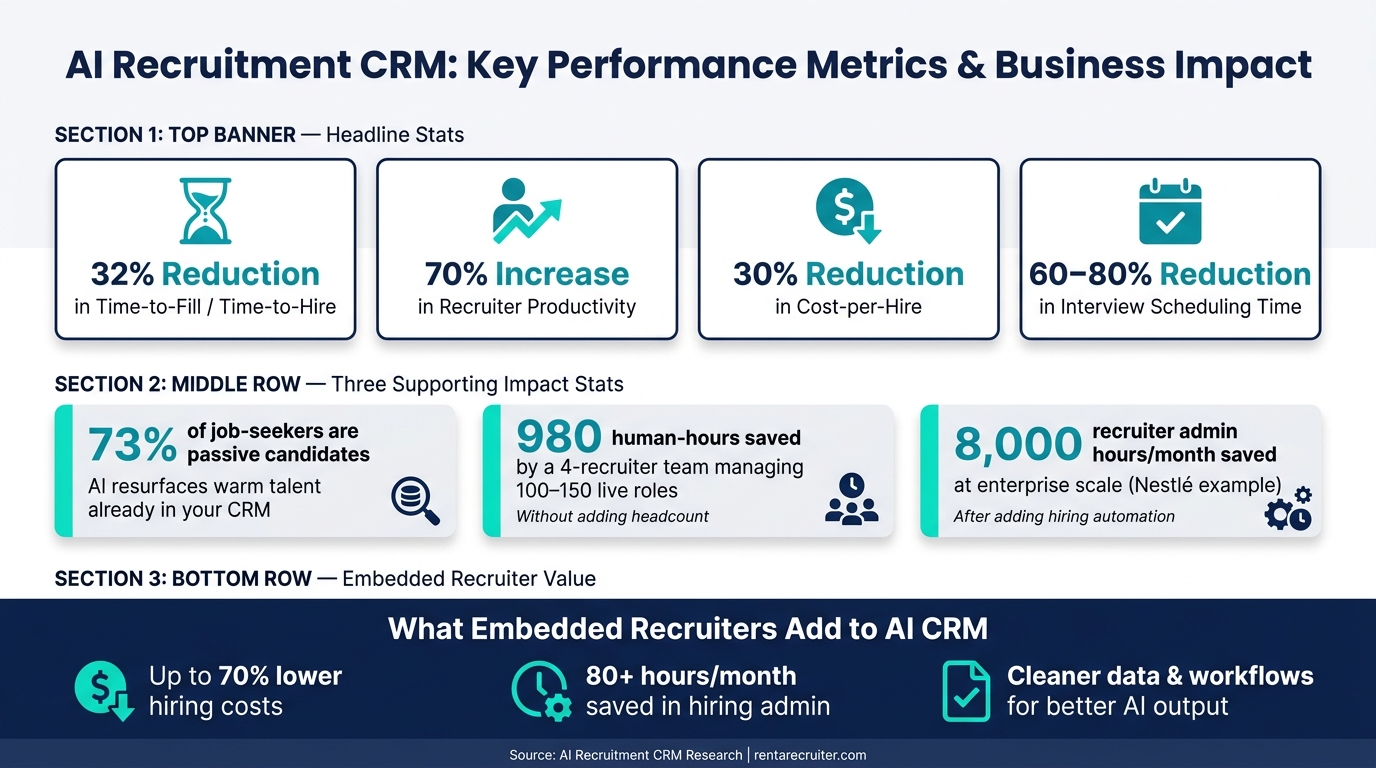
I see the shift clearly. AI in recruitment CRM helps scaling companies cut time-to-fill by 32%, lift recruiter output by 70%, and reduce cost-per-hire by up to 30% when the process behind the system is in good shape. For CEOs, CFOs, HR leaders, and Talent Leaders, that means less admin, fewer stalled roles, and more control over hiring delivery.
Here is the short version:
- AI improves candidate matching by structuring CV data, ranking fit, and surfacing past candidates already in your CRM
- AI automates pipeline work like outreach, follow-ups, scheduling, screening, and alerts on stalled roles
- The commercial upside is clear: lower hiring spend, less recruiter time lost to admin, and better role-fill speed
- The catch is simple: poor data and weak workflows limit results
- Execution matters most: this is where an embedded recruiter can help keep the system clean and the process moving
That is the core point of this article. AI does not fix a broken hiring process on its own, but it can make a well-run recruitment CRM work much harder for your business.
RecTalk Reacts: Recruiterflow AI Review | Can AI Really Remember Everything About Your Candidates?
How AI Improves Candidate Matching and Talent Discovery
Once CRM data is structured, AI does more than store candidate records. It helps you find the right people, rank them faster, and bring past talent back into play.
Resume Parsing, Profile Enrichment, and Meaning-Based Search
AI-powered CRMs use text analysis to parse resumes and pull out skills, experience, and other candidate details. That turns messy, unstructured files into richer, searchable records.
This matters because CVs come in all sorts of formats. Without AI, your team ends up doing manual data entry or working with patchy records. With AI structuring that data for you, recruiters spend less time cleaning files and more time shortlisting.
For scaling teams, the business impact is simple: faster shortlists from a larger and cleaner database.
Scoring Candidates by Job Fit and Hiring Likelihood
Once profiles are structured, AI can rank candidates by fit. That helps recruiters sort likely matches faster, while final selection still stays with people.
The best scoring setups are not black boxes. Recruiters need to see and adjust the criteria behind the score. If the logic is clear, the hiring team can trust the output and use it well.
Shared notes and fit scores also make reviews more consistent across the team. That means fewer delays, less back-and-forth, and a clearer path from shortlist to interview.
Using Existing CRM Data to Reactivate Warm Talent Pools
After ranking new applicants, AI can also resurface strong past candidates already in the CRM. Approximately 73% of job-seekers are passive [2], so there is real value in finding people who already know your brand or have engaged before.
Instead of starting every search from scratch, AI can flag past applicants who match an open role and prompt outreach before a new search begins. That shifts your CRM from a static archive into a working talent source.
For hiring leaders, that means:
- Lower sourcing time
- Less spend on new top-of-funnel activity
- Faster role fill rates using talent you already have
After the right candidates are surfaced, AI can also drive the outreach and follow-up that move them forward.
How AI Automates Communication and Pipeline Management
Once you’ve found the right people, the next job is getting them through the pipeline without delay.
That’s where many hiring teams start to crack. For scaling companies with multiple open roles, manual follow-up is usually the first thing to fail. And when recruiters are juggling a high number of vacancies at once, that gap shows up fast in slower response times, missed interviews, and stalled hires.
Personalized Outreach Across Email, SMS, and Scheduling
AI-powered CRMs use profile data you already have to draft outreach that fits the role and the person. Instead of sending the same message to everyone, the system adjusts the wording based on job fit and background.
That matters because better outreach usually means better reply rates. It also saves recruiters from spending hours writing near-identical messages across dozens of roles.
The bigger win often comes after the first message. Most recruiter replies come after the initial outreach, yet many recruiters never send a second manual follow-up. AI can run that process for you with automated sequences of 3 to 6 touches, spaced 2 to 5 business days apart. Once a candidate replies on any channel, the sequence stops [3].
When a candidate selects a time, the CRM books the meeting automatically.
That removes a surprising amount of admin. No back-and-forth. No chasing availability. No recruiter stuck in calendar management when they should be moving hiring forward.
When reply volume jumps, AI can also take care of the first layer of interaction automatically.
Chatbots and Screening Automation for High-Volume Hiring
Conversational AI can answer questions, collect availability, and route candidates into the right workflow based on their answers.
For high-volume hiring, that can take a lot of pressure off a lean team. Instead of recruiters handling every early-stage interaction by hand, the system manages the first pass and sends people down the right path.
The impact on team capacity can be hard to ignore. A four-recruiter team managing 100 to 150 live roles used automation to save 980 human-hours without adding headcount [3]. For a growing business, that kind of time saving can mean the difference between hiring at pace and falling behind.
Those interactions also feed the CRM with signals that help spot issues before they turn into missed hiring targets.
Predictive Pipeline Alerts, Forecasting, and Bottleneck Detection
Old-school reporting tells you what has already gone wrong. AI alerts show what’s about to slip [3].
Modern platforms track reply rates, stage conversion, and engagement signals in real time. If a role starts to stall or a candidate goes quiet, the system flags it and suggests the next action. That gives recruiters a clear view of where to focus first, whether that’s stalled roles, silent candidates, or weak conversion at a certain stage.
Traditional reporting shows what happened. AI alerts show what is about to slip [3].
So instead of reviewing every open role manually, recruiters can focus on the roles that need attention most [3]. For CEOs, CFOs, and hiring leaders, that means less wasted recruiter time, fewer pipeline surprises, and better control over hiring delivery.
These gains don’t happen by magic. They rely on clean data, clear workflows, and recruiter oversight. To see how your current setup compares, you can rate your recruitment process using our free analysis tool.
sbb-itb-a23bd6a
What Decision-Makers Need to Get Right Before Adopting AI in Recruitment CRM
AI Recruitment CRM: Key Performance Metrics & Business Impact
The gains covered in the previous sections, faster pipelines, smarter outreach, fewer bottlenecks, do not come from turning on a new platform. They come from the calls you make before the software goes live.
Data Quality, Workflow Design, and Human Oversight
AI is only as good as the data it runs on. If candidate records are incomplete or job requirements are written in different ways, matching and pipeline insights will be less reliable. That is why structured, consistent data matters first: standardised job descriptions, clean candidate profiles, and consistent interview stages.
Workflow design matters just as much. Many organisations need major process redesign before AI delivers its full value [1]. You need one connected workflow from sourcing through to onboarding.
AI-assisted hiring also needs documented controls, clean data, and human review before final decisions.
Get those basics right, and AI can cut admin time and improve hiring decisions.
Business Impact: Hiring Speed, Admin Time, and Cost Control
Clean data and clear workflows turn AI from a concept into measurable hiring gains.
| Metric | Expected Impact with AI CRM |
|---|---|
| Time-to-Fill / Time-to-Hire | 32% reduction [1] |
| Recruiter Productivity | 70% increase [1] |
| Cost-per-Hire | 30% reduction [4] |
| Interview Scheduling Time | 60% to 80% reduction [4] |
The admin savings are hard to ignore. Interview scheduling alone takes up 35% of recruiter time on average, and AI tools can cut that coordination time by 60% to 80% [4]. Nestle showed what this looks like at scale, saving about 8,000 recruiter admin hours per month after adding automation into its hiring workflow [4].
For CEOs, CFOs, and hiring leaders, that means less time lost to manual coordination, lower cost-per-hire, and more recruiter capacity for work that moves the business forward.
How Embedded Recruiters Help Teams Get More From AI CRM
When internal teams do not have the time to maintain those workflows, embedded recruiters help keep the system usable. AI CRM value depends on execution, not feature lists.
Most scaling companies do not have the bandwidth to keep data clean and workflows consistent. That is where an embedded recruiter can make the difference. Recruiters from Rent a Recruiter handle this directly, keeping data structured, workflows aligned, and AI outputs acted on.
The business case is simple:
- Lower hiring costs, by up to 70%
- More time back, with over 80 hours a month saved in hiring admin
- Better use of AI CRM, because the process behind it is kept in shape
Conclusion: AI Makes Recruitment CRM Work Better When Process and Execution Are Strong
AI works best when the hiring process behind it is tight. If that base is in place, AI can turn a recruitment CRM from a passive database into a system your team actually uses to manage hiring.
The gains show up when teams combine AI with clean data and clear workflows. Organisations using AI-powered recruitment platforms report a 32% improvement in both time-to-fill and time-to-hire [1]. That matters. Less admin means recruiters spend more time moving roles forward, but AI should support judgment, not replace it.
For scaling companies, the message is straightforward: fix the process first. Clean up candidate records. Make sure one person owns the workflow day to day. AI creates value when it helps recruiters do the work they already need to do, match faster, communicate better, and keep pipelines moving. That’s when AI matching, outreach, and pipeline alerts lead to faster hiring and fewer stalled roles.
If your team needs help keeping that structure in place, Rent a Recruiter embeds recruiters directly into your team to bring structure and consistency to hiring. Book a call to talk through your hiring needs.
FAQs
What data does AI need to work well in a recruitment CRM?
AI works best when your hiring data is clean, structured, and consistent.
That means candidate records should be deduplicated. Job titles, skills, seniority levels, and locations should also be standardised, so your system isn’t comparing apples to oranges.
Input quality matters just as much. In most cases, you need 12 to 24 months of historical scorecards, clear success criteria for each role, and connected ATS and HRIS data. Without that, AI has less to work with, and the output gets weaker.
It also pays to avoid proxy data that can skew decisions in the wrong direction. Use documented hiring outcomes instead, along with structured intake details like must-have versus preferred qualifications.
For hiring leaders, this is where the business case starts. Better data in means better hiring decisions out, with less wasted time, less noise in the funnel, and more confidence in how roles are assessed.
Can AI improve hiring if our recruiting process is disorganized?
Not on its own. If your recruitment process is messy, AI will scale those same issues. That often means poor matches, noisy shortlists, and more admin time burned instead of less.
AI does its best work when your ATS data is clean and your hiring process is structured and repeatable. Put that base in place first, and AI can help cut manual work and move hiring along faster.
How much recruiter work can AI realistically automate?
AI can automate more than 70% of work across the recruitment lifecycle, especially high-volume, repetitive tasks like sourcing candidates, resume screening, interview scheduling, and initial assessments.
That matters because it takes a heavy admin load off your team. Instead of spending hours on manual tasks, recruiters can focus on work that drives better hiring outcomes, like stakeholder alignment, candidate conversations, and final hiring decisions.
The best model is human and AI working together. AI handles the repeatable parts. Your team brings judgment, context, and decision-making. That mix helps you move faster without losing control over hiring quality.