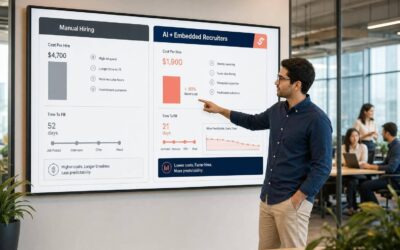
Scaling your hiring process isn’t just about adding more people to your team – it’s about building a system that keeps up with your company’s growth without sacrificing quality. When hiring breaks down, it wastes time, impacts team morale, and slows your business. The solution? A structured, data-driven process that delivers results while saving time and costs.
Key insights from our recruitment blog for scaling your hiring effectively:
- Structured processes save time: Companies with efficient hiring systems reduce time-to-offer by 24%.
- Automation is essential: AI tools and Applicant Tracking Systems (ATS) help manage high volumes, cutting manual tasks and improving efficiency.
- Data drives better decisions: Tracking metrics like time-to-fill, cost-per-hire, and retention rates helps pinpoint bottlenecks and improve outcomes.
- Candidate experience matters: 72% of candidates prefer structured screening, which also protects your employer brand.
The bottom line: A scalable hiring process isn’t about hiring faster – it’s about hiring smarter. By leveraging technology, tracking the right metrics, and aligning hiring with your growth goals, you can build a recruitment engine that supports your business now and in the future.
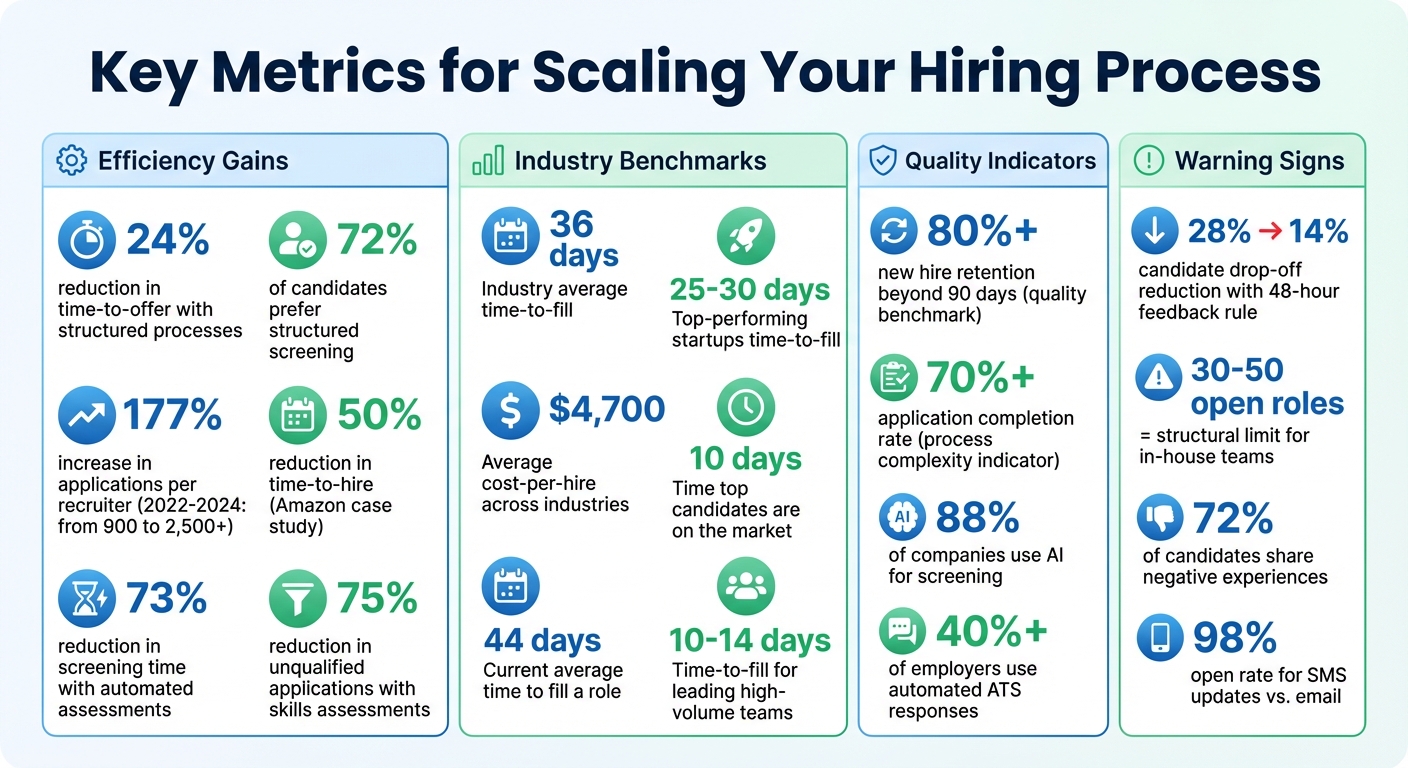
Key Metrics and Statistics for Scaling Your Hiring Process
The Science of Recruiting: Scaling Global Hiring with Data
sbb-itb-a23bd6a
Assessing Your Current Hiring Capacity
Before diving into scaling your hiring efforts, take a step back and assess where you currently stand. Skipping this step can lead to hasty decisions and misaligned solutions. As Dover puts it, "The difference between startups that scale and those that struggle often comes down to tracking the right hiring process data and acting on it consistently." [3]
Evaluating Recruitment Metrics
Start by analyzing the key metrics that define your hiring process. These include:
- Time-to-Fill: The time it takes from posting a job to offer acceptance. The industry average is 36 days, but top-performing startups hit 25–30 days. If you’re consistently taking 45 days or more, it’s a sign of inefficiency [3][6].
- Cost-per-Hire: This typically averages around $4,700 across industries [3].
- Source Effectiveness: Identify which recruitment channels are delivering your best candidates [3].
Speed isn’t the only factor – quality matters, too. For example, if fewer than 80% of new hires stay beyond 90 days, it could indicate poor fit or hiring missteps [4]. Another critical metric is the Pass-Through Rate at each stage. If only 3% of applicants make it to interviews, you might need to review 100 candidates to secure three strong interviewees [3].
Once you’ve gathered this data, it becomes easier to pinpoint specific areas where your process is breaking down or rate your recruitment process to identify gaps.
Identifying Process Bottlenecks
Your data can reveal where inefficiencies are hiding. Common issues include delays in feedback, prolonged interview scheduling, or disorganized candidate management. Silvia Rad of Growee highlights this perfectly: "If your hiring process still depends on ‘who remembers to follow up,’ you’re not hiring – you’re improvising."
Look at response times and how long candidates spend in each stage. For instance, implementing a 48-hour feedback rule can cut candidate drop-offs between late stages from 28% to 14% [2]. If less than 70% of applicants complete your application process, it might be unnecessarily complex [3]. Additionally, in-house teams often hit structural limits when managing more than 30–50 open roles at once [7].
Addressing these bottlenecks not only improves efficiency but also sets the stage for better forecasting.
Forecasting Future Talent Needs
With a clear understanding of your metrics and bottlenecks, you’re ready to plan for the future. Scaling isn’t just about meeting today’s hiring needs – it’s about preparing for what’s ahead. Mark Loughnane sums it up well: "Most hiring problems are planning problems." He adds, "The question is no longer ‘How many people do we need?’ – it’s ‘What capabilities must we build to win in the next 12–24 months?’"
Use historical data like turnover rates, past hiring trends, and seasonal fluctuations to create a flexible forecast. Instead of rigid annual headcount plans, aim for quarterly reviews to refine your assumptions as the business evolves [8][9]. Focus on identifying 5–7 key capabilities your team needs to grow rather than simply filling job titles. Before opening a role, ask yourself: if this hire were delayed by three months, what would break? If the answer is "nothing critical", you might be dealing with a structural issue rather than a genuine talent gap.
Using Technology to Scale Recruitment
Before you scale, it is vital to audit your current strategy. Once you’ve analyzed your hiring capacity, technology steps in as the ultimate multiplier. Between 2022 and 2024, the number of applications per recruiter surged by 177%, jumping from 900 to over 2,500 [12]. It’s clear that manual processes can’t keep up with this kind of growth. The most forward-thinking companies aren’t just hiring more recruiters – they’re turning to automation and AI to handle repetitive tasks. This shift allows their teams to focus on the bigger picture, addressing challenges like inconsistent feedback and scheduling delays that often derail unstructured hiring efforts.
Implementing Applicant Tracking Systems
An applicant tracking system (ATS) can replace the chaos of spreadsheets, scattered emails, and missed follow-ups. Over 40% of employers now use automated responses via their ATS to speed up hiring cycles [10]. These systems create a centralized hub where interviewers can easily access candidate notes, statuses, and feedback in one place [10][1].
Modern ATS platforms go beyond organization – they automate the heavy lifting. From posting jobs to 5,000+ job boards simultaneously to scheduling interviews and nudging interviewers for feedback, these tools streamline the entire process [11][10]. Some even use AI-driven screening and knockout questions to filter applicants, ensuring recruiters only engage with pre-qualified candidates at the interview stage [11]. This matters because top candidates are often off the market in just 10 days [13].
The results speak for themselves. Leading high-volume hiring teams report a 10–14 day time-to-fill window [11]. If you’re juggling 30 or more open roles, an ATS isn’t just helpful – it’s a necessity. Once automation is in place, the next step is leveraging data to make smarter hiring decisions.
Using Data to Improve Hiring Decisions
Technology delivers results only when you track and act on the right metrics. A good ATS should highlight pass-through rates at every stage, helping you spot where candidates are dropping out [1]. For instance, if few applicants make it to interviews, it may signal issues in your sourcing or screening process. Similarly, if less than 80% of new hires stay beyond 90 days, it’s a sign your screening may not be identifying the right fit [4].
The industry is shifting from intuition-based hiring to decisions backed by data. AI-powered tools now use context-aware matching to identify the best candidates from large applicant pools, moving beyond basic keyword filtering [12][11]. Structured digital scorecards standardize evaluations across interviewers, ensuring consistency [1]. Platforms like RecruitBPM even combine ATS and CRM functionalities for $89/month per user, making advanced capabilities accessible to smaller teams [11].
"The false choice between speed and quality disappears when you automate the right things." – RecruitBPM [11]
To refine your process, monitor metrics like your applicant-to-quality-interview ratio and time spent in each stage [11][1]. Use first-year retention rates to measure the quality of hires [11]. With these insights, you can move beyond guesswork and fine-tune your recruitment strategy for better outcomes.
Maintaining Candidate Experience During Rapid Growth
After streamlining recruitment with technology, keeping the candidate experience intact becomes critical for long-term success.
During rapid growth, the rush to hire can sometimes overshadow how candidates are treated. But here’s the thing: 72% of candidates who have a negative experience will share it with others [15]. That kind of feedback can hurt your employer brand and make future hiring even tougher. The good news? You don’t have to sacrifice speed for quality. The solution lies in building systems that are efficient yet personal.
Standardizing Interview and Onboarding Processes
Standardization isn’t about treating everyone the same – it’s about ensuring everyone receives the same quality of experience. Start by implementing structured interview kits with clear scorecards. Define 4–6 specific competencies before the job is even posted [1]. This approach ensures interviewers evaluate candidates consistently, avoiding the pitfalls of unstructured, "gut-feeling" hiring.
Amazon showcased the power of this method during their rapid expansion. Between 2020 and 2025, they processed over 75,000 applications per month while cutting their time-to-hire by 50% [14]. Their success wasn’t just about automation – it was about clearly defining what “qualified” meant and applying those standards across thousands of interviews.
For onboarding, automated portals can make a huge difference. Use tools that deliver personalized onboarding experiences with role-specific checklists and e-signatures [17][18]. This ensures professionalism, even when onboarding dozens of hires at once. Linq Consulting Solutions experienced this firsthand. In 2024, CEO Riah Gonzalez introduced automated video screening for recruiting Virtual Assistants in the Philippines. By offering candidates the option of traditional Zoom interviews or video assessments, they saw an immediate increase in applications and a significant reduction in manual interview hours [14].
"The biggest challenge has always been the man power hours to interview as many candidates as I’ve liked. We just wrapped our first full recruitment using Hirevire and it was a game changer." – Riah Gonzalez, Founder and CEO, Linq Consulting Solutions [14]
Once you’ve built a consistent process, the next step is finding the balance between speed and personalized candidate engagement.
Balancing Speed and Quality in High-Volume Hiring
To handle high volumes, automate the early stages and reserve human interaction for later. Start with automated screenings at the top of the funnel, then transition to personalized engagement for shortlisted candidates [15]. Skills assessments work well as an initial filter – they’re objective, scalable, and help cut through the flood of AI-generated resumes.
Currently, 88% of companies use AI for screening [16], and automated assessments can reduce screening time by 73%, while cutting unqualified applications by 75% [16]. The time saved here allows you to focus on giving top candidates the attention they deserve. For example, Dr. Barton Jennings, CEO of Air Secretary, used automated video interviews to screen medical secretary trainees for communication skills before in-person interviews. This approach saved significant time by filtering out unsuitable candidates early [14].
Transparency also plays a key role. Share salary ranges upfront and provide a clear hiring timeline [15]. With the average time to fill a role at 44 days [15], but top talent often off the market in days, candidates need to know where they stand. Use SMS for updates – it boasts a 98% open rate, far surpassing traditional email [14]. Frequent, even automated, communication can make candidates feel informed rather than forgotten.
These steps not only protect your employer brand but also help build a hiring framework that scales with your business growth.
Aligning Hiring with Business Growth Goals
Once your technology and processes are running smoothly, the next step is aligning recruitment with your business growth strategy.
Scaling recruitment isn’t just about filling roles – it’s about hiring smarter to fuel growth. The key difference between reactive and strategic hiring is alignment. When recruitment aligns with your growth roadmap, you avoid the panic of scrambling to fill critical roles at the last minute.
Start by syncing your hiring strategy with your market milestones. Focus on roles that directly impact revenue and delivery first – these are the positions that keep the business moving forward during expansion [8]. Leadership and support roles can follow once your core capacity is secure.
Forget the outdated approach of annual headcount plans. Instead, review your workforce plan every 90 days [8]. This lets you adjust priorities as market conditions change. By adopting this quarterly rhythm, you can challenge existing assumptions and re-prioritize based on what’s happening in real-time. As Mark Loughnane, Head of Rent a Recruiter, explains:
"Workforce planning for SMEs in 2026 requires adaptive, commercially aligned decision-making rather than static headcount plans" [8].
Embedding Recruitment Expertise
To keep up with rapid growth, your hiring strategy needs to be as agile as your business goals. When demand for talent spikes or becomes unpredictable, embedded recruitment expertise can make all the difference. Unlike traditional agencies, embedded recruiters integrate directly into your team – often in as little as 5 days [8]. They take ownership of the entire hiring process while aligning with your business priorities, not just filling vacancies.
Take MasterTech, for example – they achieved 29 successful placements and saved $123,000 over 27 months [8]. Similarly, Unique facilitated 291 interviews, resulting in 10 high-impact hires [8]. These results were possible because embedded recruiters understood both the business’s needs and the talent landscape.
In addition to embedded expertise, flexible staffing solutions can help bridge short-term gaps during periods of rapid growth.
Flexible Solutions for Workforce Expansion
A well-aligned hiring plan works best when paired with flexible staffing options. Not every hiring need requires a permanent employee. During growth phases, demand can fluctuate – sometimes you need to scale up quickly, other times you’re just plugging temporary gaps. Contract staffing offers a way to bring in skilled professionals without long-term commitments. This is especially useful for project-based work, seasonal spikes, or covering absences while searching for permanent hires.
For key strategic roles – like a VP of Sales or a Lead Engineer – one-off placements can provide targeted support. These hires demand more thorough vetting and a focus on long-term fit. The right recruitment partner will ensure candidates align with both your company’s culture and growth objectives.
Each hiring method serves a specific purpose. Embedded recruitment is ideal for ongoing, high-volume hiring. Contract staffing handles short-term needs. One-off placements are best for critical roles where quality matters most. By choosing the right approach for each situation, you can build a workforce that grows alongside your business, not against it.
Conclusion: Building a Scalable Hiring Process
Scaling your hiring process is about working smarter, not harder – moving away from chaotic, one-off methods toward structured systems that deliver measurable results. For instance, AI-powered screening tools can process candidates up to 4x faster[19], while structured role briefs reduce time-to-offer by 24%[1]. Beyond the numbers, this approach prevents burnout for your leadership team and ensures every hire drives growth from day one.
Start by auditing your current hiring metrics and identifying bottlenecks. Where do candidates drop off? Which tasks are eating up time unnecessarily? Introduce tools that automate repetitive work so your team can focus on connecting with top talent. Standardize interviews with scorecards that measure the skills and traits that matter most to your business. Finally, align your hiring roadmap with company milestones, reviewing it every 90 days instead of annually. These steps lay the groundwork for a scalable and efficient hiring strategy.
Key Takeaways
To recap, building a scalable hiring process boils down to three key principles:
- Assess your capacity honestly: Track metrics like time-to-fill, source-of-hire, and quality-of-hire to pinpoint bottlenecks early.
- Leverage technology wisely: Automate repetitive tasks like scheduling and initial screenings, while keeping human judgment for critical evaluations.
- Align hiring with business goals: Define success for every role in its first 90 days and create evaluation criteria that reflect those outcomes[1].
Companies that scale effectively don’t just hire more – they hire smarter and faster. Structured processes improve candidate experiences, with 72% of applicants reporting better interactions when these frameworks are in place[1]. Plus, avoiding a poor hire can save up to 30% of that employee’s first-year salary in wasted costs and time[5]. These principles are your blueprint for building a hiring process that supports growth.
Next Steps for Scaling Recruitment
Silvia Rad from Growee puts it best:
"If your hiring process still depends on ‘who remembers to follow up,’ you’re not hiring – you’re improvising."[1]
This underscores the need for a recruitment engine that runs smoothly without constant hands-on management. Whether you’re tackling high-volume hiring, filling short-term gaps with contract staff, or focusing on critical roles, the first step is understanding where you stand and where you want to go.
At Rent a Recruiter, we help scaling companies take control of their recruitment process in just five days. Our embedded recruiters integrate directly into your team, bringing structure, clarity, and consistency to your hiring efforts – all while saving over 80 hours of internal admin time every month. Whether you need embedded recruitment, contract staffing, or one-off placements, we’re here to support your growth. Start with a free Recruitment Health Check to see how your current process stacks up and identify areas for improvement.
FAQs
When should I implement an ATS?
You know it’s time to bring in an Applicant Tracking System (ATS) when your hiring process starts feeling messy or unmanageable. This often happens when you’re juggling multiple open roles, coordinating across several managers or teams, or dealing with delays and inconsistent hiring practices.
An ATS helps bring order to the chaos. It simplifies collaboration between teams, ensures evaluations are consistent, and takes care of repetitive tasks through automation. The result? A hiring process that’s not just more organized but also scalable as your business grows.
Which hiring metrics matter most as we scale?
When scaling, it’s critical to keep a close eye on metrics that track candidate progress through structured workflows. This includes using scorecards and maintaining calibrated interview standards to ensure consistency and fairness in evaluations.
Automation plays a big role, too. Metrics like scheduling efficiency, feedback collection rates, and stage triggers help pinpoint bottlenecks in your hiring pipeline. By focusing on these, you can create a smoother, more repeatable process that not only speeds up hiring but also preserves a positive candidate experience.
Ultimately, these metrics help you make faster, more informed decisions – exactly what’s needed during periods of rapid growth.
How do we hire fast without hurting candidate experience?
To hire efficiently without compromising the candidate experience, implement a structured workflow with clearly defined stages. Use automation tools to handle scheduling and communication, saving time and reducing manual errors. Keep feedback and candidate information centralized to ensure consistency across the process.
By using data-driven tools and structured evaluations, you can balance speed with quality, cutting down on delays and reducing candidate drop-offs. These approaches help streamline hiring, eliminate bottlenecks, and maintain fairness – even when scaling rapidly.