
If hiring sits with HR alone, you usually pay for it in delays, rework, and bad hires.
I’d frame it simply: if you want lower hiring cost, less time lost, and better control, build one hiring team across HR, hiring managers, and business leaders. For scaling companies, that means clear ownership, a set process, shared scorecards, fixed feedback timelines, and reporting that shows where hiring is slowing down. It also means knowing when to add embedded recruitment support instead of falling back on high-fee agency spend.
Here’s the short version:
- Set a hiring charter with targets for time-to-hire, cost-per-hire, and offer acceptance
- Assign one owner per stage so approvals and decisions do not drift
- Use structured intake and scorecards to cut poor-fit hiring
- Track six core metrics to spot delay, spend, and process gaps
- Add extra recruiter capacity when volume jumps, instead of overloading managers
A few numbers make the case clear:
- Small businesses in the US take about 49 days to fill a role
- Median time-to-hire is about 35 days
- Average cost-per-hire is about $4,700
- Bad hires can cost about 30% of first-year salary
- Embedded recruitment can cut hiring costs by up to 70% against agency fees and save 80+ hours per month in internal admin
If you are hiring across SaaS, IT, fintech, engineering, security, insurance, or professional services, this is the model I’d use to make hiring more predictable as the business grows.
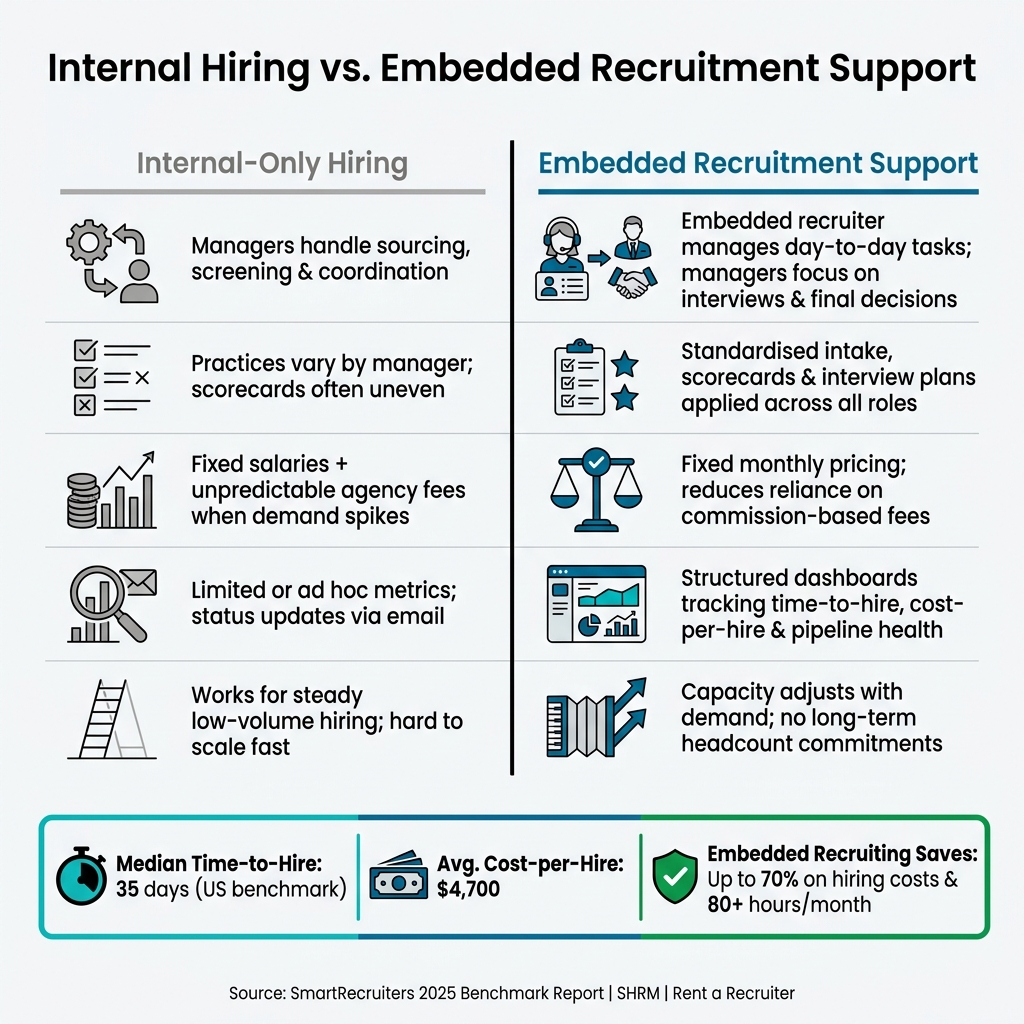
Internal Hiring vs. Embedded Recruitment: Cost, Speed & Efficiency Compared
Mastering Cross-Functional Collaboration: Proven Strategies for Team Success
sbb-itb-a23bd6a
1. Define the team’s purpose, scope, and hiring goals
Set the team’s purpose before you assign people to it. If you skip that step, stakeholders tend to pull in different directions, and hiring slows down fast. Once that shared ownership is in place, turn it into a clear charter and measurable hiring goals.
Set a clear charter for the hiring team
A one-page charter works well here. It should spell out why the team exists, which roles it covers, who owns each decision, and how success will be tracked.
Include:
- The business problem
- Role scope
- Decision owners
- Key stakeholders
- Quarterly hiring targets and deadlines
- Metrics
U.S. benchmarks give you a useful baseline. SmartRecruiters‘ 2025 benchmark report puts median time-to-hire at 35 days and offer acceptance at 79% [2]. SHRM-related summaries put average cost-per-hire at about $4,700 [1].
From there, set targets that fit your roles and market. For example:
- Time-to-hire: 40 days or less
- Cost-per-hire: $6,000 or less
- Offer acceptance: 85% or more
Clear decision rights matter just as much as the targets. If the hiring manager owns the final hire decision, the VP approves headcount, and HR signs off on offer terms, approvals move faster and you cut out confusion.
Once scope and success measures are clear, the team can shift from planning into execution.
Tie recruitment goals to business priorities
Turn business priorities into headcount plans and hiring dates. If a product launch depends on two mobile engineers being ramped up by a set date, that deadline should drive the hiring timeline. That makes hiring a business delivery issue, not just an HR task.
Each planned hire should link back to a specific business driver so prioritization stays objective [3][4].
With hiring demand tied to business priorities, the team can assign owners and run the process the same way every time. Once purpose and goals are set, assign owners for each stage of hiring.
2. Choose the right stakeholders and assign clear responsibilities
Once your hiring goals link back to business priorities, the next step is simple: decide who owns what. Use the charter from Section 1 to assign each role and each decision.
Build a hiring squad with the right mix of expertise
A typical U.S. SME hiring team has four core roles: recruiter, hiring manager, functional interviewers, and HR/People Ops. The recruiter runs sourcing, screening, and scheduling. The hiring manager owns the final hiring decision. Functional interviewers assess role-specific skills. HR/People Ops manages compensation and compliance.
For most roles, use 3 to 4 interviewers. Fewer can leave gaps. More tends to slow scheduling, drag out debriefs, and add friction you do not need. Give each interviewer one clear focus area, such as technical depth, cross-functional collaboration, or stakeholder management. Pair that with a structured scorecard so the panel stays focused and useful. [7][8]
If your internal recruiting team is stretched, Rent a Recruiter can place recruiters inside your team to run hiring end-to-end.
Map ownership across every stage of hiring
Map each hiring stage to one owner.
The table below shows typical ownership across a U.S. SME hiring team.
| Hiring Stage | Recruiter (TA) | Hiring Manager | Functional Interviewers | HR / People Ops | Department Leadership |
|---|---|---|---|---|---|
| Requisition Approval | Provides market input on role and pay | Defines role need; drafts business case | N/A | Validates policy alignment | Approves headcount and budget |
| Job Description | Drafts using templates and market data | Finalizes requirements and outcomes | Reviews for technical accuracy | Checks for inclusive and compliant language | Approves for strategic fit |
| Sourcing Strategy | Owns channels, outreach, and pipeline | Aligns on target profile | Provides referrals and niche input | N/A | N/A |
| Candidate Screening | Runs resume review and phone screens | Confirms must-haves vs. nice-to-haves | None, unless a technical screen is required | Ensures fair and consistent criteria | N/A |
| Interviews | Schedules; briefs panel; manages logistics | Participates; assesses role fit | Conducts structured functional interviews | Ensures process consistency and legality | Joins for senior hires |
| Debrief & Decision | Facilitates debrief; documents outcomes | Makes final hire/no-hire decision | Provides structured ratings and feedback | Validates decision against policy | Approves senior or strategic hires |
| Offer & Closing | Presents offer; manages candidate experience | Aligns on compensation within bands | N/A | Owns offer letter, compensation, and compliance | Approves exceptions to standard bands |
This kind of ownership map helps you spot bottlenecks fast. Add time-based service levels beside it, like interview feedback due within 24 hours and offer approval within 2 business days. That keeps the process tight and gives you something clear to escalate when a stage stalls. [5][6]
Once ownership is set, standardize intake, scorecards, and interview flow so the team can run the same process every time.
3. Build a structured process the team can run consistently
Once ownership is clear, you need a process the team can follow the same way every time. That means standardising intake, interviews, and feedback so hiring does not drift from one manager to the next.
Standardize intake, scorecards, and interview plans
Every hire should begin with a short intake meeting before sourcing starts. Bring in the hiring manager, recruiter, and one or two key stakeholders. Use that time to agree on the business problem the role solves, what success looks like in the job, and the split between must-haves and nice-to-haves.
Must-haves are non-negotiable. These usually include required experience level, work authorisation, and location or time zone limits. You should also agree compensation bands in USD at this stage, for example, $80,000 to $95,000 base, so you do not hit late-stage misalignment that slows the process or kills offer acceptance.
Nice-to-haves sit in a different bucket. That could be a certain sector background, an extra certification, or experience with a specific tool. Useful, yes. Deal-breakers, no.
From that intake, build a scorecard with 4 to 6 core competencies linked straight to the must-have criteria. Keep the scoring simple with a 1 to 5 scale, add behavioural anchors for each level, and leave space for factual evidence, specific quotes, examples, or outcomes from the interview, not vague gut feel. Give each interviewer one or two competencies to assess so feedback adds up instead of repeating the same points. Ask interviewers to complete scorecards on their own before the debrief. That keeps the discussion evidence-led and cuts down groupthink.[9][10][11]
Use simple communication rules to avoid delays
Run a 30 to 45 minute weekly hiring sync with the hiring manager, recruiter, and any stakeholders who need to be involved. Review pipeline status, blockers, and upcoming interviews. If your team is split across Eastern and Pacific Time, a midday Eastern slot tends to work well. 1:00 PM ET / 10:00 AM PT usually keeps both coasts in a workable window.
Set a fixed feedback SLA and stick to it:
- Within 24 hours for screening interviews
- Within 24 to 48 hours for panel or final rounds[12]
Once feedback slips past 72 hours, it is often too late to shape the outcome.[13] Good people move on. Interviewers forget details. Momentum drops.
Keep notes, scorecards, and hiring decisions in one shared system, not across email chains or personal spreadsheets. When everyone is working from the same record, the hiring manager and recruiter can review feedback fast and make decisions without chasing updates.
With timing locked in, the next step is picking a panel setup that suits the role.
Choose an interview panel design that fits the role
Your panel format should fit the job, not the other way around. Choose it based on role complexity, how much cross-team work the hire will do, and how fast you need to move.
A single-day mixed-function panel works well for collaborative senior roles. A multi-stage function-specific panel makes more sense for highly technical roles.
For most positions, cap the full process at 3 to 4 interview interactions. Go beyond that and you increase candidate drop-off and interviewer fatigue, without adding much to the final decision.[14][15][16]
After the process is standardised, track whether it is improving speed, consistency, and decision quality.
4. Scale the model with data, process visibility, and embedded support
Track the metrics that show whether the team is working
Once intake, scorecards, and interviews are standardised, the next job is simple: check if the system is doing what you need it to do.
That means building a monthly dashboard around six metrics: time-to-hire, cost-per-hire, interview-to-offer rate, offer acceptance rate, hiring manager satisfaction, and hours saved per month.
Each one points to a different problem.
- Time-to-hire shows where approvals, scheduling, or handoffs get stuck.
- Cost-per-hire in USD keeps budget planning grounded in actual spend.
- Interview-to-offer rate shows whether screening is filtering well.
- Offer acceptance rate highlights pay, package, or candidate experience issues.
- Hiring manager satisfaction, tracked with a short 5-point survey after each hire, picks up issues the numbers won’t.
- Hours saved per month ties process changes back to team output and admin time saved.
Review the dashboard monthly to fix short-term issues. Review it quarterly to spot bigger process changes worth making.
Keep the data in one shared place. Update it weekly through the recruiter or HR lead. That way, review meetings stay about decisions, not chasing numbers.
Add embedded recruitment capacity when internal teams are stretched
If your dashboard shows longer delays, more pressure on hiring managers, or less consistency across roles, the issue usually isn’t process. It’s capacity.
This tends to show up after funding, a product launch, or market expansion, when hiring demand jumps and the internal team can’t absorb the load without something slipping.
That’s when embedded recruitment support starts to make commercial sense. Rent a Recruiter places experienced recruiters directly into your hiring structure. They work inside your team, handle sourcing and screening, and report through your existing hiring dashboard.
The business case is pretty clear. Companies typically cut hiring costs by up to 70% compared with commission-based models, while saving more than 80 hours per month in internal hiring and admin time.
Internal-only hiring versus embedded recruitment support
| Dimension | Internal-only hiring | Embedded recruitment support |
|---|---|---|
| Internal workload | Managers handle sourcing, screening, and coordination. | Embedded recruiter manages day-to-day hiring tasks; managers focus on interviews and final decisions. |
| Process consistency | Practices vary by manager; scorecards and documentation often uneven. | Standardised intake, scorecards, and interview plans applied across roles. |
| Cost predictability | Fixed internal salaries, plus variable agency fees when demand spikes. | Fixed monthly pricing cuts reliance on unpredictable commission-based fees. |
| Reporting visibility | Limited or ad hoc metrics; status updates via email or meetings. | Structured dashboards and regular reporting on time-to-hire, cost-per-hire, and pipeline health. |
| Scalability | Works well for steady, low-volume hiring; harder to scale fast without adding permanent headcount. | Capacity adjusts with demand, supporting growth without long-term headcount commitments. |
Use these signals to decide whether you need to tighten the model, or add support.
Conclusion: Put a cross-functional hiring model in place and improve results
Once your hiring model is in place, consistency is what drives the return.
Cross-functional recruitment works when four things are clear: purpose, ownership, process, and scale. If one of those is missing, hiring slows down, costs creep up, and internal teams spend more time firefighting than hiring.
A structured hiring model helps you shorten hiring cycles, cut cost per hire, and reduce admin work. It also gives your team a clearer way to make decisions, so hiring doesn’t stall every time volume picks up.
When hiring demand grows faster than your internal bandwidth, embedded support helps keep the model on track. If hiring spikes, embedded recruiters can add capacity fast while keeping your process controlled and your team aligned.
Start here. Map your current hiring process against this framework, spot the bottlenecks, and book a call with Rent a Recruiter if you need help scaling it.
FAQs
Who should be on a hiring team?
A strong hiring team runs on clear ownership, not job titles on an org chart.
Start by mapping the key steps from requisition through to onboarding. Then give one owner to each step. That’s what keeps hiring moving and stops work from falling between teams.
Most hiring setups include the hiring manager, recruiter, sourcer, coordinator, talent lead, HR/People Ops, and RecOps.
As you scale, add support where the process is slowing down. If admin is piling up, bring in a coordinator. If pipeline is weak, add a sourcer.
That way, you’re not adding headcount for the sake of it. You’re fixing the bottlenecks that slow hiring, waste time, and drag out time-to-fill.
How do we avoid hiring delays?
Avoid hiring delays by moving away from informal, ad hoc hiring and into a structured process with clear ownership.
Start with a 45-minute intake meeting before sourcing begins. Use that time to line up on role outcomes, salary, and who has decision authority. That one step can save you weeks of back-and-forth later.
From there, make ownership explicit at every stage. Each part of the process should have one person responsible, not a vague group. If everyone owns it, no one owns it.
A simple structure looks like this:
- Assign one owner to each hiring stage
- Require interview feedback within 24 to 48 hours
- Set SLAs for handoffs between stages
- Track bottlenecks like time-in-stage and aging requisitions
This gives you more than a cleaner process. It cuts wasted time, reduces drift, and helps you spot where hiring is slowing down before roles sit open for too long.
When should we add embedded recruiters?
Consider adding an embedded recruiter when hiring demand starts to outpace your internal team’s capacity, or when a sudden hiring spike puts pressure on delivery.
You’ll usually see the signs early. Process discipline slips. Feedback slows down. Hiring speed drops. And when that happens, the cost isn’t just operational. Open roles stay open longer, managers lose time, and growth starts to stall.
An embedded recruiter gives you a practical bridge during rapid scaling. You get experienced hiring support inside your team while you decide which permanent talent acquisition roles make sense to build for the long term.
Rent a Recruiter can embed experienced recruiters into your team within days.