
If you are scaling and still paying per-placement agency fees, your hiring model may be costing you far more than it should.
I see the gap in three places: direct spend, time-to-fill, and internal time lost to admin. In the U.S., average cost-per-hire sits at $5,475 for non-executive roles, agency fees often land at 15% to 25% of salary, and open roles can cost tens of thousands while they sit unfilled. By contrast, tech-led hiring and embedded recruitment shift you to fixed monthly cost, better pipeline view, and lower cost per hire as volume grows.
If you want the short version, here it is:
- Agency-led hiring is often fine for low volume or one-off specialist searches.
- Recruitment tech cuts admin, shortens time-to-hire, and gives you live reporting.
- Embedded recruitment adds recruiter capacity and process ownership, without per-hire commission fees.
- Once hiring becomes repeatable, fixed-fee models usually beat agency fees on cost and control.
- If you want to pressure-test your numbers, use this ROI calculator.
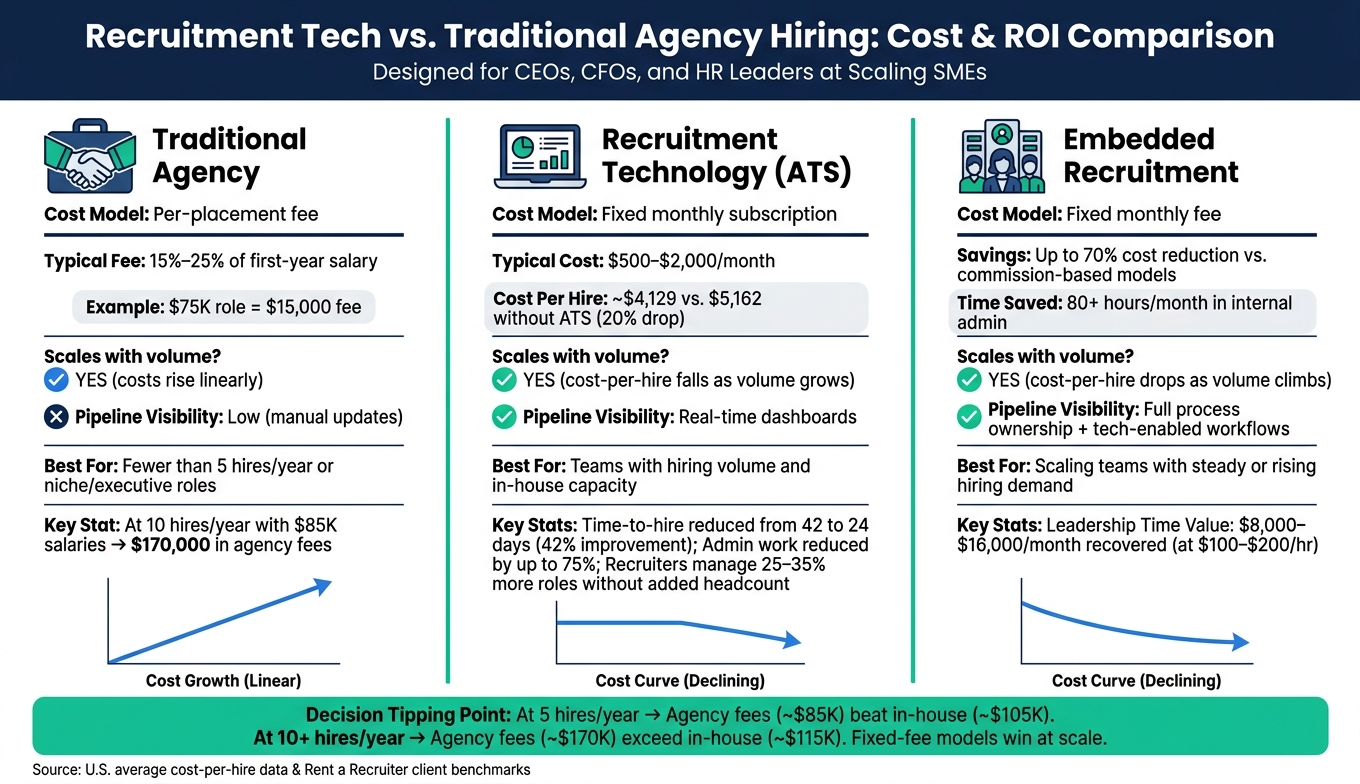
Recruitment Tech vs. Traditional Agency Hiring: Cost & ROI Comparison
The Hidden Costs of In-House Recruitment vs Agency Staffing | Save Time, Money & Hiring Mistakes
sbb-itb-a23bd6a
Quick Comparison
| Model | Cost model | Best fit | Main trade-off |
|---|---|---|---|
| Recruitment tech | Monthly software spend plus internal team time | Teams with hiring volume and in-house capacity | Tools alone do not run the process |
| Traditional agency | Fee per hire, often 15% to 25% of salary | Low-volume or niche hiring | Cost climbs with every hire |
| Embedded recruitment | Fixed monthly fee | Scaling teams that need delivery and visibility | Best when hiring demand is steady or rising |
I will break down where the money goes, when each model makes sense, and what that means for hiring cost, speed, and control.
Recruitment Technology vs. Traditional Hiring: What Each Model Includes
Before you compare different recruitment models and their costs, you need a clear view of what each actually includes.
One runs on software and automation. The other leans on manual coordination and agency support. That gap affects cost, speed, and visibility across the whole hiring process.
How Recruitment Technology Works in a Growing SME
Recruitment technology brings your hiring process into one system. For a growing SME, that usually starts with an ATS, a platform that keeps applications, hiring stages, and role data in one place.
Most modern ATS platforms now do much more than simple applicant tracking. They often include screening tools, workflow automation, job posting, sourcing support, and reporting dashboards. For hiring managers and HR leaders, that means live visibility into time-to-hire, cost-per-hire, and funnel conversion rates.[4][5]
That matters because the impact shows up in the numbers.
ATS implementation has been shown to cut average time-to-hire from about 45 days to 28 days, which is roughly a 38% improvement. Recruiters can also manage 25% to 35% more open roles without adding headcount.[4]
For a scaling business, that’s where the value starts to show. The same team can handle more hiring demand, with less admin drag and tighter control over process. Once hiring volume climbs, that shifts the cost model in your favour.
What Drives Costs in Manual and Agency-Led Hiring
Most SMEs without recruitment technology still run hiring through spreadsheets, inboxes, and shared calendars. It works, up to a point. Then the cracks show.
Without one shared system, recruiters and hiring teams spend more time chasing feedback, updating candidate status, and moving information from one tool to another. That manual effort adds up fast. You can rate your recruitment process to see where these manual bottlenecks are costing you most.
The bigger cost issue is agency spend.
In the U.S., recruitment agencies usually charge 15% to 25% of a candidate’s first-year base salary for a successful placement, with 20% a common benchmark for professional roles.[2][3][7][8] For senior or hard-to-fill roles, fees can move up to 25% to 35%.[2][7][8]
That means costs rise with every hire. As salaries go up, fees go up. As hiring volume grows, spend climbs with it.
Here’s the commercial difference in plain terms:
| Cost Driver | Recruitment Technology | Traditional / Agency-Led |
|---|---|---|
| Primary cost structure | Fixed subscription + internal recruiter time | Per-placement fee (% of salary) |
| Typical U.S. fee range | Predictable monthly spend | 15–25% of first-year base salary [2][3][7][8] |
| Scales with hiring volume? | Cost-per-hire falls as volume grows | Cost grows linearly with each placement |
| Pipeline visibility | Real-time dashboards and reporting | Manual updates; low visibility |
| Process consistency | Standardized workflows and templates | Varies by manager and agency |
Cost Comparison: Where Recruitment Technology and Manual Hiring Spend Differ
Here’s what those cost differences look like in practice.
Direct Costs: Fees, Tools, and Internal Team Time
Manual hiring stacks up costs in ways that often stay hidden until you total them. Take one $75,000 role filled through a commission-based agency. At a 20% fee, you’re already at $15,000. Add the usual extras, and direct spend climbs to $17,600.[9]
And that’s just one hire.
Keep moving at that rate, and direct spend can clear $100,000 in a single quarter.
Recruitment technology changes the maths. ATS subscriptions usually cost $500 to $2,000 per month, whether you hire one person or ten. The spend stays flat as volume grows. Teams using a modern ATS spend about $4,129 per hire compared with $5,162 without one, which is close to a 20% drop.[10]
That gap gets more important when hiring ramps up.
Embedded recruitment shifts the model again. Instead of paying per placement, you pay a set monthly fee for pipeline management and end-to-end hiring. Clients working with Rent a Recruiter often cut hiring costs by up to 70% and save more than 80 hours a month in internal hiring and admin time.
That’s not just a recruitment saving. It’s time your leadership team gets back.
The bigger cost, though, often comes from roles staying open for too long.
Hidden Costs: Vacancy Delays and Process Gaps
Direct spend is only one side of the picture. The cost of an open role is often higher than the cost of filling it.
For a sales or customer-facing role bringing in $500,000 in annual revenue, the lost output works out at about $2,000 per working day.[12] Leave that role vacant for 90 days, and the missed revenue chance can hit $180,000.[12]
That kind of delay hurts fast-growing teams. Targets slip. Managers get pulled into hiring admin. Revenue plans start to wobble.
Manual, disconnected hiring processes are a clear cause. Without one system to manage the process, screening slows, feedback gets buried in email threads, and good candidates drop out while waiting. Recruitment technology cuts that risk by putting communication in one place, automating scheduling, and showing bottlenecks early. The result is shorter time-to-fill, lower cost per hire, and more control over outcomes.
That total cost gap is what shapes ROI when hiring volume starts to climb.
ROI and Efficiency: Which Model Performs Better as Hiring Volume Grows
Cost per hire is only one part of ROI. Speed, team workload, process control, and pipeline quality shape the return as hiring volume grows. And those results look very different depending on the model you use.
When Recruitment Technology Delivers the Best ROI
Recruitment technology tends to perform best in repeated, high-volume hiring across multiple teams. The logic is simple: once you build the workflows, templates, and systems for one search, you can use them again and again.
The data supports that. One analysis found that modern recruitment technology reduced time-to-hire from 42 to 24 days, a 42% improvement, and lowered cost per hire by 37%, saving about $2,800 per role.[6] As hiring volume grows, those savings can stack up fast.
At that point, the main issue is consistency. Can your process keep producing those savings at scale? ATS workflow automation can reduce admin work by up to 75%, giving back as much as 24 hours per recruiter per week.[13][14][11] For HR leaders and hiring managers, that recovered time has a clear dollar value. It is far better spent on late-stage assessment and onboarding than on scheduling, follow-ups, and manual process work.
Centralised pipelines, shared dashboards, and standardised interview kits also give leadership a clearer view of every open role. You can see bottlenecks, shift recruiter capacity between teams, and cut duplicate sourcing before it eats into cost and time.
Still, there is a limit. When internal capacity is stretched, software on its own will not deliver the full return.
How Embedded Recruitment Adds More Value
Technology works best when someone owns the process. If your team does not have the bandwidth to run it well, tools get underused and ROI drops. That is where embedded recruitment comes in.
Rent a Recruiter places experienced recruiters inside your team, often within days, to manage hiring end to end using structured, tech-enabled workflows. Instead of paying a commission fee on every hire, you pay a fixed monthly fee, which means cost per hire drops as hiring volume climbs.[1]
Clients typically cut hiring costs by up to 70% compared with commission-based models and save more than 80 hours per month in internal hiring and admin time.[1] If leadership time is worth $100 to $200 per hour, that equates to $8,000 to $16,000 per month in recovered time before you even factor in fee savings.[1]
This matters most when hiring demand shifts month to month or sits across several teams. In those cases, process ownership, recruiter capacity, and cost control matter just as much as the software itself.
How to Choose the Right Hiring Model for Your Growth Plan
Once you’ve compared cost and ROI, the next step is simpler: pick the model that matches your hiring plan.
That means matching your approach to three things: how much you’re hiring, what kinds of roles you need to fill, and how much internal hiring capacity you actually have.
A Decision Framework for CEOs, CFOs, and HR Leaders
Start with four concrete inputs: hiring volume, role complexity, internal capacity, and current agency spend and dependence.
First, quantify your projected hires per quarter over the next 12 to 24 months. This is where the numbers start to tell a very clear story.
At 5 hires per year, with $85,000 salaries and a 20% agency fee, agencies cost about $85,000 in total. An in-house recruiter comes in at about $105,000, so at low volume, agencies are often the cheaper option. But at 10 hires per year, the maths flips. Agency fees climb to $170,000, while in-house cost stays near $115,000.[15]
That’s the tipping point. Once hiring becomes repeatable, fixed-fee, on-demand, and embedded recruitment models usually beat commission-based hiring on cost.
Next, map role complexity.
Repeatable roles like sales development reps, customer success managers, or software engineers at standard seniority levels tend to work best with structured, tech-enabled pipelines. These are the roles where process matters, speed matters, and consistency matters.
Highly specialised or executive hires are different. In those cases, targeted search support can still make sense as a supplement, rather than your default hiring model.
You should also factor in urgency. If hiring is tied to a product launch, a funding milestone, or another growth deadline, you need a model that gives you better pipeline visibility and helps cut time-to-fill. When deadlines are tight, poor visibility costs money fast.
Then look at internal capacity honestly. Not what should be available, but what actually is.
Count the recruiting hours your HR team and hiring managers can give each week. Review your annual agency spend. Look at your cost per hire. If your team is stretched thin and agency use keeps creeping up, that’s usually a sign your current setup isn’t built for the hiring load ahead.
Use the table below to turn those inputs into a hiring decision.
| Scenario | Recommended Model |
|---|---|
| Fewer than 5 hires/year, varied roles | Traditional agency for occasional searches |
| 10+ hires/quarter, repeatable roles, limited internal team | Recruitment tech + embedded recruiters |
| Niche executive or specialist hire | Targeted search as a supplement |
Conclusion: Lower Cost, Faster Hiring, Better Control
The right model is the one that protects margin, speed, and control as hiring demand grows.
For most scaling U.S. SMEs, technology-led and embedded models beat traditional agency hiring on cost, speed, and visibility once hiring volume reaches a meaningful level. You get more ownership of the process, stronger in-team capacity, and a setup that commission-based hiring struggles to support at scale.
If you want to benchmark your current model, book a call with Rent a Recruiter.
FAQs
When should we stop using agency fees?
Consider moving away from agency fees when hiring stops being occasional and starts becoming a pattern.
If you’re hiring again and again, pushing past 10 hires a year, or ramping up after funding, a product launch, or a sudden hiring spike, the old agency model can get expensive fast. What looks manageable for one or two roles often turns into a serious cost line once hiring volume picks up.
Commission-based agencies also make budgeting harder. Fees usually sit between 15% and 30% of a role’s first-year base salary, which means your costs can swing sharply from one hire to the next.
An embedded recruitment model gives you a fixed-fee setup instead. That brings more control over spend, with the potential to cut hiring costs by up to 70% and save more than 80 hours of internal admin time each month.
For CEOs, CFOs, and talent leaders, that shift isn’t just about paying less. It’s about getting a hiring model that’s easier to plan, easier to scale, and less likely to blow up your budget when growth kicks in.
Is an ATS enough without recruiter support?
An ATS can make hiring far more efficient by automating work like CV screening and interview scheduling. In many teams, that cuts admin time by 35% to 55% per hire.
That said, it is not a full replacement for recruiter support.
Software can move tasks along. It cannot handle the parts of hiring that need judgment. Things like stakeholder alignment, team fit, and offer negotiation still depend on human input. That matters even more when you’re hiring into key roles across SaaS, Technology, IT, Fintech, Engineering, Security, Insurance, or Professional Services.
There’s also a risk here. If your hiring process is weak or biased, an ATS can push that process through at scale. In other words, it can help you do the wrong thing faster.
For scaling companies, the best setup is often a hybrid model. Let the ATS handle repeatable admin. Let recruiters handle decision-making, alignment, and the parts of hiring that affect speed, cost, and quality most.
How do we calculate hiring ROI?
Use this formula: ROI = (Total Benefits – Total Costs) ÷ Total Costs.
Start with a baseline for cost-per-hire, time-to-fill, and internal admin hours. That gives you a clean before-and-after view, so you can see what hiring is costing you now and what changes over time.
Then add up your full hiring spend, not just the obvious line items. Include recruiter salaries, agency fees, job board costs, recruitment software, onboarding, manager interview time, vacancy drag, and tool inefficiencies. If you skip those hidden costs, the ROI picture gets distorted fast.
Track performance over a fixed period, usually 6 to 12 months. That time frame gives you enough data to judge cost savings, time saved, and hiring output without making decisions on a short-term spike or dip.