When your startup secures funding, hiring becomes a race against time and budget. You need the right talent quickly, but traditional tech recruitment options can drain resources fast. Commission-based agencies charge 20–30% of a hire’s salary, while in-house teams cost over $100,000 annually. For scaling companies, these costs can spiral out of control.
Embedded recruitment offers a smarter solution. With fixed monthly fees starting at $2,500, you can save up to 70% compared to agencies, while filling roles faster and building a hiring process that scales with your growth.
Key Takeaways:
- In-house recruiting: High control but costly and slow during hiring surges. Best for 15+ hires annually.
- Recruitment agencies: Fast for urgent roles but expensive, with fees that grow per hire.
- Embedded recruiters: Fixed costs, faster hiring, and scalable for 2–8 roles in 6 months.
If you’re hiring multiple roles after a funding round, embedded recruitment offers the best balance of cost, speed, and process control. Rent a Recruiter can help cut hiring costs while freeing up your team to focus on growth.
Inside the Hiring Playbook of Top-Performing Startups
sbb-itb-a23bd6a
1. In-House Recruiting
Building an internal recruiting team gives you full control over your hiring process. However, the costs add up quickly. An in-house recruiter typically earns between $50,000 and $80,000 annually, and that’s just their salary [2]. When you factor in tools like LinkedIn Recruiter (over $10,000 per year) and an Applicant Tracking System (between $3,000 and $10,000 annually), your total fixed costs climb to $63,000–$100,000+ per year [2].
Cost per Hire
This approach only becomes cost-effective if you’re hiring at scale. As Ray Gibson, Founder of Funded.club, puts it:
"Hiring an in-house recruiter costs $50,000-$80,000/year in salary alone, plus tools… That makes sense when you’re hiring 15+ people per year" [2].
For smaller hiring needs, such as 3–8 roles, these fixed costs can feel like a heavy burden.
Time-to-Fill
Internal recruiters often fill roles in about 20 days when working on a few positions. But during high-volume hiring phases, that timeline can stretch to 60 days or more. For example, a Series A fintech startup faced delays with their in-house team but managed to fill 11 roles in under 90 days by bringing in external support [1] [5]. Specialized roles, like machine learning engineers or cloud architects, can be particularly challenging for in-house teams due to limited networks in these areas [1].
Scalability
The capacity of in-house teams is limited. On average, one recruiter can manage 20–30 open roles at a time [5]. This setup works well for companies hiring 50+ people annually at a steady pace [4]. However, it becomes a bottleneck during rapid growth, such as after securing funding, when hiring needs surge unexpectedly.
Process Control
One of the biggest advantages of in-house recruiting is the ability to maintain institutional knowledge, quality standards, and alignment with your company’s values [3] [5]. Internal recruiters understand your mission, technical requirements, and what sets a top-tier candidate apart – like distinguishing a seasoned React developer from a coding bootcamp graduate [6]. This deep connection to your business often leads to better long-term hires. However, it requires time and resources to build a talent pipeline instead of just reacting to immediate vacancies [1].
Next, we’ll look at how recruitment agencies measure up in terms of speed and cost-effectiveness, or how embedded recruitment benefits compare for growing teams.
2. Recruitment Agencies
Recruitment agencies operate on a pay-for-performance basis, charging contingency fees of 15%-25% and retained fees of 25%-35% for senior roles [3][6][7]. For instance, hiring a senior developer with a salary of $140,000 could result in direct fees ranging from $21,000 to $49,000 per hire [3].
Cost per Hire
When you’re scaling a team, these costs can escalate rapidly. Hiring eight senior developers in a year through contingency agencies could mean spending around $224,000 on fees alone [3]. Beyond the financial impact, founders also lose time briefing recruiters and reviewing candidates [3]. Joel Carias, Founder & CEO of Alivio Search Partners, captures this challenge:
"Agencies optimize for speed and their commission, not your brand." [7]
Time-to-Fill
For companies prioritizing rapid hiring, especially after securing funding, agencies can deliver speed when it’s most critical. Specialized tech-focused agencies often present candidates within a week for common tech stacks and within two to three weeks for niche roles like machine learning engineers. Time-to-fill averages three to five weeks for mid-level positions and eight to twelve weeks for executive roles [6].
Take this example: in 2025, a Series A fintech client partnered with KORE1 after a national agency failed to deliver hires over two months. By narrowing the focus to specific stack requirements (TypeScript/Next.js) instead of broad enterprise backgrounds, KORE1 successfully placed two engineers in just three weeks [6].
Scalability
Agencies are highly effective for urgent or hard-to-fill technical roles [1]. However, scaling through this model becomes expensive, as every new hire incurs another fee [1][3]. Additionally, once a position is filled, startups lose access to the candidate pipeline, along with valuable insights and relationships that could benefit future hiring efforts [7][8]. Another drawback: agency-sourced candidates tend to have a lower offer acceptance rate – 68% compared to 82% for candidates sourced internally [7].
Process Control
A key limitation with agencies is the lack of transparency in the recruitment process, which can lead to misalignment with your company’s culture and long-term hiring goals [3]. To address this, negotiate a 90-day guarantee period and include specific service-level agreements in your contract, such as a 14-day target for the first slate of candidates and 48-hour feedback timelines [6][8]. Also, avoid engaging multiple contingency firms for the same role, as this can lead to rushed, low-quality sourcing driven by competition rather than precision [6][8].
This analysis sets the groundwork for considering embedded recruitment services as a more controlled and cost-effective alternative.
3. Embedded Recruiters
After weighing the pros and cons of in-house and agency recruitment models, embedded recruitment stands out as a flexible, cost-effective option tailored to businesses with changing hiring needs.
Embedded recruiters work on a subscription-based model with fixed monthly fees, typically ranging from $2,500 to $4,500 depending on your hiring volume [3]. This setup offers predictable costs, unlike traditional agencies. What sets embedded recruiters apart is their integration into your team – they attend internal meetings, use your tools, and immerse themselves in your company’s operations and values [10].
Cost per Hire
The financial benefits of embedded recruitment are clear, especially for scaling companies. For example, making eight senior hires over 12 months costs around $54,000 with a Recruitment-as-a-Service model. Compare that to $224,000 or $336,000 you’d spend with contingency or retained agencies, respectively [3]. Traditional recruitment models charge fees per hire, but with embedded recruitment, the fixed monthly rate covers all hiring needs. This eliminates unpredictable per-hire fees, making budgeting far simpler.
Scalability
One of the key advantages of embedded recruitment is its adaptability to fluctuating hiring demands. As The Nudge Group explains:
"If you need to hire fifteen engineers this quarter but only three next quarter, an embedded partner scales their resources to match your exact pipeline." [10]
This approach prevents the fixed overhead costs of a full-time recruiter – typically $50,000 to $80,000 annually, plus over $13,000 in tools [2]. It also ensures you can scale up hiring quickly when growth accelerates. Providers like Rent a Recruiter can embed experienced recruiters into your team within days, cutting costs by up to 70% compared to commission-based models. Beyond flexibility, embedded recruiters also enhance the overall hiring process.
Process Control
Embedded recruiters don’t just address cost and speed; they overhaul the recruitment process itself. Unlike agencies that focus on filling roles quickly to earn commissions, embedded recruiters build structured, repeatable hiring processes [9]. They define clear role outcomes, standardize interviews, and align stakeholders on evaluation criteria. This approach improves decision-making and ensures consistency across multiple hires. As Olga Fedoseeva, Founder of UnitiQ, puts it:
"The real question is not simply ‘Who can help us hire?’ The real question is: ‘Which hiring model helps us build the right team for execution?’" [9]
This integration provides transparency into your hiring pipeline and ensures candidates experience an authentic representation of your brand. Data shows that 67% of candidates placed through structured, fixed-fee recruitment models remain in their roles after 24 months [2], highlighting how process control leads to better long-term retention.
Advantages and Drawbacks of Each Approach
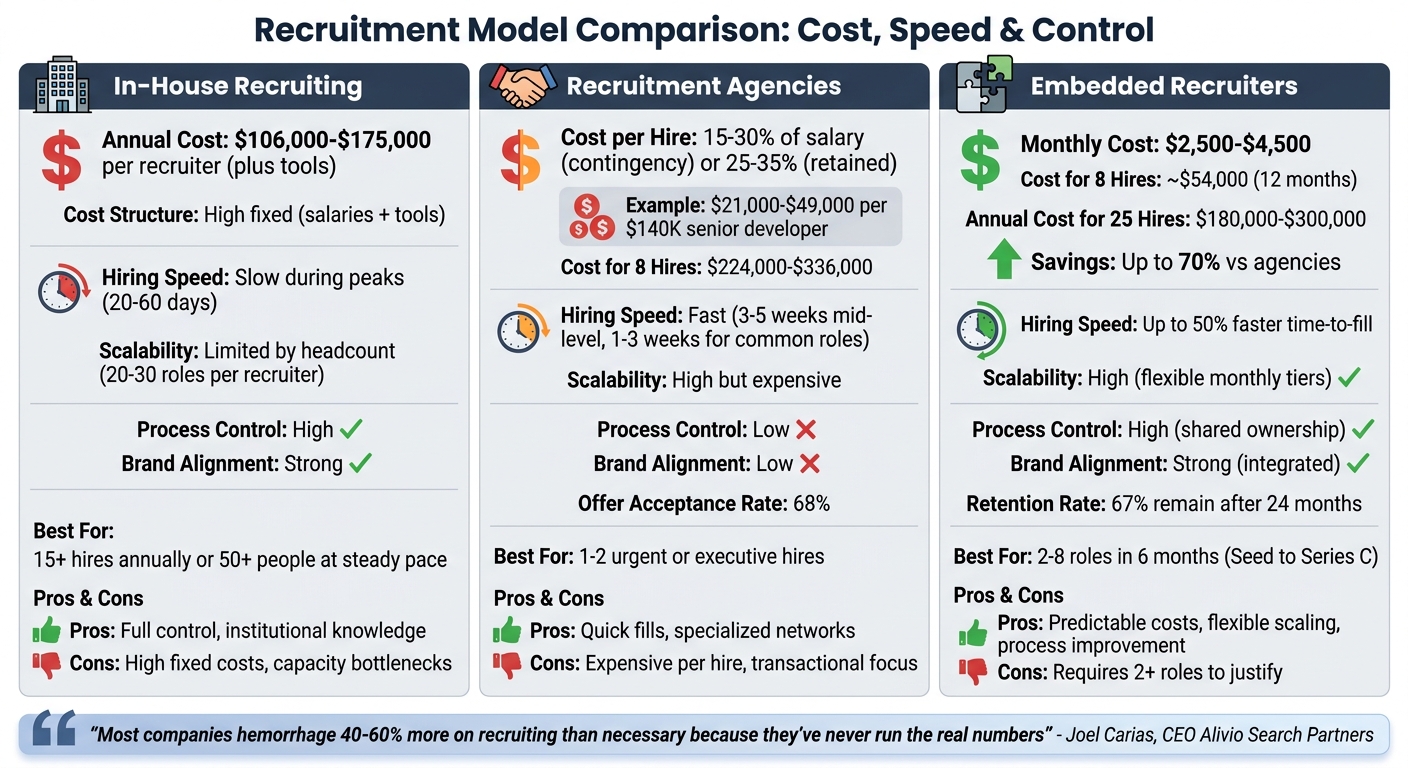
Cost Comparison of Recruitment Models for Tech Startups
Let’s break down the pros and cons of different recruitment models, focusing on how they impact costs, speed, and control. These factors are critical when aligning your hiring strategy with your startup’s growth phase.
In-house recruiting gives you control over your brand and culture but comes with steep fixed costs. Expect to spend between $106,000 and $175,000 annually per recruiter, plus additional costs for tools [7]. While this model works well for steady hiring, it can falter during busy periods, as your team’s capacity is capped by headcount.
Recruitment agencies excel at filling urgent or highly specialized roles quickly. However, the costs can balloon fast, with contingency fees typically ranging from 15% to 25% per hire [7][3]. There’s also a downside to candidate engagement – agency-sourced candidates accept offers at a lower rate (68%) compared to those sourced internally (82%) [7].
Embedded recruiters offer a middle ground with predictable costs and improved process control. Monthly fees range from $2,500 to $4,500 [3], and companies can cut hiring costs by as much as 70% compared to commission-based options. For example, an embedded recruiter model might cost $180,000 to $300,000 annually for 25 hires – less than half the expense of using agencies [7]. This approach also adapts to your hiring needs, reducing time-to-fill by up to 50% [11].
Here’s a quick comparison of the key factors across these models:
| Factor | In-House Recruiting | Recruitment Agencies | Embedded Recruiters |
|---|---|---|---|
| Cost Structure | High fixed (salaries + tools) | High variable (15–30% per hire) | Predictable monthly flat fee |
| Hiring Speed | Slow during peaks | Fast for one-offs | Up to 50% faster time-to-fill |
| Scalability | Limited by headcount | High (but costly) | High (flexible monthly tiers) |
| Process Control | High | Low (transactional focus) | High (shared ownership) |
| Brand Alignment | Strong | Low | Strong (integrated into team) |
Joel Carias, Founder & CEO of Alivio Search Partners, highlights the financial pitfalls many companies face:
"Most companies hemorrhage 40–60% more on recruiting than necessary because they’ve never run the real numbers" [7].
The real cost isn’t just in fees. Delays in hiring can have a ripple effect on your business. For instance, a four-week delay in hiring a revenue-generating role like an Account Executive could cost your company around $60,000 in lost pipeline [7]. Understanding these hidden costs helps you choose the right recruitment model for scaling after securing funding.
Conclusion
Choosing the right recruitment model comes down to your hiring needs and how much control you want over costs. If your startup only needs one or two urgent hires a year – particularly for executive roles – traditional recruitment agencies might still be the quickest option. However, their fees, which typically range from 20% to 30% of a candidate’s first-year salary, can add up fast.
When your hiring needs go beyond a handful of roles, embedded recruitment becomes a smarter choice. For example, if your company has recently closed a Seed to Series C funding round and needs to hire 2 to 8 people within six months, embedded recruiters offer a more affordable option. With monthly rates between $2,500 and $4,500 [3], you could spend around $54,000 to hire eight senior developers. Compare that to the $224,000 you’d likely pay using contingency agencies [3]. Plus, embedded recruiters bring added value with services like employer branding and improving your hiring processes – areas where traditional agencies often fall short.
In-house recruitment, on the other hand, only makes sense when you’re hiring at least 15 roles per year. At that scale, the fixed costs of maintaining an internal team can be spread across a larger hiring volume, making it more cost-efficient.
To figure out the best approach, start by assessing your hiring speed and volume or rating your recruitment process for gaps. If you’re planning to fill more than two technical roles in the next six months, it may be time to move away from costly agency fees. An embedded recruiter offers a fixed monthly fee, giving you better budget predictability while freeing up your founders from recruitment tasks. They’ll handle everything from sourcing to onboarding, saving your team valuable time.
For startups looking to control costs while scaling their hiring, Rent a Recruiter provides embedded recruitment solutions that can cut expenses by up to 70% compared to commission-based agencies. On top of that, you’ll reclaim over 80 hours per month in hiring admin, letting you focus on growing your business.
FAQs
How do I know if embedded recruiting fits my hiring plan?
Embedded recruiting works best for companies seeking scalable, consistent hiring support that seamlessly integrates into their team. By aligning with your business strategy, understanding your product, and engaging in daily operations, an embedded recruiter becomes a true extension of your company.
If your hiring demands are steady, you prioritize control over the candidate experience, and you’re focused on building long-term talent pipelines, this approach is a perfect match. However, for one-off or highly specialized roles, other recruitment solutions may be more suitable.
What does an embedded recruiter actually do day to day?
An embedded recruiter becomes a true part of your team, managing the hiring process from start to finish. They handle everything from sourcing top candidates and pre-screening them to scheduling interviews and coordinating offers. What sets them apart from agency recruiters is their deep integration into your business. They attend your meetings, immerse themselves in your company culture, and adjust to your evolving hiring needs.
This close collaboration not only speeds up the hiring process but also ensures your recruitment efforts align perfectly with your goals. The result? Faster hiring, lower costs, and the support you need to scale your business efficiently.
What should I track to prove hiring ROI after funding?
To showcase hiring ROI after securing funding, focus on metrics that directly tie recruitment to business growth and efficiency. Start with time-to-fill positions, cost-per-hire, and quality of hires – measured through factors like performance, retention rates, and key milestone achievements. Additionally, track vacancy days reduction and how it impacts revenue generation or delays in product delivery. These data points clearly connect your hiring efforts to measurable business outcomes.