
If payroll takes up 60% to 80% of your burn, a weak hiring plan can shorten runway fast.
I’d boil this down to one point: headcount forecasting is not about filling seats, it is about tying each hire to revenue, product delivery, service levels, and cash control. When I forecast well, I can plan hiring dates, loaded cost, ramp time, and recruiting capacity before delays turn into missed targets or extra spend.
Here’s the article in plain terms:
- Start with business goals, not job titles
- Rank roles by impact on revenue, delivery, or customer support
- Model full cost, not just salary, usually 1.25x to 1.50x base pay
- Add hiring lead time, often 54 days average time-to-fill plus a 60 to 90-day buffer
- Add ramp time, often 3 to 4 months before full output
- Review forecast vs actuals every month and quarter
- Check recruiting capacity, because a plan only works if hiring can keep pace
A simple rule runs through the whole piece: hire for usable capacity, not start dates on a spreadsheet. If you need someone productive by Q3, you often need to open that role months earlier. The article then shows how to turn that logic into a cost model, scenario plan, and review cycle that helps leaders make better hiring calls.
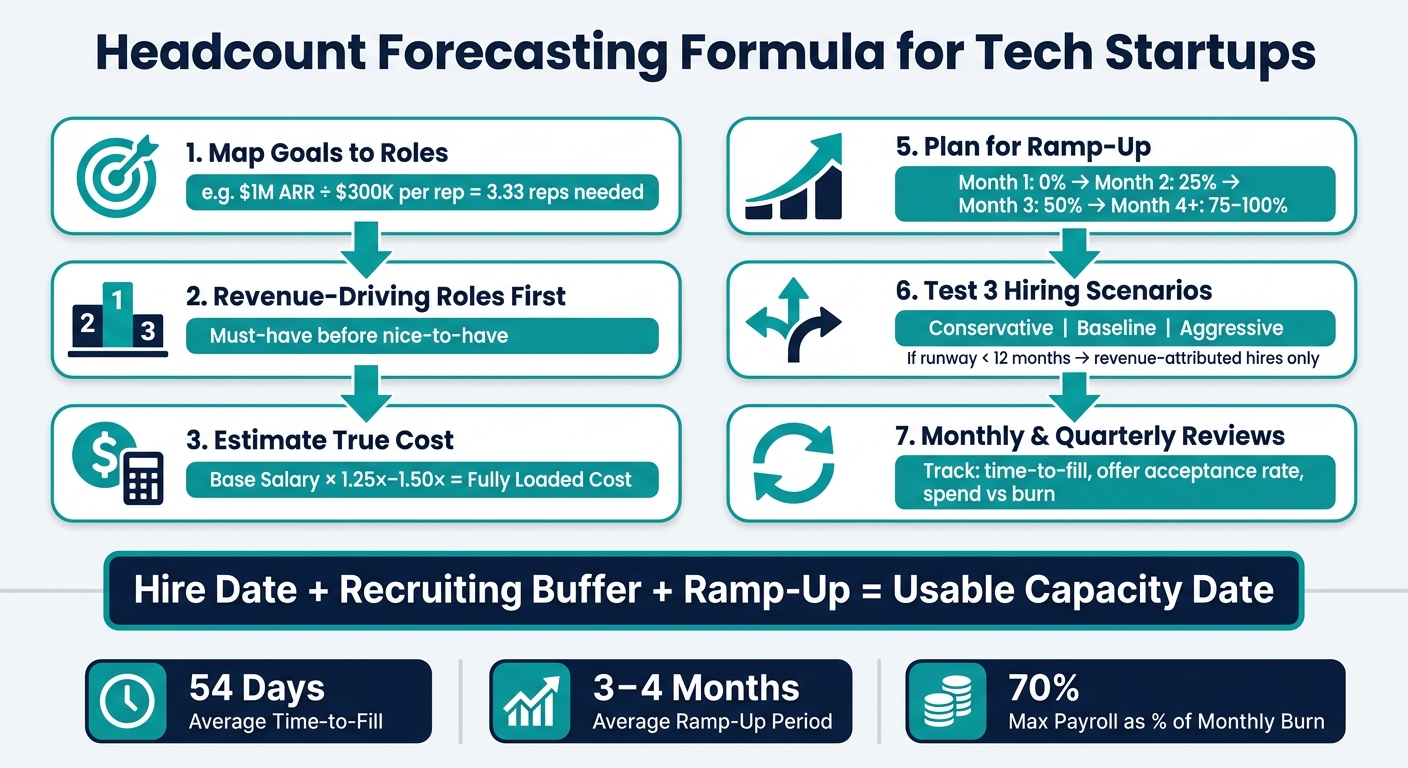
Headcount Forecasting Formula for Tech Startups
Turn business goals into role priorities
Map product, revenue, and service goals to departments
Start with the business goal, then work backward to the team and role that makes it happen.
If your target is $1 million ARR and each salesperson brings in $300,000 in ARR, you need about 3.33 reps [1]. That gives you a planning baseline, not a guess.
The same logic applies outside sales. If a product launch is tied to growth, your engineering hires need to land well before that date. You have to allow time for recruiting, onboarding, and ramp-up [1]. Hire too late, and the launch timeline starts to slip.
Once each goal is linked to a team, rank roles by business impact. That helps you focus hiring spend where it moves revenue, delivery, or service outcomes first.
Prioritize must-have roles before nice-to-have hires
Not every role should sit in the next hiring cycle.
Put revenue-driving and revenue-protecting roles ahead of expansion hires or extra management layers [3]. That keeps your hiring plan tied to output, not org chart ambition.
Before you open a req, pressure-test it:
What outcome does this role unlock, and what fails if you delay it by three months? [3]
That question cuts through vague demand fast. If the answer is unclear, the role may not belong in the current plan.
Use that priority order to size each function based on capacity assumptions, not headcount guesses.
Use capacity assumptions instead of job-title lists
A hire is not the same as output. One person on paper does not mean one full unit of delivery. Actual capacity depends on proficiency, ramp-up time, tool enablement, and workload swings [7].
| Role Category | Capacity Assumption Metric | Example Driver |
|---|---|---|
| Sales | Revenue per rep | $300K ARR per salesperson [1] |
| Engineering | Roadmap milestone | Launching Beta by Month X [1] |
| Operations | Management span | Span of control [3] |
Ramp-up matters too. A slow ramp is the safer planning model: 0% in month 1, 25% in month 2, 50% in month 3, and 75% to 100% from month 4 [5].
If you need full capacity for a launch, the hire should be planned 2 to 3 months before that milestone, so recruiting and onboarding stay ahead of demand [1]. That protects delivery timelines and helps you avoid last-minute hiring pressure.
sbb-itb-a23bd6a
Build a simple headcount and cost model
Track hiring timing, salary, and fully loaded cost
Once you know which roles come first, put them into a simple model that shows cost, timing, and runway impact in one place. Start with a spreadsheet. It’s often the fastest way to get a clean view of what you can afford and when.
Track each role’s department, priority, target start date, hiring owner, base salary, and fully loaded cost in the same sheet. Multiply base salary by 1.25x to 1.50x to estimate fully loaded cost [1][4]. That gives you a plan you can use for hiring decisions and cash flow planning, not just headcount tracking.
Payroll should generally stay below 70% of your monthly burn [1]. That leaves room for software, infrastructure, and other operating costs. If payroll starts eating too much of your burn, runway can disappear faster than expected.
Model baseline, conservative, and aggressive hiring scenarios
Use the same spreadsheet to test how hiring pace affects runway. Build three scenarios [4]:
- Conservative: critical roles only
- Baseline: core team hires
- Aggressive: rapid scale
Set clear rules for each one. For example, if runway falls below 12 months, only approve hires with direct revenue attribution [4].
This matters because hiring plans often look fine at a high level, then fall apart when timing shifts by a quarter or salary bands move up. Scenario planning helps you see that early, before costs stack up.
Factor in time-to-hire and ramp-up time
Next, turn your hiring assumptions into actual delivery dates.
Average time-to-fill is 54 days, and technical roles often take longer [2]. Add a 60 to 90-day recruiting buffer between the decision to hire and the expected start date [4]. If you skip this step, your plan can look on track on paper while the business misses launch dates in practice.
Then add 3 to 4 months before each new hire reaches full productivity [1][4]. Not every role ramps at the same pace, but you still need that buffer in the model.
Use one formula across every row: hire date + recruiting buffer + ramp-up = usable capacity date. That’s the date that matters for delivery planning.
If a developer needs to contribute to a beta launch in month 6, sourcing should begin in month 3 at the latest. Add that lead time to every row so your hiring plan reflects when people will actually start moving work forward.
How to Build a Headcount Plan to Hit Revenue Targets
Keep the forecast accurate with a regular review process
A headcount forecast should be treated as a rolling plan, not a document you build once and forget. Hiring demand shifts. Funding changes. Teams miss milestones or hit them early. Your forecast needs to move with that.
Once the hiring model is in place, tie it back to actual hiring pace and actual spend. That’s how you keep decisions grounded in what’s happening now, not what looked right three months ago.
Review forecast versus actuals every month and quarter
The most practical setup is a monthly and quarterly review cycle.
Monthly reviews should focus on what’s happening on the ground: open roles, hiring progress, spend against burn, and leading signals like sales pipeline and service volumes [7][5].
Quarterly reviews should go a level deeper. Recheck assumptions. Re-sequence roles based on product milestones or funding updates. Bring in founders, Finance, HR, recruiting, and department leads so everyone is working from the same picture [3][2].
If you’re 60% through your runway but only 40% toward your next milestone, don’t wait for the next quarter. Use the monthly review to freeze or cut headcount straight away [1].
Measure recruiting capacity and funnel health
The forecast only works if recruiting can fill roles when the business needs them. So you need to track the metrics that show whether hiring is on pace, and where delays are starting to build.
In most teams, the first warning signs show up in funnel health.
| Metric | What It Tells You |
|---|---|
| Time-to-fill | Whether recruiting speed matches your plan, with an average benchmark of about 54 days [2] |
| Resume-to-interview ratio | Whether sourcing is generating qualified candidates |
| Interview-to-offer conversion | Where candidates are dropping out of the process |
| Offer acceptance rate | Whether candidates are accepting the final offer |
| Hiring manager responsiveness | Whether internal delays are slowing the funnel down |
Weak funnel metrics are often the earliest sign that the forecast is about to miss. If offer acceptance rates drop or time-to-fill starts slipping, adjust the plan early. Waiting usually costs more, both in delayed hiring and wasted budget.
Compare predicted demand with actual hiring, and budget with actual spend, for each role. Then track forecast error over time [7][4]. That gives Finance and recruiting a clear view of whether assumptions around time-to-hire, ramp-up, and salary still hold up, and where they need to be tightened.
Execute the plan with scalable recruitment support
A headcount forecast only works if your hiring team can deliver on time. Once the forecast is locked in, the next issue is simple: do you have enough recruiting capacity to execute it?
When embedded recruitment support helps a startup hit hiring targets
Use embedded recruitment support when hiring demand jumps after funding, a product launch, or a growth push, and your internal team can’t keep up. It works best when hiring demand is uneven or hard to predict, when leadership time is getting pulled into hiring admin, or when hiring delays are starting to hit revenue or delivery timelines [3].
This is the key point: you do not need more planning. You need enough recruiting power to deliver the plan you already have.
How Rent a Recruiter supports forecast delivery
Rent a Recruiter places experienced recruiters directly into your team, often within 5 days, and manages hiring end-to-end, from sourcing through to offer. That gives you more structure, more visibility, and a clearer view of where every role stands.
An embedded recruiter works inside your process, so founders and hiring managers spend less time chasing updates and more time making decisions. The model uses fixed monthly pricing and can cut hiring costs by up to 70% [3]. For a startup where headcount already makes up 60% to 80% of early-stage burn [6], that kind of cost control can have a direct effect on runway.
Conclusion: Build a forecast, review it often, and align hiring capacity to growth
When recruiting capacity matches the forecast, hiring stays tied to growth. Build the plan, review it often, adjust when needed, and keep execution moving.
If you need extra hiring capacity during a funding round or product launch, Rent a Recruiter can embed recruiters within days and help keep the forecast on track.
FAQs
How far ahead should we plan hires?
Use a rolling 12-month forecast instead of a fixed annual plan. Review it every quarter so hiring stays tied to what’s happening in the business, like revenue targets and product roadmaps.
That gives you room to adjust before hiring slips off course. If growth slows, you can pull back. If demand picks up, you can move sooner without scrambling.
Plan hiring across three timeframes:
- 0 to 90 days for immediate needs
- 90 days to 12 months for near-term team growth
- 12 to 36 months for longer-range headcount planning
One more point matters here: start hiring 2 to 3 months before someone needs to be fully productive. That time covers search, interviews, notice periods, onboarding, and ramp-up.
If you wait until the role feels urgent, you’re already late. And late hiring usually means lost time, extra pressure on your team, or missed revenue.
What should be included in fully loaded headcount cost?
Fully loaded headcount cost is more than salary alone.
A common benchmark is 1.25 to 1.50 times base salary. That usually includes employer payroll taxes, benefits, office space, equipment, and software.
For international hires, the cost is often higher. Use 1.3 to 1.6 times base salary to account for extra spend like visa sponsorship, foreign employer social contributions, and added accounting complexity.
If you leave these costs out of your model, your hiring plan can look cheaper than it is. That creates risk for burn rate and runway planning.
Build these figures into your financial model from the start so you can track headcount cost with more accuracy and make better hiring decisions.
When should a startup add recruiting support?
Add recruiting support when your internal hiring capacity can’t keep up with business growth, or when hiring starts pulling leadership away from core priorities.
It’s also the right move when hiring demand is uneven, candidate quality is inconsistent, or open roles are slowing revenue and delivery. embedded recruiting support gives you flexible capacity and a more structured process, so you can stay ahead of hiring instead of reacting to it.