
We recommend starting with one niche hiring channel, then testing it for 2 to 4 weeks against qualified candidates, screening hours, and cost. For specialised roles, a focused audience can mean less time reviewing unsuitable applications, but a smaller pool does not guarantee better hires.
We use three channel types for different needs:
- Specialist job boards and association networks to reach people with relevant skills or industry experience.
- Professional communities to build relationships with hard-to-reach specialists.
- Portfolio networks to find relevant work before starting a conversation.
The next step is to apply the same assessment criteria across channels and track hiring outcomes, not application volume. <u>Check team capacity before adding more sourcing</u>: if screening or decisions are delayed, more applicants will not solve the problem. You can rate your recruitment process to identify where these bottlenecks occur.
This guide sets out how we choose channels, plan outreach, measure hiring costs, and decide when embedded recruitment can help keep searches moving.
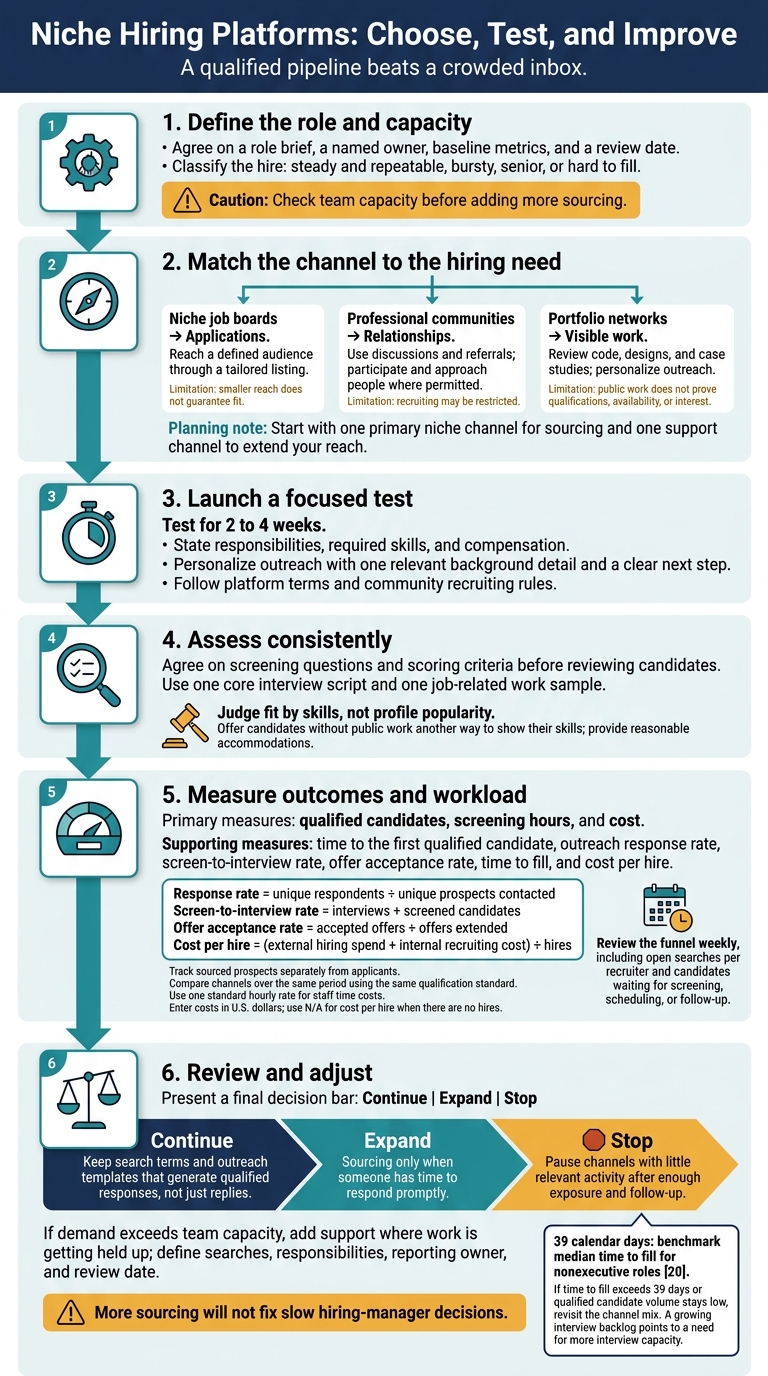
Niche Hiring Platforms: Choose, Test, and Improve
Secret Job Boards You NEED to Know About To Get Hired Faster
sbb-itb-a23bd6a
Types of Niche Hiring Channels
Job advertising brings in applications. Relationship-based sourcing starts conversations. Portfolio networks help you find relevant public work before someone applies. These functions overlap, but knowing what each channel does helps you choose where to spend your sourcing time.
Specialist Job Boards and Association Networks
Specialist boards focus on an industry, role, company type, professional association, or work arrangement.
Wellfound targets startup and tech hiring.[1] The IEEE Job Site reaches engineering and tech candidates and includes a resume database.[2]
Membership gives you context, not proof of qualifications. Remote-work boards group candidates by work arrangement, not by a single skill set.
Before you pay for a posting, check audience activity, role fit, geography, fees, posting rules, candidate search access, and ATS connections. For remote roles, check that the audience matches your state restrictions and time-zone requirements. A specialist audience does not guarantee suitable applicants. For growing companies, talent acquisition services can help bridge the gap between posting and hiring.
Technical and Portfolio Communities
GitHub exposes repositories, documentation, and examples of technical collaboration; Behance exposes creative portfolios and project descriptions.
Public work can show relevance, but it does not prove qualifications or interest. Check the person’s contribution, how recent the work is, and how closely it matches your role. Volume and polish alone should not determine candidate rankings.
Reddit and Discord support specialist discussions and referrals rather than automatic access to job seekers.
Check platform terms and each community’s rules before participating as a recruiter, posting jobs, or sending direct messages. Use designated hiring spaces where permitted. Avoid scraping usernames or sending bulk outreach, and put interested people through the same assessment process as other applicants.
Compare Channels by Hiring Need
Match the channel to what you need: applications, relationships, or visible work.
| Channel type | Purpose | Discovery signal | Suitable roles | Sourcing approach | Main limitation |
|---|---|---|---|---|---|
| Niche job boards | Reach a defined audience | Specialized experience and professional context | Technical, industry-specific, startup, or remote roles | Publish a tailored listing | Smaller reach does not guarantee fit |
| Professional communities | Build relationships | Discussions and referrals | Hard-to-reach specialists | Participate and approach people where permitted | Recruiting may be restricted |
| Portfolio networks | Discover relevant work | Code, designs, and case studies | Software, data, design, and creative roles | Review work and personalize outreach | Public work does not prove qualifications, availability, or interest |
A focused board may cut screening time but take longer to deliver a qualified candidate. Community sourcing takes time to build relationships. Portfolio discovery takes time to verify work.
Track time to the first qualified candidate and screening hours, using the same qualification criteria across channels. Record outreach responses separately from applications so you can compare results without mixing different measures.
Choose Channels and Plan Your Sourcing
Turn your channel choice into talent acquisition strategies and a sourcing plan that fits the role and your hiring workload.
Match Channels to Role Requirements
Use role intake to classify the hire: steady and repeatable, bursty, senior, or hard to fill. Before committing, check search access, data handling, and total cost.
Start with one primary niche channel for sourcing and one support channel to extend your reach. Add Recruitment as a Service only during hiring spikes.[3]
Write Clear Job Posts and Personal Outreach
State responsibilities, required skills, and compensation. Check applicable U.S. pay-transparency rules before publishing.[3] Explain what “fast-moving” means for the role: changing priorities, limited support, or responsibility for building processes.
Make outreach personal and direct. Reference one relevant detail from the candidate’s background and state the next step.
Then apply the same review standard to every candidate.
Assess Candidates With Consistent Criteria
Agree on screening questions and scoring criteria before reviewing candidates. Use one core interview script and one job-related work sample to keep assessments consistent.
| Evidence type | What it can establish | What still needs assessment |
|---|---|---|
| Relevant public project | A reason to assess a possible skills match | Individual contribution and ability to perform required tasks |
| Community discussion or referral | Relevant professional context | Qualifications, interest, and role fit |
| Structured screening | Whether answers meet agreed requirements | Deeper skills and performance on relevant tasks |
| Work sample and structured interview | Performance against defined, job-related criteria | Areas the exercise or interview did not test |
Judge fit by skills, not profile popularity. Do not penalize candidates who have no public work. Offer another way to show their skills and provide reasonable accommodations.
Send privacy and automated-screening tools through legal review before use. Automated matches are not hiring decisions.[3]
Measure Results and Plan Recruiting Capacity
Once your channels are live, measure which ones produce qualified hires, not just activity. This helps you direct recruiting time and budget towards channels that deliver.
Track Hiring Conversions, Time, and Costs
Use the same funnel for every channel: outreach response rate, qualified candidates, screen-to-interview rate, offer acceptance rate, time to fill, and cost per hire.
Track sourced prospects separately from applicants. Compare channels over the same period, apply the same qualification standard, and allow time for responses.
- Response rate = unique respondents ÷ unique prospects contacted.
- Screen-to-interview rate = interviews ÷ screened candidates.
- Offer acceptance rate = accepted offers ÷ offers extended.
Measure time to fill consistently across searches. The benchmark median for nonexecutive roles is 39 calendar days [3].
Calculate cost per hire as (external hiring spend + internal recruiting cost) ÷ hires. Use one standard hourly rate to calculate staff time costs.
Template only. Enter costs in U.S. dollars; use N/A for cost per hire when there are no hires.
| Channel | Period | External spend ($) | Internal recruiting cost ($) | Qualified candidates | Interviews | Hires | Time to fill (days) | Cost per hire ($) |
|---|---|---|---|---|---|---|---|---|
| Specialist job board | ||||||||
| Association network | ||||||||
| Technical community |
Review Channel Results and Team Workload
Use your funnel report to identify whether channel quality or team capacity is slowing hiring.
Assign one person to maintain the report and an owner for each search. Review the funnel weekly, checking open searches per recruiter and candidates waiting for screening, scheduling, or follow-up.
If time to fill exceeds 39 days or qualified candidate volume stays low, revisit your channel mix [3]. A growing interview backlog points to a need for more interview capacity.
Keep search terms and outreach templates that generate qualified responses, not just replies. Pause channels with little relevant activity after enough exposure and follow-up. Expand sourcing only when someone has time to respond promptly.
Add Embedded Recruiters During Hiring Spikes
When hiring demand outpaces your team’s capacity, add support where work is getting held up, before delays build. More sourcing will not fix slow hiring-manager decisions.
For any added support, define the searches, responsibilities, reporting owner, and review date.
Rent a Recruiter places recruiters inside your team on a fixed monthly model, adding hiring capacity during funding rounds, product launches, or other demand spikes.
Assess the engagement using the same measures above: internal hours saved, qualified candidates, hiring time, and total cost. Hire count alone does not show how much time or money the support saves.
Conclusion: Start With a Focused Hiring Plan
After comparing channels, focus on one role and one clear sourcing path. Define the role, then choose the narrowest niche channel that fits. A qualified pipeline beats a crowded inbox.
Set a Role, Owner, and Review Date
Before launching, agree on a role brief, one primary channel, a named owner, baseline metrics, and a review date. Put these in place before expanding.
Track response and acceptance rates, time to fill, hiring costs, recruiting hours, and workload. At the review, use those results to decide whether to continue, expand, or stop using the channel.
If hiring demand exceeds your internal capacity, add embedded recruiter support to keep searches moving.
FAQs
How can I test niche hiring with a small budget?
Focus your spend with the 2-Channel Rule: choose two high-performing platforms that match your priority roles. Before committing budget, define success metrics, such as cost per hire or application volume, and cap the test at 90 days.
Use low-cost tools to automate admin and save your team time. Search by skills and domain signals, not just job titles, to find people who match your hiring needs.
Review ROI quarterly and move 10% to 20% of your budget to the best-performing channels.
What if my niche channel attracts too few candidates?
Start by checking whether the problem is message quality or sourcing capacity. Specialized communities often produce fewer candidates, so focus on quality rather than volume.
Fewer than three viable candidates per opening signals a need for more active sourcing. Before dropping the channel, personalize your outreach and improve your job descriptions.
If your team lacks capacity, Rent a Recruiter can embed experienced recruiters to handle sourcing and end-to-end hiring.
How can I reach specialists without public portfolios?
Look beyond standard job boards to communities where specialists spend their time, including GitHub, Stack Overflow, Kaggle, industry forums, and trade associations. These channels can help you reach passive candidates who are active in their field but may not have a standard LinkedIn presence.
Use context-aware semantic search to find people by their skills, code contributions, or published research, rather than relying on keywords or job titles alone. Personalize your outreach by referencing their work and explaining what you offer, so they have a clear reason to respond.