
Hiring after funding is a make-or-break moment for startups. With investor pressure to show results, scaling teams quickly becomes a priority. But rushing to hire without a plan can lead to costly mistakes, mismatched roles, and a bloated payroll.
To avoid these pitfalls, successful startups focus on three key areas:
- Align hiring with business goals: Tie every role to measurable outcomes like revenue targets or product milestones.
- Streamline recruitment processes: Standardize job descriptions, interview frameworks, and success metrics to save time and reduce errors.
- Control costs with flexible models: Embedded recruitment cuts costs by up to 70% compared to traditional agencies while ensuring consistent hiring.
Scaling hiring doesn’t mean hiring fast; it means hiring right. This guide outlines practical strategies to build a recruitment process that supports growth without breaking your budget. If recruitment is taking up too much of your time, Rent a Recruiter can embed experienced recruiters into your team within days, saving you time and cutting costs.
Key Challenges in Post-Funding Recruitment
Misaligned Hiring Plans and Budgets
Startups often approach headcount planning by dividing their funding into average salaries – "$2M for salaries means 20 people at $100K each." While simple, this approach overlooks the specific roles that drive growth.
A more effective strategy links each hire to a measurable revenue goal. For instance, if your aim is to reach $15M ARR, you might calculate how many account executives you need and how long it will take them to ramp up. This clarity ensures you’re hiring for impact, not just filling seats. Without this focus, startups risk inflating payrolls without gaining the expertise needed to hit revenue milestones.
Another common pitfall is relying too heavily on generalists. The versatile team that propelled you to Series A may lack the specialised skills needed for Series B. Growth at this stage often demands expertise in areas like sales, product development, or engineering – areas where generalists can struggle to deliver. Combine this with misaligned budgets, and many startups find themselves stuck in a cycle of reactive, inconsistent hiring.
Ad Hoc and Reactive Hiring Processes
Without a structured hiring process, every new role becomes a fresh challenge. Founders end up writing job descriptions from scratch, piecing together interview panels, and making decisions without a clear framework. This isn’t just time-consuming – it’s costly. For example, leaving an Account Executive role unfilled can cost a SaaS startup between $60,000 and $120,000 in missed ARR [2]. And with tech roles now taking an average of 52 days to fill [3], the delays add up fast.
"The first 90 days after a funding announcement are the most valuable recruiting window a startup will ever have." – Zavnia [2]
That window doesn’t stay open for long. Disorganised hiring processes often lead to missed opportunities, and slow hiring sends a negative message to investors.
"Slow hiring signals either process dysfunction or difficulty attracting talent. Both are concerning to downstream investors." – Zavnia [2]
Founders Overburdened by Recruitment
On top of these challenges, founders often take on the bulk of hiring responsibilities. At the Series A stage, most startups lack a dedicated Head of Talent, leaving recruitment to the founder – who’s already juggling product development, investor relations, and daily operations.
The problem has only worsened. Since 2022, the number of open roles per recruiter has jumped 56%, while recruiter headcount has dropped by 23% [3]. When founders are stretched thin, hiring slows down, and leadership burnout becomes a real risk. If key positions remain unfilled three months post-funding, the existing team feels the strain, leading to overwork and even attrition among top performers [2].
Tackling these challenges head-on is essential for building a hiring process that keeps pace with your growth ambitions.
sbb-itb-a23bd6a
Building a Scalable Recruitment Framework
Align Hiring Plans With Business Milestones
One common mistake post-funding startups make is calculating headcount based solely on budgets and average salaries, rather than tying hiring to specific business milestones. A smarter approach is to align hiring decisions with key goals, such as revenue targets or product launches. Before opening a new role, ask yourself: "What will fall apart in the next 90 days if this role isn’t filled?" and "Can this gap be addressed with contractors or by reallocating internal resources?"
If the answer to the second question is yes, that role likely isn’t urgent. It’s also useful to plan for three potential scenarios:
- Base Case: Stick to the current roadmap.
- Upside: Add 30–40% more roles if revenue or funding exceeds expectations.
- Downside: Scale back by 50% if runway becomes tighter.
Always include a 15–20% buffer to account for recruiter turnover, candidate drop-offs, and unforeseen delays [1].
"Most hiring problems aren’t hiring problems – they’re planning problems." – Newxel [4]
By anchoring hiring to clear milestones, you’ll naturally prioritise roles and create a logical hiring sequence.
Prioritize Key Roles and Hiring Sequence
Not all roles are equally critical during the early growth phase. Hiring out of sequence – like bringing in a Head of Engineering before building a solid backend team – can result in inefficiencies and wasted resources. A better approach is to focus on foundational roles first, followed by specialists and leadership hires as the team grows.
For example, start with a technical lead or senior backend engineer to establish the architecture and technical standards. Once that’s in place, bring in a core team – such as full-stack engineers, QA, and DevOps – to execute the product roadmap. Specialists, like frontend or data engineers, can be added once the backend is stable. Leadership roles, such as an Engineering Manager, typically make sense when your team grows beyond 8–10 members [4].
| Phase | Roles | Objective |
|---|---|---|
| 1. Foundation | Tech Lead / Sr. Backend | Establish architecture and technical standards |
| 2. Build | Full-stack Engineers, QA, DevOps | Execute the product roadmap and ensure reliability |
| 3. Specialization | Frontend, Data, ML Engineers | Add capabilities once the backend is stable |
| 4. Leadership | Engineering Manager / Head of Eng | Scale the team beyond 8–10 members |
Keep in mind that recruiters also need ramp-up time – usually 30 to 60 days. If you’re planning a hiring sprint, such as filling 15 roles in three months, make sure this ramp time is accounted for so you don’t lose momentum.
Use Flexible Recruitment Models
Managing costs after funding can be tricky, especially since payroll often represents 60–80% of a startup’s operating expenses [4]. Every full-time hire is a long-term financial commitment, which can be challenging when hiring needs spike after funding but then slow down. Flexible recruitment models can help convert these fixed costs into variable ones.
For instance, a full-time in-house recruiter is ideal if you’re hiring consistently – around 2–3 people per month. However, this can cost $80,000–$120,000+ annually. During intense hiring periods, such as needing 10–15 hires quickly, fractional recruitment services are a more cost-effective option. Services like Rent a Recruiter embed experienced recruiters into your team in just a few days, handling the entire process without the overhead of a permanent hire. Compared to traditional agencies that charge 20–25% of a candidate’s first-year salary (around $24,000–$30,000 for a $120,000 role), embedded recruitment can reduce costs by up to 70% [1].
A hybrid approach often works best: founders can focus on final interviews and offer decisions, while embedded or fractional recruiters handle the heavy lifting of sourcing and screening. This way, leadership can stay focused on strategic goals without letting recruitment slow down.
Setting Up Recruitment Operations for Scale
Standardize Job Roles and Hiring Processes
To avoid the chaos of ad hoc hiring, you need a consistent framework. Once you’ve mapped out your hiring needs, focus on standardizing your recruitment process. Without this structure, every new role can turn into a disorganized scramble – different interviewers asking unrelated questions, shifting evaluation criteria, and decisions made on instinct rather than evidence.
Start by creating a hiring playbook. This should include standardized job descriptions, market-aligned compensation ranges, and consistent interview rubrics for each position. Research backs this up: structured interviews predict job performance with a reliability of r = 0.51, compared to just r = 0.20–0.31 for unstructured ones [6]. Define clear success metrics for new hires, including performance expectations for their first 90 days. This keeps interviewers aligned and provides a consistent framework to evaluate candidates.
Once your processes are standardized, you can shift your focus to attracting high-caliber talent.
Strengthen Employer Branding to Attract Talent
Your employer brand is your magnet for talent. Experienced candidates will dig deep – they’ll check your LinkedIn presence, read employee reviews, and scrutinize your leadership’s public statements.
"There are so many signals that an employer could give me as to whether or not they’re a great place to work. I’m looking at things on their career site. I’m looking at what their employees are saying on LinkedIn. I’m looking at what their CEO is saying." – Kellie McCann, Employer Branding Consultant [7]
A strong employer brand doesn’t just attract talent – it saves money. Companies with a compelling brand reduce cost-per-hire by 43% and turnover by 28% [6]. Refresh your job descriptions to include more than just technical skills. Highlight your company’s mission, the behaviors you reward, and a realistic snapshot of the role’s daily responsibilities. Authenticity resonates more than a polished façade.
With your processes streamlined and your brand refined, the next step is building the capacity to handle growing recruitment demands.
Embed Dedicated Recruitment Capacity
Even with a solid process and a strong employer brand, scaling your hiring efforts comes down to volume – and volume requires dedicated resources. Founders or HR generalists juggling sourcing, screening, scheduling, and offer management often find themselves stretched too thin.
This is where embedded recruitment steps in. Instead of outsourcing to an external agency that divides its attention across multiple clients, embedded recruiters integrate directly into your team. They use your tools, represent your brand, and follow your processes. Rent a Recruiter offers this solution, placing skilled recruiters into growing companies within days. These recruiters manage the entire hiring process, helping businesses scale their recruitment function efficiently. For example, NextDC successfully filled 20 roles in just three months using this model, saving $416,086 in agency fees and reclaiming over 80 hours per month in administrative tasks [8].
The biggest advantage? Consistency. With a dedicated recruiter managing your pipeline, nothing slips through the cracks. Candidates get timely updates, and hiring managers aren’t left chasing answers. It’s a streamlined approach that ensures your recruitment efforts keep pace with your growth.
Controlling Costs and Reducing Hiring Risks
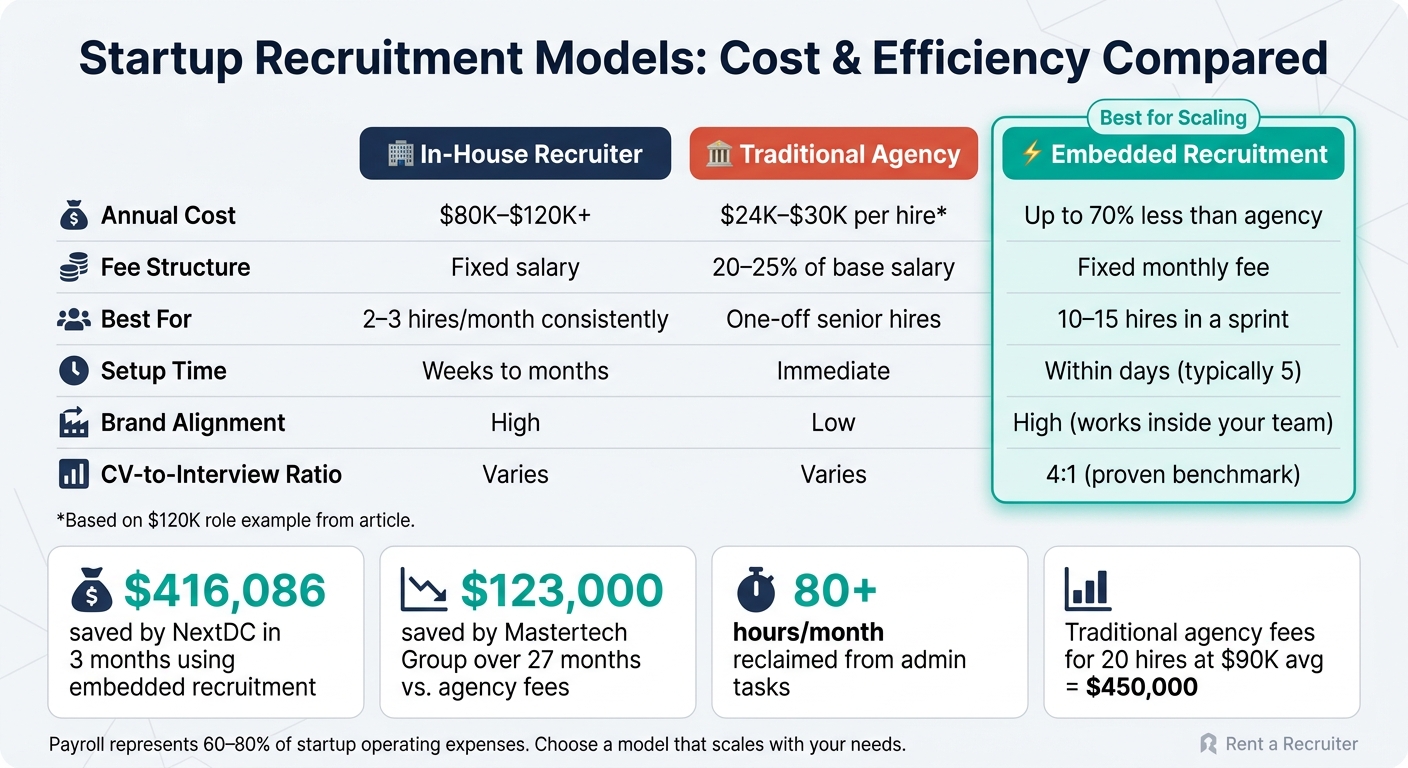
Startup Recruitment Models: Cost & Efficiency Compared
Build a Financially Sound Hiring Model
Hiring costs can spiral quickly after securing funding. On top of base salaries, benefits and taxes add another 25–35% to compensation packages [5]. Multiply this by 20 roles, and the additional expenses can eat into your runway faster than expected.
To keep hiring aligned with business performance, cap quarterly headcount growth at 30% and rely on scenario-based forecasting. Using Base, Upside, and Downside Cases ensures your hiring plans stay flexible. If a key revenue milestone is delayed, your hiring schedule adjusts automatically instead of locking you into rigid timelines [5].
"The question is no longer: ‘Can we afford these extra recruiters forever?’ It’s more: ‘What’s the right mix of capacity that will support our range of scenarios?’" – Qualigence Blog [10]
Cut Hiring Costs With Embedded Recruitment for Tech Startups
Traditional recruitment agencies charge 20–25% of a hire’s base salary in fees. For a team of 20 hires with an average salary of $90,000, this adds up to $450,000 in fees alone.
By contrast, Rent a Recruiter offers a fixed monthly fee, eliminating commission-based markups and cutting costs by up to 70% compared to traditional agencies [8]. You can estimate your potential savings using an embedded recruitment ROI calculator. For example, Mastertech Group adopted this model for 27 months, embedding a dedicated Talent Partner who delivered 29 successful hires. The result? A $123,000 savings compared to agency fees, all while maintaining a 4:1 CV-to-interview ratio [9][8]. This approach also freed internal teams from recruitment admin, allowing HR and founders to focus on scaling the business. With lower costs and streamlined processes, tracking accountability through metrics becomes even more critical.
Set Hiring Guardrails and Track Key Metrics
Even with a cost-effective hiring model, expenses can drift without proper checks. Require formal approval for each new role, tying it directly to your 12-month revenue projections rather than vague assumptions about team needs [5].
To measure success, focus on key hiring metrics:
- Time-to-fill: Tracks how quickly roles are being filled, reflecting operational efficiency.
- Cost-per-hire: Keeps spending transparent; the U.S. average for non-executive roles is $5,475 as of 2026 [6].
- Quality-of-hire and retention: Evaluate how well new hires perform and stay engaged, with retention benchmarks at 6 and 12 months.
Strategic recruitment, when consistently applied, can reduce cost-per-hire by 25–40% and improve quality-of-hire by 30–50% over three years [6]. These metrics ensure every hire aligns with both short-term budgets and long-term growth, turning hiring into a controlled, measurable process rather than a reactive scramble.
Conclusion: Building a Hiring Process That Supports Growth
Key Lessons for Post-Funding Startups
Scaling hiring after securing funding requires more than just filling roles; it demands a well-thought-out process. The most successful startups align every new hire with clear business milestones, invest in recruitment infrastructure early, and keep a close eye on costs. A critical transition often overlooked is moving from generalists to specialists. The "everyone wears many hats" mindset that works for smaller teams can hinder progress once you hit 30 or 50 employees. At this stage, your hiring strategy must evolve. Bringing in middle management before it becomes an urgent need allows your leadership team to stay focused on strategy rather than getting bogged down in daily operations. The strategies shared here are key to building a hiring process that supports sustainable growth.
Targeted hiring, supported by structured processes like standardized scorecards and applicant tracking systems (ATS), consistently delivers better results than reactive, high-volume recruitment. Efficiency trumps headcount every time.
Call to Action
This highlights why a structured approach to hiring is essential for growth. If your team is spending more time managing recruitment than driving the business forward, it’s time to rethink your approach. Rent a Recruiter places experienced recruiters directly within your team – typically within 5 days – to handle the entire hiring process while keeping costs predictable [9].
"Embedded recruitment for startups isn’t a short-term fix – it’s becoming the new standard in competitive talent markets where skills, culture and speed matter most." – Mark Loughnane, Lead of Rent a Recruiter [9]
Whether you need temporary support to hit key hiring goals or a long-term partner to scale alongside your growth, book a call with Rent a Recruiter to see how much you could save and start hiring with confidence.
FAQs
Which roles should we hire first after raising?
When deciding which roles to prioritize, focus on aligning them with your business goals and product roadmap. Start by tackling your most pressing bottlenecks. For example:
- If product development is slowing you down, bring in a technical lead or senior engineer.
- Struggling with inconsistent demand? A growth marketer can make a difference.
- If scaling accounts is the challenge, consider adding operations or customer success support.
Every hire should directly contribute to achieving a critical business milestone. This approach not only drives progress but also ensures you’re protecting your runway.
How do we tie headcount to revenue and runway?
To keep headcount aligned with revenue and runway, focus on milestone-driven triggers instead of sticking to a calendar-based hiring plan. Every new role should have a clear link to either a revenue target or a critical product milestone.
Start by calculating capacity needs. Look at the output required, account for ramp-up time for new hires, and only bring in additional team members when demand outpaces your current capacity. Use fully loaded costs (including benefits) to keep burn rate projections accurate and ensure hiring decisions are tied to measurable business growth.
When should we use embedded recruiters vs hiring in-house?
In-house recruitment is a strong choice when your business needs consistent, high-volume hiring – think 15 or more hires annually. It’s particularly effective when maintaining long-term alignment with your company’s values and having full control over the hiring pipeline are top priorities. That said, it can become expensive and sluggish during periods of rapid growth or unexpected hiring surges.
On the other hand, embedded recruiters are a game-changer for scaling startups dealing with fluctuating hiring needs, sudden spikes, or highly specialized roles. They work directly as part of your team for a fixed monthly cost, giving you the agility, speed, and alignment you need – without the hefty price tag of traditional recruitment agencies.