A single bad hire can cost your business up to 27 times their annual salary. For scaling companies, every hire directly affects growth, productivity, and revenue. Yet, most businesses lack a proper system to measure and improve hiring quality.
High-quality hires contribute faster, stay longer, and deliver measurable results. Companies in the top quartile for hiring quality see 24% higher revenue per employee. On the other hand, low-quality hires lead to wasted costs, higher turnover, and lost productivity.
The solution? Focus on talent acquisition strategies like clear success profiles, structured interviews, and reviewing outcomes to improve hiring decisions by 20–30%. For businesses needing immediate support, Rent a Recruiter offers an embedded recruitment model that reduces hiring costs by up to 70% while ensuring better hiring outcomes.
Every hire matters. The right process can transform hiring from a bottleneck into a growth driver.
Quality of Hire, what is it, how do you measure it, how do you utilize it in hiring?
sbb-itb-a23bd6a
1. High-Quality Hires
When a new hire starts contributing immediately, the impact on your business is measurable. Companies in the top quartile for quality of hire achieve 24% higher revenue per employee compared to those in the bottom quartile [5]. For scaling SMEs, this difference can be the deciding factor in hitting growth targets.
Productivity
Top-tier hires ramp up faster and make fewer costly errors. Globally, the average time to full productivity is 8 months [5]. However, businesses that implement structured 90-day onboarding programs can reduce that timeline by 30% [2]. This accelerated productivity helps scaling SMEs stay agile and competitive, often making the difference between maintaining momentum and losing ground.
Retention and Turnover
Retention is where hiring quality truly pays off. Alarmingly, 50% of new hires fail to meet expectations within the first 18 months [5]. Replacing these hires costs, on average, 30% of their first-year salary, and for senior roles, that figure can exceed 100% when lost productivity is considered [5]. High-quality hires are more likely to stay. For example, employees sourced through internal mobility boast a 91% one-year retention rate, while referrals achieve 82% – significantly higher than the 68% retention rate for job board hires [2]. This underscores the importance of sourcing and screening candidates effectively.
Revenue Contribution
Quality hires directly boost revenue. A single-point improvement in the Quality of Hire Index translates to a $1.9 million increase in annual revenue for the median Fortune 500 company [1]. At a leadership level, the stakes are even higher: a high-performing mid-level leader delivers a 289% return on investment within two years [8]. Placing the right person in the right role, with proper support, can transform business outcomes.
Team and Cultural Fit
Cultural alignment is often overlooked but is critical for hiring success. Research reveals that 89% of hiring failures are due to attitudinal issues or cultural mismatches, not a lack of technical skills [4]. High-quality hires not only perform well individually but also strengthen team dynamics. As Ahryun Moon, CEO of GoodTime, explains:
"The hiring challenge in 2026 isn’t about adding more people or cutting teams. It’s about redesigning how hiring work gets done." [6]
Defining cultural fit before posting a job – through clear success profiles and behavioral criteria – can improve quality of hire metrics by 20% [5]. It also reduces the risk of hiring someone who disrupts team cohesion.
For scaling SMEs, partnering with expert services like Rent a Recruiter ensures you’re attracting candidates who not only meet technical requirements but also align with your company’s culture. This focus on cultural fit is a key advantage as we explore the costly consequences of poor-quality hires.
2. Low-Quality Hires
Bringing in the wrong talent doesn’t just affect your bottom line; it ripples through your entire organization. The immediate costs – wasted salaries, recruitment fees, and onboarding time – are just the tip of the iceberg. The broader impact can quietly disrupt teams, derail projects, and even stall revenue growth.
Productivity
Underperformers don’t just fail to pull their weight; they actively drag down the productivity of those around them. Managers, for instance, spend about 17% of their time – nearly seven hours a week – dealing with underperformers [9]. That’s time they could have spent driving strategy, scaling operations, or focusing on growth initiatives. Meanwhile, top performers are left to pick up the slack, correct mistakes, and shoulder extra responsibilities. Over time, this creates a toxic cycle of burnout and frustration, even among your best employees.
"A mediocre hire who sticks around too long can cost more than an obvious flop, because everyone keeps adjusting around them." – LatHire [7]
Retention and Turnover
Bad hires are a leading cause of employee turnover, accounting for up to 80% of departures [9]. The financial toll is staggering: replacing an entry-level employee costs 30–50% of their annual salary, while mid-level roles can cost 100–150%, and executives 200–300% or more [10]. For example, losing a manager earning $62,000 after just 30 months could result in a total organizational loss of $840,000 when all associated costs are considered [9]. Beyond the numbers, this constant churn disrupts team dynamics and stability, leaving a lasting impact on morale and productivity.
Revenue Contribution
Every low-quality hire represents a missed opportunity to bring in a top performer. In roles like software engineering, where the best talent can be 8 times more productive than the average employee, the difference is stark [9]. These performance gaps directly affect revenue generation, and as your company grows, the impact of underperformers compounds, dragging down overall efficiency and profitability.
Team and Cultural Fit
The damage caused by a bad hire often goes beyond measurable metrics. When someone doesn’t align with your team’s values or way of working, it creates friction that can erode team cohesion and strategic progress. Misaligned hires not only disrupt workflows but also risk alienating your top performers. When the work environment deteriorates, your best people are often the first to leave, creating what’s known as regrettable attrition – losing the talent you can least afford to lose because of those you should never have hired in the first place.
Poor cultural fit doesn’t just affect one individual; it can undermine entire teams, breaking down engagement and momentum.
For scaling SMEs, where each role plays a critical part in growth, the stakes are even higher. The cumulative effects of low-quality hires – from lost productivity to team instability – can derail strategic goals, making the cost of getting it wrong far greater than just financial losses.
Pros and Cons
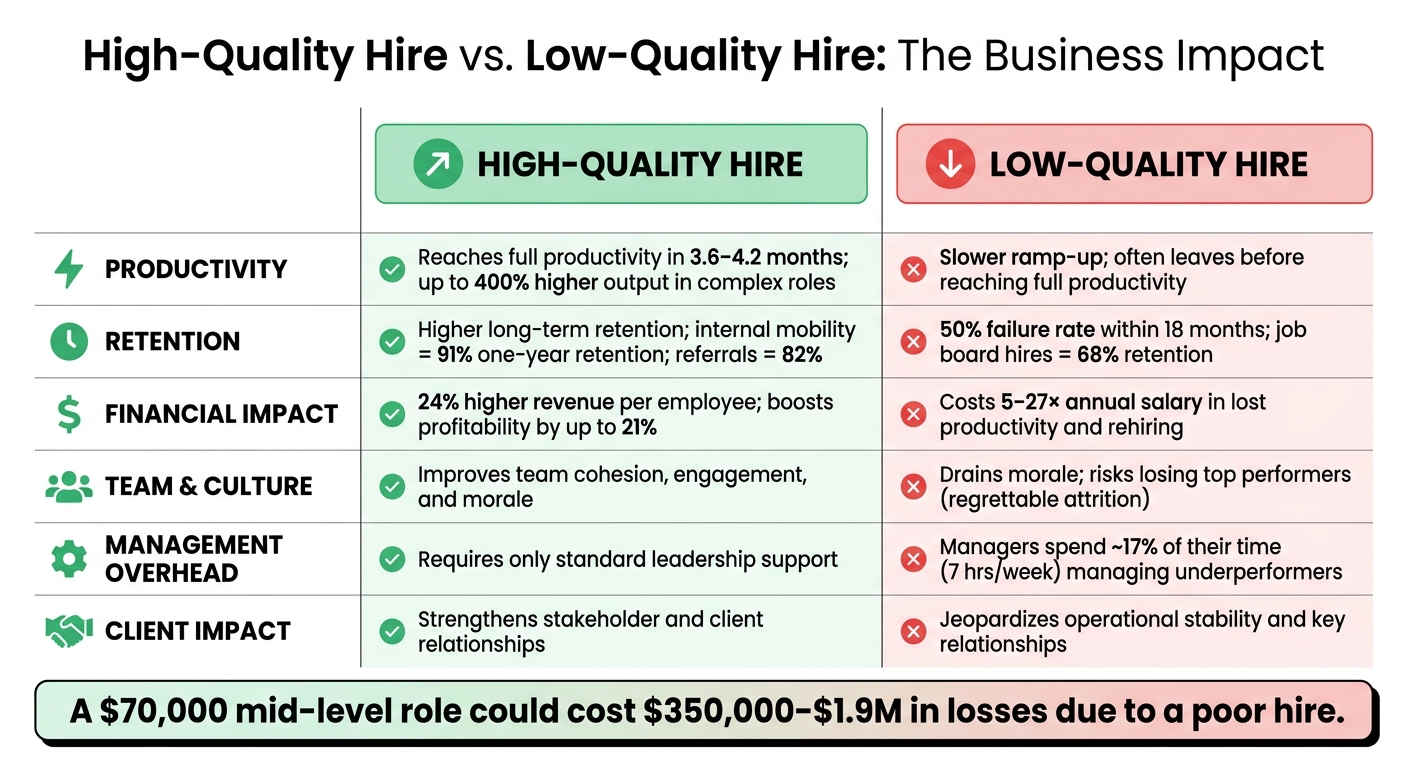
High-Quality Hire vs Low-Quality Hire: The Business Impact
The gap between a high-quality hire and a low-quality one is massive – it affects everything from revenue to team morale and the speed of your company’s growth. The table below breaks down the key outcomes of both.
| Criteria | High-Quality Hire | Low-Quality Hire |
|---|---|---|
| Productivity | Achieves full productivity in 3.6–4.2 months [2], delivering up to 400% higher output in complex roles [4] | Takes longer to ramp up and often leaves before reaching full productivity [3] |
| Retention | Stays longer, reducing talent acquisition services that reduce long-term costs [1] | 50% failure rate within 18 months [5] |
| Financial Impact | Generates 24% higher revenue per employee [5] and boosts profitability by up to 21% [3] | Can cost 5–27× their annual salary in lost productivity and rehiring [3] |
| Team & Culture | Improves team cohesion, engagement, and morale [3] | Drains morale and risks losing top performers [3] |
| Management Overhead | Requires only standard leadership support [1] | Demands excessive management time, pulling focus from growth initiatives [3] |
| Client Impact | Strengthens relationships with stakeholders and clients | Jeopardizes operational stability and key relationships |
The numbers tell a clear story. A $70,000 mid-level role could cost your business anywhere from $350,000 to $1.9 million in losses due to poor hiring – factoring in lost productivity, extra management time, and rehiring expenses [3]. For scaling SMEs, where every hire directly impacts momentum, the stakes are even higher. A great hire propels your business forward, while a poor one can leave you scrambling to recover.
Conclusion
The quality of your hires directly impacts business growth. For scaling SMEs, every new addition to the team can either boost momentum or slow it down. That’s why getting it right isn’t just important – it’s essential. These metrics highlight the value of a streamlined, effective hiring process. For high-growth SMEs, each hire plays a pivotal role in shaping the path toward sustainable growth.
Improving the quality of hires doesn’t require an overhaul. Simple, focused changes can make a big difference. Start by creating success profiles that define what the role should achieve at 6, 12, and 24 months before you even begin sourcing. Use structured interviews with consistent scorecards to evaluate candidates fairly. Finally, close the loop by reviewing hire outcomes at the 90-day and 12-month marks. These steps can deliver a 20–30% improvement in hire quality [7].
If building this kind of structured, repeatable process feels overwhelming, there’s a solution. Rent a Recruiter offers an embedded recruitment model tailored for SMEs. Their recruiters join your team within days, providing the expertise and systems needed to hire effectively at scale. This approach not only reduces hiring costs by up to 70% compared to traditional commission-based models but also ensures your hiring process drives the quality improvements essential for your business to grow.
FAQs
How do I measure quality of hire in my business?
To gauge the quality of hire effectively, focus on metrics that tie directly to your business objectives. These might include 90-day retention rates, performance review scores, employee engagement survey results, and ramp-to-productivity timelines.
Blend this objective data with manager feedback across 3–5 critical dimensions to create a well-rounded view. From there, calculate an average score to standardize your assessment. Tools like spreadsheets can help you track these metrics consistently for every hire, allowing you to identify trends and pinpoint areas for improvement.
Take it a step further by analyzing results based on hiring sources. This insight can help you fine-tune your recruitment strategy, ensuring it aligns with your growth goals.
What are the biggest early signs a new hire will fail?
Identifying early signs that a new hire might not succeed can save your team time and resources. These signs include a slower-than-expected ramp-up despite impressive credentials, struggles to keep up with the role’s demands or structure, and a clear mismatch with the expected work style or goals.
Other warning signals include poor communication skills, which can be especially problematic in remote environments, early disengagement, missed deadlines, or behavior that adds unnecessary workload for the team. Often, these issues trace back to factors like unclear success benchmarks, gaps in skills assessment during the hiring process, or overlooking cultural and role fit during recruitment.
How can an embedded recruiter improve hiring quality fast?
An embedded recruiter improves hiring outcomes by becoming part of your team and introducing a systematic, measurable hiring process. They streamline workflows, apply standardized evaluation scorecards, and align hiring criteria with your company’s objectives. By focusing on building strong talent pipelines, refining screening processes, and monitoring key metrics like 90-day retention rates and time-to-productivity, they tackle bottlenecks as they arise. This approach ensures you gain quicker access to top-tier candidates while maintaining high hiring standards.