If your hiring volume jumps before your process is locked, your legal risk, admin load, and hiring costs usually jump with it—often visible when you calculate your hiring ROI.
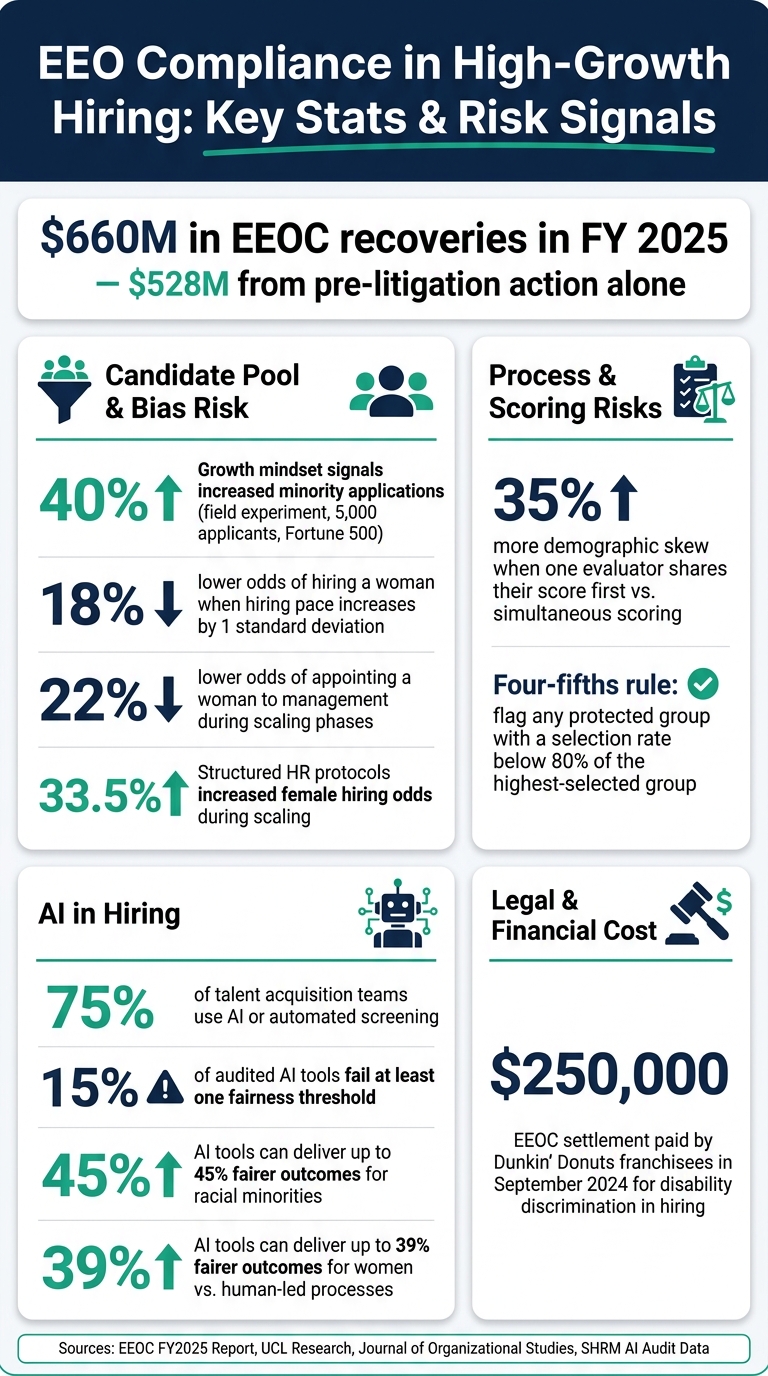
I see the pattern again and again in scaling SaaS, Technology, IT, Fintech, Engineering, Security, Insurance, and Professional Services firms. More roles mean more interviewers, more judgement calls, and more room for inconsistent decisions. That can lead to delays, rework, and direct cost. The EEOC reported $660 million in recoveries in FY 2025, with $528 million from pre-litigation action alone.
Here is the short version:
- Structured hiring cuts drift when teams are hiring at pace
- Stage-by-stage tracking helps you spot issues before they turn into complaints
- AI tools still sit under your liability, even if a vendor built them
- Documented scoring and rejection reasons save time later if decisions are questioned
- Embedded support can help if your team lacks capacity to keep process control in place
If you are scaling headcount, this comes down to one business question: can you keep hiring output high without losing control of cost, time, and decision quality?
That is what this article gets into, in simple terms.
The Compliance Compass: Guiding Talent Acquisition Through EEO, OFCCP Compliance in 2025
sbb-itb-a23bd6a
What Recent Research Says About EEO Compliance and Hiring Outcomes
EEO Compliance in High-Growth Hiring: Key Stats & Risk Signals
The studies below point to a simple commercial truth: as hiring volume climbs, EEO controls shape who enters your funnel, how fairly people are assessed, and how much risk your business carries.
Wider Candidate Pools and Stronger Representation
Recent research shows that EEO controls affect both applicant mix and screening results. In a field experiment with 5,000 prospective applicants at a Fortune 500 company, adding "growth mindset" signals increased minority applications by 40% [7]. By contrast, business-case language did not reduce the racial gap in applications [7].
That matters if you’re scaling fast and need a broader pool without slowing the process down. Small wording choices at the top of the funnel can change who applies.
Once people move into screening, the weak spot often shifts from attraction to assessment. University College London found that missing job-relevant criteria penalises underrepresented groups, especially disabled candidates [6]. If your team starts screening before the rubric is locked, bias can creep in fast.
Use a fixed, job-relevant rubric before screening starts. It gives managers a clear standard, cuts inconsistency, and helps you avoid drift when req volume picks up.
Quality of Hire, Efficiency, and Fewer Process Delays
A study of 224,970 job hirings and 28,617 managerial appointments found that a one standard deviation increase in company scaling reduced the odds of hiring a woman by 18% and appointing a woman to management by 22% [4]. In plain terms, when hiring speeds up, managers are more likely to fall back on familiar shortcuts.
That creates two problems at once. You widen risk, and you weaken decision quality.
The same study found that founders with formal HR education increased the odds of female hiring by 33.5% during scaling phases and fully mitigated scaling-related bias [4]. The takeaway is not that every founder needs HR training. It is that structured hiring protocols matter most when the business is under pressure.
When the process is clear, your team spends less time second-guessing decisions, less time reopening searches, and less time dealing with avoidable delays. This is particularly true for global teams, as seen in our embedded recruitment case study for Unique.
Legal Exposure, Financial Cost, and Employer Reputation
The same pattern shows up in risk. When hiring controls are weak, the cost is not abstract. It lands in legal spend, leadership time, and brand damage.
In September 2024, Dunkin’ Donuts franchisees paid $250,000 to settle an EEOC disability discrimination case tied to hiring failures [5]. That is a direct reminder that poor process control can become a hard dollar problem fast.
Research also shows that highly qualified minority candidates may avoid companies that use diversity language only symbolically, because they expect weak follow-through [8]. So this is not just about compliance on paper. If your messaging says one thing and your process says another, strong applicants may opt out before you ever get the chance to assess them.
The EEOC has also flagged high-tech discrimination charges involving age, pay, and genetic information [5]. For scaling companies in SaaS, Technology, IT, Fintech, Engineering, Security, Insurance, and Professional Services, that is a warning sign. Risk does not stop at race and gender, and it tends to grow when hiring expands faster than process discipline.
Which EEO Practices Work Best in Scaling Recruitment
Structured Workflows, Documented Criteria, and Consistent Interviews
The research points to a simple move: build compliance into the hiring process itself. In practice, that means replacing ad hoc judgment with structured evaluation.
A common issue in fast-growth hiring is vague criteria used differently by each hiring manager. "Culture fit" is a classic example. Instead of relying on that loose label, define job-related behaviours, such as collaborative problem-solving, and score them against a rubric.
One data point stands out. Groups where one evaluator shares their view first show 35% more demographic skew than groups where all evaluators submit scores at the same time [9]. Once one person speaks first, later scoring tends to drift in that direction. The fix is simple: require independent scoring before calibration.
Start with standardised requisition intake. Before screening begins, set:
- Role requirements
- Scoring dimensions
- Interview questions
That gives you a hiring process people can follow under pressure, not just one that looks good on paper.
Data Tracking, Adverse Impact Monitoring, and AI Safeguards
Once your process is standardised, the next control is measurement. Track each hiring stage, resume review, interview, assessment, and offer, so you can see where outcomes start to shift. If you do not measure stage by stage, problems stay hidden until they become expensive.
Use the four-fifths rule to flag adverse impact. If a protected group’s selection rate falls below 80% of the highest-selected group’s rate, it needs review [9].
For SMEs with smaller candidate volumes, one role alone may not give you enough data to spot a pattern. Pooling data across similar role families, for example, all engineering roles, gives you enough statistical weight to run a useful analysis.
AI tools are now a normal part of talent acquisition. 75% of talent acquisition teams use some form of AI or automated screening, and 15% of audited AI tools fail at least one fairness threshold, often because they were trained on biased historical data [10]. That matters. If the data going in is biased, the output can be too.
The right response is not to avoid AI. It is to control it. Audit tools before deployment and then annually after. That is even more important as state rules tighten and independent audits become common practice [10].
There is also a commercial point here. Recent data suggests AI hiring tools can deliver up to 45% fairer outcomes for racial minorities and 39% fairer outcomes for women than the human-led processes they replace [10]. Used well, AI can help reduce bias. Used badly, it can scale it.
How Embedded Recruitment Supports Compliant Hiring at Scale
When internal teams cannot keep that level of structure at volume, embedded hiring support helps hold the line. High-growth SMEs often know what compliant hiring should look like, but they do not have the bandwidth to run it the same way every time.
That is where embedded recruitment can help. Embedded recruiters add structure fast: standardised intake, documented decisions, consistent interviews, and stage-level tracking. For scaling teams, that means compliance becomes part of day-to-day hiring, not a clean-up job after the fact.
Building a Compliance-Ready Hiring Infrastructure
The next step is practical: turn EEO principles into repeatable controls, clear ownership, and clean records.
The Core Controls Every Scaling Company Needs
Structured hiring does not mean building a big HR function. It means putting the right controls in the right places before hiring volume spikes.
Start with job analysis. Every role should begin with a documented list of core duties and objective, measurable criteria. Strip out language tied to protected classes, and make sure each requirement links back to the work itself. [11]
Use standardized screening and lawful interview guides. Keep approved screening questions, interview guides, and scorecards in one version-controlled system. If you use AI in screening, route each screen through human review. [11][2]
Track disposition logging closely. Every rejected candidate should have a clear reason on file tied to the hiring criteria. Vague notes are hard to stand over if your process is challenged. [11]
Set clear ownership. One person, usually a Senior HRBP or Legal Counsel, should own EEO controls and the AI inventory. That inventory should include vendor name, version, hiring stage, and deployment date. If a tool leads to discriminatory outcomes, the employer still carries the liability. [2]
Keep record retention tight. Retain selection data, validation evidence, adverse-impact records, and candidate notices for two years. [2]
A Phased Rollout Plan for High-Growth SMEs
After a funding round, product launch, or market expansion, build these controls in phases. Trying to do everything at once usually slows hiring when you need pace most.
Phase 1: Assess your current risk. Review your highest-volume roles first. Look for missing job analyses, inconsistent screening questions, and any AI tools that do not have documented audits.
Phase 2: Standardize the steps that happen most often. Tighten requisition intake, screening criteria, and interview guides for the roles you hire again and again. This is where inconsistency stacks up fast as volume grows.
Phase 3: Add reporting and audit checks. Run adverse impact analysis at least quarterly. If hiring volume is high, do it monthly. [2]
Phase 4: Review and adjust monthly. Set a monthly cadence to review stage-level data, inspect disposition logs for vague rejection reasons, and confirm AI tool audits are happening on time. Review diversity-program language, including aspirational goals and diverse-slate policies, against current enforcement priorities. [3]
Comparison Tables: Ad Hoc vs. Structured Hiring and Stage-by-Stage Controls
The tables below show what changes when hiring moves from ad hoc manager-led decisions to a more controlled process, and where each control fits day to day.
| Feature | Ad Hoc Manager-Led Hiring | Structured Compliance-Ready Hiring |
|---|---|---|
| EEO Risk | High; prone to similarity bias and stereotypes | Low; uses documented criteria and job analysis [2] |
| Speed | Variable; depends on individual manager availability | Consistent; follows defined workflows and automated stages |
| Visibility | Low; decision-making logic is often unrecorded | High; includes AI tool inventories and audit logs [2] |
| Consistency | Low; different managers apply different criteria | High; same rubrics applied to all candidates |
| Liability | Direct; employer is responsible for all undocumented decisions | Reduced through validation, documented overrides, and human review [2] |
| Hiring Stage | Common EEO Risk | Evidence-Based Control |
|---|---|---|
| Job Analysis | Outdated or non-job-related requirements | Documented job analysis linked to essential functions [11] |
| Sourcing | Narrow pools or exclusionary ad language | Documented outreach across approved channels; neutral ad language [3] |
| Screening | AI bias or proxy variables in algorithms | Regular adverse impact audits and four-fifths rule checks [2] |
| Interviewing | Unstructured, subjective questioning | Fixed question sets, consistent scorecards, and job-related notes [11][2] |
| Selection | Missing or vague rejection documentation | Centralized disposition logs with criteria-tied reasons [11] |
| Post-Hire | Incomplete record retention | Minimum two-year retention of all selection data [2] |
Conclusion: EEO Compliance as Part of Your Hiring Infrastructure
Key Takeaways for HR and Business Leaders
EEO compliance should sit inside your hiring infrastructure, not off to the side as a legal box-tick.
When you build it into process design, documentation, and review, you get better hiring outcomes, less bias, and fewer delays. That matters at scale. It turns compliance from a reactive task into a repeatable way of hiring.
The strongest hiring teams don’t leave decisions to gut feel. They rely on documented criteria, consistent scoring, and clear decision records.
What to Do Next If you are hiring as you scale
Start by auditing the parts of your process where manager judgment plays the biggest role. In most cases, that’s where subjectivity creeps in. Standardise criteria and scoring there first.
If you’re using automated screening tools, make sure you have an up-to-date AI inventory that includes the vendor, version, and validation evidence. Under U.S. law, you’re still responsible for discriminatory outcomes, even when the tool comes from a third party. [2]
Run adverse impact checks using the four-fifths rule on your highest-volume roles. If a protected group’s selection rate drops below 80% of the top-selected group, treat that as an early warning sign and investigate before it turns into a complaint. [1]
If your team can’t keep that rhythm going internally, the process usually starts to drift.
Get Help Building Compliant Hiring Capacity at Scale
That’s where an embedded recruiter can help.
If hiring is moving faster than your internal process can handle, the risk is clear. Rent a Recruiter places experienced recruiters into your team within days, helping you scale hiring with structure and control while cutting costs by up to 70% and saving over 80 hours per month.
For scaling SMEs in technology, SaaS, fintech, engineering, and professional services, that means you can grow hiring volume without losing process ownership.
FAQs
What is the four-fifths rule?
The four-fifths rule is a guideline in the EEOC’s Uniform Guidelines on Employee Selection Procedures.
Put simply, if the selection rate for a protected group is less than 80% of the selection rate for the group with the highest rate, that can point to possible adverse impact.
For hiring leaders, this is a quick way to spot risk in your process before it turns into a bigger legal or operational problem.
How often should we audit AI hiring tools?
Audit AI hiring tools at least annually.
You should also run an extra audit after any major system update, workflow change, or shift in applicant demographics.
That gives you a clear check on compliance and helps spot bias before it turns into a hiring, legal, or reputational problem.
When should a scaling company formalize hiring controls?
A scaling company should put formal hiring controls in place early, ideally before a high-growth push starts, or right as it begins.
That matters for one simple reason: once hiring volume picks up, loose process gets expensive. You lose time, create inconsistency, and increase legal risk.
Set clear, compliant procedures for job postings, candidate screening, and interviews. This helps cut discrimination risk, meet EEO obligations, and keep your team aligned with changing federal and state enforcement.
For CEOs, CFOs, and HR leaders, this is not just a policy exercise. It protects hiring speed, lowers avoidable risk, and gives you more control as headcount grows.