Bad hiring process costs more than a slow hiring process. In 2026, one weak step in screening, pay, AI, or work authorisation can lead to delays, rework, tax issues, back pay, and legal cost across more than one state.
If you are scaling in SaaS, Technology, IT, Fintech, Engineering, Security, Insurance, or Professional Services, you need a hiring process that does two jobs at once: keep roles moving and keep risk under control. The article makes that simple. It narrows recruitment compliance down to four areas that affect cost, time, and control most:
- Set the role up properly before launch
- Control screening, pay, and I-9 steps
- Track AI tools and candidate data
- Assign owners, training, and audit dates
A few numbers stand out. 23 states now have automatic record sealing rules noted in the article. One cited study found adverse impact in AI screening for 26% of Black applicants and 15% of Asian applicants at role level. It also notes that 94% of business spreadsheets used for functions like payroll contain critical errors. The message is clear: manual hiring admin breaks under scale.
For leadership teams, that turns compliance into a business issue, not just an HR issue. You need clear checkpoints, clean records, and named owners inside the workflow, whether that sits in-house or through <a href="https://rentarecruiter.com/embedded-recruitment-service/">embedded recruitment</a> support. The rest of the article walks through that checklist in plain terms.
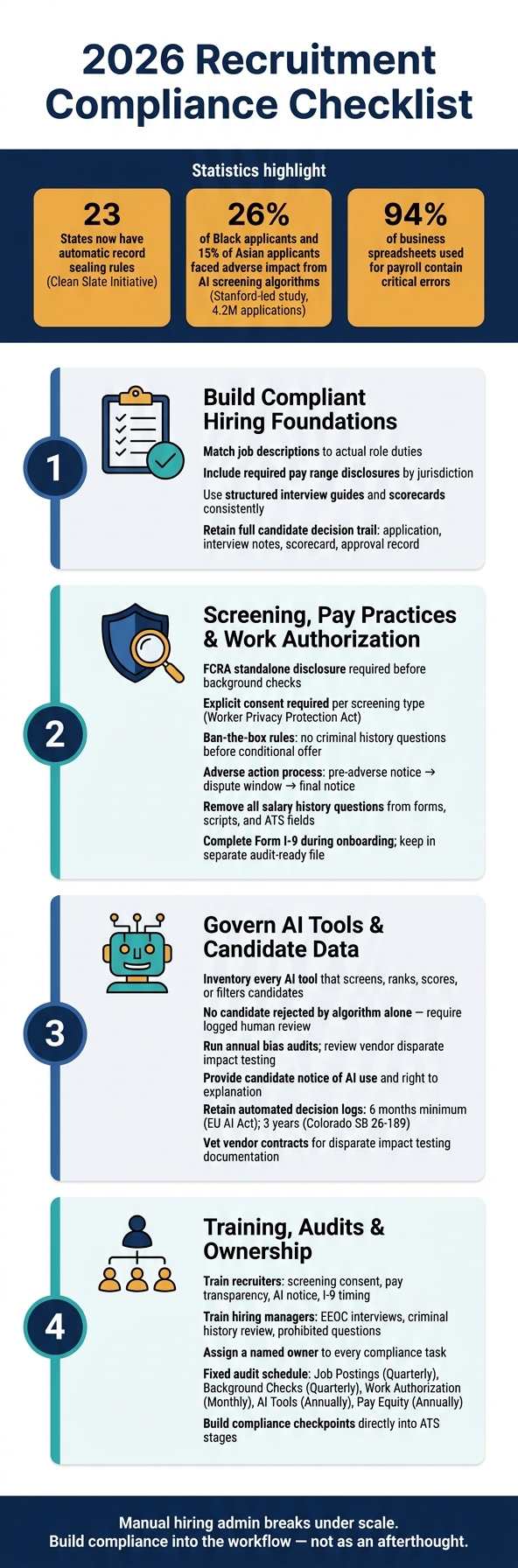
2026 Recruitment Compliance Checklist: 4 Key Areas to Manage Risk
Your 2026 HR Compliance Checkup: Policies, Pay Practices, and Legal Updates
sbb-itb-a23bd6a
Checklist 1: Build compliant hiring foundations before roles go live
Before you open a role, get the basics locked in. Posting details, selection criteria, and recordkeeping should be set before anyone applies. This is where compliance moves from policy to day-to-day hiring. A vague job description, a missing disclosure, or a loose interview standard can create risk before the post is even live.
Review job descriptions, qualifications, and pay range disclosures
Your job description should match the work the person will actually do. Keep core duties clear and specific. Strip out qualifications that look nice on paper but are not required for the role.
If the role could be done by a contractor, confirm classification before posting. If you control the worker’s schedule, priorities, and day-to-day tasks, the role likely fits employee status, no matter what the contract says [1]. Spotting that early can help you avoid retroactive reclassification, back taxes, and fines.
You also need to include any required pay range disclosure for the jurisdiction where the role is posted.
Apply EEOC-aligned selection criteria and interview controls
Once the role is live, consistency matters. Use the same standard for every candidate applying to that role. That means the same structured interview guide and the same scorecard across the process.
Keep interview questions tied to the role. Review the guide before interviews start so everyone is assessing against the same bar. If managers are freelancing the process, risk goes up fast; using Recruitment as a Service can help standardize these controls.
Retain records that support every hiring decision
After interviews, keep the full decision trail in one place. If a hiring decision is challenged, your documentation is what backs you up.
Each candidate file should include:
- Application
- Interview notes
- Scorecard
- Approval record
Centralize those files so they are easy to pull for an audit or claim. If your team cannot find the records fast, the process is too loose.
Checklist 2: Screening, background checks, pay practices, and work authorization
Once the role is live, screening, pay practices, and work authorization become the highest-risk parts of hiring. Handle them in order: background checks first, compensation controls next, then I-9 and work authorization. Document each step as you go. If there’s ever a complaint, audit, or dispute, that paper trail can save you time, legal spend, and a lot of stress.
Run background checks and criminal history reviews consistently
FCRA requires a standalone disclosure, separate from the job application, before any background check takes place. Under the newer Worker Privacy Protection Act, you also need explicit consent for each type of screening you carry out, not just one blanket approval [2].
Criminal history reviews need tighter process control too. As of 2026, 23 states have put automatic record sealing in place under the Clean Slate Initiative, which limits what employers can access [2]. Many jurisdictions also enforce ban-the-box rules, so you cannot ask about criminal history until after a conditional offer. Credit checks are also being limited more often, usually to roles with direct financial access or fiduciary duties [2].
The EEOC still expects individualized assessments, not blanket exclusions. That means you need to weigh:
- The nature of the offense
- How much time has passed
- How closely it relates to the role [2]
If a background check raises concerns, the adverse action process is not optional [2]:
- Send a pre-adverse action notice
- Allow a dispute window so the candidate can respond or explain the findings
- Send the final adverse action notice only after that window closes
Miss this process and you create legal exposure fast. A rushed hiring team can turn one screening issue into a compliance problem that costs far more than the role itself.
After screening, strip salary-history data out of every compensation step.
Remove salary history questions and support pay equity
Audit every application form, recruiter script, intake call, and ATS field for salary-history questions, then remove them. Train hiring managers on what they can and cannot ask during pay discussions. Keep the conversation tied to the role’s pay range, not prior compensation.
When you make an offer, document why that offer was made and keep the record trail clear and in date order [3]. This matters if pay decisions are ever challenged. You need a record that shows logic, consistency, and control.
Spreadsheets are a weak spot here. 94% of spreadsheets used for business functions like payroll contain critical errors [3]. That’s not a small admin issue. It can become a payroll problem, a pay equity claim, or an audit headache. Integrated HR and payroll platforms give you centralized, secure records and the audit trail you’ll need if a claim is filed [3].
Once pay controls are in place, close out onboarding with work authorization and document retention.
Complete Form I-9 on time and prepare for audits
Complete identity and work authorization checks during onboarding. For remote hires, verify identity and residency through documented trails to help prevent disguised candidates [1]. Keep I-9 and identity records in a separate, audit-ready file.
That separation matters. If you ever face an audit, you do not want teams scrambling through mixed personnel records to find missing documents. A clean filing process makes audit response faster and cuts the risk of missed or incomplete records.
Checklist 3: Govern AI hiring tools and candidate data
After background checks and work authorisation, AI screening is often the next compliance risk. If your team uses any tool that screens, ranks, scores, or filters candidates on its own, you need governance in place, not just a vendor contract, especially when using flexible hiring models that scale quickly.
Create an inventory of every AI or automated screening tool
Start by listing every tool that screens, ranks, scores, or filters candidates before human review. That includes ATS filters, resume scoring tools, assessments, and ad-targeting algorithms.
For each tool, record:
- what data it uses
- what it outputs
- who owns it internally
- where it sits in your hiring workflow
This inventory gives you a clear view of where AI is shaping hiring decisions. It also helps you track compliance with local AI hiring rules, including NYC Local Law 144 [4].
Once you’ve mapped every tool, set rules for candidate notice, human review, and audit logging.
Set bias audits, candidate notice, and review rules
The core rule for 2026 is straightforward: no candidate should be rejected by algorithm alone. A 2026 Stanford-led study of 4.2 million applications found that roughly 26% of Black applicants and 15% of Asian applicants faced adverse impact for individual roles from AI screening algorithms [6]. That is not a hypothetical issue. It is a documented pattern.
Require logged human review for every reject and advance decision. Require hiring managers to record a logged rationale for each decision. That record is what turns human review into something real, rather than a box-ticking exercise [6].
Use the table below to assign ownership and set review cadences across your main AI compliance areas:
| AI Compliance Area | Checklist Action | Owner | Review Frequency |
|---|---|---|---|
| Human Oversight | Review and authorize all "reject" decisions; ensure override capability | Hiring Manager / Recruiter | Per decision |
| Bias Auditing | Review vendor disparate impact testing and data quality reports | Compliance Officer / HR Lead | Annual |
| Event Logging | Verify system is recording all automated decision events | IT / System Admin | Continuous; monthly audit |
| Candidate Notice | Provide clear notice of AI use and right to explanation | Recruitment Ops | Per application |
| Log Retention | Ensure logs are stored for a minimum of 6 months | Data Protection Officer | Semi-Annual |
Limit candidate data collection and secure vendor controls
Once oversight rules are in place, tighten data use and vendor access. Collect only the data you need for the role. Store assessment outputs, screening scores, and background data in secure systems with access controls. Set a retention schedule and follow it.
The EU AI Act requires employers to retain automatically generated logs for at least six months, while Colorado’s SB 26-189 pushes that minimum to three years for certain records [4][6].
Vendor contracts need closer scrutiny too. Before you sign or renew, make sure the vendor can provide written documentation showing how the system was tested for disparate impact. Confirm the system supports automatic event logging. Add a clause that requires the vendor to notify you of material changes.
If a candidate asks how AI affected the decision, give a clear explanation.
Checklist 4: Make compliance repeatable through training, audits, and clear ownership
The controls in the first three checklists only work if recruiters and hiring managers follow them the same way, every time. If the process changes from one role to the next, risk slips in fast. Legal review should be a fixed part of every search, not something you add later when a problem shows up.
Train recruiters and hiring managers on the rules they use
Train recruiters on screening consent, pay transparency, AI notice, and I-9 timing. Train hiring managers on EEOC-compliant interviews, individualized criminal-history review, and prohibited questions.
Keep that training documented. Store completion records in one central place so you can prove who completed what, and when. If laws change or your hiring workflow shifts, update the training and run it again. That saves time during audits and cuts the chance of inconsistent decisions across teams.
Audit the recruitment process on a fixed schedule
A fixed audit schedule creates accountability. It also stops compliance work from turning into a last-minute scramble. Use the same workflow checkpoints to run recurring audits, and make sure each one has a clear owner, the right documents, and a set review cadence.
| Compliance Category | Process Owner | Key Documents | Audit Interval |
|---|---|---|---|
| Job Postings | Recruitment Manager | Job descriptions, pay range disclosures | Quarterly |
| Interviews | Hiring Managers | Interview notes, selection criteria logs | Semiannually |
| Background Checks | HR Compliance | Standalone consent forms, adverse action notices | Quarterly |
| AI Tools | HR Tech / IT | Bias audit reports, candidate notices, vendor controls | Annually |
| Work Authorization | Recruiters | Form I-9, identity verification records | Monthly (new hires) |
| Recordkeeping | HR Operations | Candidate data logs, I-9 forms, consent records | Annually |
| Pay Equity | HR / Finance | Pay gap analysis, salary range disclosures | Annually |
Schedule audits in advance. Assign each one to a named owner. Log the result when it is done. If nobody owns the audit, it usually does not happen. And if the result is not recorded, you have no proof the review took place.
Assign ownership and scale the process with embedded recruitment support
Every compliance task needs a named owner. Without clear accountability, reviews get skipped and records go missing. Build compliance checkpoints directly into your ATS stages so no role can move forward until the required steps are complete.
That one change can save a lot of back-and-forth. It also gives leadership more visibility into where hiring slows down, where approvals stall, and where risk is building. Approval workflows and reporting dashboards help you spot gaps early, before they turn into legal or operational issues.
If you need extra support, embedded recruitment can keep those compliance checkpoints inside the hiring workflow. Teams also use partners like Rent a Recruiter when they want tighter process control without adding more internal admin.
Conclusion: A 2026 recruitment compliance checklist that protects growth
Recruitment compliance in 2026 covers job design, screening, I-9s, AI, and recordkeeping. If one part breaks, risk can spread across the whole hiring process. The fix is simple: build compliance into the workflow itself, not as a box-ticking task at the end.
Good hiring means collecting only the data you need to make lawful, defensible decisions. That keeps the process tighter, cuts admin, and makes it easier to repeat the same standard across every hire. The same rule should hold from the job post right through to data retention.
As screening and AI review face more rules, requiring a clear AI policy, informal hiring creates risk you don’t need. The teams that stay protected rely on documented workflows, clear ownership, and regular recruitment audits. They don’t treat compliance as a one-off project. They make it part of how hiring gets done.
If your team needs extra hiring capacity, Rent a Recruiter embeds experienced recruiters into your team within days, bringing structure, visibility, and consistency to hiring.
FAQs
What is the biggest hiring compliance risk in 2026?
The biggest hiring compliance risk in 2026 is fast hiring growth without enough control around it. When hiring ramps up and your process can’t keep pace, things start to slip. Decisions become inconsistent. Bias creeps in. Legal risk grows, often before leadership spots the problem.
This is where scaling companies get caught out.
A hiring spike can look like progress on paper. More openings, more interviews, more offers. But if your team is making rushed decisions without a clear process, you’re not just dealing with a hiring issue. You’re dealing with a business risk that can lead to claims, fines, and wasted spend.
AI hiring tools add another layer of risk. They can save time, yes, but they do not remove employer responsibility. If an algorithm creates biased outcomes, your business is still on the hook, even when the software comes from a third party.
That means you need more than a tool. You need proper audits, clear documentation, and human oversight. Without that, AI can speed up the wrong decisions just as easily as the right ones.
For CEOs, CFOs, and hiring leaders, the point is simple: growth without hiring control is expensive. And in 2026, compliance risk tends to show up fastest when recruitment scales faster than the process behind it.
Which hiring steps should we audit first?
Start before you open the role by auditing a few core areas:
- Worker classification under Department of Labor or IRS guidelines
- Requisition approvals, role requirements, scoring criteria, and interview guides
- Job postings for salary ranges and biased language
This step helps you confirm legal compliance and build consistency from day one.
Miss this stage, and small issues can turn into expensive ones. A classification error can create tax and labour risk. Weak approvals can slow hiring. Vague scorecards can lead to inconsistent decisions and poor hiring outcomes.
Get it right early, and you save time, cut risk, and give every stakeholder a clearer hiring process.
How do we use AI in hiring without creating bias risk?
Use AI in hiring with human oversight and strong data governance.
Before you roll out any AI tool, audit it. Then review it every year. Models trained on historical data can repeat old bias, and that can damage hiring outcomes, slow decisions, and create legal risk.
Standardise hiring with job-relevant rubrics. Track outcomes at each stage for adverse impact. And make sure a qualified person can interpret, challenge, and override AI decisions.
That last part matters. AI should support hiring decisions, not make them on its own. You need clear accountability, clean process control, and someone in the loop who can step in when the output does not look right.