Hiring bias costs businesses time, money, and talent. From unconscious name bias to flawed AI tools, these blind spots shrink your talent pool, slow down hiring, and lead to poor decisions. But fixing bias isn’t just about ethics – it’s about better hiring outcomes and business performance.
Here’s what you need to know:
- Bias starts early: Name bias, affinity bias, and gender bias often filter out strong candidates before interviews even begin.
- AI tools aren’t neutral: Automated systems can reinforce discrimination through proxy data like ZIP codes or university names.
- Blind screening works: Removing personal details from resumes can increase diversity in interview pools by up to 46%.
- Structured processes save time and money: Clear, competency-based criteria and consistent workflows improve decision-making and reduce bad hires.
Why it matters: Diverse teams make better decisions and outperform financially. Addressing bias widens your talent pool, reduces time-to-hire, and strengthens compliance – especially as regulations tighten globally.
What’s next? Build a bias-resistant hiring process. This means auditing your recruitment funnel, adopting blind screening, training teams on unconscious bias, and leveraging ethical AI tools. For scaling companies, embedded recruitment support can ensure these changes stick while reducing hiring costs by up to 70%.
Learn how embedded recruitment can improve your hiring process.
Know your unknowns: Check your unconscious bias when screening candidates
sbb-itb-a23bd6a
Where Bias Enters the Screening Process
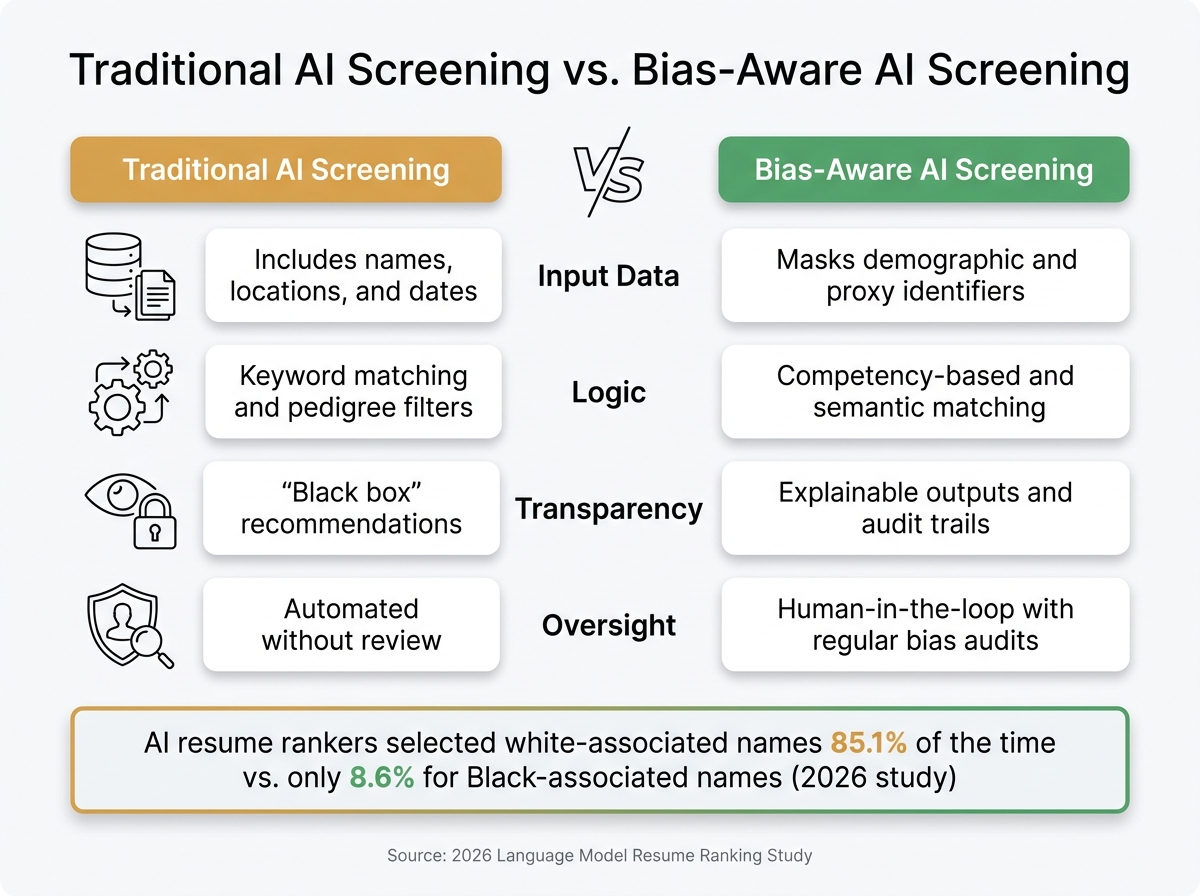
Traditional AI Screening vs. Bias-Aware AI Screening: Key Differences
Bias finds its way into the hiring process through various channels – sometimes stemming from human judgment, and other times through the very tools designed to simplify recruitment.
Common Biases in Screening
Several cognitive biases can shape how resumes are reviewed. For instance, confirmation bias leads recruiters to focus on information that supports their initial impressions. Affinity bias causes a preference for candidates with similar backgrounds or interests, while status quo bias perpetuates established hiring patterns – often favoring candidates from the same schools or backgrounds as previous hires. Then there’s the halo and horn effect: a well-known employer on a resume might cause a recruiter to overlook potential weaknesses, while an unconventional career path may unfairly raise doubts about a candidate’s abilities.
But bias isn’t limited to human judgment. Recruitment tools, though designed to streamline hiring, can also perpetuate these tendencies.
How Screening Tools and Processes Introduce Bias
Automated tools often reinforce existing patterns, sometimes unintentionally. For example, keyword-matching systems tend to favor resumes that mirror the language used by previously successful candidates. Platform defaults also play a role: research reveals that 96% of minimum-tenure filters in sourcing tools are set at exactly 12 months. This rigid threshold can unfairly exclude candidates who’ve taken parental leave or experienced layoffs. Additionally, employer-prestige filters are used in 70.7% of recruiter sourcing searches, creating further barriers for candidates from less traditional backgrounds. Sharon Braun from Auburn University highlights this issue:
"Discrimination is more pronounced when hiring depends more heavily on subjective evaluation and less pronounced when evaluation is constrained by standardized, verifiable criteria." [5]
While traditional systems exhibit bias through preset filters, AI-powered tools introduce their own set of challenges, often requiring stricter safeguards.
AI in Screening: Risks and Safeguards
AI screening tools may seem impartial, but they can produce highly skewed outcomes. A 2026 study found that language-model-based resume rankers selected white-associated names 85.1% of the time, compared to only 8.6% for Black-associated names. In direct comparisons between Black men and white men, Black men were selected 0% of the time across three major embedding models [1][4][6].
These disparities often arise from proxy leakage. Even when explicit demographic data is removed, proxies such as ZIP codes, university names, or graduation years can still reveal demographic information. The consequences are not just reputational but legal. In August 2023, iTutorGroup settled a $365,000 lawsuit after its software automatically rejected female candidates over 55 and male candidates over 60 [1].
To mitigate these risks, companies can adopt safeguards like masking identifying information before it reaches ranking algorithms, conducting regular audits of default filters, and having human reviewers critically evaluate AI-generated shortlists rather than relying on them blindly.
Bias in screening undermines diversity efforts by narrowing the pool of qualified candidates. Addressing it requires intentional changes, whether through better tools or more thoughtful processes.
| Feature | Traditional AI Screening | Bias-Aware AI Screening |
|---|---|---|
| Input Data | Includes names, locations, and dates | Masks demographic and proxy identifiers |
| Logic | Keyword matching and pedigree filters | Competency-based and semantic matching |
| Transparency | "Black box" recommendations | Explainable outputs and audit trails |
| Oversight | Automated without review | Human-in-the-loop with regular bias audits |
How to Reduce Bias in Candidate Screening
Define and Standardize Competency-Based Screening Criteria
To tackle bias effectively, start by defining clear, competency-based criteria before reviewing candidates. Studies show that women often apply only when they meet 100% of the listed qualifications, while men apply at closer to 60% [7]. Overly vague or inflated requirements can unintentionally discourage qualified candidates from applying.
Once you’ve set precise criteria, create a question bank tied directly to these competencies. Ask every candidate the same questions in the same order, and use a consistent scoring system with behavioural anchors. This approach ensures interviewers submit scores independently before group discussions, reducing anchoring bias. Structured interviews using this method have predictive validity rates between 0.42 and 0.51, compared to just 0.19 to 0.38 for unstructured interviews [7].
"The organizations that make the most meaningful progress on bias-free hiring are those that change their processes and systems, not just their awareness." – InCruiter Editorial Team [3]
Use Blind Screening Techniques
After defining criteria, blind screening can help remove bias during the initial review process. This involves removing personal details such as names, photos, addresses, graduation years, and university names from resumes. Research indicates resumes with white-sounding names receive 50% more callbacks than identical resumes with Black-sounding names [8][7][11]. Similarly, resumes with white-sounding names are 75% more likely to receive interview requests than those with Asian names [10]. Blind screening has been shown to increase diversity in interview pools by as much as 46% [3].
Many modern Applicant Tracking Systems (ATS) allow for these details to be masked during the initial review stage. If your ATS lacks this feature, an impartial team member can manually redact identifying information before resumes are forwarded to the hiring team [8]. To maximise fairness, follow blind screening with structured interviews and diverse panel participation.
Train Hiring Teams on Unconscious Bias
Even with process improvements, addressing unconscious bias requires targeted training. Awareness alone isn’t enough; training helps hiring teams identify and counteract biases like affinity bias or the halo effect. Alarmingly, 48% of HR managers acknowledge that bias influences their hiring decisions [3], making it a visible but often unresolved issue.
Training shouldn’t be a one-off event. Reinforce it with calibration sessions before launching new hiring cycles, rotate who leads debriefs, and require scores to be submitted before discussions begin [7]. Research shows that when hiring decisions are made unanimously by a group, gender disparity in outcomes is nearly eliminated. Conversely, when decisions rest with a single leader, the gender gap can widen by 15.8 percentage points [9].
Use Ethical AI and Monitor Screening Data
Ethical AI tools can complement human-led efforts by ensuring consistent screening, but they must be actively managed and audited. Request a third-party bias audit from vendors – ideally within the past 12 months – to confirm their tools meet ethical standards [2].
Once implemented, use the EEOC‘s 80% rule to monitor shortlist data. If the selection rate for any protected group falls below 80% of the highest-scoring group, it’s a signal to investigate [2][13]. Conduct these reviews at least quarterly to catch any issues early, such as model drift.
With the EU AI Act categorising recruitment AI as "high-risk" and introducing penalties of up to €35 million or 7% of global turnover starting August 2, 2026, compliance is becoming increasingly important for companies operating internationally [2][7].
"Bias risk in AI screening is easy to overlook when the tool works smoothly and the shortlist looks sensible. The problem only becomes visible when a regulator audits your process." – Ben Lovis, Editor, HireForge [2]
Building Structured Screening Processes in Scaling Companies
A Step-by-Step Approach to Bias-Free Screening
For fast-growing SMEs, one of the biggest risks in hiring is allowing bias to creep into the process. Moving from unstructured, ad hoc screening to a clear, auditable workflow takes a series of deliberate steps.
Start by auditing your recruitment funnel. Pull conversion rates by protected groups across key stages – Applied, Screened, First Interview, Final Interview, and Offer. This will help you identify where candidates from certain groups are dropping out and highlight areas of the process that need improvement [7].
Next, establish clear, weighted criteria directly tied to the job description. Remove identity markers like names, graduation years, ZIP codes, and college names from resumes before screening. Document all criteria and scoring methods to avoid "moving the goalposts" for candidates who might feel like a natural fit [15].
Keep measuring outcomes. Use the EEOC’s four-fifths rule quarterly: if any protected group’s selection rate drops below 80% of the highest-scoring group, it’s a signal to investigate further [14]. For example, a fintech startup in 2025 implemented blind resume screening and saw the interview-to-offer ratio for women jump from 31% to 48% in just one hiring cycle (as seen in this embedded recruitment case study) [12]. These kinds of gains don’t happen by chance – they result from intentional changes to the process.
"Inclusive hiring practices in 2026 are the same boring discipline they have always been, just under more pressure. The teams that ship the boring discipline win the candidates." – Pin [7]
By following these steps, you can build a hiring process that remains consistent, even as your company scales.
How Embedded Recruitment Support Helps
As your company grows, maintaining a structured, bias-resistant screening process becomes harder without the right support. Scaling teams – especially in fields like technology, SaaS, fintech, or engineering – often face intense pressure to fill roles quickly. This urgency can lead to shortcuts that undo the progress you’ve made in creating a fair process.
This is where embedded recruitment support proves invaluable. Instead of outsourcing your hiring entirely or stretching your internal team too thin, embedded recruiters join your organization and take ownership of the hiring process. They bring the discipline needed to maintain structured workflows, implement interview rubrics, and monitor for fairness – all while working as part of your team.
Rent a Recruiter provides experienced recruiters who can integrate into your team within days. They introduce documented processes, ensure compliance, and conduct regular reviews to catch potential issues before they escalate. This approach not only strengthens your screening process but also reduces risks tied to compliance and bias. Companies partnering with Rent a Recruiter often see up to 70% lower hiring costs and save over 80 hours a month in internal hiring admin, freeing up resources to focus on building a robust, bias-free recruitment function.
"Awareness without process change is not enough. If a recruiter returns from a bias training workshop and goes straight back to conducting unstructured interviews… the training has achieved very little." – InCruiter [3]
Conclusion: Building a More Inclusive Recruitment Process
Key Benefits of Bias-Free Screening
Removing bias from screening doesn’t just tick a box – it directly improves hiring outcomes and strengthens compliance. By focusing on performance indicators instead of factors like names, graduation years, or school prestige, you’re making smarter hiring decisions that are grounded in actual job performance. And the benefits are immediate.
For starters, your talent pool widens dramatically. Companies in the top quartile for gender and ethnic diversity see financial gains of 39% and 27%, respectively. On top of that, reducing turnover costs – ranging from $15,000 to $50,000 per employee for smaller businesses – can have a significant impact on your bottom line [13][16]. For fast-growing SMEs, this isn’t just theory; it’s a direct route to better hires, stronger teams, and reduced attrition.
Structured processes also bolster your compliance efforts, which is crucial as regulatory scrutiny increases. The EEOC logged 88,531 discrimination charges in FY 2024, marking a 9.2% rise from the previous year [7]. A documented and consistent screening process serves as your best line of defense against these risks. With clear rubrics and measurable recruitment metrics, you’re not just avoiding penalties – you’re building a recruitment system that’s both fair and effective.
"Hiring bias is a quality problem, not just a fairness problem. It costs small businesses 30–50% of first-year salary per bad hire." – FirstHR SMB Guide [13]
Take the Next Step
A bias-free screening process doesn’t just protect your business – it powers sustainable growth. Achieving this requires clear criteria, consistent workflows, and accountability at every stage, especially when hiring demands are high and your team is scaling quickly.
Rent a Recruiter places experienced recruiters directly into your team, ready to implement structured workflows, ensure compliance, and maintain consistency as your headcount grows. Ready to reduce bias and streamline your hiring? Book a call or calculate your potential savings to see how embedded recruitment could transform your hiring process.
FAQs
What should be removed in blind resume screening?
To promote fair and unbiased blind resume screening, eliminate personally identifiable information such as full names, photos, addresses, and contact details. Additionally, remove references to educational institutions, graduation dates, gendered titles (like Mr. or Ms.), and any mentions of religious or cultural affiliations. This approach ensures the focus remains solely on skills and qualifications, reducing the likelihood of bias – whether intentional or not.
How can we tell if our AI screener is biased?
Treat your AI screener like a critical system, not some mysterious "black box." Start by applying the four-fifths rule: compare selection rates across different demographic groups. If any group’s selection rate falls below 80% of the highest-performing group, it’s a red flag that demands further investigation.
Take it a step further with third-party bias audits, a thorough review of the training data, and close monitoring of the features your model relies on. Most importantly, build in human oversight at key stages to catch and correct potential biases before they impact outcomes.
Which hiring metrics prove screening is fair?
To create a more equitable screening process, monitor stage-by-stage pass-through rates across various demographic groups. One critical metric to watch is the Adverse Impact Ratio, guided by the EEOC’s four-fifths rule. This rule flags potential bias if any group’s selection rate drops below 80% of the highest-performing group. Additionally, assess how applicant demographics align with those advancing to interviews. Any noticeable gaps can highlight areas where bias might be influencing decisions, allowing you to address them proactively.