
If you are scaling and still paying per-hire agency fees, your hiring model may be costing far more than the invoice shows.
I’d sum it up like this: embedded recruitment lowers hiring spend by replacing percentage-based fees with a fixed monthly cost, cutting internal admin time, and reducing the cost of roles sitting open. In many cases, businesses report up to 70% lower recruitment spend, 80+ hours a month saved, and lower vacancy drag when hiring ramps up.
To compare costs across every model, see our hiring model comparison guide.
For CEOs, CFOs, HR leaders, and Talent leaders, the commercial point is simple:
- Lower fee spend than agency-led hiring
- More budget control with fixed monthly pricing
- Less admin load on HR and hiring managers
- Lower vacancy cost through faster fills
- Better visibility across pipeline, spend, and hiring output
If you hire in waves across SaaS, Technology, IT, Fintech, Engineering, Security, Insurance, or Professional Services, this is usually where the numbers start to shift in your favour.
What follows is the short version of the case for embedded recruitment, focused on cost, time, and hiring output.
Most hiring teams look at agency invoices and think that is the full cost.
It is not.
I’d look at hiring cost in three parts. First, there is the fee itself. Agency commissions often sit at 15% to 30% of salary, so a $100,000 hire can cost $15,000 to $30,000 before you count anything else. Second, there is internal time. Screening, interview scheduling, follow-up, and reporting eat hours every week. Third, there is vacancy cost. When a role stays open, the business pays through delayed delivery, lost output, or extra pressure on the rest of the team.
That is where embedded recruitment changes the model.
Instead of paying a new fee every time you make a hire, you move to a fixed monthly cost, often in the $5,000 to $20,000 range depending on scope and volume. That gives you a steadier cost base and makes hiring spend easier to plan against headcount targets.
The savings do not stop at supplier fees.
An embedded recruiter handles the work that often clogs up internal teams, sourcing, screening, scheduling, follow-up, and reporting. That means your HR team and hiring managers spend less time on admin and more time on decisions that move the business forward. In reported case data, companies have saved 80+ hours per month, and some engagements have saved 600+ hours over a multi-month hiring push.
There is also the cost of delay.
Open roles can cost $4,000 to $5,700 per month or more, depending on the role and the business impact. If hiring stalls, that cost keeps building. With an embedded model, you usually get one clear owner, one process, and better pipeline control. That helps reduce stalled interviews, repeat briefs, and restarted searches.
The result is not just lower spend. It is more predictable hiring economics.
If I were building the business case, I would track:
- Cost per hire
- Agency spend avoided
- Internal time saved
- Vacancy cost reduced
- Time to fill
- Offer acceptance rate
Those measures show whether the model is saving money in the places that matter, not just reducing one line item.
This matters most when hiring is concentrated.
If you are hiring after funding, entering a new market, launching a product, or building out teams in Engineering, Product, Sales, Security, or IT, embedded recruitment often has the strongest return. The more repeated hiring you do, the easier it is to see the gap between fixed monthly support and repeated commission fees.
A brief comparison helps make that clear:
| Model | Cost shape | Internal admin load | Budget control | Best fit |
|---|---|---|---|---|
| Traditional Agency | Variable, per-hire fees | Medium | Low | Low-volume or occasional hiring |
| In-House Recruiter | Salary plus tools and overhead | Medium to high | Medium | Steady hiring demand |
| Embedded Recruitment | Fixed monthly cost | Low | High | Scaling or project-based hiring |
The main point is simple.
You should not judge recruitment cost by supplier invoice alone. You need to count fees, time, and vacancy drag together. When you do that, embedded recruitment often comes out as the lower-cost option for scaling companies.
If you want to test the numbers against your own plan, use an ROI calculator or speak with Rent a Recruiter to compare your current spend with a fixed monthly model.
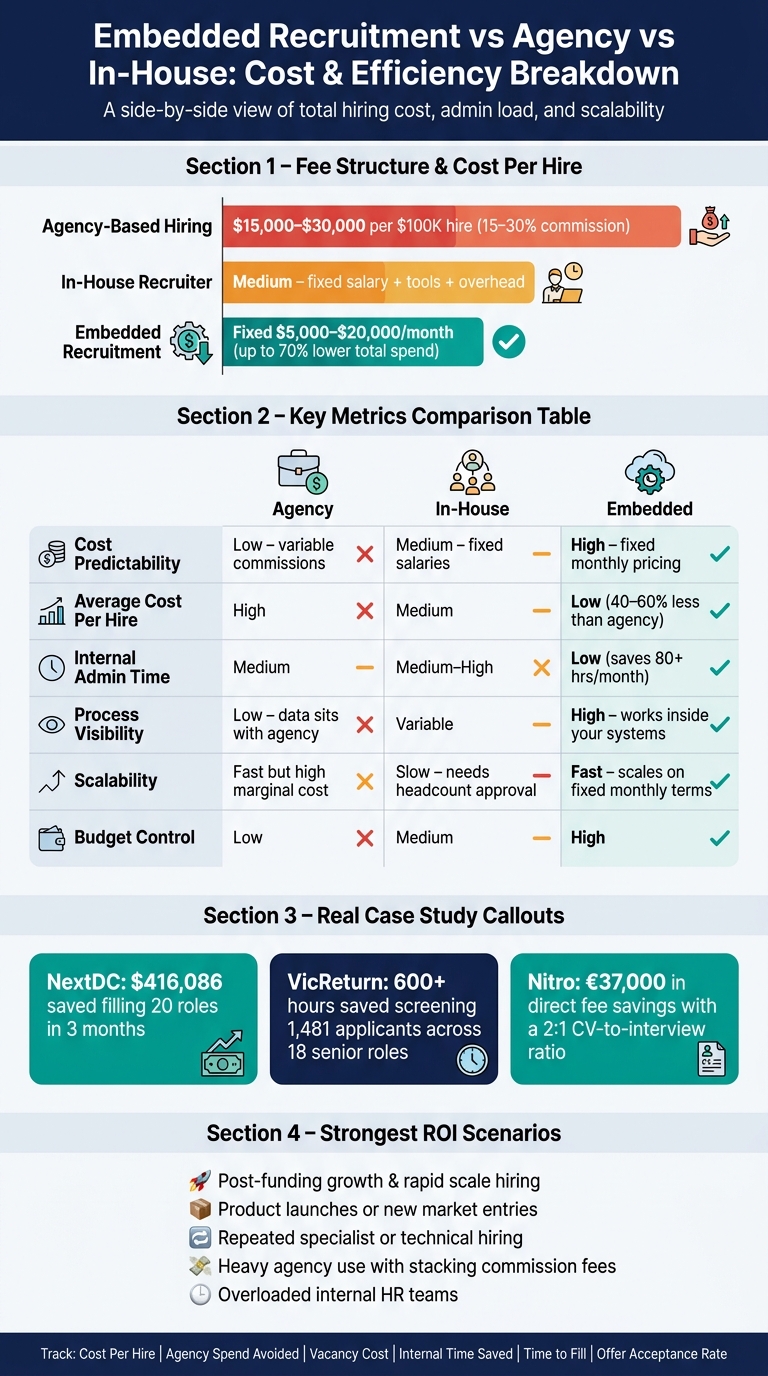
Embedded Recruitment vs Agency vs In-House: Cost & Efficiency Breakdown
2. How Embedded Recruitment Lowers Total Hiring Spend
Embedded recruitment cuts hiring spend in three places: fees, admin time, and vacancy cost.
Fixed Monthly Pricing vs. Variable Agency Fees
With a traditional agency, each hire comes with a fee linked to salary. At 15% to 30% of first-year compensation, a single $100,000 hire can cost $15,000 to $30,000 in placement fees alone [7][8][10].
Embedded recruitment swaps that variable cost for a flat monthly fee. Pricing usually sits between $5,000 and $20,000 per month, based on hiring volume and scope [5][9]. In many cases, businesses cut total recruitment spend by up to 70% [2][1].
For CFOs and finance teams, that changes the conversation. You can plan around a steady monthly cost instead of taking repeated one-off fees that climb as salaries and headcount grow.
The other part of the savings story is less obvious, but it hits just as hard: internal admin time.
Lower Admin Load and Better Use of Recruiter Time
A lot of hiring cost never appears as an agency invoice. It shows up in lost team hours.
Recruiting coordinators spend 46% of their time on scheduling alone, and manual scheduling can take 243 minutes per role compared with 27 minutes when self-scheduling is set up in a structured way [11].
An embedded recruiter takes ownership of the work that usually clogs up internal teams, including sourcing, screening, scheduling, follow-up, and reporting.
In a Unique.ai case study, the embedded recruiter coordinated 291 interviews, made 17 offers, and delivered 13 hires across multiple locations [3].
That kind of ownership matters because it takes pressure off HR, Talent, and hiring managers. Clients also often save over 80 hours per month in hiring and admin time [2][1]. That means your team can spend more time on planning, stakeholder management, and decision-making, instead of chasing calendars.
Fewer Delays, Fewer Restarts, Less Wasted Spend
Open roles cost money, even when that cost is easy to miss in the budget. Monthly vacancy costs can run above $4,000 to $5,700 per open role [12]. Leave a role open for weeks, and the cost keeps stacking up.
Embedded recruitment helps reduce that drag by giving each search one clear owner and a structured process. That usually means fewer stalled interview rounds, fewer repeated briefs to outside agencies, and fewer searches that need to restart after a candidate drops out.
This is often where the biggest savings show up. A NextDC case study reported $416,086 in savings from filling 20 roles in 3 months through an embedded model [2][4].
sbb-itb-a23bd6a
3. What Research and Case Studies Show About Savings
The mechanism is clear. The next step is simpler: do the numbers back it up?
Reported Reductions in Cost Per Hire and Agency Spend
Industry benchmarks put average U.S. cost per hire at about $4,000 to $4,700, which means there is room to cut spend with an embedded model.[19][22]
Published RPO data shows embedded and embedded-style models reducing cost per hire by 40 to 60% when set against traditional recruitment agency approaches. Some providers also report RPO fees at 60 to 75% less than contingency staffing costs.[6][14][17]
Case data points in the same direction. Nitro achieved 15 hires with a 2:1 CV-to-interview ratio, which led to savings of about €37,000 in direct fees.[2]
That matters because the cost model changes. Instead of paying repeated per-placement commissions across an extended hiring period, you move to a fixed monthly cost. For scaling teams, that can make hiring spend far more predictable.
Time and Process Savings Beyond Placement Fees
Fee savings are only part of the picture. In many cases, time saved inside the business is just as important.
VicReturn filled 18 senior roles over 4 months with Rent a Recruiter. During that period, the embedded recruiter screened 1,481 applicants and saved the internal HR team over 600 hours of administrative work.[1]
That recovered time has a direct business effect. It cuts internal labor drag and gives HR space to focus on work that moves the company forward, not just interview scheduling, screening admin, and pipeline chasing.
Embedded RPO programs also often reduce time-to-hire by 40 to 55%.[14][15] Faster hiring lowers vacancy cost and helps teams move faster on business-critical roles.
It also helps you stay on plan. During funded growth phases or product launches, a delayed hire can push back a revenue milestone. Better hiring speed lowers that risk.[14][16]
How to Judge Whether the Evidence Is Sound
Not every savings claim deserves face value. You need to look at the baseline, time frame, hiring volume, indirect costs, and candidate quality before treating any number as solid.
A 27-month engagement covering 29 placements, like Mastertech’s partnership with Rent a Recruiter, gives you a far better signal than a single hire over two weeks.[13]
Candidate quality matters too. High-performing embedded models often run CV-to-interview ratios between 2:1 and 4:1.[2][13] That usually points to better screening and better-fit shortlists, not just more volume.
There is also a bigger point here. Bersin‘s maturity research shows that optimized talent acquisition functions can spend more per hire while still producing better business results, including higher revenue and lower attrition.[18][20][21]
So the goal is not to drive cost per hire as low as possible. The goal is better return across cost, speed, and quality.
The next section shows how to measure those savings against your current hiring baseline.
4. How to Measure Recruitment Savings Accurately
Once you can see savings in research and case studies, the next step is to measure them against your own hiring baseline. If you want to prove savings from embedded recruitment, use one framework across a fixed period, such as a quarter or 12 months, so you’re comparing like with like.
The Core Metrics to Track
Start with cost per hire (CPH). Add up all recruitment spend for the period, including agency fees, internal recruiter salaries, job board spend, ATS licences, interview costs, and then divide that total by the number of hires. If total recruitment spend is $250,000 across 50 hires, your CPH is $5,000.
Next, track total agency spend avoided. Add up your current agency invoices, then compare that number with what those same hires would cost under a fixed monthly embedded recruitment model.
Vacancy cost is another direct measure. Work out the daily cost of an open role, whether that’s lost revenue, delayed delivery, or overtime, then multiply it by the number of days the role stays open.
To round out the picture, track efficiency. Internal time saved shows how many recruiter and hiring manager hours an embedded recruiter takes off your team’s plate by handling sourcing, screening, scheduling, and reporting. Time to fill and offer acceptance rate show whether your pipeline is moving faster and bringing through better-matched people, which cuts repeat work and reduces the need to restart searches.
Comparison Table: Agency, In-House, and Embedded Recruitment
Use the same time period, role mix, and cost inputs across all three models. That’s what gives you a clean comparison your finance team can trust.
| Dimension | Agency-Based Hiring | Internal-Only Hiring | Embedded Recruitment |
|---|---|---|---|
| Cost predictability | Low, variable commissions create budget swings [5][7] | Medium, fixed salaries help, but extra tools and overtime can push costs up | High, fixed monthly pricing supports steadier budgeting across changing hiring volumes |
| Average cost per hire | High, commission-based fees push CPH up fast [7] | Medium, depends on recruiter output and hiring volume | Low, often lower than agency-based hiring [2][1] |
| Agency spend | High by definition | Low to medium | Minimal, agencies are kept for edge cases |
| Recruiter utilisation | External focus, not always tied to internal priorities | Can work well, but often limited by headcount and competing HR work | High, recruiter time is tied to named teams, pipelines, and hiring plans |
| Internal admin time | Medium, managers still need to brief, coordinate, and follow up with multiple vendors | Medium to high, especially where processes are manual | Low, embedded recruiters handle the admin [2][1] |
| Process visibility | Low, pipeline data sits with the agency | Variable, depends on ATS maturity | High, recruiters work inside your systems and give steady reporting [3][1] |
| Scalability | Can scale fast, but with a high marginal cost per hire | Slow, needs headcount approval and extra recruiter hires | Fast, extra embedded support can scale on fixed monthly terms |
How to Build a Business Case for Leadership
The goal is simple: a side-by-side dollar comparison that finance can check.
Say your current annual recruitment cost is $600,000, and the same hiring output through embedded recruitment would cost $350,000. That gives you $250,000 in direct savings.
Then add the value of recovered HR and hiring manager time. Use a fully loaded hourly rate so the number stands up to scrutiny. This helps you show the full business impact, not just the supplier cost difference.
With the baseline in place, the next step is to identify where embedded recruitment drives the strongest return.
5. When Embedded Recruitment Delivers the Biggest Savings
Once you’ve got a cost baseline, the next step is simple: where does embedded recruitment save you the most?
In practice, the biggest gains show up when hiring is high, uneven, or tied to a set window. If your business needs more hiring capacity but doesn’t want to add permanent headcount, this is where the model tends to pay off fastest.
Company Situations Where Savings Are Strongest
Embedded recruitment tends to save the most when your business is dealing with:
- Post-funding growth, when headcount needs to scale fast without growing the internal recruitment team
- Product launches or new market entries, when hiring demand jumps for a fixed period
- Repeated specialist hiring, especially for technical or niche roles like software engineering, QA, or Salesforce
- Heavy agency use, where percentage-based fees stack up across multiple hires
- Overloaded internal HR teams, where screening, scheduling, and reporting pull people away from higher-value work
The pattern is pretty clear. Savings are easiest to see when hiring is concentrated and repeated, not when recruitment demand stays low and steady.
That lines up with the case studies above. When companies go through intense hiring periods, the cost gap becomes much easier to spot.
Key Takeaways for HR, Finance, and Business Leaders
Look at both direct savings and operating gains.
That means tracking cost per hire, agency spend avoided, and vacancy cost, but also the day-to-day gains that often get missed, like hours recovered and time to fill. For CFOs and HR leaders, that gives a much clearer picture of total hiring cost, not just the invoice from an agency.
Next Step: Review Your Hiring Cost Baseline
Before you change your recruitment model, benchmark what you’re spending now.
Start with your current agency spend, cost per hire, and internal time used each month. That baseline gives leadership something concrete to assess, and it makes any savings forecast far easier to stand over.
FAQs
How do I calculate vacancy cost?
Calculate vacancy cost by combining internal costs, external costs, and the business impact of leaving a role unfilled.
Start with cost per hire:
(Total Internal Recruiting Costs + Total External Recruiting Costs) / Number of Hires
Internal costs cover the time your team spends on hiring admin and decision-making. That includes scheduling, interviews, and the hours hiring managers or HR spend moving the process forward. Those costs often get missed, but they add up fast, especially when senior people are pulled away from revenue work or team delivery.
External costs are easier to spot because they sit on invoices. This usually includes job ads, agency commissions, and assessments. If you’re hiring across multiple roles, these costs can stack up fast and push your total hiring spend far beyond what was planned.
Then there’s the part many teams underestimate, the cost of doing nothing while the role stays open. A vacancy can mean lost revenue, slower project delivery, missed customer demand, or pressure on the rest of the team. In growth-stage SaaS, Technology, IT, Fintech, Engineering, Security, Insurance, and Professional Services businesses, that knock-on effect is often where the biggest cost sits.
When you add all three together, internal costs, external costs, and business impact, you get a much clearer view of what an open role is actually costing you.
When does embedded recruitment save the most?
Embedded recruitment delivers the biggest savings for scaling companies dealing with fast growth, uneven hiring demand, or expansion into new markets.
It works especially well for businesses making 10 to 24 hires per year. Instead of paying unpredictable agency fees, you move to a flat monthly retainer.
That shift can cut hiring costs by up to 70% and save more than 80 hours of internal admin time each month.
For CEOs, CFOs, and HR leaders, that means lower hiring spend, less budget volatility, and more time back for the work that moves the business forward.
How long should we measure ROI?
Measure ROI over 6 to 12 months so it lines up with your longer-term hiring plans and growth targets.
If your hiring plan is still taking shape, a 3- to 6-month pilot gives you room to test the model and see what it does for recruiting costs and team efficiency. Most companies see ROI within 2 to 6 months.