
If your team is spending 10 to 15+ hours a week on manual sourcing, free AI-powered recruitment tools are not low-cost, they are draining hiring capacity.
I’d sum it up like this: free tools suit low-volume hiring, but once you are filling repeat roles across SaaS, IT, Engineering, Fintech, Security, Insurance, or Professional Services, the cost shifts into recruiter time, slower shortlists, and missed hiring targets. Paid tools start to make sense when they cut admin, improve visibility, and lower cost per hire enough to beat the monthly fee. You can also rate your recruitment process to identify specific efficiency gaps.
Here’s the short version:
- Free tools work when you hire only now and then
- Paid tools work when you have repeat hiring, shared ownership, or pipeline reporting needs
- Manual sourcing can eat 13 hours a week per recruiter
- Manual recruiting can cost 30% to 40% more per hire once time waste is included
- Starter paid ATS plans often sit around $99 to $299/month
- If the issue is team bandwidth, not software, Rent a Recruiter or an embedded recruiter may be the lower-cost fix
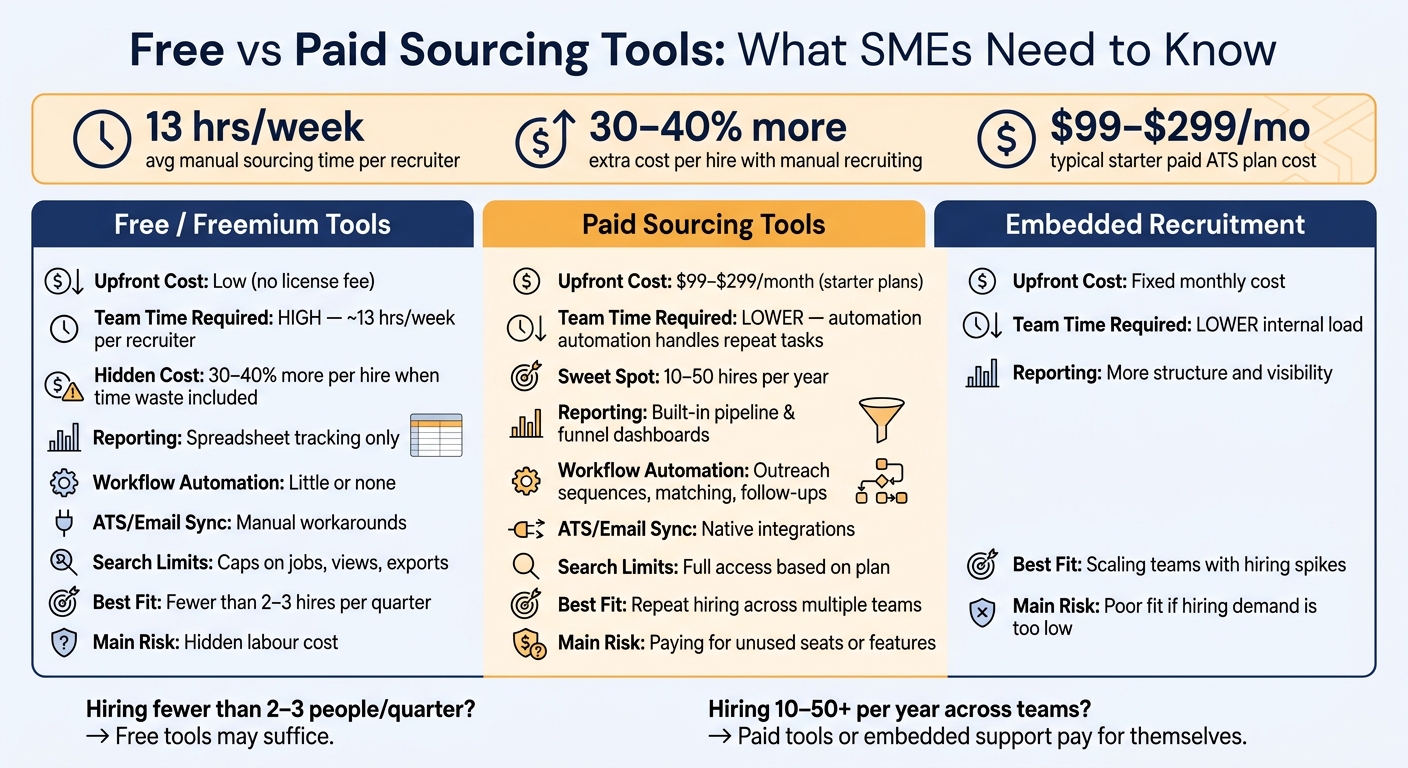
Free vs Paid Sourcing Tools: SME Cost & Efficiency Breakdown
Applicant Tracking Systems Demo | Free & Paid
For SMEs looking to scale without the overhead of traditional agencies, exploring Recruitment as a Service can provide a more predictable cost structure than managing multiple tool subscriptions.
sbb-itb-a23bd6a
Quick Comparison
| Setup | Upfront cost | Team time | Reporting | Best fit | Main risk |
|---|---|---|---|---|---|
| Free / freemium tools | Low | High | Limited | Fewer than 2 to 3 hires per quarter | Hidden labour cost |
| Paid sourcing tools | Monthly software cost | Lower | Built-in dashboards | Repeat hiring across teams | Paying for unused seats or features |
| Embedded recruitment | Fixed monthly cost | Lower internal load | More structure and visibility | Scaling teams with hiring spikes | Poor fit if hiring demand is too low |
The point is simple: I would not judge this choice by software price alone, much like evaluating a fractional recruiter based on hourly rate rather than output. I’d look at cost per hire, hours lost, and whether your current setup can keep pace with the next 6 to 12 months of hiring demand.
1. Free Sourcing Tools: Where They Help and Where They Fall Short
Common free options for search, Boolean building, and basic sourcing
Most SMEs begin with a simple sourcing setup: Boolean search, a browser extension for contact clues, a free ATS plan, and a spreadsheet to keep track of activity. It gets the job done, at least at the start.
A search like site:github.com "machine learning" "Austin, TX" -jobs can pull up very specific technical profiles without paying for a sourcing platform.[2] That gives a founder or HR generalist a usable way to search the market with no software spend. Browser extensions can also surface email patterns or partial contact details from LinkedIn profiles, which helps you build small prospect lists by hand.
Add a free ATS tier and the setup starts to look workable. For example, Zoho Recruit‘s free plan supports one active job at a time.[1] Free LinkedIn search is also limited. You get six basic filters, one free job at a time, and messaging only for first-degree connections.[5]
On paper, that looks lean. In practice, the question is simple: does this setup save your team time, or just avoid a software bill?
Where free tools work well for smaller or one-off hiring
For early-stage companies or teams hiring only now and then, free tools can work well. There is no license fee and no long contract, which matters when hiring plans change month to month. If leadership wants to test demand before approving spend, this kind of setup gives you a low-cost starting point.
It also gives small teams room to learn. You can test two outreach messages, compare response rates, try different metro areas, or sense-check how much talent exists for a role, all without waiting for budget sign-off.
That can be enough when hiring volume is low and the process stays simple.
The trouble starts when hiring becomes repeatable, shared across teams, or tied to growth targets.
The hidden costs of free sourcing for growing teams
The main issue is not the tool itself. It’s the manual work the tool leaves behind.
When recruiters or HR managers rely on a patchwork of free tools, they spend a lot of time copying candidate details between systems, logging outreach by hand, and chasing updates across inboxes and spreadsheets. One estimate puts manual sourcing work at about 13 hours per week per recruiter when automation is limited.[4]
That is not a small admin problem. It’s a capacity problem.
Once hiring becomes recurring, manual tracking turns into a bottleneck. Manual recruiting can cost 30% to 40% more per hire when recruiter time and process waste are included.[3] So while free tools cut upfront spend, they move the cost somewhere else, into your team’s time, slower follow-up, and less output per recruiter.
As hiring volume climbs, those hidden costs wipe out the early savings.
You see it most clearly in the day-to-day workflow.
| Factor | Free / Freemium Tools | Paid Tools |
|---|---|---|
| Time required | High, with a lot of manual work | Lower, with automation handling repeat tasks |
| Workflow automation | Little or none | Outreach sequences, matching, follow-ups |
| ATS/email/calendar sync | Weak, or manual workarounds | Native integrations with ATS, email, calendar |
| Search and export caps | Limits on jobs, views, searches, exports | Full access based on plan |
| Reporting | Spreadsheet tracking by hand | Built-in pipeline and funnel analytics |
| Scalability | Starts to break under more volume | Built to handle growing hiring demand |
At that point, paid tools are not just about convenience. They’re about capacity, control, and the cost of keeping hiring moving.
2. Paid Sourcing Tools: What SMEs Gain in Speed, Control, and Scale
The paid tool categories most relevant to growing companies
For SMEs, the goal is not to buy more features than you need. It is to get the right support for the hiring work in front of you.
Most paid sourcing tools sit in three groups: talent databases, ATS platforms with sourcing features, and AI workflow tools that automate search, outreach, and follow-up. Those features start to matter when hiring volume begins to climb.
For growing SMEs, the upside is simple: less admin, cleaner data, and faster progress across multiple open roles. That matters far more when hiring is repeatable and frequent, not just a once-in-a-while task.
When paid tools justify the monthly cost
A paid tool earns its keep when the time you save and the speed of hire outweigh the monthly fee. In plain terms, if your recruiters or hiring managers are spending hours on manual sourcing, chasing updates, and piecing together reports, the cost can start to make sense fast.
It tends to pay off when you:
- run several open roles at the same time
- involve multiple stakeholders in hiring decisions
- hire for the same IT recruitment roles again and again
Built-in reporting is another part of the case. It gives you visibility into time-to-fill, source quality, and funnel drop-off, which free tools usually cannot track.[9]
The tradeoffs SMEs should weigh before buying
Paid tools are not an automatic win. Setup takes time. If configuration is poor, or the team does not get proper training, adoption drops and spend gets wasted.
That is where many SMEs get caught out. They buy a platform with far more than they will use, then end up paying for features that never affect hiring results. As headcount or hiring volume grows, seat-based pricing can also push monthly costs higher than expected.[6][7][8][10][11]
The real test is simple: does the team use it? A tool that sits idle adds cost and nothing else. A mid-tier tool that your team uses every day will beat an advanced platform that gets ignored.
So the next step is not asking whether paid tools are better in general. It is asking whether your current hiring stage makes the spend worth it.
3. How to Pick the Right Sourcing Setup for Your Hiring Stage
Once the cost trade-off is clear, the next step is to match your setup to your hiring stage.
When free tools are enough and when paid tools make more sense
Start with two things: hiring volume and role complexity.
Free tools can work for occasional backfills. But once hiring becomes repeatable across teams, paid tools start to make more sense. If Sales, Product, and Engineering are all hiring at once, manual tracking usually falls apart. People end up chasing spreadsheet updates, and no one has a clean view of role status without asking around.
That has a direct business cost. You lose time, slow down decisions, and make it harder for leaders to spot bottlenecks early.
A simple framework for assessing total cost of ownership
Most SMEs compare sourcing tools as if the only number that matters is the monthly subscription. It doesn’t.
A better way to look at it is the full cost of running the process: recruiter time, hiring manager time, and delay costs, weighed against the monthly fee. If manual sourcing burns more time than a paid tool saves, the subscription is justified. You can also use an ROI calculator to compare these costs against potential savings. [12][13][14]
There are also costs that don’t sit neatly on an invoice. Reporting gaps matter. Candidate data ownership matters. If you can’t re-engage a strong candidate from six months ago because their details are buried in someone’s inbox, that’s a cost. If leadership can’t get a clear view of pipeline health, that’s a cost too.
Put simply, the cheapest tool on paper can end up being the most expensive setup in practice.
Where embedded recruiting support fits into the tool decision
If your main bottleneck is hiring capacity, not software, embedded support can fill that gap.
For SMEs scaling after funding, entering new U.S. markets, or dealing with a spike in open roles, the issue often isn’t which platform to buy. It’s whether you have enough bandwidth and process discipline to get results from any tool at all. Rent a Recruiter embeds experienced recruiters into your team to add capacity, structure, and visibility without stretching your internal team too thin. [15][16][17]
That leaves one practical question: what is the leanest setup that still supports growth?
4. Choose the Lowest-Cost Setup That Still Supports Growth
The cheapest tool on paper often turns into the more expensive setup once you factor in time, missed hiring windows, and strain on your team.
If you’re hiring fewer than 2 to 3 people per quarter, you can usually keep things lean. A free ATS tier, basic LinkedIn search, and a disciplined manual process are often enough at that stage. For many scaling teams, that setup keeps costs down without adding admin that you don’t need.
Your next 6 to 12 months of hiring demand should drive the decision. As hiring volume goes up, paid ATS cost per hire drops, which is why starter plans in the $99 to $299/month range start to make sense when you’re hiring in the 10 to 50 hires per year range [18][19].
There comes a point where this stops being a software issue and becomes a capacity issue.
Map your hiring demand for the next 6 to 12 months. Then look at how much time your team is spending on sourcing today, and compare that with a lean paid setup. If manual sourcing is eating 10 to 15+ hours a week, or if hiring delays are starting to hit revenue or delivery, it’s time to change the setup or add support.
If bandwidth is the bottleneck, embedded recruiting support can be the lowest-cost route that still keeps growth on track. Rent a Recruiter places experienced recruiters directly into your team within days, giving you more structure, visibility, and consistency in hiring.
Choose the leanest setup that keeps hiring moving as your business grows.
FAQs
How do I know when free tools stop being enough?
Free tools tend to stop working once manual recruiting costs you more than it saves.
That cost usually shows up in three places: lost time, patchy hiring results, and missed hiring opportunities. What looked cheap at the start can become expensive once your team is spending hours chasing feedback, scheduling interviews, and figuring out where each candidate stands.
You’ll often see the strain when you move past 10 hires per year or grow to around 15 to 50 employees. At that stage, hiring gets harder to manage with spreadsheets, inboxes, and basic tools.
Common signs include:
- Struggling to find candidate notes when your team needs them
- Manual interview scheduling creating bottlenecks
- Poor visibility into where candidates are in the pipeline
For hiring leaders, that’s the tipping point. The issue isn’t just admin hassle. It’s slower hiring, less control, and a higher risk of losing good people before you can make a decision.
What costs should I compare beyond the monthly software fee?
Look past the monthly software fee and focus on the total cost of ownership.
That means adding the internal time your team spends on screening, scheduling, and admin, across hiring managers, HR, and operations. A tool can look low-cost on paper, then quietly eat up hours across the business.
You should also include job ad spend, assessment tools, background checks, referral bonuses, vacancy costs, and replacement risk. That gives you a much clearer view of whether the tool is actually saving money and time, or simply pushing the workload back onto your team.
When is embedded recruiting support a better fit than new software?
Embedded recruiting support is often the better fit when your team needs more than tool adoption. If you need to build a hiring process that can scale and repeat, software alone won’t get you there.
Tools can automate admin. Embedded recruiting adds the human layer that shapes hiring strategy, improves sourcing channels, and manages delivery from start to finish.
This matters most when your internal team is stretched during growth. It also matters when you want to avoid traditional recruitment agency fees that climb with every hire.
An embedded recruiter gives you:
- Dedicated hiring capacity inside your team
- More consistent employer branding across every touchpoint
- A fixed monthly cost you can plan around
For scaling companies, that means more control, less wasted time, and a hiring function built to support growth.