
We see recruiter-hiring manager collaboration as a shared process, not a handoff. Before sourcing starts, agree on the business need, budget, assessment criteria, and who owns each step. Set a 24-hour feedback target to reduce waiting time and keep decisions moving.
Our approach puts five things in place:
- Clear requirements: Connect each hire to business goals and agree on compensation before the search begins.
- Named owners: Keep tasks, approvals, and decisions in one applicant tracking system.
- Consistent assessments: Use shared scorecards and independent ratings before discussing applicants.
- Shared metrics: Track hiring time, cost per hire, offer acceptance, and 30-, 60-, and 90-day results.
- Capacity checks: Review each search and add recruiting support when workload causes delays.
Start with one priority role. Measure where time and money go, then fix the bottlenecks. <u>Your team keeps final hiring authority</u>, including when we provide embedded recruitment support.
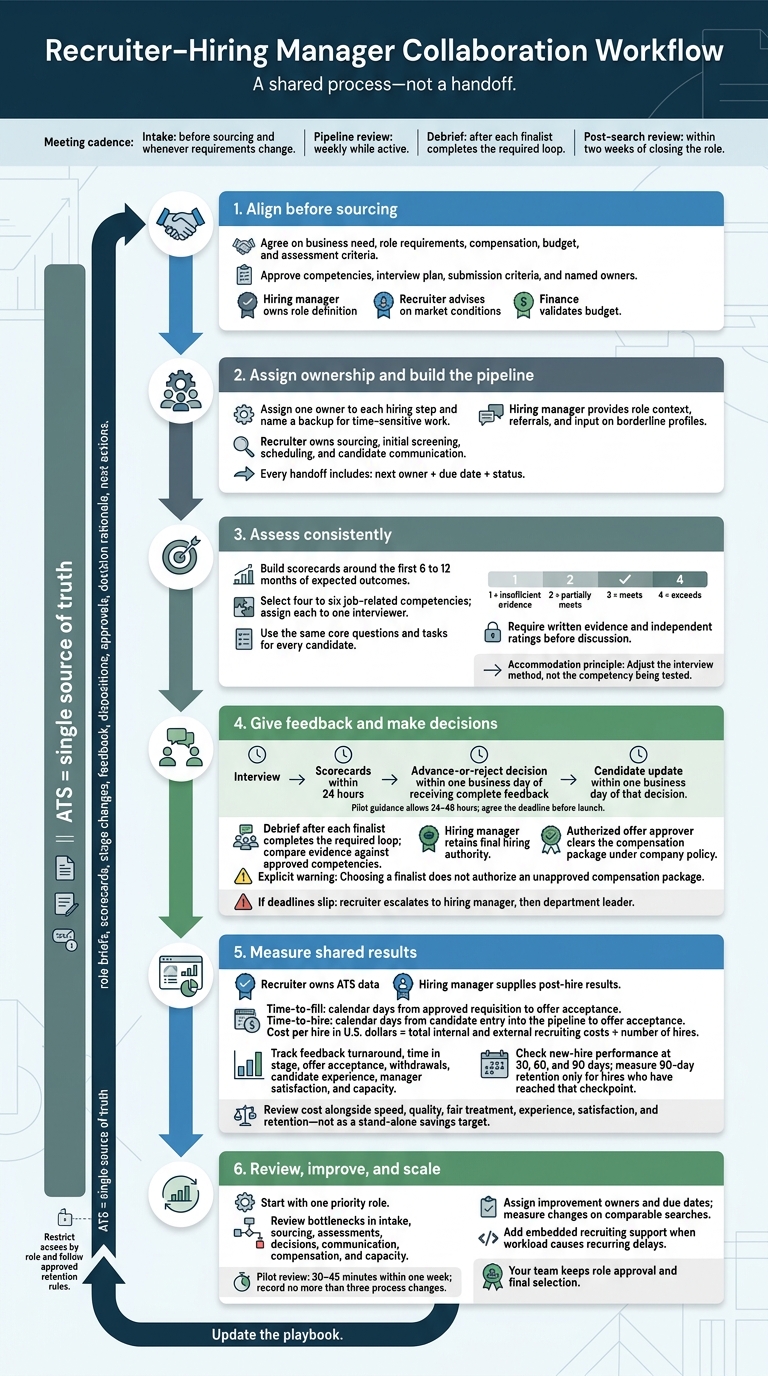
Recruiter–Hiring Manager Collaboration Workflow
Uniting Hiring Managers and Recruiters – Collaborative Recruitment Approach
sbb-itb-a23bd6a
Define Ownership Across the Hiring Process
Once the intake checklist is approved, assign one owner to each hiring step so work moves forward without confusion or missed handoffs.
Assign Roles at Each Hiring Stage
Use a RACI matrix to make responsibility clear. Replace the titles below with actual names.[5][7]
| Hiring stage | Responsible | Accountable | Consulted / informed |
|---|---|---|---|
| Role definition | Hiring manager | Hiring manager | Recruiter advises on market conditions; finance validates budget |
| Sourcing | Recruiter manages outreach and pipeline tracking | Recruiter | Hiring manager provides referrals and role context |
| Initial screening | Recruiter checks approved baseline qualifications and logistics | Recruiter | Hiring manager reviews borderline profiles |
| Technical or functional assessment | Named interviewers evaluate assigned competencies | Hiring manager | Recruiter checks process consistency |
| Scheduling | Recruiter arranges interviews | Recruiter | Hiring manager and interviewers provide availability |
| Interview feedback | Each interviewer records evidence for assigned competencies | Hiring manager | Recruiter tracks missing feedback and escalates delays |
| Hiring decision | Hiring manager evaluates documented evidence | Hiring manager | Interview panel recommends; HR advises |
| Offer approvals | Recruiter routes the package for approval | Named offer approver under company policy | Recruiter informs hiring manager |
| Candidate communication | Recruiter sends updates and coordinates offers | Recruiter | Hiring manager supports finalist conversations; HR handles specialized communications |
Name a backup for time-sensitive work. Every handoff needs a next owner, due date, and status so your team knows who acts next and when.
Keep candidate selection separate from offer authorization. Choosing a finalist does not authorize an unapproved compensation package.
Once you assign ownership, log every handoff in the ATS. Keeping the record in one place makes decisions visible and reduces time spent chasing updates.
Keep Hiring Records in the ATS
Make the ATS your single source of truth for role briefs, scorecards, stage changes, feedback, dispositions, and approvals. Each revision should show what changed, who approved it, and which active candidates it affects.[4][6]
Require only the minimum record needed at each stage. The recruiter logs candidate progress and next actions. Interviewers complete scorecards. The hiring manager records the decision rationale, and authorized approvers record offer clearance.
Use interview blocks and feedback reminders to keep work moving. Add a role dashboard showing aging roles, stage counts, overdue tasks, pending approvals, and blockers. Recruiters and hiring managers can then see progress and missed handoffs across searches without chasing separate updates.[9]
Restrict access by role, keep sensitive data out of informal channels, and follow counsel-approved retention rules.[4][8]
Use Consistent Candidate Assessments
Once ownership is clear, agree on how you’ll assess every candidate. Shared standards keep hiring decisions tied to the role’s requirements.
Create Competency-Based Interview Scorecards
Build your scorecard around the role’s first 6 to 12 months of expected outcomes. Select four to six job-related competencies from the approved intake checklist and assign each to one interviewer.
Use the same core questions and tasks for every candidate. Keep follow-up questions limited to clarification. Replace gut feel with observable skills: technical execution, customer judgment, collaboration, prioritization, or written communication.
Define the ratings before interviews: 1 = insufficient evidence, 2 = partially meets, 3 = meets, 4 = exceeds. Require written evidence for every rating, and calibrate interviewers before sourcing starts.[14]
Competency Behavioral anchor Interview question Assigned interviewer Rating Evidence Follow-up question Hire decision Technical problem-solving Identifies assumptions, tests alternatives, and explains tradeoffs Describe a production issue you diagnosed. What did you investigate first, and what changed as a result? Engineering manager 1–4 Actions, decisions, outcome What would you do differently now? Advance / Hold / No hire Customer judgment Balances customer needs, business impact, and delivery constraints Tell us about a time you declined or redesigned a customer request. Product manager 1–4 Decision process, measurable result How did you communicate the tradeoff? Advance / Hold / No hire Collaboration Shares relevant information, handles disagreement constructively, and follows through Describe a disagreement with a cross-functional partner. Peer interviewer 1–4 Behavior, resolution, outcome What did you learn? Advance / Hold / No hire
Explain the process in advance and give candidates a clear way to request reasonable accommodations. Adjust the interview method, not the competency being tested. Involve HR or an accommodation specialist, and share only the logistics interviewers need.[10][11][12]
Set Feedback Deadlines and Meeting Schedules
Agree on deadlines before sourcing starts:
- Submit scorecards within 24 hours of each interview.
- Make an advance-or-reject decision within one business day of receiving complete feedback.
- Update the candidate within one business day of that decision.
Set clear turnaround targets for submitted-candidate reviews and approvals as well. When deadlines slip, the recruiter escalates to the hiring manager, then the department leader.
Lock in the meeting schedule alongside the scorecard so decisions don’t stall while your team waits for feedback.
| Meeting | Participants | Purpose | Frequency | Outputs |
|---|---|---|---|---|
| Intake | Recruiter and hiring manager | Calibrate assessment standards | Before sourcing and whenever requirements change | Approved competencies, interview plan, submission criteria, owners |
| Pipeline review | Recruiter and hiring manager | Review progress, risks, delays, and candidate communication | Weekly while active | Pipeline status, priority actions, risks, sourcing changes, next communications |
| Debrief | Interview panel, recruiter, and hiring manager | Review independent ratings | After each finalist completes the required loop | Independent ratings reviewed, decision or documented next step |
| Post-search review | Recruiter, hiring manager, and key partners | Identify improvements | Within two weeks of closing the role | Metrics, process issues, lessons, agreed improvements |
Every submission must include a resume, evidence against the approved criteria, availability, and any recruiter concerns tied to those criteria.
If requirements change, pause submissions. Document the business reason, approve the revision, and apply it consistently to affected candidates.
Collect Independent Feedback Before Debriefs
Require independent ratings before interviewers discuss candidates or see other feedback. Each interviewer submits observed evidence, decision reasons, follow-up questions, and a recommendation.
During the debrief, recruiters and hiring managers compare evidence against the approved competencies, not personality or impressions. When ratings differ, ask which observation explains the gap.
Use a targeted follow-up only to fill gaps in evidence, not to get a preferred answer. The designated decision approver confirms the final rationale and unresolved risks. The recruiter then communicates the outcome.
Structured interviews give you comparable evidence. They don’t replace accountable judgment.[13]
Consistent scoring also makes search-level performance easier to measure.
Measure Hiring Results and Recruiting Capacity
Track Shared Hiring Metrics
Use one shared hiring dashboard. Your recruiter owns ATS data; your hiring manager supplies post-hire results.
Define time-to-fill as the days from approved requisition to offer acceptance. Define time-to-hire as the days from candidate entry into the pipeline to offer acceptance.[16][17] Use calendar days for both and track approval delays separately.
| Category | Metric and definition | Owner | Data source | Review |
|---|---|---|---|---|
| Process | Approval time: calendar days from hiring request submission to requisition approval | Hiring manager and finance/HR approver | HRIS or ATS approval timestamps | Monthly and during quarterly workforce planning |
| Process | Feedback turnaround: median business hours from an interview or submitted assignment to completed interviewer feedback | Interviewers; recruiter monitors | ATS scorecard timestamps | Weekly while a role is active |
| Process | Time in stage: calendar days a candidate remains in each stage | Recruiter; hiring manager acts on stalled stages | ATS stage-history report | Weekly |
| Process | Interview-to-offer ratio: offers made divided by candidates completing the defined interview stage | Recruiter and hiring manager jointly | ATS interview and offer records | After each search and quarterly by role family |
| Process | Offer acceptance rate: accepted offers divided by total offers made | Recruiter; hiring manager provides input on role and compensation factors | ATS and offer records | Monthly and after each search |
| Process | Candidate withdrawals: candidates who voluntarily leave before a decision, grouped by stage and reason | Recruiter | ATS disposition data and candidate survey or notes | After each search and quarterly |
| Process | Source quality: hires, qualified finalists, or successful 90-day employees by source | Recruiter, validated with the hiring manager | ATS source data plus HRIS performance and retention data | Quarterly, using a mature cohort |
| Outcome | Hiring-manager satisfaction: standardized rating of candidate quality, process clarity, recruiter partnership, and decision support | HR or recruiting operations collects; hiring manager responds | Short post-search survey | After each search |
| Outcome | Candidate experience: candidate rating of communication, scheduling, fair treatment, transparency, and respect | Recruiter or recruiting operations | Anonymous candidate survey and withdrawal reasons | After each search; aggregate quarterly |
| Outcome | New-hire performance: agreed 30-, 60-, or 90-day indicators, such as ramp milestones, manager assessment, or role-specific deliverables | Hiring manager, with HR support | Performance or onboarding system | At 30, 60, and 90 days |
| Outcome | 90-day retention: percentage of new hires still employed 90 days after their start date | HR or people operations | HRIS | Monthly or quarterly |
Calculate cost per hire in U.S. dollars by dividing total internal and external recruiting costs by the number of hires. Include labor, tools, advertising, assessments, travel, checks, referrals, and agency fees.[15][17]
Cost is not a stand-alone savings target. Review it alongside hiring speed, offer acceptance, assessment quality, fair-treatment indicators, candidate experience, manager satisfaction, and retention.[18]
Connect ATS and onboarding records using consistent requisition and hire IDs. Compare similar roles using medians rather than averages, and review stage-level results and distributions. For retention measures, include only hires who have reached the relevant checkpoint.
Track survey response rates and investigate selection-rate disparities with qualified HR or employment counsel.[19] Early performance and retention tell you where to investigate, but they do not prove recruiter effectiveness. Onboarding and manager support also affect results.
Use these findings to identify whether you need to rate your recruitment process, align hiring expectations, or add recruiting capacity.
Review Each Completed Search
Once the dashboard shows the outcome, review what drove it and what needs to change.
- Role and intake: Did requirements, level, compensation, location, and timing match the actual need?
- Sourcing and assessment: Which sources produced qualified finalists? Did evaluations fairly measure the approved competencies?
- Decisions and communication: Where did candidates wait, withdraw, or receive unclear information? These are common challenges in recruitment that impact conversion.
- Compensation and closing: Why did candidates accept or decline?
- Capacity and outcomes: Did recruiter workload limit delivery? Is the hire meeting ramp expectations?
- Next searches: Choose one or two changes, assign owners and due dates, and update the playbook. Measure their effect on comparable searches. Add performance and retention findings when those checkpoints arrive.
If delays or missed commitments keep recurring because recruiters are overloaded, address the capacity gap rather than treating it as process friction.
Add Embedded Recruiters to Fill Capacity Gaps
When your metrics show a capacity gap, add an embedded recruiter to own intake, sourcing, scheduling, reporting, and candidate communication. Your hiring manager keeps final decision authority. Rent a Recruiter can provide that support.
Conclusion: Put the Process Into Practice
Make collaboration a repeatable system with approved intake, clear ownership, shared records, structured scorecards, fast feedback, and post-search reviews. These practices help your team make faster decisions, cut administrative work, and plan hiring costs more predictably. Test the system on one critical role first.
Start With One Priority Role
Choose one business-critical opening rather than changing every requisition at once. Use the intake brief as your pilot standard.
Set an interview feedback deadline of 24-48 hours, with independent scorecards submitted before the debrief. Before launch, establish baselines in your shared dashboard for speed, quality, cost, and capacity. Once the pilot is live, track only the metrics that tell you whether the process is faster and cleaner. You can also rate your recruitment to identify other hidden inefficiencies.
Useful examples include time to first qualified candidate slate, time to decision, offer acceptance, withdrawals, and recruiter capacity.
Schedule a 30-45-minute post-search review within one week of offer acceptance or search closeout. Record no more than three process changes, each with an owner and due date. If capacity is the bottleneck, add embedded support.
Roll out the process to similar roles first, then adjust it by function. If capacity remains the bottleneck, Rent a Recruiter can add embedded recruiting support while your team keeps role approval and final selection.
FAQs
How do we resolve disagreements over candidate quality?
Replace subjective opinions with evidence-based assessment. During debriefs, recruiters should ask managers to back up vague feedback with specific evidence linked to the agreed-upon scorecard. Use consistent scoring and behavioral anchors so everyone assesses the same competencies against the same standards.
If disagreements persist, hold calibration sessions to address inconsistent evaluations or unconscious bias. Recruiters bring market context and oversee the process, while the hiring manager remains the single decision owner.
How can we secure buy-in from busy hiring managers?
Agree on ownership and timelines before sourcing starts. Run a structured 45-60-minute intake with all decision-makers. Define 2-3 non-negotiables and success metrics, then name one decision owner, typically the hiring manager. This gives your team clear criteria and accountability from the start.
Set service-level agreements (SLAs) to keep hiring moving. Require scored feedback within 24-48 hours of interviews and agree on a deadline for the final decision, for example, within 24-48 hours post-interview.
Use shared scorecards and one applicant tracking system (ATS) dashboard so everyone can see the pipeline in real time and assess candidates against the same criteria.
How do we distinguish process bottlenecks from capacity gaps?
Process bottlenecks mean work gets stuck at a hiring stage. Slow feedback, vague briefs that lead to rework, or approvals with no clear decision owner can all delay a hire.
Capacity gaps mean hiring demand exceeds your available staff or interview slots. Recruiters or managers become overbooked, overtime increases, scheduling takes more coordination, and roles stay open as hiring volume grows.
To tell which issue you’re facing, review time-to-fill, time spent in each stage, feedback turnaround, and weekly recruiter task time. These measures help you see whether you need to fix the process or add capacity. [1][2][3]