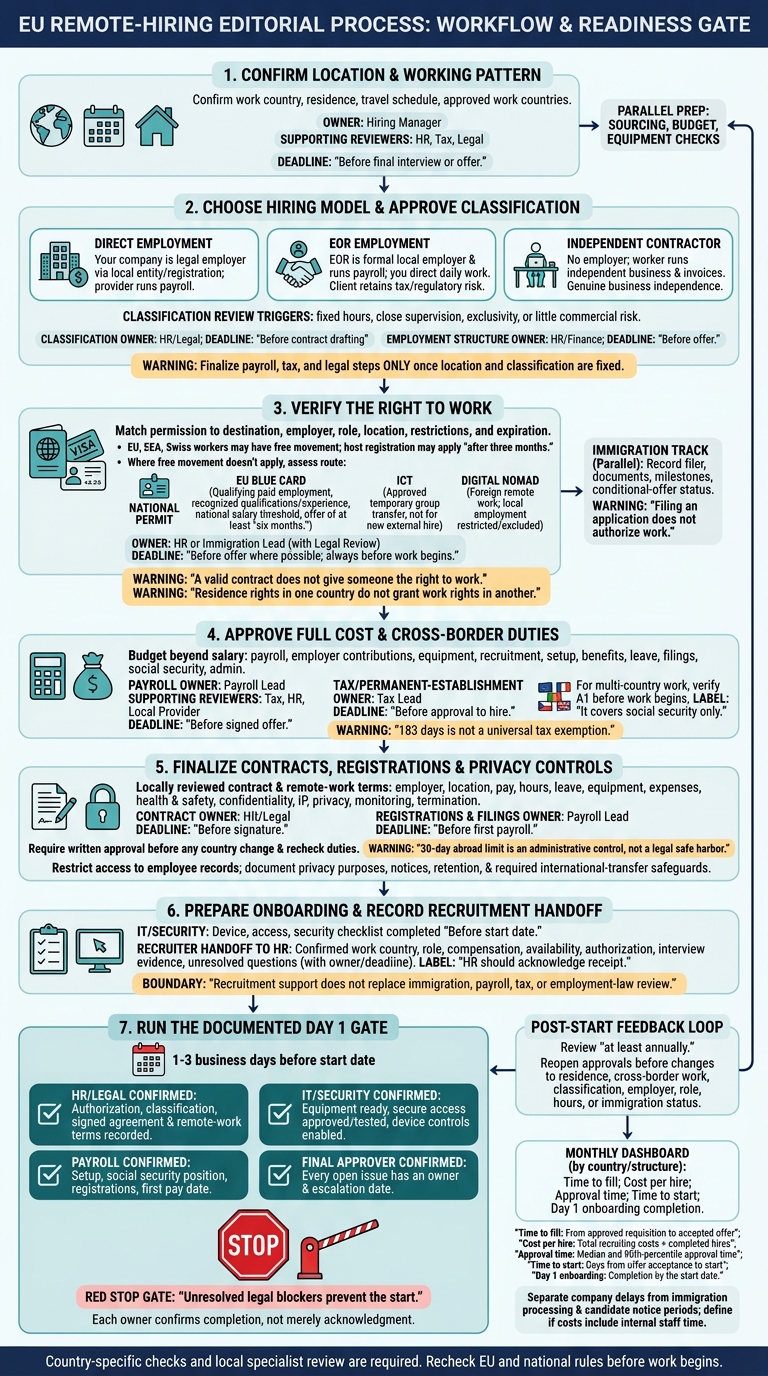
Before you hire remotely in the EU, confirm where the person will work, how you will employ them, and what the full cost will be. We recommend settling these points before making an offer so you can set a realistic budget and start date.
For your hiring team, that means:
- Choose the hiring model: Direct employment, an employer of record (EOR), or a contractor arrangement.
- Check the right to work: Match the worker’s permission to the country and role, with local specialist review.
- Budget beyond salary: Include payroll, employer contributions, equipment, recruitment, and setup costs.
- Assign clear owners: Give HR, finance, legal, and IT responsibility for approvals and onboarding.
- Track results: Measure cost per hire, approval time, and readiness for Day 1.
Our starting point: <u>resolve legal blockers before work begins</u>. A readiness check 1-3 business days before the start date helps your team catch missing steps before they delay the hire.
This guide brings those decisions into one hiring process, with recruitment as a service support kept separate from legal, tax, and payroll advice.
EU Remote Hiring: From Planning to Day 1
Remote Work in Europe: The Legal Risk
sbb-itb-a23bd6a
Choose the Hiring Structure and Authorization Route
Your hiring model and work authorization must match. A valid contract does not give someone the right to work.
Compare Direct Employment, EORs, and Contractors
Once you’ve confirmed the location, choose a model that matches the level of control, independence, and length of the engagement. Direct employment suits long-term roles when you can meet local employer duties. EOR arrangements are still employment under local law. Contractors must have genuine business independence.[5][7][8]
| Factor | Direct employment | EOR employment | Independent contractor |
|---|---|---|---|
| Legal employer | Your company, through a local entity or registration | The EOR is the formal local employer | No employer; the worker runs an independent business |
| Control over work | Your company generally controls duties, schedules, policies, and performance management | You direct daily work; the EOR handles formal employment administration | The contractor controls methods, schedules, and business operations |
| Payroll | Your company or its payroll provider runs payroll | The EOR runs payroll | The contractor invoices for services |
| Social security | Employer and employee duties apply under the relevant system | Usually administered through the EOR | The contractor generally handles contributions, unless national law requires otherwise |
| Setup | May require an entity, registration, payroll, employment documents, and compliance processes | Requires EOR due diligence, a service agreement, onboarding, and country eligibility checks | Requires valid business status, a contract, invoicing, tax documents, and evidence of independence |
| Main risk | Incorrect registration, payroll, or employment terms | Assuming an EOR removes all client-side tax, regulatory, or operational risk | Misclassification, back taxes, penalties, and reclassification as employment |
Review contractor classification if the arrangement involves fixed hours, close supervision, exclusivity, or little commercial risk. These details can expose your business to back taxes and penalties. With an EOR, confirm who makes employment decisions, carries liability, and handles payroll and social security duties.[5][7][8]
Once you’ve chosen the engagement model, check the worker’s right to work in that country.
Check Free-Movement Rights and Work Authorization
EU, EEA, and Swiss workers may have free-movement rights, but host-country registration may still apply after three months. Check the destination country’s rules. You can also review our hiring model FAQs for more on how different recruitment structures work.[4][10][13][14] Where free movement does not apply, identify the permit route that covers the role.
For other nationals, check the permit’s issuing country, employer, role, location, restrictions, and expiration date. Residence rights in one country do not grant work rights in another. Keep authorization evidence, assign responsibility for renewals, and check whether approval is required before work starts.[5][9]
Confirm the route before committing to a salary, start date, or onboarding plan.
Compare Work Permits and Remote-Work Visas
Match the candidate’s status to the correct route. Choose the shortest route that legally covers the work.
| Route | Typical eligibility | Permitted work | Income or qualification requirements | Duration and employer duties |
|---|---|---|---|---|
| National employment permit | Non-EU candidate with a qualifying job offer | Approved employment, often tied to an employer or role | National salary, qualification, or labor-market requirements | National limits apply; sponsorship, reporting, and renewal duties may apply |
| EU Blue Card | Highly qualified non-EU employee | Qualifying paid employment, not self-employment | Recognized qualifications or qualifying experience, a salary meeting the national threshold, and an offer of at least six months[11][12] | Country-specific validity; job-change, reporting, and mobility conditions apply |
| Intra-company transfer permit | Manager, specialist, or trainee moving from a non-EU group company to a related EU entity | Approved temporary assignment within the corporate group | Qualifying corporate relationship, prior employment, and role-specific criteria | Assignment limits apply; the employer must document the transfer and meet host-country rules |
| Digital nomad permission | Eligible remote worker serving a foreign employer or clients | Foreign remote work; local employment may be restricted or excluded | National income, insurance, and other eligibility requirements | National duration and renewal rules apply; tax and social security duties still apply |
Blue Card thresholds and procedures vary by country. An ICT permit is not the normal route for a new external hire.[3][6][8][11]
Check the destination country’s requirements against guidance from the relevant government or immigration authority.[5][9] Record the official source and verification date, then recheck before making the offer and before the start date.
Review Payroll, Employment Terms, and Cross-Border Duties
Work authorization alone is not enough. Once confirmed, map your payroll, tax, contract, and privacy duties before day 1 so hiring costs and flexible hiring model requirements are clear.
Set Up Payroll and Social Security
Before setting up payroll, confirm the employee’s work location, residence, employer entity, status, work pattern, start date, citizenship, and days worked across countries.
Your payroll and finance teams should check employer registration, withholding, contributions, mandatory benefits, and leave costs. Budget for setup, filings, social security, and recurring administration. Specify the pay currency and the method and timing for currency conversion. Keep payslips, filings, leave records, and location records for the required retention period.
For multi-country work, verify the A1 before work begins. It covers social security only, not tax residence, employment law, or immigration status.[18]
Review each cross-border arrangement separately for tax, payroll, employment law, and immigration. Match payroll setup to the contract terms for pay, location, and working time.
Write Remote-Work Terms and Location Rules
Use a locally reviewed contract that covers the employer, approved location, pay, hours, leave, equipment, expenses, health and safety, confidentiality, IP, privacy, monitoring, and termination.
Before day 1, verify identity, right to work, payroll data, registrations, equipment delivery, emergency contacts, and security training. These checks help prevent avoidable start-date delays.
Mandatory local protections can override your contract. Require written approval before any country change, including dates, address, and expected working pattern. Recheck payroll, tax, social security, immigration, employment law, safety, and privacy. Record the decision and next review date.
An internal 30-day abroad limit is an administrative control, not a legal safe harbor.
Assess Tax Risks and Data Protection
Your tax review should cover workdays, residence ties, treaty rules, duration, seniority, local activity, and authority to bind the company. 183 days is not a universal tax exemption. Treaty conditions vary.[2]
Include employee records, monitoring, and cross-border storage in your remote-hiring setup. Document applicable GDPR duties, lawful processing purposes, privacy notices, restricted access, processor agreements, and retention periods.
Monitoring must be necessary, proportionate, and disclosed beforehand. For transfers outside the EEA, use adequacy, approved safeguards, or a valid derogation, and disclose the mechanism to individuals.[15][16][17]
| Risk trigger | Possible consequence | Control | Owner |
|---|---|---|---|
| Regular work in another country | Withholding, tax-residence, or registration duties | Track workdays and review domestic and treaty rules | Tax adviser and payroll |
| Senior employee negotiates contracts or manages local operations | Permanent-establishment or business-registration exposure | Review actual duties and authority before approval | Tax adviser and legal |
| Broad access to employee records or intrusive monitoring | Excessive or unlawful processing | Restrict access; document purpose, proportionality, and retention | HR and privacy lead |
| HR records transferred outside the EEA | International-transfer requirements | Verify the transfer mechanism and required safeguards | Privacy lead and security owner |
Build a Repeatable EU Hiring Process
Assign Owners and Hiring Approvals
Turn the earlier compliance checks into one approval workflow. Give each decision one accountable owner, link the evidence, and record approval dates. Set earlier deadlines where local rules require them.
Keep one record per role so recruiting, HR, finance, payroll, legal, tax, and IT work from the same facts. This helps prevent repeated checks and late-stage delays.
| Decision | Accountable owner | Supporting reviewers | Required evidence | Approval deadline |
|---|---|---|---|---|
| Work location and travel pattern | Hiring manager | HR, tax, legal | Candidate’s declared residence, travel schedule, approved work countries | Before final interview or offer |
| Work authorization | HR or immigration lead | Legal, candidate | Passport or identity document, residence permit, visa, or application status | Before offer where possible; always before work begins |
| Worker classification | HR or legal | Finance, payroll | Employee-versus-contractor assessment and working arrangement | Before contract drafting |
| Employment structure | HR/finance | Legal, payroll | Direct-employer, EOR, or contractor decision | Before offer |
| Payroll and social security | Payroll lead | Tax, HR, local provider | Registration plan, payroll country, social-security determination | Before signed offer |
| Tax and permanent-establishment risk | Tax lead | Legal, finance | Written risk assessment and escalation decision | Before approval to hire |
| Contract terms | HR/legal | Hiring manager, payroll | Localized employment agreement and remote-work addendum | Before signature |
| Registrations and filings | Payroll lead | HR, finance | Registration confirmations and filing calendar | Before first payroll |
| Equipment and access | IT/security | Hiring manager, information security | Device, access, and security checklist | Before start date |
Run sourcing, budget, structure, and equipment checks in parallel to save time. Finalize payroll, tax, and legal steps only once location and classification are fixed.
Immigration follows its own timeline. Some applications require an offer or signed contract. Record who files, the required documents, milestones, and whether the offer is conditional. Filing an application does not authorize work.
Collect only the identity data needed for legal, payroll, or onboarding purposes. Store it in a secure system with role-based access, encryption, audit logs, controlled downloads, and retention rules. Provide the relevant privacy notice.[20][21]
Add Embedded Recruitment Support
Rent a Recruiter places recruiters inside your team to speed up sourcing, interview coordination, candidate communication, pipeline reporting, and handoffs.
Before final offer approval, the recruiter should hand HR the confirmed work country, role, compensation, candidate availability, authorization status, and interview evidence. Include unresolved questions, with an owner and deadline for each. HR should acknowledge receipt so the handoff is recorded.
Recruitment support does not replace immigration, payroll, tax, or employment-law review.
Track Costs and Check Readiness Before Day 1
Once approvals are in place, check whether your process is fast enough to repeat. Review a monthly dashboard by country and employment structure, covering:
- Time to fill: From approved requisition to accepted offer.
- Cost per hire: Total recruiting costs ÷ completed hires.[19]
- Approval time: Median and 90th-percentile approval time.
- Time to start: Days from offer acceptance to start.
- Day 1 onboarding: Completion by the start date.
Define whether costs include internal staff time. Separate company delays from immigration processing and candidate notice periods so you can see where your team can reduce waiting time.
Use a documented Day 1 gate, 1-3 business days before the start date, to verify legal, payroll, and working arrangements. Each owner must confirm completion, not just acknowledge a task.
- HR/legal: Authorization confirmed, classification approved, and signed agreement and remote-work terms recorded.
- Payroll: Setup, social-security position, required registrations, and first pay date confirmed.
- Hiring manager: Approved location and work pattern, onboarding schedule, and support channels confirmed.
- IT/security: Equipment ready, secure access approved and tested, and required device controls enabled.
- Final approver: Every open issue has an owner and escalation date. Unresolved legal blockers prevent the start.
Review the arrangement at least annually. Reopen approvals before changes to residence, cross-border work, classification, employer, role, hours, or immigration status.
Conclusion: Confirm Requirements Before Work Begins
Remote hiring in the EU requires a country-specific check. Once you’ve chosen the country, hiring structure, and authorization route, confirm the hire’s location, right to work, contract terms, payroll, and approvals together before work starts.
Recheck EU and national rules before the start date, and resolve any open points with local specialists. A residence permit or digital-nomad visa may allow residence or remote work, but it does not, by itself, authorize work for your company.[22]
Keep official-source checks and specialist advice in the hiring record. If a legal requirement remains unresolved, delay the start rather than allowing informal work.
If hiring as you scale, rather than compliance, is slowing recruitment capacity, book a call with Rent a Recruiter for hiring coordination. Leave legal, payroll, tax, and privacy decisions to specialists.
FAQs
Can my U.S. company hire EU workers without a local entity?
Yes, but direct hiring requires careful management of tax and compliance risks. It can create a permanent establishment in the worker’s country, potentially triggering corporate taxes, payroll obligations, and penalties.
Many companies use an Employer of Record (EOR) as the legal employer to manage payroll, taxes, and local employment compliance. This helps reduce those risks and lets you onboard workers quickly without setting up your own EU legal entity.
How do I estimate the full cost of an EU remote hire?
Base salary is only part of your hiring cost. Your budget also needs to account for compliance costs and the work required to manage payroll and HR:
- Permanent establishment risks: Potential corporate taxes, payroll obligations, and local registration requirements.
- GDPR compliance: Data processing agreements and safeguards for international data transfers.
- Worker classification and local labor law errors: Potential back pay, tax penalties, and legal fees.
- Administrative overhead: Maintaining compliant payroll and HR systems.
What if a remote employee moves countries without approval?
An employee working from another country may unintentionally create a permanent establishment for your company. This can trigger corporate tax liabilities, payroll obligations, penalties, and interest [1].
Reduce this risk with a written cross-border remote work policy that requires HR or finance approval before an employee relocates. Track employee locations and review them quarterly to spot approaching risk thresholds. Adjust duties or limit time in-country before your company faces legal exposure [1].