
Hiring fewer than 15 people annually? Recruitment agencies can save you money. Scaling fast with predictable hiring needs? In-house teams may lower your cost per hire.
Most companies overspend by 40–60% on recruitment because their hiring strategy doesn’t match their business needs. Here’s the bottom line:
- Recruitment agencies charge 15–30% of a hire’s salary but offer flexibility for low or unpredictable hiring volumes.
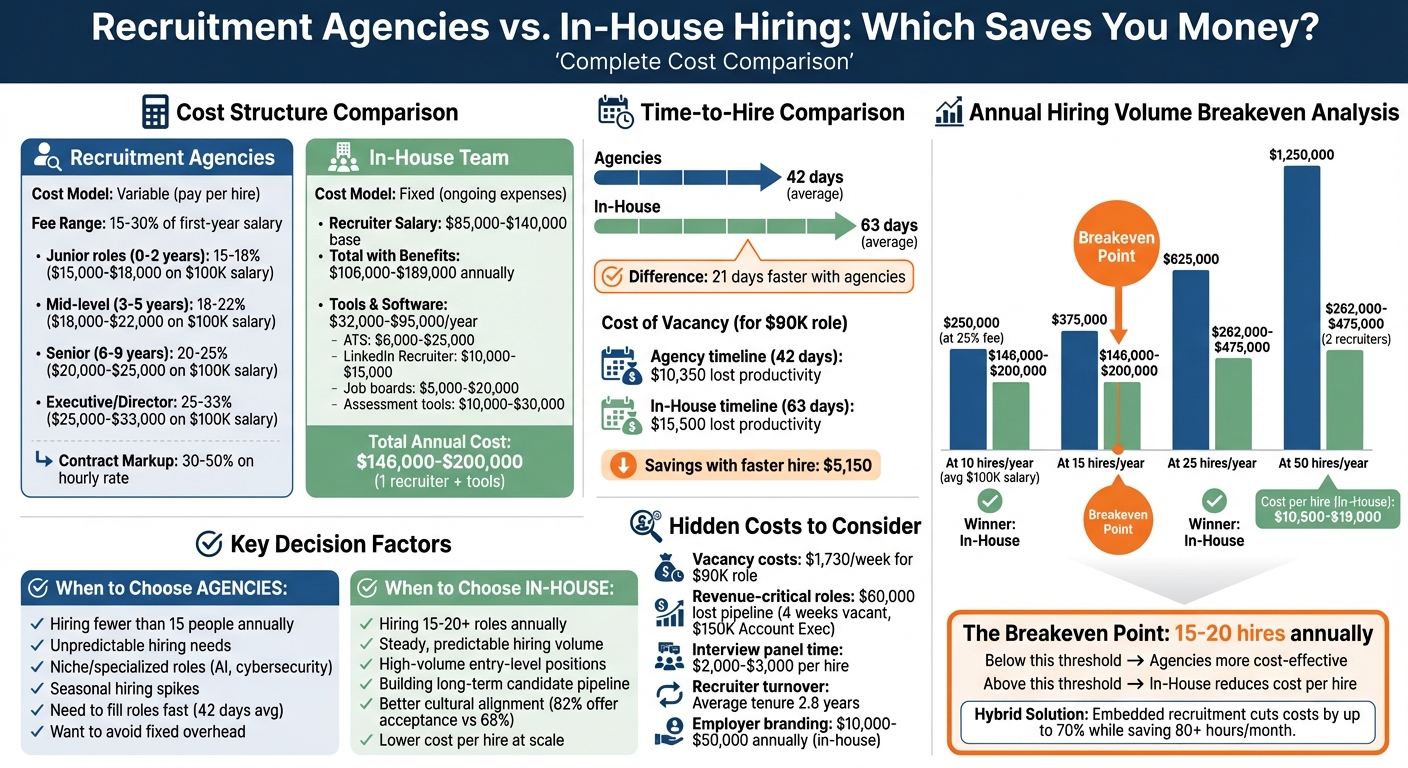
- In-house teams cost $146,000–$200,000 annually but become cost-effective when hiring 15–20+ roles per year.
Key takeaways:
- Agencies fill roles faster (42 days vs. 63 days for in-house), reducing vacancy costs.
- In-house teams provide better alignment with your long-term hiring goals.
- The breakeven point is around 15–20 hires annually – below that, agencies are more cost-efficient.
If your hiring needs fluctuate or require niche expertise, agencies may be the better option. For steady, high-volume hiring, an in-house team reduces costs over time. A hybrid approach, like embedded recruitment, balances flexibility and control while cutting costs by up to 70%.
Recruitment Agencies vs In-House Hiring Cost Comparison
AGENCY VS IN-HOUSE RECRUITMENT | What is a BETTER option for you? (2021)
sbb-itb-a23bd6a
Cost Per Hire: Agencies vs. In-House Teams
Breaking down the direct costs of comparing different recruitment models helps you make smarter decisions.
What Recruitment Agencies Charge
Recruitment agencies usually operate on a contingency fee model, charging 15–30% of a candidate’s first-year salary. The exact percentage depends on the role’s seniority and how challenging it is to fill. For example, hiring a mid-level software engineer with a $100,000 salary might cost $18,000–$22,000 in fees. Specialized or senior roles often push fees to 20–25%, while executive-level positions can range between 25–33% of the salary [3].
Here’s a quick breakdown of agency fees by role level:
| Role Level | Fee Percentage | Example Cost (at $100K salary) |
|---|---|---|
| Junior (0–2 years) | 15–18% | $15,000–$18,000 |
| Mid-Level (3–5 years) | 18–22% | $18,000–$22,000 |
| Senior (6–9 years) | 20–25% | $20,000–$25,000 |
| Executive/Director | 25–33% | $25,000–$33,000 |
For contract staffing, agencies often add a 30–50% markup to the contractor’s hourly rate. For instance, a DevOps engineer billing at $85 per hour could cost you $110–$123 per hour after the markup [3].
"Contingency recruiting is transactional by design. The agency’s incentive is to fill the role quickly, not necessarily to find the best fit." – Exodata [3]
Building an in-house hiring team, however, involves a different cost structure altogether.
What In-House Hiring Costs
Running an in-house recruitment team comes with fixed costs, regardless of how many hires you make. A technical recruiter’s base salary typically ranges from $85,000 to $140,000. When you factor in benefits and other overhead, those costs rise to $106,000–$189,000 annually [1][3].
Beyond salaries, you’ll need to invest in recruitment tools. Here’s a snapshot of potential expenses:
- Applicant Tracking System (ATS): $6,000–$25,000 per year
- LinkedIn Recruiter seats: $10,000–$15,000 each
- Job board postings: $5,000–$20,000 annually
- Sourcing and assessment tools: $10,000–$30,000 annually
Altogether, your yearly tool costs could range from $32,000 to $95,000 [3].
You also need to account for the time hiring managers and interview panels spend on each hire – typically 20–30 hours, translating to $2,000–$3,000 in lost productivity. Lastly, with the average recruiter staying in their role for just 2.8 years, you may face recurring costs for backfilling and onboarding [1].
Cost Per Hire Comparison
When you compare these models, the financial advantages shift depending on how many people you need to hire. For example, if you’re making 10 hires per year at an average salary of $100,000, recruitment agency fees (at 25%) would total $250,000. Meanwhile, an in-house setup – including one recruiter and the necessary tools – would cost between $146,000 and $200,000. At 25 hires annually, agency costs jump to $625,000, while in-house costs range from $262,000 to $475,000 [3].
A single recruiter can typically handle 15–25 open roles and close 3–5 hires per month. If your hiring needs are fewer than 15 hires a year, the fixed costs of an in-house team may outweigh the benefits. But as your hiring volume grows, the cost per hire drops, making in-house recruitment more cost-effective. The breakeven point? Around 15–20 hires annually. You can use an embedded recruitment savings calculator to see how these volume shifts impact your specific budget.
Total Cost of Ownership: Beyond the Obvious Expenses
The upfront price tag rarely paints the full picture. Hidden costs can quietly disrupt budgets, particularly when comparing in-house teams and recruitment agencies. Let’s break down these often-overlooked expenses.
Fixed Costs of In-House Teams
Running an in-house recruitment team comes with predictable costs – salaries, office space, and benefits, which typically add 20–30% to base compensation. Even when hiring slows down, these expenses don’t disappear, increasing the cost-per-hire during quieter periods [4].
Then there’s employer branding. Maintaining a career page, updating engineering blogs, and managing social media might not seem like recruitment costs at first glance, but they often fall under marketing budgets. These efforts can quietly add $10,000–$50,000 annually [3].
Variable Costs of Recruitment Agencies
Recruitment agencies operate differently. They charge only when they deliver results, which shifts financial risk off your balance sheet [2]. This model is appealing when hiring needs are unpredictable or when testing new markets without committing to permanent staff. But that flexibility comes at a price. Agency fees, typically 15–30% of a hire’s salary, can escalate quickly as hiring scales. And while you gain the hire, you don’t retain long-term benefits like a candidate pipeline or deeper market insights. Agencies also provide 60–90 day replacement guarantees, which can reduce the risk of a poor hire [4].
Total Cost Comparison
Beyond direct costs, vacancies themselves can significantly inflate recruitment expenses. For instance, leaving a senior engineer role unfilled for four weeks could cost $15,000–$25,000 in lost productivity and team strain [3]. The stakes are even higher for revenue-generating roles. A A $150,000 Account Executive vacancy could result in $60,000 in lost revenue over the same period50,000 Account Executive vacancy could result in $60,000 in lost revenue over the same period, highlighting the need for predictable recruitment models [1].
"The biggest cost isn’t the recruiter’s salary – it’s the Vacancy Cost." – Hirefex [2]
Additionally, interview panels add another layer of expense. Each hiring decision can cost $2,000–$3,000 in lost productivity. Scale that across 20 hires, and you’re looking at $40,000–$60,000 – costs that often remain invisible on recruitment invoices [3].
Time-to-Hire: How Speed Affects Costs
The speed of hiring doesn’t just impact timelines – it directly influences recruitment costs. Every day a role stays vacant drains both productivity and revenue. Let’s break down how recruitment agencies and in-house teams compare when it comes to speed and the financial impact of delays.
Recruitment Agencies: Faster Turnaround
On average, recruitment agencies fill roles in 31–45 days, with the median being 42 days [5]. This efficiency comes from their access to pre-screened candidates and active databases, allowing them to deliver shortlists within 10–14 days for critical roles like sales or product launches [5].
For a $90,000 position, a 42-day time-to-hire equates to approximately $10,350 in lost productivity [5]. Agencies’ ability to shorten hiring timelines can significantly reduce these costs, especially for roles that directly impact revenue.
In-House Hiring: Slower Process
In-house recruitment typically takes 45–70 days, with a median of 63 days [5]. That’s about three weeks longer than the average agency timeline. For the same $90,000 role, this extended timeframe results in $15,500 in lost productivity, a difference of $5,150 compared to agency hiring [5]. This gap often outweighs the savings companies believe they achieve by avoiding agency fees.
The challenge intensifies when internal recruiters juggle 6–12 open positions at once [1]. Hiring managers also spend significantly more time per hire – 15–25 hours compared to just 6–10 hours when working with an agency [1].
The True Cost of Empty Positions
To estimate weekly productivity loss, divide the annual salary by 52 [5]. For a $90,000 role, that’s roughly $1,730 per week in lost output [5].
Revenue-driving roles create even greater financial strain. For instance, a $150,000 Account Executive generating $800,000 annually can cost around $60,000 in lost pipeline for every four weeks the position remains open [1]. By cutting time-to-hire by 14 days across 10 revenue-critical roles (each valued at $120,000), companies could recover nearly $230,000 in annual revenue [1].
"Every extra week a revenue-critical role sits open costs you in missed sales, delayed product launches, or overworked existing team members." – Alivio Search Partners [1]
Scalability and Flexibility: Which Model Fits Your Needs
When deciding how to manage recruitment, scalability and flexibility are key considerations. In-house teams come with fixed costs, regardless of hiring volume, while agencies charge only for successful placements [2]. This difference becomes critical during periods of rapid growth or slower hiring cycles.
An internal recruiter typically manages around 8 active roles at once [1]. During hiring surges, this capacity can be quickly exceeded, often leading businesses to rely on costly agency support [1]. On the other hand, when hiring slows, the fixed expenses of salaries and tools for internal teams can strain budgets.
Here’s a closer look at when each approach makes the most financial sense.
When In-House Hiring Works Best
If your hiring needs are steady and predictable, in-house teams can offer distinct advantages. For example, companies regularly filling 50+ entry-level roles with consistent demand can justify the fixed costs of internal recruiters. A two-recruiter team with annual costs ranging from $262,000 to $475,000 can reduce the per-hire cost to $10,500–$19,000 [1].
Beyond cost, internal recruiters bring a deeper understanding of your business. They align closely with your values, team dynamics, and long-term goals, which often leads to better hiring outcomes. Internally sourced candidates accept offers at a rate of 82%, compared to 68% for agency-sourced candidates [1]. However, with an average recruiter tenure of just 2.8 years [1], turnover can disrupt this institutional knowledge, creating gaps that may affect hiring efficiency.
When Agencies Are the Smarter Option
For businesses facing unpredictable hiring needs, agencies offer the advantage of variable costs. This approach is particularly useful during hiring surges, such as after securing funding, launching a product, or handling seasonal spikes. By paying per hire, companies avoid the ongoing expenses tied to a permanent in-house team.
"In-house teams are a fixed cost in a variable-demand environment." – Alivio Search Partners [1]
Agencies also excel in sourcing niche technical talent, like AI or cybersecurity experts, by leveraging specialized networks and up-to-date candidate databases. They can deliver shortlists in as little as 10–14 days [6]. For smaller businesses hiring fewer than 10–15 roles annually, paying 20–30% of the hire’s salary is often more cost-effective than maintaining a full-time recruiter [1].
This flexibility makes agencies a practical choice for businesses navigating seasonal or unexpected hiring spikes.
Finding the Right Balance
To decide between these models, start by evaluating your annual hiring volume and how predictable your needs are. High, steady demand typically favors an in-house team, while irregular or specialized hiring often points toward agency support.
For mid-sized companies, a hybrid approach can offer the best of both worlds. Embedded recruitment solutions, like Rent a Recruiter’s model, provide dedicated recruiters who integrate with your team for a fixed monthly fee. This combines the cultural alignment of in-house hiring with the flexibility of external support. Businesses using this approach often cut hiring costs by up to 70% compared to traditional agency fees and save over 80 hours a month on administrative tasks.
Ultimately, your choice will depend on whether your business needs consistent recruitment capacity or the ability to scale up and down with demand. Fixed costs are ideal for steady hiring, while variable costs are better suited for managing fluctuating needs.
Summary and Next Steps
Deciding between recruitment agencies and building an in-house hiring team depends on your hiring needs and budget. Recruitment agencies typically charge 18–30% of a candidate’s salary per placement, offering speed and convenience. On the other hand, maintaining an in-house team costs between $106,000 and $175,000 annually but provides stronger alignment with your company’s values when hiring volumes justify the expense [1][3].
Key Differences Between Agencies and In-House Teams
The main cost distinction lies in how each model operates: agencies charge variable fees based on placements, while in-house teams come with fixed overhead costs. With agencies, you only pay when they successfully fill a role, shifting financial risk away from your business. In contrast, in-house teams incur expenses whether you’re hiring a handful of employees or filling dozens of roles. For equivalent positions, agency fees may exceed internal recruitment costs, especially when factoring in the cost of unfilled vacancies [5].
Time-to-hire is another key factor. Agencies typically fill roles in 42 days, compared to 63 days for in-house teams [5]. For roles that directly impact revenue, such as Account Executives, those extra three weeks could translate to $60,000 in lost opportunities [1]. However, candidates sourced through agencies accept offers at a lower rate – 68% compared to 82% for internally sourced candidates – potentially extending the overall hiring timeline [1].
How to Choose the Right Approach for Your Business
Your decision should reflect your hiring volume and the complexity of your roles. If you’re hiring fewer than 10–15 people annually, agencies can be more cost-effective by eliminating the need for recruitment tools and full-time salaries [1][3]. For companies with steady hiring needs of 50+ roles annually – particularly predictable, entry-level positions – an in-house team can reduce per-hire costs to $10,500–$19,000 [1].
Role complexity and urgency also matter. Use agencies for specialized positions like AI engineers or cybersecurity experts, where their expertise and networks justify the fees. For high-volume, entry-level roles with a strong applicant flow, internal teams are better equipped to manage the process efficiently [5]. If your hiring needs fluctuate due to funding rounds, product launches, or seasonal demands, agency models can help you avoid the burden of fixed overhead during slower periods.
Enhance Your Hiring Process
A hybrid model might be the most effective solution for many businesses. If you’re growing steadily but want to avoid the high fees of traditional agencies or the fixed costs of an in-house team, Rent a Recruiter offers a flexible alternative. With this approach, experienced recruiters are embedded into your team for a fixed monthly fee, giving you the benefits of in-house recruitment – like cultural alignment and control over your pipeline – without the long-term commitment.
Our clients typically reduce hiring costs by up to 70% and save over 80 hours each month on administrative work. You retain ownership of your candidate pipeline, strengthen your employer brand, and establish a scalable recruitment process – all without the unpredictability of per-placement fees or the burden of permanent headcount.
Curious about how much you could save? Visit rentarecruiter.com to calculate your potential savings or schedule a call to discuss your hiring strategy.
FAQs
How do I calculate my true cost per hire?
To get an accurate picture of your hiring costs, use this formula: (Total Internal Costs + Total External Costs) ÷ Total Number of Hires.
Make sure you account for both direct and hidden expenses. Direct costs include things like recruiter salaries and job advertising. But don’t stop there – hidden costs can add up fast. Think about:
- Time spent on interviews by your team
- Subscriptions for tools like your ATS
- Lost productivity while roles remain unfilled
- Expenses tied to onboarding new hires
These factors are easy to overlook but can heavily impact your bottom line. For senior positions, the stakes are even higher. Vacancies in key roles often result in lost revenue that can far outweigh the direct hiring costs.
When does an in-house recruiter pay for itself?
When you bring an in-house recruiter on board, they can quickly justify their cost by cutting down on external agency fees and streamlining the hiring process. The key is steady hiring needs. If your company consistently hires, the savings from reduced agency reliance and improved efficiency can outweigh the fixed costs of salaries, benefits, software, and overhead tied to an in-house team. The tipping point varies based on how many roles you’re filling and how specialized those roles are.
What’s the cheapest way to handle hiring spikes?
Using external recruitment agencies can be one of the most budget-friendly solutions for handling sudden hiring surges. These agencies are designed to move quickly, often filling roles in just 20–30 days, and they can ramp up efforts as needed without the overhead of maintaining a dedicated in-house team. For specialized roles, where in-house hiring costs can soar past $20,000 per hire, agencies offer a more flexible option. Their fees typically range between 20–25% of the candidate’s first-year salary, making them a practical choice for businesses with unpredictable hiring demands.