Your recruitment vendor contract should control hiring costs, not leave you paying for someone else’s mistakes. We recommend agreeing who does the work, who makes hiring decisions, and who pays when things go wrong before you sign.
Check five areas:
- Scope and fees: Define tasks, approvals, deliverables, and charges.
- Claims and liability: Confirm who funds the defence, pays claims, and bears costs above agreed limits. A 12-month fee cap is a starting point, not a rule.
- Insurance: Check that policies cover the work and risks you are assigning.
- Data and access: Set rules for candidate information, system permissions, and incident reporting.
- Exit terms: Agree how records, accounts, and unfinished hiring work transfer when the contract ends.
Our starting point is simple: <u>match responsibility to control</u>. Have the right internal owners and qualified counsel approve the terms so contract gaps do not become extra costs or hiring delays.
Understanding the Importance of Indemnification Clauses
sbb-itb-a23bd6a
Define Each Party’s Responsibilities
Define the work before assigning financial risk. Set out who handles each task and who makes the decisions. Keep recruiting support separate from temporary staffing so the contract reflects the service you’re buying.
List Hiring Duties and Fees in the Statement of Work
Use the statement of work (SOW) to spell out tasks, deliverables, and fees. Assign responsibility for organizing candidate information, evaluating candidates against pre-configured criteria, and handling candidate communications.
Include screening records and draft candidate messages as required deliverables. Require approval before any outbound candidate message is sent, and restrict mailbox access to authorized roles.[3]
Clarify Who Controls Employment Decisions
Recruiting support does not mean decision authority. The client should review all vendor-provided outputs, carry out required human review, and make the final employment decisions. Assign responsibility for required notices and for approving how candidate data is collected and used.[3]
For temporary staffing, make sure the contract reflects actual supervision and control. Contract labels alone do not determine employment status or joint-employer risk. These role definitions set the baseline for indemnity and liability limits.
Match Indemnification and Liability Limits to Risk
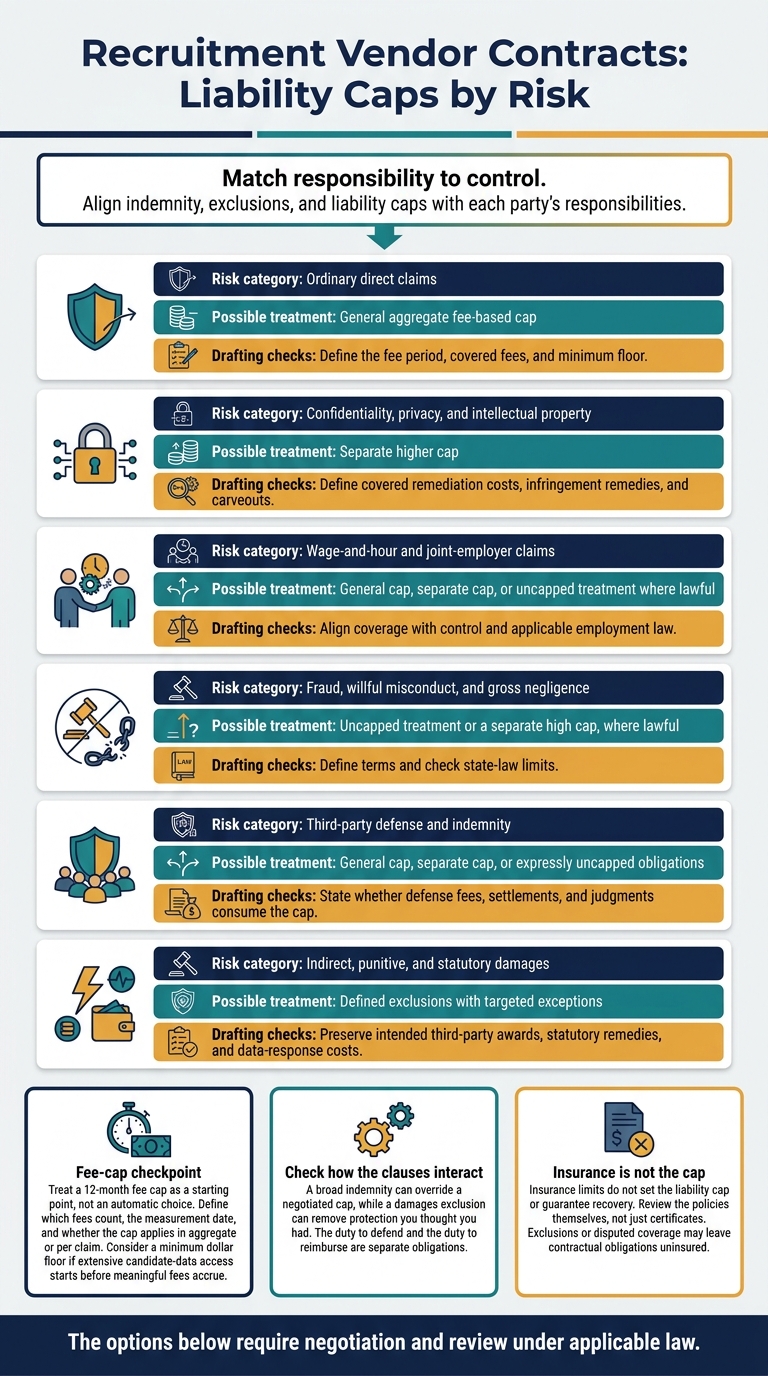
Recruitment Vendor Contracts: Liability Caps by Risk
Align indemnity, exclusions, and liability caps with each party’s responsibilities. Your contract should address vendor-caused hiring, privacy, and employment claims without leaving gaps in protection. A broad indemnity can override a negotiated cap, while a damages exclusion can remove protection you thought you had. Match obligations to each party’s control, exposure, and available insurance.
Define Which Claims Indemnity Covers
Specify the third-party claims covered and the conduct that triggers indemnity. Tie coverage to losses caused by defined acts, not claims merely related to the agreement.
Include negligence, misconduct, specified breaches, and legal violations involving confidentiality, candidate data, intellectual property, wage-and-hour rules, or joint-employer claims. Exclude company-caused losses from the vendor’s indemnity and allocate responsibility according to control.
Spell out which defense, investigation, and candidate-notification costs are covered, and whether direct losses are recoverable. Have counsel review state-law requirements, particularly where either party must cover the other’s negligence.[4][6]
Set Rules for Claim Defense and Settlement
Once covered claims are defined, assign control of the defense and settlement. The duty to defend and the duty to reimburse are separate obligations. State whether defense funding starts when a claim is tendered or only after coverage is confirmed.
Require written notice. Late notice should reduce obligations only if it materially harms the defense.
Specify who controls the defense and require qualified counsel. Set exceptions for conflicts, failure to defend, or claims seeking injunctive relief. Require both parties to cooperate and preserve records.
Require prior written settlement consent for admissions, payments, continuing duties, or settlements that lack a full release. These duties should survive termination for claims arising from work performed during the contract term.
Set Liability Caps and Exclusions by Risk
Treat a 12-month fee cap as a starting point, not an automatic choice. Define which fees count, the measurement date, and whether the cap applies in aggregate or per claim. Consider a minimum dollar floor if extensive candidate-data access starts before meaningful fees accrue.
Match each risk category to the exposure. The options below require negotiation and review under applicable law.
| Risk category | Possible treatment | Drafting checks |
|---|---|---|
| Ordinary direct claims | General aggregate fee-based cap | Define the fee period, covered fees, and minimum floor. |
| Confidentiality, privacy, and intellectual property | Separate higher cap | Define covered remediation costs, infringement remedies, and carveouts. |
| Wage-and-hour and joint-employer claims | General cap, separate cap, or uncapped treatment where lawful | Align coverage with control and applicable employment law. |
| Fraud, willful misconduct, and gross negligence | Uncapped treatment or a separate high cap, where lawful | Define terms and check state-law limits. |
| Third-party defense and indemnity | General cap, separate cap, or expressly uncapped obligations | State whether defense fees, settlements, and judgments consume the cap. |
| Indirect, punitive, and statutory damages | Defined exclusions with targeted exceptions | Preserve intended third-party awards, statutory remedies, and data-response costs. |
Insurance limits do not set the liability cap or guarantee recovery. Review the policies themselves, not just certificates. Exclusions or disputed coverage may leave contractual obligations uninsured.[5]
Check Insurance, Compliance, and Data Protection
Check Whether Insurance Covers Contract Risks
Check coverage against the risks in your contract, not just whether the provider has insurance.
Request an insurance schedule covering commercial general liability, professional liability, cyber liability, workers’ compensation, and employment practices liability, as applicable to the services and employment relationships. Record limits, deductibles or self-insured retentions, policy dates, and endorsements.
Review exclusions for recruiting advice, contractual liability, privacy incidents, and employment claims. Check the scope of any additional-insured endorsement. Additional-insured status does not automatically cover professional negligence, employment claims, or privacy violations.
Require notices of cancellation and material reductions in coverage, subject to what the insurer provides. Add a separate obligation for the vendor to notify you.
For claims-made policies, check when coverage starts, not just when it expires. The retroactive date should precede the vendor’s work. Specify reporting deadlines, coverage continuity requirements, and who pays for tail coverage after termination.
Assign Hiring Compliance and Candidate Data Duties
Insurance does not replace clear accountability. Your contract must assign hiring compliance and data-handling duties so neither party assumes the other owns the task.
Attach a responsibility matrix covering discrimination prevention, accommodations, background checks, wage-and-hour compliance, classification, payroll, and applicable state hiring rules. The EEOC treats staffing firms and clients as potentially sharing these obligations.[7]
Avoid relying on a generic FCRA compliance clause. Name who provides the stand-alone disclosure, obtains written authorization, supplies pre-adverse-action materials, handles disputes, and sends final notices.[2][8][9]
Require approval before automated hiring tools are used. Assign any applicable notice, audit, accessibility, and human-review duties.
Use a separate data schedule to define system access, retention, and incident-response duties. It should set:
- Incident-notification deadlines, cooperation duties, retention periods, deletion rules, and records-access rights.
- Confidentiality terms, permitted uses, subcontractor approval, and security safeguards.
- Responsibilities for applicable state privacy notices and candidate rights requests, including who responds.
Require multifactor authentication and least-privilege access, and prohibit unapproved reuse of candidate information.
Define Decision Rights for Embedded Recruiters
Recruiters working inside your team need clear limits on access and authority. Define what they can do independently and what needs your approval.
For embedded recruiters, specify which systems they may access, which messages they may send, and which actions require company approval. Reserve job criteria, pay, accommodations, background checks, and offers for designated company approvers.
Name escalation contacts for complaints, disputes, and data incidents. Require activity logs, weekly reporting, and prompt access removal when assignments end.
Conclusion: Review the Contract Before Signing
Treat signing as a cross-functional approval step. HR, finance, security, and qualified U.S. employment and commercial counsel should each sign off on their areas of responsibility before you commit[1].
Assign Evidence Checks and Approval Owners
Use this checklist to record the evidence reviewed and who owns each approval. Escalate unresolved risks with counsel’s recommendation.
| Clause or review step | Risk | Evidence to request | Approval owner |
|---|---|---|---|
| Service scope and control | Duties and fees do not align | Statement of Work (SOW) | HR / Finance |
| Fees and payment terms | Unexpected charges | Fee schedule | Finance / HR |
| Indemnity triggers | You assume costs for third-party claims | Indemnification clause | Counsel / Finance |
| Liability limits | Exposure exceeds agreed protection | Limitation-of-liability clause | Counsel / Finance |
| Insurance | Coverage does not match contract risk | Policy evidence, including relevant endorsements | Finance / Counsel |
| Data and records procedures | Failure to meet candidate privacy and security obligations | Privacy policy, data-retention schedule, and security controls | Security / Counsel |
| Decision liability | Discriminatory hiring or automated bias claims | Clause confirming customer responsibility for final employment decisions | Counsel / HR |
| Governing law | Disputes in an unfavorable jurisdiction | Governing law and venue clause | Commercial counsel |
Confirm Termination and Handoff Terms
Check termination and suspension rights, including suspension for security incidents, material breach, or non-payment[3].
Confirm how candidate data will be returned or deleted when the contract ends. Document what happens to account credentials, mailbox permissions, and queued candidate messages after termination[3].
Make documented approval of scope, liability, insurance, data handling, and exit terms a condition of signing.
FAQs
What if my recruitment vendor refuses to negotiate liability?
Treat refusal as a serious red flag. One-sided liability terms can leave your business exposed to payroll tax issues, misclassification claims, and data breaches caused by the vendor’s compliance failures or negligence.
Insist on uncapped liability for gross negligence and higher liability caps for intellectual property infringement or data security. Before you engage the vendor, require a valid certificate of insurance and check that indemnification covers the vendor’s own misconduct.
Can I be liable for my vendor’s hiring mistakes?
Yes. Your company can face legal and financial consequences for a vendor’s hiring mistakes, even if you weren’t directly involved. Worker misclassification, discriminatory screening, and data breaches can leave you exposed because you often share responsibility for workers’ fair treatment and safety.
To limit that exposure, your contract should clearly assign indemnification responsibilities, set strict compliance requirements, and require appropriate insurance, including professional liability and cyber liability coverage.
What happens if a claim exceeds my vendor’s insurance?
Your company could be left paying claims above your vendor’s insurance limits. Reduce that exposure with clear indemnification terms that hold the vendor accountable for its actions, misconduct, or errors.
Negotiate liability caps that protect your business, including super-caps of at least 3x total contract fees for high-risk areas. Keep liability for gross negligence uncapped.
Before work starts, verify the vendor’s insurance coverage and ability to pay potential claims.