
Hiring delays cost money and talent. For small businesses, it takes an average of 36.5 days to fill a role, and after 40 days, candidate drop-off rates rise by 12%. This inefficiency is even more damaging during growth phases when every delay compounds existing shortages.
The solution? Talent pools. Unlike traditional hiring, which starts from scratch for each vacancy, talent pools are pre-vetted candidate databases that speed up hiring by up to 60% and cut costs significantly.
Here’s why talent pools matter for scaling companies:
- Faster hiring: Reduce time-to-hire by tapping into a pre-screened pipeline. This ensures you don’t sacrifice quality for speed hiring without alignment.
- Lower costs: Avoid hefty recruitment agency fees and reduce sourcing expenses.
- Scalability: Build a hiring system that grows with your business.
- Better hires: Re-engage candidates already familiar with your company.
Reactive hiring leaves you playing catch-up, while talent pools give you the tools to hire efficiently and support long-term business growth. If you’re scaling, it’s time to rethink how you approach recruitment.
The Talent Pool in a Nutshell | AIHR Learning Bite
sbb-itb-a23bd6a
1. Talent Pools
A talent pool is essentially a curated list of pre-screened candidates who are either already familiar with your company or have been identified as strong potential hires. Instead of starting from scratch every time a role opens, you can tap into this ready-made pipeline, saving time and resources while maintaining hiring quality.
Recruitment Efficiency
Using talent pools can significantly speed up the hiring process. Instead of spending time sourcing and screening new candidates, you can re-engage individuals already vetted and familiar with your brand. This approach can cut time-to-hire by 50–60% [2], freeing your team to focus on connecting with the most qualified candidates rather than wading through countless unqualified applications.
Cost Reduction
Hiring from scratch comes with hefty expenses, including sourcing fees and agency commissions. In the U.S., the average cost per hire is around $5,475 for non-executive positions and $35,879 for executive roles, with recruitment taking up about 26% of the HR budget [5]. Re-engaging candidates from a talent pool helps avoid these costs. As Ann Schumann, Content Writer and Former Recruiter at Manatal, puts it:
"Leaving your talent pool untouched is a measurable cost. Every role filled from scratch adds avoidable spend and delays." [2]
By leveraging talent pools, companies can cut unnecessary expenses while maintaining a steady stream of potential hires.
Scalability
For growing SMEs, talent pools offer a talent acquisition strategies to solve hiring challenges. Keeping an organised pipeline segmented by skills, seniority, and readiness allows you to respond quickly to unexpected hiring needs. In fact, companies that actively manage talent pools report that 20% of their hires come directly from these pools [3]. This approach not only saves time and money but also ensures minimal disruption during periods of growth. Rent a Recruiter’s embedded recruitment model is a prime example of how experienced recruiters use talent pools to create a scalable hiring process.
Candidate Quality
Talent pools don’t just save time and money – they also improve the quality of hires. Candidates in these pools often have a better understanding of your company’s culture, increasing the likelihood of offer acceptance and long-term retention. According to research, 60% of talent acquisition leaders highlight reduced time-to-hire as a key benefit of talent pools, while 57% point to improved hire quality [3]. Revisiting "silver medalists" – candidates who performed well in interviews but weren’t selected – can ensure you always have a pipeline of skilled and culturally aligned talent.
Unlike reactive hiring, which often leads to rushed decisions, talent pools give SMEs the confidence and flexibility to hire efficiently and effectively.
2. Standard Recruitment Methods
Standard recruitment methods often leave scaling SMEs stuck in a cycle of reacting to vacancies rather than proactively building their teams. The typical process – posting a job ad, collecting applications, screening resumes, and conducting interviews – might feel familiar, but it’s not necessarily effective for growing businesses. The main issue? It’s entirely reactive. Hiring only kicks off when a role opens, putting you in a constant race to catch up.
Recruitment Efficiency
In traditional recruitment, every new role means starting from scratch. Without a pre-built pipeline, recruiters spend the majority of their time sourcing candidates instead of focusing on meaningful engagement. For SMEs using an embedded recruitment service or small internal teams, this can mean up to 70% of time spent on manual sourcing and admin tasks [7].
The result? A painfully slow process. The median time-to-fill across industries sits at 45 days, stretching to 48–51 days in tech roles as of 2025 [7]. These delays don’t just waste time – they also increase the risk of losing candidates mid-process. This inefficiency creates a domino effect, amplifying other hiring challenges.
"Reactive hiring isn’t a strategy. It’s the absence of one." – Niklas Huetzen, CEO & Co-Founder, Automindz [7]
Cost
The financial toll of traditional methods is hard to ignore. Agency fees alone can eat up 20–25% of a candidate’s first-year salary [7]. For example, making 15 hires at an average salary of $120,000 could cost your business around $360,000 in placement fees [7].
And the expenses don’t stop there. Unfilled roles come with hidden costs. On average, a vacancy costs $500 per day in lost productivity, climbing to over $1,700 per day for senior technical positions [7]. Over 50 days, a vacant senior engineering role could rack up an opportunity cost exceeding $86,550 for a 100-person SME [7].
Scalability
Traditional recruitment doesn’t scale well. Starting from scratch for every hire means the workload grows with each new vacancy. For small talent acquisition teams handling 15–30 hires annually, this quickly becomes unsustainable. Worse, missed candidates often disappear from the pipeline, forcing businesses to reinvest time and resources to attract similar talent [4].
Candidate Quality
Standard job ads only reach a limited pool of active candidates, leaving passive candidates – who often outperform their active counterparts – out of reach. Data shows that passive candidates have 25% higher retention rates and deliver 9% better job performance [7]. Relying on reactive hiring can also lead to rushed decisions, increasing turnover risk and ultimately weakening team quality [1][8].
These limitations underscore why proactive approaches, like building talent pools, are increasingly essential for scaling businesses. They offer a way to sidestep the inefficiencies and costs of traditional recruitment while improving hiring outcomes.
Pros and Cons
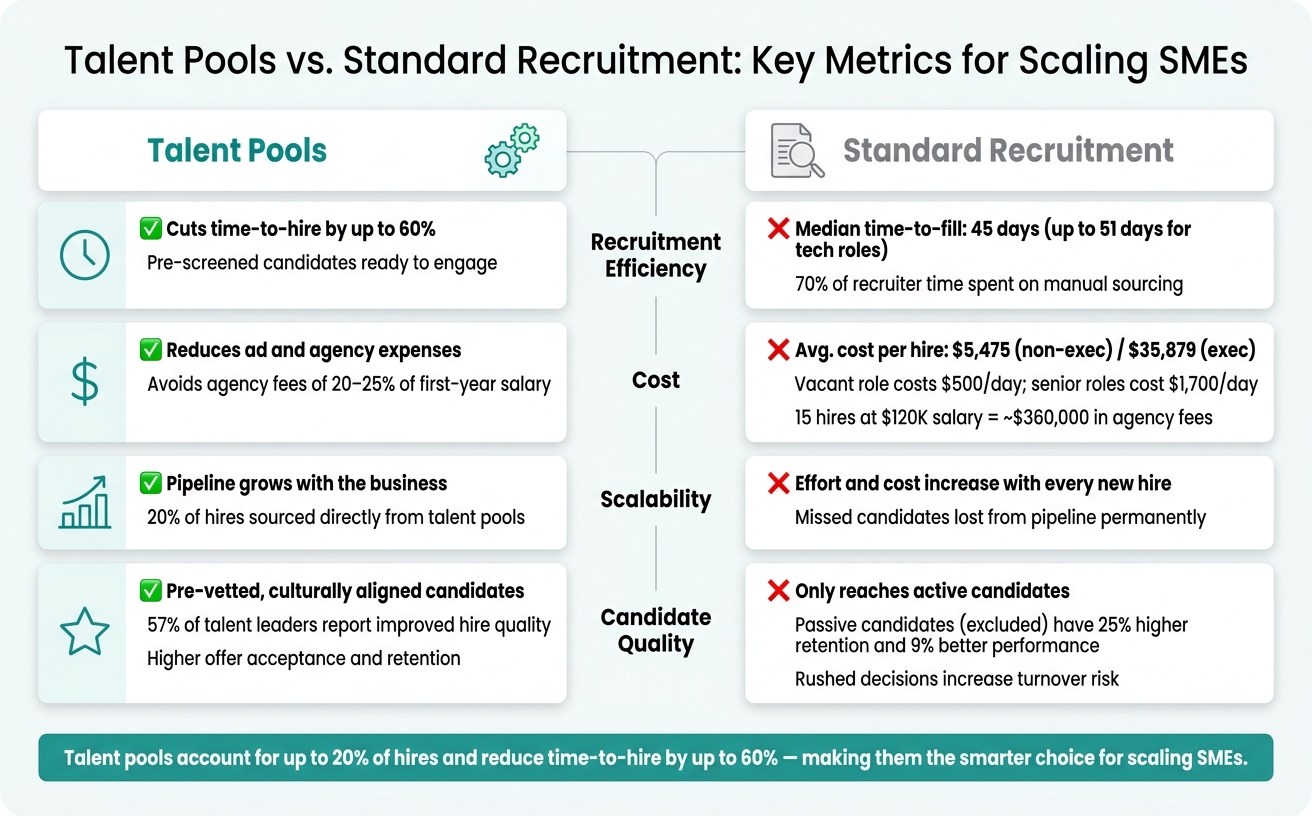
Talent Pools vs. Standard Recruitment: Key Metrics for Scaling SMEs
When comparing talent pools to standard recruitment, the differences lie in how they address hiring as you scale, efficiency, and long-term value.
Talent pools excel in long-term hiring strategies. They enable faster hiring without sacrificing quality, as pre-screened candidates can reduce time-to-hire by up to 60% [2]. In contrast, standard recruitment is better suited for immediate, short-term hiring needs, though it often involves a longer process, averaging 45 days to fill a role [3].
"Talent pools represent a rapport- and trust-building process that can be conducted with large groups of targeted individuals effectively as a precursor to, and driver of, more successful selection and hiring decisions." – Charles Goretsky, Insights Author, Wowledge [3]
However, talent pools require consistent effort to maintain their effectiveness. Without regular updates and engagement, they risk becoming outdated and unreliable [3].
Standard recruitment, on the other hand, is straightforward. Candidates are actively job-seeking, which often results in higher initial responsiveness. But this simplicity has its drawbacks. A full hiring cycle must be restarted for every vacancy, which can overwhelm small teams. Additionally, 56% of recruiting leaders report talent shortages as their biggest hurdle [3].
Here’s how the two approaches stack up:
| Factor | Talent Pools | Standard Recruitment |
|---|---|---|
| Recruitment Efficiency | High; pre-screened candidates cut time-to-hire by up to 60% [2] | Low; each vacancy requires starting the process anew [3] |
| Cost | Lower; reduces ad and agency expenses [3] | Higher; ongoing costs for job postings and sourcing [2] |
| Scalability | High; creates a pipeline that grows with the business [9] | Low; costs and effort increase with each hire [3] |
| Candidate Quality | High; candidates are pre-vetted and familiar with your company [3] | Variable; depends on the available talent pool at the time [10] |
Each method has its place, but talent pools clearly offer a more scalable and cost-efficient solution for businesses looking to streamline recruitment over time.
Conclusion
Talent pools offer growing SMEs a consistent advantage over traditional recruitment methods. Unlike starting from scratch for every new hire, a well-maintained talent pool provides a steady stream of pre-vetted candidates. This means faster hiring, reduced costs, and stronger long-term matches for your team.
Research shows that talent pools can account for up to 20% of hires, significantly cutting time-to-hire while improving candidate quality [3]. This proactive approach ensures SMEs can scale efficiently without sacrificing the quality of their hires.
"Building and maintaining a talent pool represents a strategic shift from transactional hiring to relationship-based talent acquisition: a change that delivers measurable benefits in hiring speed, quality, cost, and candidate experience." – Hirex [6]
If you’re ready to optimise your hiring strategy, the next steps are straightforward. Start by segmenting candidates based on skills, re-engage with high-potential candidates from the past, and automate the process of staying in touch. Think of it as creating a dynamic pipeline that evolves with your business needs, rather than a static list of names.
For SMEs looking to establish this foundation quickly, Rent a Recruiter offers embedded recruitment solutions. With experienced recruiters integrated directly into your team, you can cut hiring costs by up to 70% and reclaim over 80 hours of admin time each month. Whether it’s scaling after funding or meeting a sudden spike in demand, having the right recruitment infrastructure can turn hiring into a predictable, growth-driving process.
FAQs
How do you build a talent pool from scratch?
To create a talent pool from the ground up, begin by analyzing your workforce plans to pinpoint key roles and skills your business will need. Assign a dedicated team or individual to oversee its development, and organize the pool into categories based on factors like skills, job functions, or career levels.
Dive into market research to understand your ideal candidates – what they value, where they are, and how to reach them. Connect with them proactively through tailored communication and build relationships over time. This ensures your talent pool remains engaged and ready to meet future hiring demands.
How do you keep a talent pool fresh and engaged?
Keeping your talent pool active and engaged requires consistent effort. Regular communication is key – reach out to candidates even when there aren’t immediate openings. Share company updates, industry news, or details about relevant opportunities to keep the connection alive.
Make it a habit to update candidate profiles and reconnect with those who’ve gone quiet. Hosting webinars, inviting candidates to events, or sharing meaningful content can strengthen relationships and keep your pipeline dependable and ready when you need it.
What roles should you fill from a talent pool first?
Focusing on key roles that are both essential to strategy and hard to source, such as leadership or niche expertise, is crucial. By doing this, you align your hiring efforts with your business’s most pressing goals and set the stage for sustained growth.