
If nobody owns each step of hiring, you pay for it in slower fills, more agency spend, and wasted management time.
I’d sum it up like this: define the work first, then assign one owner per stage, then lock in handoffs and KPIs. That is how you cut delays, keep recruiters focused on hiring work that moves offers forward, and stop your process from leaning on Slack follow-ups and memory.
For a scaling business, the commercial case is simple:
- Clear role ownership cuts time-to-fill
- Better handoffs reduce admin drag and duplicated work
- Cleaner process control lowers the odds of falling back on high-fee agencies
- Role clarity helps your hiring model keep up with growth at 80, 150, or 200+ employees
A few numbers make the point fast:
- In-house recruiters handle 13.4 open roles on average
- Teams spent 42% of their time scheduling interviews in one recent data set
- A planning rule many growing firms use is 1 recruiter per 50 to 100 employees in steadier growth, or 1 per 30 to 50 employees when hiring volume is high
If you want a hiring team that scales, I’d focus on four things:
- Map hiring demand
- Split work by function, not vague titles
- Give each stage one clear owner
- Track KPIs that show where delays and cost sit , as seen in our recruitment case studies
That is the core model this article walks through, with a clear line between recruitment and HR, role design for recruiters, sourcers, coordinators, hiring managers, and where to add support as hiring volume climbs.
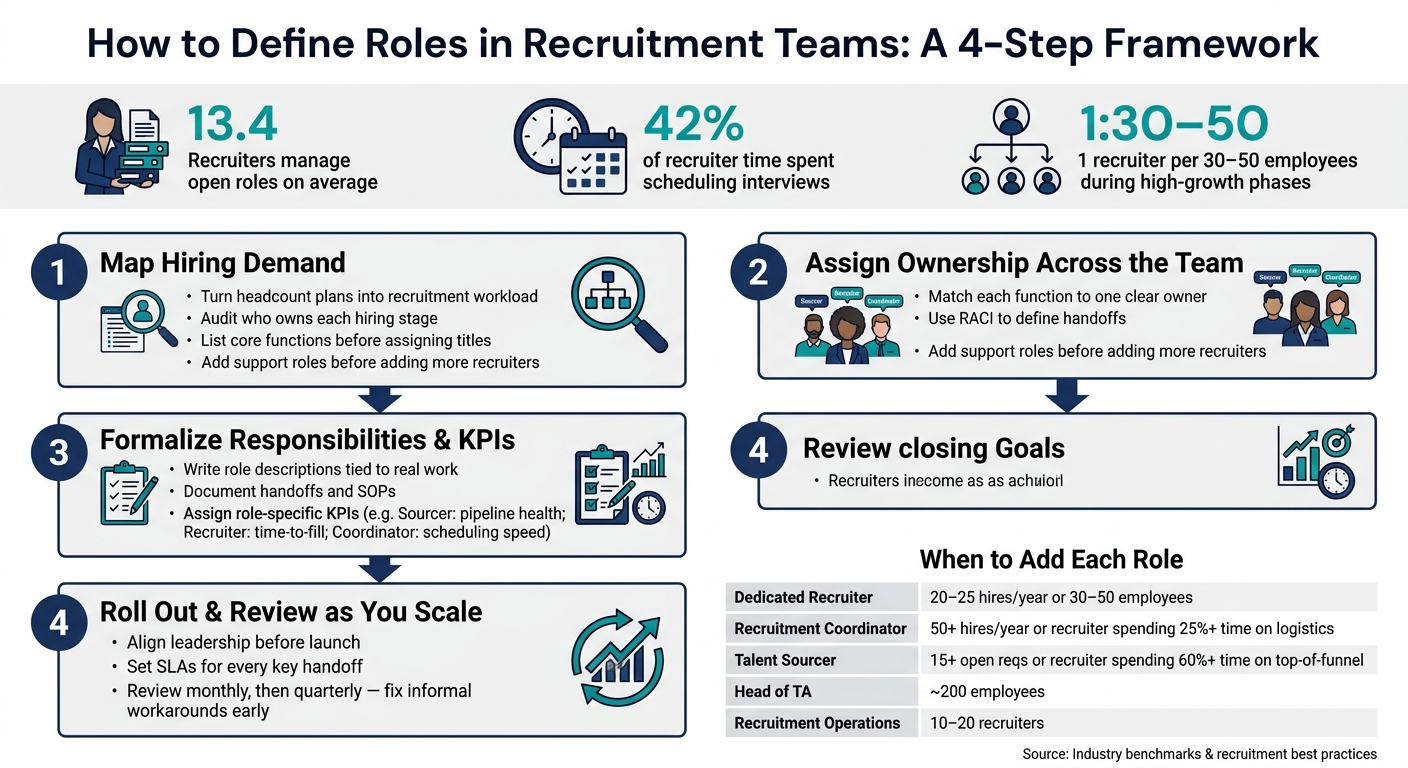
How to Structure a Recruitment Team: 4-Step Framework
The ‘recruiter playbook’ your team needs – before it’s too late
sbb-itb-a23bd6a
Step 1: Map hiring demand and the work your team needs to cover
Start with the work your team needs to handle, not the job titles you think you need to hire for. That shift matters. It turns hiring from a vague resourcing chat into a clear view of workload, gaps, and cost.
The goal here is simple: take your growth plans and turn them into the hiring work your team will need to absorb.
Turn growth plans into recruitment demand
Pull your headcount plan and hiring plan for the next few quarters. Then break that demand down by department, seniority, role type, and hiring difficulty.
A team hiring senior engineers, niche security talent, or leadership roles is dealing with a very different workload from a business unit filling mid-level roles every month. Same number of hires on paper, very different level of effort in practice.
In 2026, in-house recruiters average 13.4 open roles at once, so use your headcount plan and hiring complexity to test whether your current team can hit target [3]. This helps you decide what kind of support you need, not just whether hiring feels busy. For many SMEs, Recruitment as a Service provides a more predictable way to scale than traditional agency models.
You may need:
- a recruiter to run hiring end-to-end
- a sourcer to build pipeline
- a coordinator to keep interviews and offers moving
- operations support to sort reporting, systems, and workflow
As a planning benchmark, allow one recruiter per 50 to 100 employees in stable growth, or one per 30 to 50 employees in fast growth [2].
Once you know your likely capacity, compare that with how hiring works today, not how you hope it works.
Audit your current hiring process and informal ownership
Most scaling companies run hiring through a mix of good intentions, Slack messages, and people stepping in when things start to wobble. Put the process on paper.
Write down who owns each stage:
- job brief
- posting
- screening
- interview scheduling
- feedback follow-up
- offer letter
This exercise usually shows two problems straight away. Some steps have no clear owner. Other steps depend on one or two people carrying the process through informal effort.
Look closely at handoffs. That’s where time disappears.
Research shows recruiting teams spent 42% of their time scheduling interviews in 2022 [4]. If feedback sits for days, or offers wait on sign-off, the issue often isn’t effort. It’s ownership. Fix that first.
That audit gives you a plain view of which parts of the process need a named owner before you start assigning titles.
List core recruitment functions before assigning roles
List the functions first. Assign people after.
That sounds obvious, but plenty of companies do the opposite. They shape roles around the team they already have, then wonder why hiring still feels messy. If the work and the ownership don’t match, bottlenecks show up fast.
The table below sets out the core functions in a typical recruitment process, what happens when no one owns them, and who usually takes the lead:
| Function | Main Activities | Risk if Unassigned | Likely Owner |
|---|---|---|---|
| Requisition Planning | Headcount forecasting, intake meetings, role scoping | Misaligned expectations, poor role scoping | Recruiter / TA Lead |
| Sourcing | Market mapping, outbound outreach, pipeline building | Weak shortlists, over-reliance on inbound or agencies | Sourcer / Talent Specialist |
| Screening | Phone screens, résumé review, skills validation | Poor candidate quality reaching interview stage | Recruiter |
| Interview Management | Scheduling, scorecard prep, logistics | Stalled pipeline, inconsistent candidate experience | Recruitment Coordinator |
| Decision Support | Feedback collection, debrief facilitation | Slow decisions, candidate drop-off | Recruiter / TA Lead |
| Offer Coordination | Pay discussions, offer letters, background checks | Offers stall, candidates accept elsewhere | Recruiter |
| Recruitment Operations | ATS management, reporting, workflow design | Data gaps, systemic slowdowns, no visibility | Recruiting Operations |
Every function needs a named owner. If sourcing has no owner, your pipeline will lean on inbound applicants. If interview management has no owner, hiring managers lose time and candidates drift. If operations has no owner, you lose visibility into cost, speed, and output.
With the work mapped, the next step is assigning ownership across the team.
Step 2: Assign ownership across the recruitment team
Once you’ve listed the functions from Step 1, give each one one clear owner. Start simple: match each function to a single role, then use RACI to sort out handoffs.
If ownership is fuzzy, hiring slows down. Tasks sit in limbo, interview stages drag, and nobody knows who should step in. Clear ownership fixes that.
Define core roles and what each one owns
Most high-growth SMEs do not need a big recruiting team. They need clear lines of ownership. Here’s how the core roles usually split out:
| Role | Primary Purpose | Key Responsibilities |
|---|---|---|
| Head of Talent / TA Lead | Owns strategy and budget | Headcount planning, executive relationships |
| Full-Cycle Recruiter | Owns screening through offer | Candidate screening, hiring manager calibration, interview loop management, closing offers |
| Talent Sourcer | Owns the top-of-funnel pipeline | Passive candidate outreach, market mapping, target list building |
| Recruitment Coordinator | Owns logistics and scheduling | Interview scheduling, candidate travel, background checks, offer administration, ATS data integrity |
| Hiring Manager | Owns the hiring decision | Job requirements, technical interviews, final candidate selection |
| HR / People Ops | Owns the onboarding handoff | Transition from offer acceptance to onboarding |
One handoff needs to be spelled out with zero confusion: the recruiter owns the process from job briefing through offer acceptance. After that, HR or People Ops takes over.
That one line matters more than it seems. If the recruiter-to-HR handoff is vague, offers can stall, onboarding can wobble, and your new hire experience takes a hit before day one.
Use a RACI model to clarify ownership and speed up decisions
Once the roles are named, map the decisions and handoffs between them. A RACI model gives each person one of four positions for every key hiring activity: Responsible (does the work), Accountable (final owner if it stalls), Consulted (gives input), or Informed (kept updated).
| Hiring Activity | Sourcer | Recruiter | Coordinator | Hiring Manager |
|---|---|---|---|---|
| Sourcing & Outreach | R/A | C | I | C |
| Initial Screening | C | R/A | I | I |
| Interview Scheduling | I | C | R/A | C |
| Interviewing & Selection | I | C | I | R/A |
| Offer Negotiation | I | R/A | C | C |
| Offer Letter / Admin | I | C | R/A | I |
| Hiring Manager Communication | I | R/A | I | C |
R = Responsible, A = Accountable, C = Consulted, I = Informed.
This table does one job well: it shows who owns each step. When a stage stalls, you can point to a named owner instead of falling back on a vague sense that someone should deal with it.
That saves time. It also cuts friction between recruiters and hiring managers, because expectations are set up front rather than argued about halfway through a live search.
Adjust role design as hiring volume grows
Early-stage companies often start with one person running the full funnel. At low volume, that can work. But once hiring picks up, the context switching between sourcing, closing, and admin starts to drag down output.
The practical rule is simple: add support roles before adding more recruiters. A sourcer or coordinator can take work off your recruiter’s desk, so that recruiter can spend more time on conversion, stakeholder management, and closing.
The trigger points below show when it makes sense to split work instead of piling more onto one person:
| Role to Add | When to Pull the Trigger |
|---|---|
| Dedicated Recruiter | 20 to 25 hires per year, or 30 to 50 employees [3] |
| Recruitment Coordinator | More than 50 hires per year, or when a recruiter spends more than 25% of their time on logistics and scheduling [1][3] |
| Talent Sourcer | More than 15 open requisitions, or when a recruiter spends more than 60% of their time on top-of-funnel work [1][3] |
| Head of TA | Around the 200-employee mark [3] |
| Recruitment Operations (RecOps) | Team reaches 10 to 20 recruiters [3] |
You do not need to lock the structure forever on day one. You just need a setup that gives each hiring activity a clear owner, keeps bottlenecks visible, and makes it easier to track output against workload.
Step 3: Formalize responsibilities, workflows, and success metrics
Clear ownership from Step 2 only works if you write it down. If you don’t, roles slip back into grey areas the minute hiring volume jumps or someone leaves. This step is about putting the structure on paper so it holds up as the business grows and teams change.
Write role descriptions that reflect real hiring work
A good role description does more than list tasks. It shows what the person owns, what decisions they can make, and where their responsibility stops.
Write each role around ownership, decision rights, and the handoff point. Keep it tied to the work they handle every day, what they can decide without waiting, and when the work moves to the next person. If a recruiter has to stop and ask for permission every time a pipeline stalls, hiring slows down and candidates lose interest. Using an embedded recruitment service can help solve this by providing dedicated support that integrates directly into your team’s workflow.
As automation handles more top-of-funnel activity, people should spend more time on judgment, hiring manager calibration, and closing candidates.
Document handoffs and standard operating procedures
Document the recruiter-to-HR handoff in your SOPs. Then map the smaller handoff steps that often create delays: shortlist timing, feedback deadlines, offer follow-up, and ownership after verbal acceptance. These can look minor on paper. In practice, they’re often the reason a strong candidate drops out.
Set turnaround targets for each handoff and make those expectations visible across the team. That gives you something concrete to manage. When delays happen, you can treat them as a workflow issue to fix, not a personal failing.
Once handoffs are clear, you can measure how the structure performs.
Measure each role with the right KPIs
The aim is simple: give each person metrics they can directly influence. Holding a coordinator to account for time-to-fill makes no sense. Holding them to account for scheduling speed and feedback lag does.
Track the metrics that show where capacity breaks first as hiring volume grows.
| Role | Primary KPIs |
|---|---|
| Sourcer | Pipeline health, source-to-screen conversion rate, diversity of pipeline |
| Recruiter | Time-to-fill, offer acceptance rate, candidate experience score |
| Coordinator | Scheduling speed, feedback lag, interviewer turnaround time |
| Hiring Manager | Hiring manager satisfaction score, quality of hire |
| TA Leader | Cost-per-hire, quality of hire, team productivity |
Use bottleneck metrics that show where the process is slowing down. If there’s a steady gap between offer stage and acceptance, you likely have a closing issue. If candidates drop off after the first interview, the problem is often feedback speed or the interview experience.
Good metrics should point to the structural issue, not just tell you that something went wrong.
Avoid building a setup that only works because one person is quietly patching gaps outside their role. That might hold for a while, but it won’t scale, and it won’t give you clear control over cost, time, or hiring outcomes.
Step 4: Roll out the structure and review it as the business scales
Launch the new structure with leadership alignment and team training
Once roles, handoffs, and KPIs are written down, the next step is rollout. Start with leadership alignment. Founders, department heads, and HR leaders need to agree on who signs off on hiring decisions, what interviewers are expected to do, and how often recruitment performance will be reviewed. If leaders are not aligned on approval rights, interviewer standards, and review cadence, the structure will slow down instead of speeding things up.
Then train hiring managers on structured interviews, scorecards, and feedback deadlines. That keeps the process consistent and cuts down on delays caused by vague feedback or missed steps. After launch, use the KPIs tied to each role to see if the new structure is reducing bottlenecks and saving time.
Before launch, set Service Level Agreements (SLAs) for every key handoff. Feedback deadlines, shortlist turnaround, and offer follow-up timing should all be tied to a clear number. That way, everyone knows what good looks like, and you can spot slippage early.
Use hiring data and feedback to refine roles over time
Once the structure is live, review it on a fixed cadence. Monthly works well at the start. When the process settles, move to quarterly reviews. Look at the KPIs for each role, workload balance, and where candidate drop-off is happening.
If the same people are staying overloaded review after review, shift work. Scheduling or sourcing can often move to a coordinator or sourcer, which frees up hiring managers and recruiters to focus on higher-value work.
Keep an eye on informal workarounds too. When people start bypassing the process to get things done, that usually points to a role boundary that no longer fits. Fixing that early can save a lot of wasted time later.
Conclusion: Build a recruitment team model that scales with demand
A strong structure spreads hiring responsibility across the team instead of leaning on a small number of people to plug gaps. Clear ownership leads to faster decisions, fewer delays, and a hiring process that can keep up as demand grows.
If you do not have the internal capacity to build or run that structure alone, an embedded recruitment partner like Rent a Recruiter can add immediate hiring support and help you build a process that scales.
FAQs
How do I know if my recruitment team is understaffed?
Look at workload and the warning signs.
Recruiters often hit capacity at 20+ open requisitions. For standard roles, 13.4 requisitions is a workable baseline. For scarce-skill roles, that drops to 4 to 5.
You’ll usually see the strain before hiring grinds to a halt.
Watch for:
- Delays in moving roles or candidates through the process
- Candidate drop-off during the hiring journey
- Recruiters relying on memory instead of documented processes
- Recruiters spending more than 25% of their time on scheduling and admin
When that starts happening, the issue usually isn’t effort. It’s capacity. And that has a direct impact on time-to-hire, hiring quality, and internal cost.
When should I split recruiting, sourcing, and coordination into separate roles?
Split these roles as your team scales and admin work starts slowing recruiters down.
Add a coordinator when recruiters spend 25%+ of their time on scheduling or ATS upkeep, or when the team reaches 100 to 150 employees.
Add a sourcer when recruiters are handling 15+ open roles, inbound applicants aren’t enough, or 60%+ of their time is going into top-of-funnel work.
What KPIs matter most for each hiring role?
KPIs should show hiring flow, hiring quality, and team readiness.
Talent acquisition leaders usually own the top-line numbers. That includes overall hiring outcomes and budget performance. For CEOs, CFOs, and HR leaders, those metrics matter because they show whether hiring is helping the business grow without letting costs drift.
Recruitment managers stay closer to day-to-day delivery. They track requisition spread across the team, SLA adherence, and recruiter performance. In plain terms, they need to know who is working on what, whether hiring activity is moving on time, and where pressure is building.
Recruiters focus on conversion points inside the funnel. That means stage timing, feedback lag, and drop-off rates. These numbers help you spot where hiring slows down, where candidates disengage, and where manager delays are hurting fill rates.
Specialist roles, such as workforce planning analysts, look at the medium-term picture. They track time-to-hire, source performance, and future pipeline sustainability. That gives leadership a clearer view of whether the business can meet upcoming hiring demand without last-minute scrambling.