
If your hiring team is still running tech recruitment solutions through spreadsheets and email, you are likely paying more and filling roles later than you should.
From the data in this piece, manual hiring sits at about $3,500 per hire and around 40 days to fill a role. ATS-led hiring brings that to about $1,900 per hire and roughly 26 days. For scaling teams in SaaS, IT, Engineering, Fintech, Security, Insurance, and Professional Services, that gap hits cost, team capacity, and hiring output.
Here is the short version:
- Manual hiring can work when hiring volume is low
- ATS-based hiring gives you better tracking, lower admin time, and more control
- The split shows up in screening speed, scheduling, reporting, consistency, and scale
- If your team cannot find candidate notes fast, or roles are stalling in inboxes, your process is already costing you money
From manual to automated: How Recruit CRM is transforming LCR International’s recruitment workflow
Quick Comparison
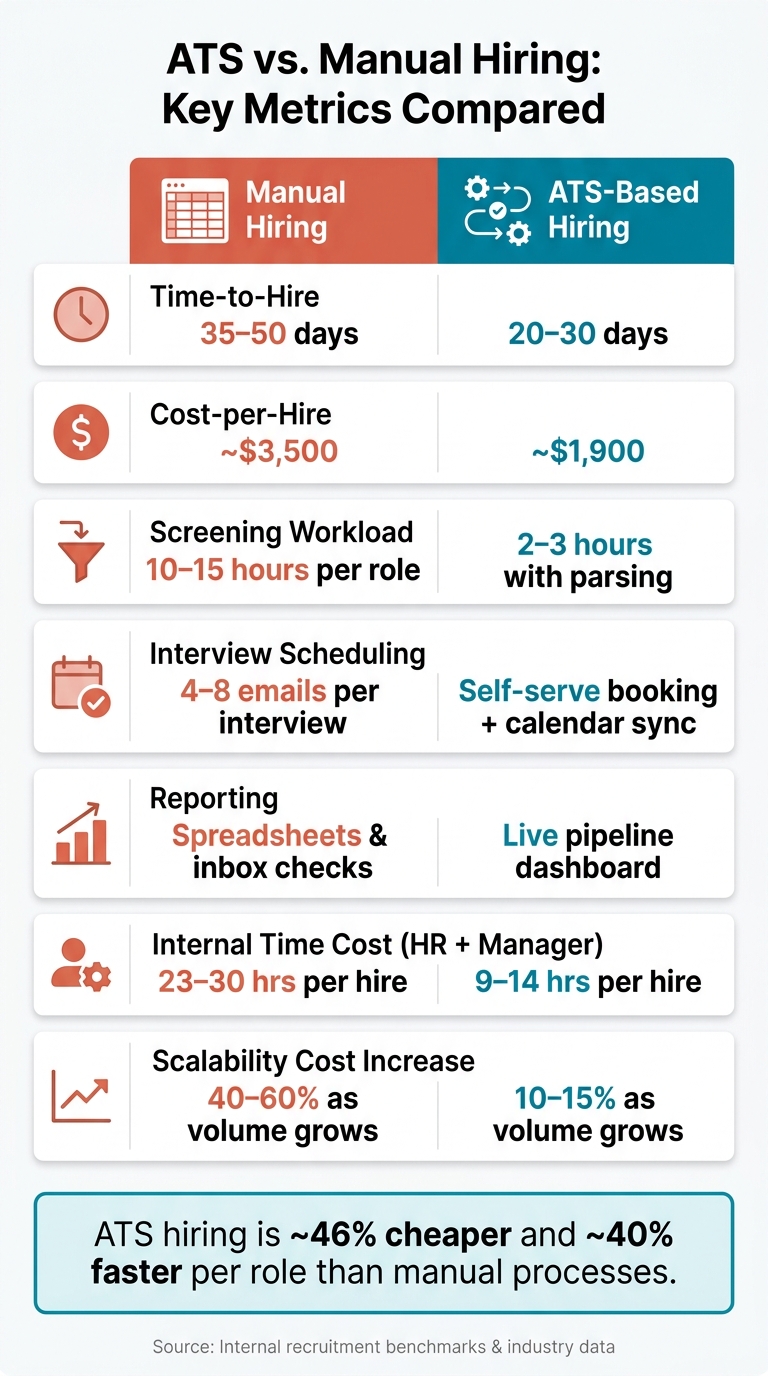
ATS vs. Manual Hiring: Cost, Speed & Efficiency Compared
| Area | Manual Hiring | ATS-Based Hiring |
|---|---|---|
| Time-to-hire | About 35 to 50 days | About 20 to 30 days |
| Cost-per-hire | About $3,500 | About $1,900 |
| Screening workload | 10 to 15 hours per role | 2 to 3 hours with parsing |
| Scheduling | 4 to 8 emails per interview | Self-serve booking and calendar sync |
| Reporting | Spreadsheets and inbox checks | Live pipeline view |
| Scale | Strains as roles stack up | Holds up better under volume |
| Decision quality | More drift across interviewers | Structured scorecards |
The core point is simple: manual hiring is fine for low volume, but once recruitment becomes repeatable, multi-role, or team-based, an ATS gives you more speed, lower spend, and tighter control.
ATS-Based Hiring for Tech Roles
How ATS workflows improve speed and visibility
Tech hiring gets messy fast. You’ve got multiple interview stages, coding reviews, panel interviews, and a lot of calendar juggling. That’s where ATS structure starts to pay off.
When the workflow sits in one place, handoffs move faster across recruiters, engineers, and hiring managers. People know what stage a candidate is in, what happens next, and who owns it.
ATS automation also strips out a lot of admin. Automated resume parsing cuts screening time from 10 to 15 hours per role down to 2 to 3 hours [4]. Self-service scheduling cuts the usual email ping-pong by matching open interview slots with interviewer calendars. Structured scorecards help teams assess each technical candidate against the same standards, which cuts inconsistent feedback across hiring managers [6].
Speed is one part of the story. Visibility is the other. ATS dashboards give leaders live pipeline visibility. Hiring managers can see candidate status straight away, which means recruiters spend less time chasing updates and more time moving roles forward.
There’s also a clear capacity gain. Recruiters using automated screening and scheduling can manage 25% to 40% more open requisitions [5]. For scaling tech teams, that can mean fewer delays, less pressure on internal teams, and better hiring output without adding more recruiting headcount straight away.
Where ATS processes can fall short
The upside disappears when teams use the system halfway.
An ATS breaks down when the workflow is set up badly or used inconsistently. Tech hiring often includes coding assessments, panel interviews, and stage-specific feedback. If those steps are not mapped properly inside the system, the ATS stops being a workflow engine and turns into a place where data goes to sit.
Keyword filtering is another weak spot. It can screen out strong people who do not match the exact wording the system expects. A self-taught developer or someone changing careers can get filtered out even when they have the skills to do the job [3][7].
Then there’s hiring manager behavior. If interviewers skip scorecards or leave feedback in Slack, email, or side notes, the process starts to fall apart. You lose visibility, decisions slow down, and reporting becomes patchy.
The point is simple: ATS gains depend on process discipline. If the setup is poor or hiring managers do not follow it, the speed, visibility, and workload gains do not last.
sbb-itb-a23bd6a
Manual Hiring for Tech Recruitment
Why some early-stage teams still hire manually
Manual hiring leans on job boards, email, and spreadsheets instead of a single hiring system. For some early-stage teams, that can still work.
If you’re hiring one or two developers a year, one person can often run the process end to end without much extra admin. If the role shifts halfway through the search, the team can change direction fast. That kind of flexibility helps when you’re still figuring out what the role should look like.
Why manual processes break under hiring pressure
That setup works only while hiring volume stays low.
One mid-level backend role with 200 applications can take 22 hours of first-round screening [6]. Scheduling a single interview often needs 4 to 8 back-and-forth emails just to line up a candidate with a busy engineering lead [2]. Across several open roles, admin starts to take over.
Then things get messy. Feedback ends up scattered across Slack DMs, email threads, and people’s memory. Spreadsheets drift out of date. And when someone asks why a candidate was rejected, there is no clean audit trail to point to [2].
The cost shows up fast. Manual workflows can stretch vacancy periods by 20% to 35% [1]. In tech hiring, every extra week matters. When a role stays open, your existing engineers carry the load. That means less time spent shipping product, slower delivery, and more strain on the team.
At that stage, the problem is not hiring style. It is capacity, consistency, and control. That is where ATS and manual hiring start to split, in speed, consistency, and workload.
ATS vs. Manual Hiring: Head-to-Head Comparison
Once hiring volume picks up, the gap gets hard to miss. It shows up first in speed, cost, and control. Put the two models side by side, and the trade-offs are clear.
| Factor | Manual Hiring | ATS-Based Hiring |
|---|---|---|
| Sourcing Workflow | Manual posting and data entry [4] | Multi-platform posting and automated sourcing [4][9] |
| Screening Speed | 10 to 15 hours per position [4][8] | Instant parsing; 60% of unfit candidates auto-filtered [9] |
| Interview Coordination | Manual scheduling delays [4][8] | Self-service scheduling; automated calendar sync [4] |
| Reporting | Spreadsheet-based tracking; limited visibility [1] | Live dashboards; forecasted pipeline data [8][10] |
| Scalability | Starts to strain as hiring volume grows [4] | Handles high volume without adding headcount [8] |
| Internal Time Cost | 15 to 20 hours (HR) + 8 to 10 hours (manager) per hire [4] | 5 to 8 hours (HR) + 4 to 6 hours (manager) per hire [4] |
| Process Consistency | Prone to bias and fatigue [10] | Structured scorecards [8][10] |
Efficiency, time-to-hire, and hiring manager workload
Manual tech hiring typically takes 35 to 50 days [4]. ATS-supported hiring cuts that to 20 to 30 days, and in heavily automated pipelines, as little as 1 to 2 weeks [8].
For scaling teams, that time gap hits hard. Top developers are often off the market within 48 hours [10]. So this is not a small process tweak. It can decide whether you make the hire at all.
There is also the internal workload. ATS automation cuts HR admin time by 40% to 60% [1]. Hiring manager time per hire drops from 8 to 10 hours to 4 to 6 hours [4]. That gives your team hours back each week, which matters when leaders are already stretched across delivery, revenue, and team growth.
Cost, scalability, and quality of hiring decisions
Manual hiring can look cheaper at first because there is no software line item. But that view misses the full cost. The bigger expense is usually staff time, delays, and the strain that builds as openings stack up.
An ATS lowers total labour cost and deals with growth far better. Scalability costs increase only 10% to 15% as hiring volume rises with an ATS, compared to 40% to 60% for manual setups [1]. If your business is hiring across SaaS, IT, Engineering, or Fintech teams at the same time, that gap adds up fast.
There is also a decision-quality issue. Manual processes rely more on memory, inboxes, and gut feel. ATS-based workflows use structured scorecards [8][10], which gives your team a more steady way to assess people across roles and interviewers.
Candidate experience and process consistency
Manual hiring often creates an uneven candidate journey by default. Without automated updates or clear next steps, people are left waiting. In tech hiring, waiting usually means losing them to another offer.
Sixty percent of job seekers abandon applications when the process feels slow or disorganised [9]. That is not just a candidate problem. It is a pipeline problem, a speed problem, and in the end, a revenue problem when key roles stay open.
ATS-based hiring keeps people moving through the same structured process. Updates are standardised. Handoffs are cleaner. Screening is less exposed to the bias and fatigue that often show up in manual review [10].
The next question is when that gap becomes too wide for a manual process to handle. You can also explore our recruitment model FAQs to see how these systems integrate with existing teams.
Choosing the Right Hiring Model and Next Steps
When manual hiring works and when an ATS becomes necessary
This comes down to one thing: can your team keep hiring organised as volume goes up?
Manual hiring can work for very low-volume teams. If you’re hiring once in a while, with a small group and a short pipeline, spreadsheets, email, and Slack may be enough.
That changes fast when hiring becomes recurring, or when more than one person needs pipeline visibility. At that point, an ATS is usually the better fit. It gives you one place to track candidates, feedback, stage movement, and next steps.
Here’s a simple test. If you cannot find every candidate note in a few seconds without digging through email or Slack, manual tracking is already costing you time [2].
How to move to a structured hiring process
Once that tipping point is clear, the next step is to move from scattered hiring to one repeatable workflow.
Start with an audit of what you already have. Look at where candidates get stuck, where feedback goes missing, and where scheduling eats up the most time. That shows you where the drag is, and where your team is losing hours.
Then set a minimum viable pipeline before you touch any software:
- Applied
- Pre-Screened
- Tech Screen
- Hiring Manager Review
- Interview Loop
- Offer
- Hired/Rejected [2]
Once those stages are clear, and each one has an owner, set up your ATS around that process, not the other way round. Software should support your hiring model, not dictate it.
Clean up your data first. Then move the pipeline into the ATS.
If you need hiring capacity right now, Rent a Recruiter places experienced recruiters into your team to add structure and manage hiring end to end.
Conclusion: Matching your hiring model to your growth stage
The right model matches your hiring volume, team size, and need for consistency.
Manual hiring can work at low volume. But once tech hiring becomes recurring and multi-role, ATS-based hiring is the stronger operating model. You get faster decisions, lower cost, and a process that can handle growth without breaking.
FAQs
When should a team switch from manual hiring to an ATS?
A team should move to an Applicant Tracking System (ATS) when manual hiring stops being workable. That often happens once you’re making more than 10 hires per year, or when the business grows to 15 to 50 employees.
At that point, the cost isn’t just admin. It’s lost time, slow hiring, and less control over the process.
Common signs are easy to spot:
- Poor visibility into where candidates sit in the process
- Inconsistent communication with candidates and hiring managers
- Too much time spent coordinating interviews
- Tracking data across spreadsheets or scattered tools
If your team is piecing hiring together manually, an ATS helps you bring everything into one place. You spend less time chasing updates and more time moving roles forward.
Can an ATS improve hiring without adding recruiter headcount?
Yes. An Applicant Tracking System (ATS) can improve hiring and help your team get more done without adding headcount.
It takes repetitive admin off recruiters’ desks, things like resume screening, interview scheduling, and candidate communication. That gives them more time to focus on interviews, stakeholder alignment, and keeping top talent engaged through the process.
The commercial upside is simple: less admin, more recruiter capacity, and faster hiring cycles.
In many teams, an ATS can cut admin work by 35% to 55% per hire. That means your recruiters can handle more applications, move roles through the pipeline faster, and spend more time on the parts of hiring that drive better outcomes.
What mistakes cause an ATS to fail in tech recruiting?
An ATS often breaks down in tech hiring when you use it to manage volume instead of testing for job-related skill.
That’s where the gap shows up.
Rigid keyword matching can screen out qualified people simply because they use different terms, structure their experience in another way, or come from a non-linear career path. In tech, that matters. Strong engineers, product leaders, and security hires do not always look the same on paper.
It also falls short when companies automate a messy, inconsistent, or biased screening process. If the process is weak at the start, the ATS just scales the problem.
The result is simple: the system rewards keyword matches over actual ability. You miss strong talent, and you surface people who’ve learned how to game the process.
For hiring leaders, that creates a direct business problem. More noise, less signal, slower hiring, and weaker shortlist quality. In scaling teams, that can mean wasted interview time, delayed hiring plans, and higher cost per hire.