
If your hiring process is loose, you lose time, burn cash, and miss strong people.
If I strip this down, the article makes one point: you should compare different recruitment models to pick the one that fixes your main hiring problem first. If you need delivery and control now, an embedded recruiter model is the fastest route. If you need a clearer process, use the CIPD framework. If leadership habits are the problem, EY is the better fit. If you need to see where drop-off happens in the funnel, McKinsey gives you the measurement layer.
For scaling firms in SaaS, IT, fintech, engineering, security, insurance, and professional services, that choice affects cost, hiring output, and manager time. Some SMEs use Recruitment as a Service to cut hiring costs by up to 70% against agency fees, and stronger process control can save 80+ hours per month in internal hiring admin. McKinsey also found that firms in the top quartile for ethnic and cultural diversity were 36% more profitable than bottom-quartile peers, while top-quartile gender diversity was linked to a 25% higher chance of above-average profitability.
Here’s the short version:
- Need hiring support now? Use embedded recruitment.
- Need process discipline? Use CIPD.
- Need leadership behaviour to change? Use EY.
- Need funnel data and drop-off insight? Use McKinsey.
- Need lower recruitment spend? Many firms use Rent a Recruiter or other embedded recruitment providers instead of commission-led agency models.
- Need ROI clarity? Check the ROI calculator.
7 Inclusive Hiring Practices Your Organization Should Implement
Explore our recruitment video library for more expert insights on building inclusive teams.
sbb-itb-a23bd6a
Quick Comparison
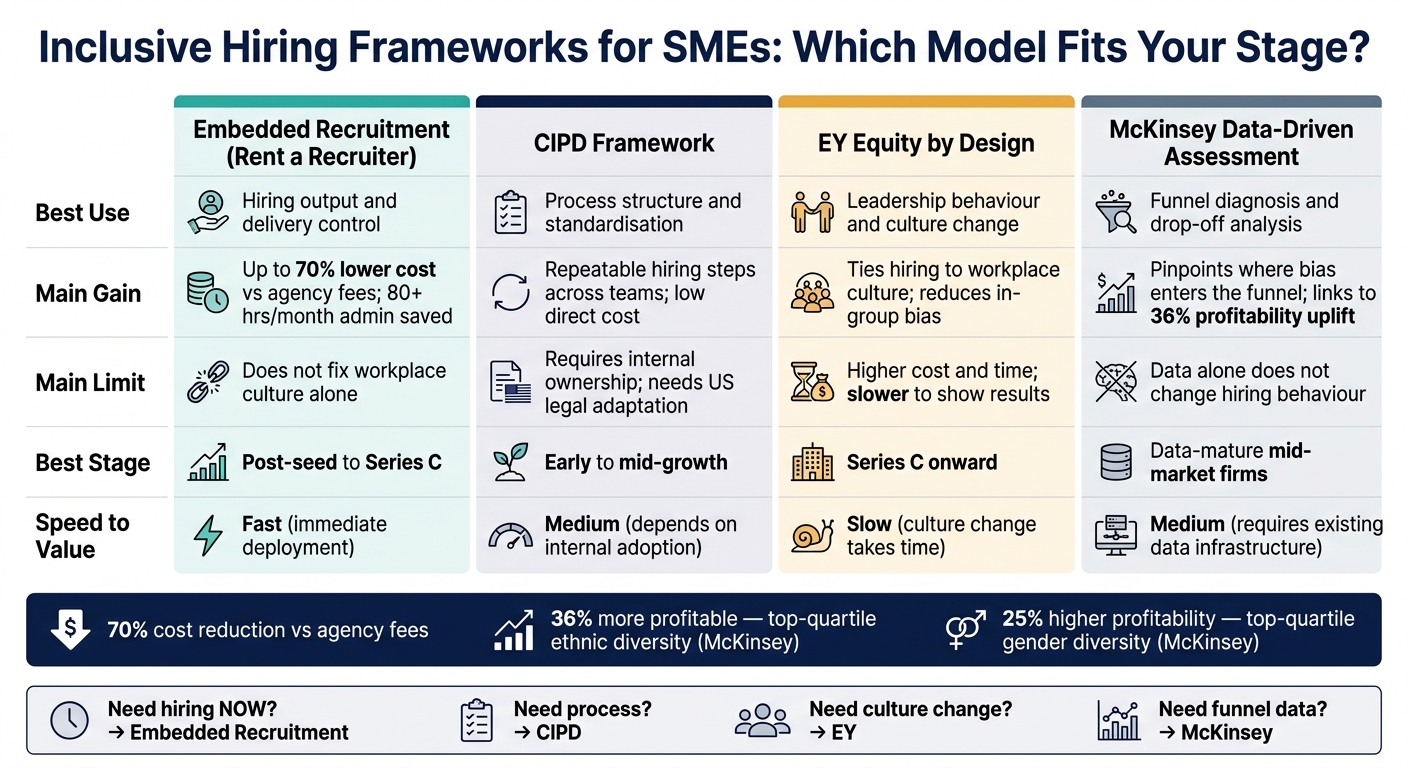
Inclusive Hiring Frameworks for SMEs: Side-by-Side Comparison
| Model | Best use | Main gain | Main limit | Best stage |
|---|---|---|---|---|
| Embedded Recruitment | Hiring output and control | Lower cost, less admin, stronger process | Does not fix workplace behaviour on its own | Early-stage to Series C |
| CIPD Framework | Process structure | Clear hiring steps across teams | Needs internal ownership | Early to mid-growth |
| EY Model | Leadership and workplace habits | Better alignment between hiring and company behaviour | More time and budget needed | Later-stage SMEs |
| McKinsey Assessment | Funnel diagnosis | Better view of where drop-off happens | Data alone does not change behaviour | Data-mature firms |
If I were advising a scaling SME, I would start with the bottleneck in front of me: delivery, process, leadership, or data. That is the lens the rest of the article uses.
1. Rent a Recruiter Embedded Inclusive Hiring Model

Rent a Recruiter works through an embedded recruitment model, placing experienced recruiters inside an SME’s team to run hiring end to end. For high-growth SMEs, that matters because it turns inclusive hiring into a repeatable operating system, not just a policy on paper.
Process Structure
The embedded recruiter reviews the hiring workflow for bias and inconsistency, then rebuilds each stage: job descriptions, interview kits, scoring rubrics, debriefs, and sourcing channels.
Job descriptions are rewritten to remove exclusionary language and focus on skills-based requirements. Structured interview kits use competency-linked scoring rubrics, and standardised debriefs cut bias in group decisions. Sourcing is broadened through outreach to underrepresented talent pools, partnerships with local colleges or affinity groups, and a more mixed set of job advertising channels.
The result is a consistent process for every candidate. That gives you a clearer view of where candidates drop out, where friction shows up, and what needs to change.
Equity Measurement
Embedded recruiters help SMEs set up simple funnel dashboards, using existing ATS tools or spreadsheets, to track applicant diversity, pass-through rates, time in stage, offer and acceptance rates, and starting pay parity for comparable roles.
If candidates without standard degree backgrounds are dropping off at the phone screen, the recruiter can revise the screening questions. That kind of visibility matters. Without it, hiring teams are guessing. With it, you can spot patterns early and fix them before they affect hiring outcomes.
These metrics are usually reviewed monthly or quarterly with leadership and hiring managers. That shifts inclusive hiring from a broad intention into a tracked operating practice.
SME Scalability
This model fits SMEs that do not have a dedicated DEI or talent team. The main gain is speed. You get a structured, inclusive hiring process without having to build a full internal recruiting function from scratch, using proven talent acquisition strategies for growth.
Templates, playbooks, and interview guides can be rolled out fast, without a large upfront spend, and recruiter capacity can scale with hiring volume. SMEs typically reduce hiring costs by up to 70% compared to commission-based agency models. That can free up budget and leadership time for people management and growth.
Compliance and Accessibility
Embedded recruiters align each stage of the process with U.S. Equal Employment Opportunity rules and ADA obligations. They do this by reviewing job postings for language that may be discriminatory, training hiring managers on compliant interview questions, and keeping hiring decisions documented in a consistent way.
Accessibility is built into the process. Job ads and career pages use plain language. Interview formats stay flexible. Candidates are told how to request accommodations.
This also helps with consistency. Standardised steps reduce individual discretion and make hiring decisions easier to defend. Rent a Recruiter does not replace legal counsel, but it does support compliant hiring practices that cut risk while keeping the candidate experience equitable. For SMEs that need hiring discipline now, that day-to-day consistency is a big part of the value.
2. CIPD Inclusive Recruitment Framework
The Chartered Institute of Personnel and Development, CIPD, treats inclusive recruitment as a step-by-step hiring system, from role design through onboarding. Where an embedded recruitment model turns inclusion into day-to-day delivery, CIPD gives you a checklist your team can use across roles, managers, and hiring spikes. Although CIPD is UK-based, its process-led model fits U.S. SMEs well when matched with EEOC guidance and ADA rules.[13][3][7]
Process Structure
CIPD breaks hiring into five parts: role design, attraction, application, selection, and post-offer.[4][12] The point is simple: build inclusion into each hiring step, not bolt it on later.
At the role design stage, CIPD advises employers to define skills and competencies clearly and avoid vague filters such as cultural fit. That matters because loose criteria often lead to inconsistent decisions.
During attraction, CIPD recommends offering flexible working by default and publishing salary ranges. For scaling firms, that does two things. It cuts negotiation gaps and gives hiring managers a clearer, more consistent starting point.
In the application stage, anonymised applications and the removal of unnecessary work history questions can help reduce bias. At selection, structured interviews and skills-based tasks keep scoring more consistent across interviewers and roles.
Post-offer is part of the framework too. CIPD highlights feedback for all candidates, early reasonable accommodations for new hires, and an invitation for strong candidates to reapply.[4][8][11][12] For a growing business, that gives you one repeatable hiring standard rather than a DEI model that sounds good in theory but falls apart in practice.
Equity Measurement
CIPD puts weight on outcomes, not just process.[8][11] In other words, it is not enough to say the process was fair. You need to check what happened at each stage.
That means tracking application-to-offer conversion so you can see where candidates are dropping out or being screened out. If one group gets through application but stalls at interview, that tells you where to look.
CIPD data shows that only 38% of employers collect diversity data at all.[14][15] That leaves most firms without the data needed to assess recruitment equity. For SMEs, the answer does not need to be complex. A simple tracker covering applicants and hires by gender, ethnicity, and disability status, where voluntarily disclosed, can show patterns that need attention.[6][2]
For hiring leaders, this is not just a reporting exercise. It helps you spot waste in the funnel, reduce manager inconsistency, and protect hiring quality as volume grows.
SME Scalability
One reason CIPD works for SMEs is that it is modular.[8][11][12] You do not need to build a large HR function before you can use it. You can start with a few core controls and build from there.
A practical starting point includes:
- clearer job descriptions
- structured interviews
- accommodation prompts built into the process
CIPD research shows that reviewing job descriptions, making reasonable accommodations, and using structured interviews are among the most common and effective inclusive recruitment practices.[11][15] Because the framework is checklist-based, it helps SMEs formalise hiring without building everything from scratch.[5][9]
That matters when hiring volume grows faster than manager capability. In that situation, consistency becomes a commercial issue. Poorly trained managers make slower decisions, reject good people for unclear reasons, and create avoidable risk. CIPD gives teams a baseline process they can repeat across managers and business units.
Compliance and Accessibility
Job postings should clearly state that accommodations are available. Employers should also ask applicants, up front, whether they need reasonable accommodations during the application, assessment, or interview stages.[8][10]
Job descriptions and career pages should also be accessible. That includes accessible formats, captions, transcripts, and alt text.[10] These are not admin extras. They reduce friction in the process and make it easier for candidates to engage without delay.
When these steps are built into a standard operating procedure, your team creates a documented record of consistent hiring decisions. That supports compliance if hiring practices are ever reviewed.[1][2] It also makes the process easier to run at scale, especially when multiple managers are hiring at once.
For high-growth SMEs, that is the real win: a hiring process people can follow, measure, and repeat without losing control as demand increases.
3. EY Equity by Design and Culture Change Continuum
EY’s Equity by Design model builds inclusion into the full employee lifecycle, while its Culture Change Continuum shows how to make inclusive hiring stick. Earlier frameworks focus on standardising hiring steps. EY adds the leadership and workplace layer that stops those steps from slipping over time.
Process Structure
EY combines Equity by Design with its Culture Change Continuum, a phased model that moves from awareness to sustained inclusive practice.[16][18] In hiring terms, that means setting a baseline, training hiring managers, tackling in-group bias, and making inclusive behaviour the default.[18][17]
At the process level, EY adds a few practical moves that matter. These include broadening sourcing through apprenticeships, internships, returner programmes, and community partnerships. It also means removing identity details from applications before manager review, then publishing salary ranges and auditing pay scales to cut subjectivity and unexplained gaps.[23][22]
For scaling companies, that matters because process alone is not enough. If managers keep making ad hoc decisions, hiring quality drifts, time-to-hire grows, and pay gaps become harder to spot.
Equity Measurement
EY recommends tracking representation, hires, attrition, and progression, then pairing that with candidate feedback to show where the process is breaking down.[26][16][19] That keeps inclusion tied to hiring performance, not just internal reporting.
This is where many teams get stuck. They track top-line numbers, but they don’t see where friction sits. Candidate feedback helps you spot whether the issue is sourcing, screening, interviews, or offer stage. That gives you something useful to fix, not just a dashboard to review.
SME Scalability
For SMEs, the goal is not only to standardise hiring. It is to make sure managers use that standard in the same way every time. EY warns against trying to recruit diverse talent without changing the workplace around it.[17]
The difference here comes down to leadership and ownership. EY points to visible leadership sponsorship and a small taskforce to own the framework, monitor data, and update practices based on results.[17][20][21]
In a smaller business, that can be a big advantage. A founder or CEO who backs the change in public often speeds up adoption and makes it easier to keep momentum. Because SMEs have fewer layers, they can often move through the Culture Change Continuum faster when leadership commitment is visible.[21][20]
For hiring leaders, the commercial point is simple: clear ownership cuts drift. It saves manager time, keeps standards tighter, and makes hiring outcomes more predictable.
Compliance and Accessibility
EY’s accessibility guidance maps neatly to U.S. hiring. Ask about accommodations early, share materials in advance, enable captions in virtual interviews, and make sure application systems work with assistive technology.[23][24] Accommodations should be free for applicants, and accessibility commitments should be visible in job postings and career pages.[3][25]
For high-growth SMEs hiring at pace, the safest route is to build these steps into a standard process template. That makes consistency far more likely and helps reduce compliance risk while keeping the candidate experience clear and usable.
If the focus moves from culture change to proving whether hiring is getting better, the next framework gives you that measurement lens.
4. McKinsey Data-Driven Inclusion Assessment
McKinsey’s inclusion assessment is a data-led diagnostic built to find where hiring creates unfair drop-off or weak belonging.[27][30] It measures belonging, equality, and openness.[28][30] If CIPD gives you the steps and EY makes ownership clear, McKinsey shows you where the hiring funnel is still breaking down. In plain terms, the earlier models define the process. McKinsey helps you test if that process is doing what you think it is.
Process Structure
The most useful place to start is the Assess phase. Quantitative funnel data, paired with short candidate surveys, can show where the process feels unfair, unclear, or inconsistent.[31][32] For a scaling SME, that should lead to a simple view of which stages, channels, or criteria are screening out qualified candidates.
You do not need a complex system on day one. A basic spreadsheet or dashboard is often enough to track stage-by-stage conversion and rejection reasons by group, or you can use a recruitment health check to identify these gaps. That is where this model earns its keep. It helps leaders pinpoint where inclusion slips, rather than just documenting the hiring journey.
Equity Measurement
McKinsey connects diversity with stronger profitability, but for SMEs the hiring value is more direct: it helps you spot where bias enters the funnel.[34][35] That matters because only 27% of companies have all DEI recruitment best practices in place for hiring and performance reviews.[27] Core debiasing practices include clear criteria, trained evaluators, diverse slates, and bias reminders.[29]
For SMEs, the practical version of equity measurement comes down to tracking:
- representation in the funnel
- conversion and pass-through rates
- time-to-hire
- offer rates by candidate group[31][32]
Patterns matter. If candidates from nontraditional educational backgrounds keep dropping out after phone screens, that is a strong prompt to review degree requirements and screening criteria. SMEs should also review job descriptions and selection criteria to check that requirements are tied to the role, rather than quietly filtering people out for reasons unrelated to job performance.[31]
Decision prompts, meaning tactical reminders and named leaders trained to call out unconscious bias in talent discussions, are a low-cost way to improve decision quality.[33] They will not fix the whole system on their own, but they can stop weak habits from rolling through the funnel unchecked.
SME Scalability and Compliance
McKinsey’s model works well for SMEs because it starts with data you likely already have.[31][32] In the early phase, businesses can collect voluntary demographic data and run simple inclusion surveys with recent hires and rejected candidates.[31] As hiring volume grows, they can add more detailed analytics to see where inclusion scores drop for certain groups or which sourcing channels lead to more even outcomes.[31][32]
Over time, those findings can feed into hiring manager scorecards, performance reviews, and regular leadership meetings.[32] That is where the commercial value becomes clearer. You are not just gathering data for its own sake. You are using it to cut wasted time, improve hiring decisions, and reduce avoidable funnel loss.
On the compliance side, demographic data collection should line up with U.S. equal employment rules. Participation should be voluntary, privacy safeguards should be clear, and the data should be used to monitor fairness, not to shape individual hiring decisions.[31] If privacy is weak or disclosure does not feel safe, the data will be too thin to support sound decisions.
SMEs should also avoid assessment methods that disadvantage certain groups without job-related justification.[28][30][31] The openness measure matters here because it shows whether candidates feel safe asking for accommodations.[28][30]
Its strength is diagnosis. Its weakness is that measurement alone does not change hiring behavior.
Pros and Cons by Framework
Use the comparison below to line up each framework with your hiring capacity, budget, and stage of growth. Each one improves hiring in a different way. One strengthens execution, one brings structure to the process, one shifts leadership habits, and one shows where bias appears in the funnel. The table compares them on speed, depth, and business fit.
| Framework / Model | Pros | Cons | Best Fit |
|---|---|---|---|
| Rent a Recruiter Embedded Model | Fast deployment; immediate process control; lower admin load | Does not replace broader culture work | Early-stage SMEs with urgent hiring needs and no formal TA function; post-seed to Series C |
| CIPD Inclusive Recruitment Framework | Full-funnel process standardization; evidence-based; low direct cost; flexible | Needs U.S. legal adaptation; depends on internal ownership | SMEs formalising hiring practices with an HR lead in place; early to mid-growth |
| EY Equity by Design and Culture Change Continuum | Links hiring to culture change; addresses in-group bias and leadership behavior; builds long-term belonging | Higher external cost; slower to show hiring results; high leadership lift | Later-stage SMEs with established HR/DEI functions and budget for culture work; Series C onward |
| McKinsey Data-Driven Inclusion Assessment | Tested across 135,000+ employees globally[36]; pinpoints funnel drop-off with data; links inclusion to financial performance | Higher external cost; requires sufficient HR data volume; measurement does not drive action by itself | Data-mature mid-market firms with strong HRIS/ATS and existing DEI programs |
The commercial trade-off is pretty clear.
If you need hiring output now, the Rent a Recruiter embedded model gives you speed, control, and less internal admin. If your team already has HR ownership and needs a more consistent process, CIPD gives you a lower-cost way to audit your recruitment process to tighten execution. If you’re further along and want hiring change tied to leadership and workplace behaviour, EY goes deeper, but it takes more time and budget. If you already have the systems and data, McKinsey helps you spot where candidates drop out, but data alone will not fix the process.
That comparison leads directly to the rollout choice in the conclusion.
Conclusion
High-growth SMEs should start with the bottleneck in front of them: process, culture, or measurement. Then pick the framework that fits. Use CIPD when you need hiring process consistency. Use EY when the issue sits around culture and retention. Use McKinsey when you need a clear diagnosis. And if you need hiring capacity fast, an embedded recruiter model gives you day-to-day delivery.
In practice, the best SME setup doesn’t rely on one lever alone. It layers these functions together. Inclusion works best when process, culture, and measurement run as one system, not as separate projects.
McKinsey’s research links diverse leadership teams with stronger profitability, which strengthens the business case for inclusive hiring. For SMEs without in-house recruiting capacity, an embedded recruiter helps turn that thinking into execution.
For SMEs without internal recruiting capacity, Rent a Recruiter’s embedded model adds immediate hiring capacity and builds inclusive practices into the workflow.
FAQs
How do I choose the right hiring framework for my SME?
Choose a hiring framework that replaces ad hoc, gut-feel decisions with a repeatable, structured process.
The goal is simple: focus on four to six observable, role-specific competencies that link directly to business results. That means looking at what drives success in the job, not leaning on vague ideas like culture fit.
Then assess each competency using standardized interview questions and clear scoring rubrics. Every interviewer measures the same things, in the same way.
That gives you:
- Fairer, evidence-based comparisons
- Better support for EEO compliance
- Less bias in decision-making
- A hiring process that stays fast and predictable as your team grows
For scaling companies, this matters. When hiring decisions rely on instinct alone, quality slips, interview loops drift, and teams lose time. A structured framework gives you more control, better hiring signals, and a process you can use again and again without reinventing it for every role.
Can I combine embedded recruitment with process and data frameworks?
Yes. Embedded recruitment works best when it sits inside a clear process and data setup, not off to the side.
An embedded recruiter joins your team and works inside your systems. That means they can apply standardised workflows, documented scorecards, and live tracking across every role.
The commercial upside is simple. Hiring becomes more consistent, more repeatable, and easier to control internally. You’re not relying on ad hoc decisions or chasing updates across emails and spreadsheets.
Instead, your hiring framework turns into a repeatable cycle that supports better speed, stronger hiring quality, and lower cost.
For scaling companies, that often means cutting hiring costs by up to 70% and saving more than 80 hours of admin time each month.
What should we measure first to improve inclusive hiring?
Start by setting baseline metrics, then review your hiring funnel one stage at a time. Look at the demographic mix of your applicant pool so you can see whether your sourcing is reaching a broad range of groups.
From there, track pass-through rates by demographic group at each stage. This helps you spot where drop-off happens, not just that it happens.
Use the four-fifths rule as a simple check. If a protected group’s selection rate falls below 80% of the highest group’s rate, that stage needs a closer look for possible bias.
For hiring leaders, this matters because you can’t fix what you can’t see. Better visibility into funnel performance means better hiring decisions, less wasted time, and lower risk.