Global tech hiring needs a clear budget and hiring process, not just a longer country list. We recommend starting with one priority role across two or three approved markets, with agreed pay bands, working-hour overlap, and assessment criteria before outreach begins.
To keep your costs and hiring timelines under control, we focus on three things:
- Plan the full cost: Compare salary, employment costs, equipment, and recruitment spend, not salary alone.
- Measure hiring outcomes: Track time to a qualified shortlist, cost per hire, and which channels produce hires.
- Keep decisions moving: Assign owners for screening, offer approval, and onboarding, then review performance at 30, 60, and 90 days.
Our approach is simple: <u>test the process before expanding it</u>. Here is how we connect market selection, sourcing, and hiring handoffs so you can see where time and money go.
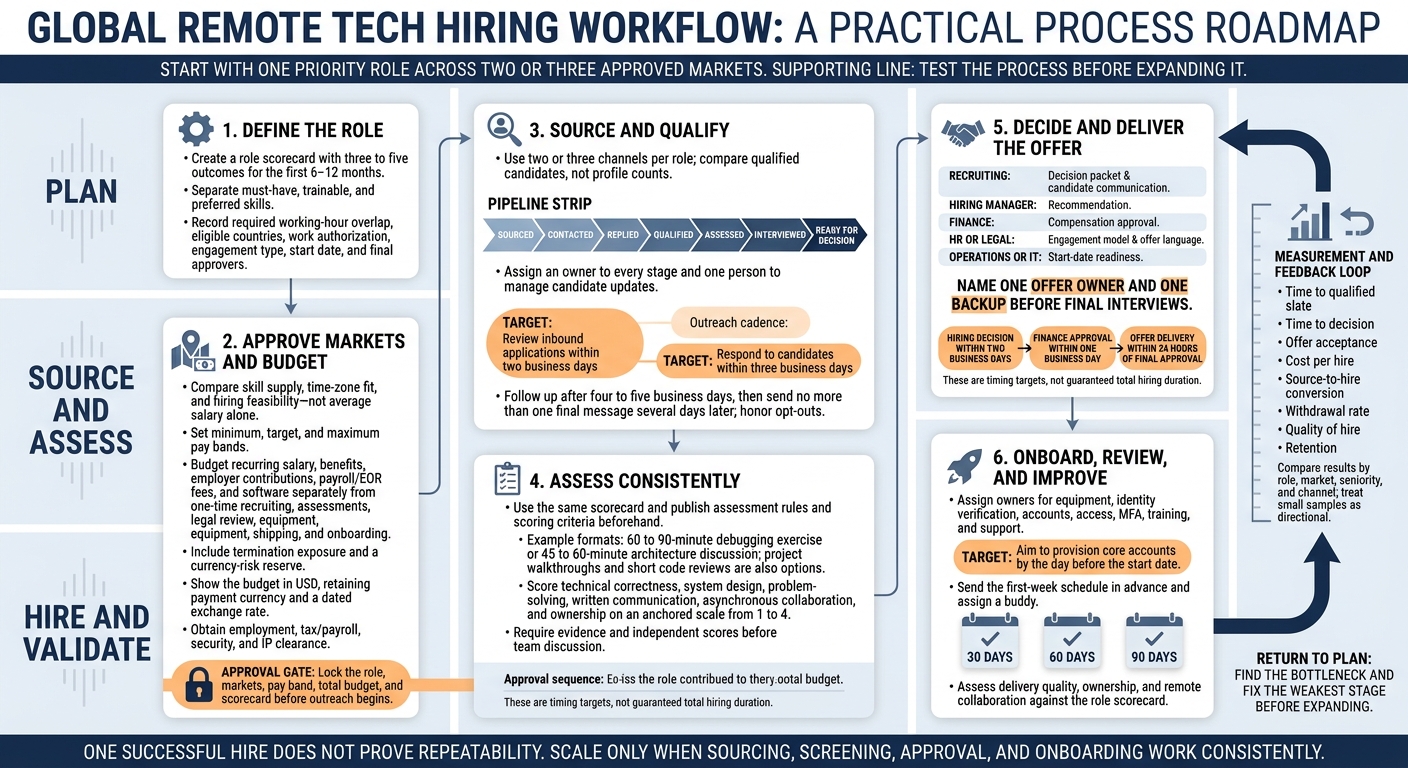
Global Tech Hiring: From Role Planning to 90-Day Review
Plan Roles, Markets, and Pay Bands
Define Role Outcomes and Requirements
Define the role first. Then check which markets and pay bands can support it.
Map each roadmap milestone to the skills and capacity needed to deliver it. Decide whether that calls for a new hire, internal reassignment, contractor, or embedded IT recruitment support.
Build a role scorecard with three to five outcomes for the first 6-12 months. Include core responsibilities, technical skills, seniority indicators, decision-making authority, reporting line, and remote-work and communication expectations. Separate must-have, trainable, and preferred skills so your search stays focused.
Record required working-hour overlap, eligible countries, work authorization, engagement type, start date, and final approvers. Use this scorecard as the source of truth for the job description, embedded recruitment brief, and interview rubric. Changes to level, location, must-have skills, pay, or employment model need approval.
Compare Markets and Hiring Requirements
Compare countries against the scorecard, not average salary alone. Each market must meet your requirements for working-hour overlap, work authorization, engagement type, and start date.
Jordan and the UAE may serve different hiring needs. Include either only after confirming you can hire there. Replace vague overlap labels with exact shared hours based on your team’s schedule and the candidate’s location.
Narrow your options by skill supply, time-zone fit, and hiring feasibility.
| Market | Role-specific talent | Time-zone fit | Compensation pressure | Engagement checks and sourcing effort |
|---|---|---|---|---|
| Ireland | Engineering, customer success, and EU-facing roles | Check U.S. overlap, including weeks when daylight-saving transition dates differ | Reported mid-level software-engineer pay: €65,000-€85,000 annually.[6] | Confirm payroll and permit/work-location alignment; experienced engineering searches can be competitive. |
| Australia | Engineering, product, and APAC coverage | U.S. overlap may require staggered schedules; daylight saving varies by state | Benchmark by role, level, and location | Validate employment or contractor arrangements; make APAC ownership explicit in outreach. |
| United States | Engineering, product, security, AI, and technical leadership | Specify hours across U.S. time zones | Generally high; specialty and location matter | Check state-specific employment obligations; scarce specialties need focused sourcing. |
| Jordan | Engineering, support, operations, and knowledge-work roles | Confirm European and Middle Eastern overlap and local time rules | Use Jordan-specific role data | Validate payroll, benefits, contractor classification, data access, and intellectual-property terms. |
| United Arab Emirates | Senior technology, digital transformation, and regional leadership | Map overlap to the team’s actual working hours | Reported senior software-engineer pay: AED 300,000-480,000 annually.[4] | Confirm employment route, insurance, visas, and end-of-service obligations.[3][5] |
Attach dated salary evidence, current employment guidance, and written payroll or employer-of-record (EOR) feasibility confirmation to the brief. Record the review date and check daylight-saving changes, public holidays, data-access limits, and candidate availability.
Reported salary ranges are inputs to verify, not offers.
Set Pay Bands and Total Hiring Budgets
Use your chosen market to set the minimum, target, and maximum pay band for each level. That band then feeds into the total hiring budget. Keep base salary separate from bonus, equity, and benefits.
Use one global leveling framework for comparable roles, then decide how geography affects pay. Lock the pay band and total budget before outreach begins.
| Band model | Budget trade-off | Pay-equity trade-off | Administrative trade-off |
|---|---|---|---|
| Location-based | Tracks city-level labor markets closely | Comparable work may receive different pay | Requires city, address, and relocation rules |
| Country-wide | Simplifies forecasting | May miss differences between expensive and lower-cost cities | Easier to maintain within each country |
| Hybrid | Combines global levels with country adjustments | Supports consistent levels with documented geographic differences | Requires a maintained matrix and exception rules |
Show the budget in USD, while retaining the payment currency, EUR, AUD, USD, JOD, or AED, and a dated exchange rate.
Separate recurring salary, benefits, employer contributions, payroll/EOR fees, and software from one-time recruiting, assessments, legal review, equipment, shipping, and onboarding costs. Include termination exposure and a currency-risk reserve. Have finance confirm both the annual cost and the maximum first-year cash needed.
Before approval, attach written clearance from employment, tax/payroll, security, and IP reviewers. An EOR arrangement does not remove these checks.
sbb-itb-a23bd6a
Run Sourcing, Outreach, and Screening
Once the role, market, pay band, and scorecard are approved, use on-demand engineering recruitment to put sourcing into a tracked pipeline: sourced, contacted, replied, qualified, assessed, interviewed, ready for decision. Give each stage an owner and assign one person to manage candidate updates. Review inbound applications within two business days and respond to candidates within three business days.
Apply the privacy notices, retention periods, deletion rules, and opt-outs required in each jurisdiction. Reusing profiles for a talent pool requires a separate purpose, new disclosure, and consent that candidates can withdraw. An earlier application does not cover that reuse.[7][8][10]
Choose Sourcing Channels by Role
Turn the scorecard into a one-page search brief. Use two or three channels for each role and compare qualified candidates, not profile counts. That keeps sourcing focused on hiring outcomes rather than activity.
Public visibility does not prove ability. For AI and machine-learning roles, check deployment, monitoring, data quality, failure handling, and production ownership, not just research or prototypes.
| Channel | Strength | Limit | Suitable roles | Verification needed |
|---|---|---|---|---|
| Professional networks | Access to experienced product, engineering, and leadership candidates | Profiles may be outdated or overstated | Experienced engineers, product managers, and leaders | Actual responsibilities, impact, availability |
| Open-source communities | Shows practical contributions and collaboration | Commit volume does not prove job readiness | Maintainers, infrastructure engineers | Contribution scope, production experience, ownership |
| Specialist technical communities | Access to niche expertise | Smaller pools; outreach must respect community norms | Security, cloud, data, AI/ML | Technical depth and experience running systems |
| Employee referrals | Often provide more context on collaboration and culture | Similar networks can narrow the pool | Experienced engineers and team leads | Same scorecard and assessment as other candidates |
| Regional networks | Access to candidates in specific countries or underrepresented markets | Eligibility still needs checking | Country-specific technical hires | Location, engagement eligibility, compensation |
| Talent mapping | Helps find passive or scarce profiles | Reusing sourced profiles requires privacy controls | Senior specialists and technical leaders | Current scope, interest, lawful data use |
Plan Outreach and Initial Qualification
Use the same scorecard for outreach and qualification. Reference relevant experience, explain the challenge and ownership, and state location eligibility, required working-hour overlap, pay, and assessment steps upfront.
Follow up after four to five business days, then send no more than one final message several days later. Include an easy opt-out, honor it promptly, and close unanswered sequences.
Use one qualification form to record experience, availability, location eligibility, compensation expectations, work authorization or engagement type, and time-zone overlap. Compare channels and markets using the same qualification criteria and two measures: response rate = replies ÷ delivered messages and qualified-candidate rate = qualified candidates ÷ completed screens.
Hypothetical outreach message: Your work improving high-volume API reliability appears relevant to a role owning our event-processing platform. The position is open to candidates in the United States and Canada, with at least four hours of overlap with Eastern Time; the target base-pay range is $150,000–$180,000 for U.S. employees. Would you be open to a 20-minute conversation about the reliability and scaling challenges? Reply “no thanks” if you prefer no further contact.
Assess Technical Skills and Remote Collaboration
Move qualified candidates into a standardized assessment of technical skill and remote execution. Keep it as short as a valid assessment allows: a 60 to 90-minute debugging exercise, project walkthrough, short code review, or 45 to 60-minute architecture discussion. Publish the time limit, permitted tools, allowed reference materials, AI-assistance rules, and scoring criteria beforehand.
Score technical correctness, system design, problem-solving, written communication, asynchronous collaboration, and ownership on an anchored scale from 1 to 4. Require evidence and independent scores before the team discusses results.
Test remote working habits through a written handoff or incident note, not conversational style. Never use unpaid work that could ship as production output. Offer appropriate accommodations, keep medical information separate, and limit identity and experience checks to what is relevant and proportionate. Track assessment completion and conversion by market.[9][11]
Manage Hiring Handoffs and Track Results
Once screening is complete, move finalists through one approval path, with clear owners and deadlines.
Prepare Decision Records and Offer Approvals
Create a written ownership map and a standard decision packet. Include the role scorecard, candidate profile, interview and assessment evidence, check status, compensation recommendation, proposed location and engagement model, start-date availability, and any open risks or approvals. Attach the interview evidence behind the decision, and share only the candidate data needed to make it.
Keep responsibilities clear. Recruiting owns the packet and candidate communication. The hiring manager owns the recommendation. Finance approves compensation. HR or legal checks the engagement model and offer language. Operations or IT confirms readiness for the start date.
Name one offer owner and one backup before final interviews. Set these approval targets:
- Hiring decision within two business days.
- Finance approval within one business day.
- Offer delivery within 24 hours of final approval.
Escalate missed deadlines automatically so time zones do not hold up the offer.
Send a short offer summary, followed by the reviewed agreement. The agreement should state the employer or contractor entity, classification, approved work location, pay currency and schedule, benefits, tax responsibility, IP ownership, confidentiality, hours, overlap, start date, and any open conditions.
If the currency, title, start date, or engagement structure changes during approval, send a revised written summary and log the change in the decision packet. Once the offer is accepted, move straight to preboarding and access setup.
Plan Equipment, Access, and Onboarding
Preboarding should support day-one productivity, not just compliance.
Assign owners and deadlines for device delivery, identity verification, accounts, code and issue access, VPN or zero-trust access, MFA, security training, and emergency support. Allow for customs, local purchasing restrictions, and shipping delays. Agree on a fallback if delivery slips.
Aim to provision core accounts by the day before the start date.[12] Grant only the permissions the role needs, test access during preboarding, and remove unused or temporary access after onboarding.
Send the first-week schedule in advance. Include time-zone conversions, product and architecture context, team introductions, security and compliance training, development-environment setup, documentation links, and meetings with the manager and key collaborators. Assign a buddy and document where to escalate problems.
Set 30-, 60-, and 90-day outcomes against the role scorecard. Measure observable delivery quality, ownership, and remote collaboration, rather than completed tasks alone.
Track each handoff in weekly reporting so approval, access, and onboarding delays are visible.
Review Hiring Metrics and Recruiting Capacity
Review pipeline timing, time spent in each interview stage, recruiter workload, and weekly onboarding progress.
As workload grows, watch open requisitions, qualified candidates per recruiter, weekly sourcing and screening volume, interview coordination time, and approval delays. Check how hiring demands affect the team’s existing priorities.
Track time to qualified slate, time to decision, offer acceptance, cost per hire, source-to-hire conversion, withdrawal rate, quality of hire, and retention. Compare results by role, market, seniority, and channel.
Find the bottleneck before changing requirements or adding capacity. Treat small samples as directional, not firm evidence.
If hiring volume still exceeds your team’s capacity, embedded recruiting support can take on the overflow. During spikes or sustained growth, Rent a Recruiter embeds recruiters to manage hiring end-to-end. Agree on ownership, reporting, expected capacity, and delivery timelines before work begins.
Conclusion: Test the Process With One Role
Treat your first search as a test of the full hiring system. Start with one priority role across two or three approved markets. Before outreach begins, confirm that the full system is ready.
Set your hiring window and success criteria before launch. Each week, review funnel conversion by market and channel, check spend against budget, and gather candidate feedback on communication, scheduling, and expectations.
At 30, 60, and 90 days, use manager and new hire feedback to check whether your assessment matched on-the-job performance. One successful hire does not prove the process will work again. If quality, cost, candidate experience, or handoffs fall short, fix the weakest stage before expanding the search.
If hiring capacity becomes the constraint, contact Rent a Recruiter. Scale only when sourcing, screening, approval, and onboarding work consistently across roles and regions.
FAQs
How do I choose between equally qualified candidates in different countries?
Use a standardized competency-based scorecard to compare technical depth, project scope, and impact against the same criteria. Check time-zone overlap with U.S. business hours and how well each person uses your team’s asynchronous communication tools.
Bring multiple team members into interviews to assess fit with your team’s culture and the ability to work independently in a remote setting. Verify tax residency and local labor law requirements to reduce compliance risks and support a long-term hire.
When should I adjust pay bands for exchange rate changes?
Review your pay bands when offers fall short of market expectations or candidates repeatedly lose interest over compensation [1]. An offer acceptance rate below 80% often points to a need to review salary benchmarks [2].
Track screening and interview feedback, too. If qualified candidates show little interest, check whether your pay range matches the approved role requirements [1].
How do I know my global hiring process is ready to scale?
You’re ready when you can plan roles by region, urgency, requirements, and time-zone overlap, with clear business targets for time-to-fill, cost-per-hire, pipeline quality, and internal hours saved. Measure results against a 6-12-month baseline.
Your hiring process should track each stage using standardized scorecards, role-based access, and bottleneck alerts, so you can spot delays and keep decisions moving.
Confirm compliance and system fit for both U.S. and international processes. Then test readiness with a 30-60-day pilot before full rollout.