Hybrid work is here to stay, but hiring for it isn’t simple. Without clear policies and the right processes, you risk misaligned expectations, higher costs, and losing top candidates. Scaling companies need a smarter approach to attract and retain talent in hybrid roles.
Here’s what works:
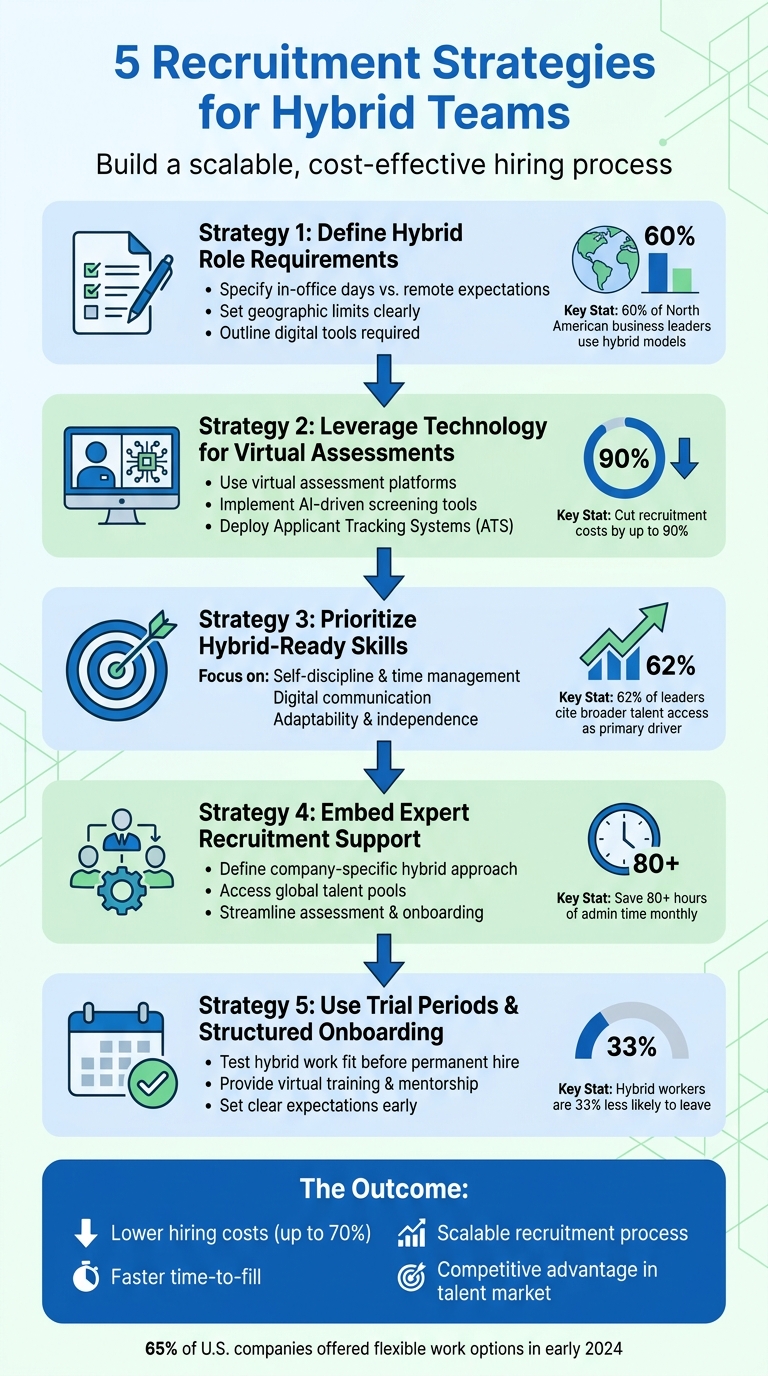
- Define hybrid role requirements: Be specific about in-office days, remote expectations, and geographic limits to avoid confusion.
- Leverage technology: Use virtual assessments, AI tools, and applicant tracking systems to cut costs and evaluate candidates effectively.
- Prioritize hybrid-ready skills: Focus on traits like self-discipline, time management, and communication to ensure success in flexible environments.
- Bring in expert recruitment support: Embedded recruitment providers, like Rent a Recruiter, streamline hiring with scalable, cost-effective solutions.
- Trial periods and structured onboarding: Test candidates’ hybrid work fit while reducing turnover and speeding up productivity.
The result? Lower hiring costs (up to 70%), faster time-to-fill, and a recruitment process that scales with your business. Hybrid hiring isn’t just a necessity – it’s a competitive advantage. Let’s dive deeper into how these strategies work.
5 Recruitment Strategies for Hybrid Teams: A Complete Framework
1. Set Clear Hybrid Role Requirements
Alignment with Hybrid Work Needs
Unclear hybrid work policies can lead to costly misunderstandings. A job posting that simply states "hybrid work available" leaves too much room for interpretation – some candidates might expect one office day a week, while others assume it means several in-person meetings. With 60% of North American business leaders already using a hybrid model [4], clarity is crucial. Be specific about the office-to-remote ratio in your job descriptions. For example, phrases like "Tuesday-Thursday in office" or "two to three times per quarter for team sprints" set clear expectations. Additionally, include geographical requirements, such as "must live within 50 miles of our Austin office for short-notice meetings", to ensure candidates understand location constraints upfront.
Scalability for High-Growth Companies
Hybrid work isn’t one-size-fits-all. Each role requires a tailored approach. For instance, a customer success manager may thrive with full flexibility, while a hardware engineer might need regular access to on-site facilities. Interestingly, 62% of business leaders say broader access to talent is a primary driver for adopting hybrid work [4]. Fractional recruitment services help high-growth companies scale more effectively by removing geographical limits – but only if they clearly define which roles are suited for remote work and which need in-person collaboration. This clarity not only helps attract the right talent but also makes onboarding smoother, as explained below.
| Hybrid Model Type | Description | Best For |
|---|---|---|
| Scheduled | Specific days or times for in-office work | Teams needing regular collaboration |
| Flexible | Employees decide when to work on-site | Independent, high-trust roles |
| Role-based | Office or remote options depend on job function | Organizations with diverse roles |
| Location-based | Remote work limited to specific regions | Distributed teams across various locations |
Efficiency in Assessing and Onboarding Talent
It’s not just about where employees work – it’s also about how they work. Outline the digital tools your team uses (e.g., Slack, Zoom, Asana) and highlight the soft skills required, such as self-discipline and effective virtual communication. With only 2% of workers wanting to return to the office full-time [1], attracting candidates who excel in flexible environments helps reduce mismatches during hiring. It also speeds up onboarding by ensuring new hires are ready to thrive in a hybrid setup from day one.
sbb-itb-a23bd6a
2. Use Technology for Virtual Assessments
Alignment with Hybrid Work Needs
Virtual assessment tools are tailor-made for evaluating the skills that matter most in hybrid roles: how candidates perform when working remotely. Instead of relying on traditional interviews alone, you can assess their ability to use the tools your team depends on – whether it’s Slack for communication, Trello for project tracking, or Asana for task management. Skills-based tests, like coding challenges, writing tasks, or case studies, mimic real-world remote work scenarios to evaluate problem-solving and independence [8]. With 82% of company leaders planning to allow remote work at least part-time [2], these assessments help pinpoint candidates who are ready to thrive in hybrid environments.
Cost-Effectiveness
Digital assessment platforms save significantly on travel and logistics costs tied to traditional hiring. Structured video interviews on platforms like Zoom or Microsoft Teams allow candidates from anywhere in the country to participate, without the need for flights or hotel stays. For initial screenings, AI-driven tools like Tengai automate repetitive tasks, such as phone interviews, which can cut recruitment costs by as much as 90% [5]. High-growth companies dealing with large applicant pools can also benefit from Applicant Tracking Systems (ATS), which filter candidates by criteria like location, skills, or availability, saving countless administrative hours. This cost-efficient approach makes it easier to scale recruitment efforts across regions without sacrificing quality.
Scalability for High-Growth Companies
Take Travis Burch, National Sales Recruiter at CoAdvantage, as an example. Between 2022 and 2024, he successfully hired and onboarded over 200 professionals across 10 states. By standardizing recruitment processes and using Predictive Index assessments, he scaled operations after CoAdvantage’s acquisition of PrimePay. This strategy helped grow their Business Consultant team from 105 to 170 members in just two years [3]. The secret? Leveraging technology to ensure a consistent hiring process. Whether candidates were applying from Austin or Albany, virtual interviews and uniform scoring rubrics ensured everyone was evaluated fairly and efficiently.
Efficiency in Assessing and Onboarding Talent
Virtual assessment tools speed up hiring while improving the quality of hires by focusing on measurable skills. For example, situational judgment tests evaluate adaptability and communication in virtual scenarios, while coding challenges provide an objective measure of technical abilities without needing in-person supervision [2]. These data-driven methods also help reduce unconscious bias, enabling you to identify key hybrid-work traits like self-discipline and digital communication skills – qualities that are harder to gauge in a casual interview [2][1]. By integrating these tools, you can create a consistent and scalable process for assessing talent across hybrid roles.
The Future of Hiring: How Hybrid Work Changed Recruiting for Good
3. Focus on Skills for Hybrid Success
Building on the earlier emphasis on role clarity and tech assessments, the next step is honing in on the skills that make hybrid work effective.
Aligning with Hybrid Work Demands
Thriving in a hybrid setup requires a mix of soft and technical skills. On the soft skills side, self-discipline, time management, and independence are non-negotiable for managing workloads without constant oversight. Strong communication ensures seamless collaboration between remote and on-site teams, while adaptability and emotional intelligence help employees transition smoothly between home and office environments. With 60% of North American business leaders already adopting hybrid models [4], these skills are critical for building productive and cohesive teams.
Cost Benefits of Hybrid Skills
Focusing on hybrid-specific skills doesn’t just improve performance – it also cuts costs. Remote work reduces the need for office space, lowering overhead expenses [2]. Utilizing a fixed-cost recruitment model can further stabilize these budgets. These savings can be redirected into areas like employee benefits or growth initiatives. Additionally, 62% of business leaders recognize the recruitment advantages of hybrid work, including access to a broader talent pool. Companies with diverse management teams also report a 19% boost in innovation revenue [4][1].
Supporting Scalability for Rapid Growth
Hybrid skills unlock access to talent beyond local borders, making it easier to scale quickly. This flexibility is especially crucial for high-growth companies. With more than half of employees stating they’d quit if remote work options disappeared [1], prioritizing hybrid capabilities becomes essential for retaining top talent. Judy Collister, Executive Vice President and Human Resource Officer at Park Place Technologies, highlights this reality:
"If you’re not in a global business now, you’re going to be competing with global businesses for the very best employees" [3].
Streamlining Recruitment and Onboarding
A structured approach simplifies hiring for hybrid roles. Behavioral interviews that focus on real-world scenarios – like meeting deadlines or resolving communication challenges remotely – offer a clear picture of a candidate’s adaptability. Meanwhile, digital skills assessments can confirm their proficiency with tools like Slack, Zoom, Microsoft Teams, and Asana. Virtual onboarding further accelerates productivity for new hires [2][4].
4. Embed Expert Recruitment Support
Alignment with Hybrid Work Needs
Hybrid work setups vary widely. Some companies stick to scheduled office days, like "Tuesdays and Thursdays", while others embrace flexible or results-driven models. Expert recruiters help define your company’s hybrid approach and communicate it clearly to candidates. They update job descriptions to outline in-office expectations or location requirements, ensuring candidates fully understand the role. Additionally, they focus on identifying key traits for remote success – like self-discipline, strong digital communication, and time management – while actively addressing proximity bias [2][4].
Reducing Recruitment Costs
Recruitment support from experienced professionals can significantly lower hiring expenses. Advanced tools streamline candidate evaluation, while targeted assessments measure hybrid-specific skills like self-discipline and time management. This approach reduces the likelihood of hiring mistakes, saving companies the high costs associated with turnover and retraining [2]. These savings are further amplified by the reduced overheads of hybrid work, such as lower office rent and utility bills [1]. Together, these factors create a cost-efficient recruitment strategy.
Scaling for Growth
With well-defined hybrid roles and effective virtual assessments, expert recruitment support becomes a key driver of scalability. Rapidly growing companies can’t afford to let geography limit their talent search. Skilled recruiters tap into global talent pools and use platforms like FlexJobs and We Work Remotely to attract candidates who value hybrid flexibility [4]. For businesses experiencing hiring surges – whether due to new funding or product launches – embedded recruitment solutions offer the agility to scale quickly. For instance, Rent a Recruiter embeds seasoned professionals into your team, enabling faster global hiring while cutting recruitment costs by up to 70% and saving over 80 hours of internal admin time each month.
Streamlining Talent Assessment and Onboarding
Expert recruitment support doesn’t just help you find the right candidates – it ensures they hit the ground running. By integrating applicant tracking systems (ATS) with virtual onboarding tools, recruiters create a smoother transition for new hires. This setup provides instant access to candidate data, speeding up decision-making and improving communication [6]. Structured onboarding programs, including online training, virtual team introductions, and regular check-ins, help hybrid employees settle in quickly. This reduces time-to-hire and minimises the productivity gap caused by vacant positions [5][6].
5. Use Trial Periods and Structured Onboarding
Alignment with Hybrid Work Needs
Trial periods offer a practical way to evaluate whether candidates can thrive in a hybrid work environment. They allow you to observe how well someone balances remote flexibility with in-office collaboration before making a permanent hire. For instance, trial periods reveal if a candidate can handle tasks independently and communicate effectively across various settings [4]. Some companies tie remote work privileges to specific performance benchmarks during this period [4], while others require initial in-office engagement to foster relationships before transitioning to a hybrid schedule [1]. This phased approach ensures that the candidate’s work style aligns with your hybrid work model, whether it involves set office days or more flexible arrangements. Combined with thoughtful onboarding, this process ensures smoother integration into your team.
Cost-Effectiveness
Getting onboarding right from the start can save your business from expensive hiring mistakes. Data shows that hybrid workers are 33% less likely to leave their jobs, and just one office day per week can improve retention rates by 41% [7]. A structured onboarding program – featuring virtual training, mentorship opportunities, and regular feedback sessions – helps new hires become productive faster, cutting down the costs tied to unfilled roles and employee turnover [2]. To make this approach even more effective, set clear expectations early. Define work hours, required office days, and communication practices before the trial period even begins [1]. When paired with clear job roles, targeted assessments, and professional support, this strategy forms the backbone of a strong hybrid recruitment process.
Efficiency in Assessing and Onboarding Talent
Streamlined onboarding doesn’t just save money – it speeds up how quickly new hires contribute to your team. Combining standardized trial periods with structured onboarding has proven effective for scaling teams at top-performing companies [3]. Ensure candidates have immediate access to necessary tools and equipment during the trial [2]. Regular check-ins, whether daily stand-ups or weekly reviews, can quickly resolve any communication challenges [2]. It’s worth noting that 87% of employees believe having the right technology is crucial for succeeding in a hybrid work setup [7]. By addressing these needs early, you set both the candidate and your team up for success.
Comparison Table
This table highlights the differences between virtual and in-person assessments, helping you decide which to use for a balanced hybrid recruitment process.
| Feature | Virtual Assessments | In-Person Assessments |
|---|---|---|
| Cost | Lower; avoids travel and office-related expenses | Higher; includes travel, facility costs, and staff coordination |
| Candidate Reach | Global; open to anyone with internet access | Local or regional; limited to those within commuting distance |
| Scheduling Efficiency | High; allows quick scheduling and automated screening | Moderate; depends on physical logistics and manual planning |
| Interaction Quality | Limited nonverbal cues; potential for technical disruptions | Richer; captures body language and personal dynamics |
| Best Use Case | Ideal for initial screenings, technical tests, and assessing remote work skills | Best for final evaluations of culture fit and relationship building |
| Key Limitations | Prone to tech issues, distractions at home, and "Zoom fatigue" | Higher costs, restricted geography, and logistical challenges |
By blending these methods, recruiters can strike a balance between cost savings and gaining deeper candidate insights. Virtual assessments are perfect for testing remote work skills while keeping expenses in check. For instance, AI-powered tools can reduce recruitment costs by as much as 90% [5].
"Ensuring that these digital tools provide a comprehensive view of a candidate’s qualifications remains an ongoing challenge" [9].
A hybrid approach combines the strengths of both formats. Use virtual tools to evaluate skills like self-management and online collaboration. Then, leverage in-person meetings to gauge cultural alignment and foster personal connections. This strategy offers the cost efficiency and global accessibility of virtual hiring while preserving the nuanced understanding that face-to-face interactions bring.
Conclusion
Building a successful hybrid team requires a well-thought-out recruitment strategy that addresses the unique challenges of combining in-office and remote work. Without clear expectations, consistent evaluation processes, and scalable systems, companies risk losing top talent before they even join. In fact, 80% of organizations that enforced return-to-office mandates reported losing employees as a result [3].
To overcome these challenges, five key strategies stand out: defining hybrid role requirements, leveraging technology for virtual assessments, prioritizing skills suited for hybrid success, integrating expert recruitment support, and using trial periods with structured onboarding. Together, these steps provide a solid framework for attracting and retaining top talent in a hybrid work environment.
"Hybrid work isn’t merely a response to changing times or the preferences of demanding candidates. It’s a genuine recruiting advantage." – Pete Newsome, President, 4 Corner Resources [4]
Beyond improving talent acquisition, these strategies also deliver measurable cost savings. Tools like Applicant Tracking Systems, virtual assessment platforms, and embedded recruitment support help manage large candidate pools efficiently. This can reduce hiring costs by up to 70% and save over 80 hours of administrative work each month – time and resources that can be reinvested into employee development and retention. For businesses looking to streamline their hybrid hiring processes, solutions like Rent a Recruiter offer the expertise needed to make recruitment seamless.
As hybrid work continues to gain traction – 65% of U.S. companies offered flexible work options in early 2024 [3] – the question is no longer if you should adopt hybrid recruitment strategies but how quickly you can implement them. For fast-growing SMEs, acting swiftly is essential to maintaining a competitive edge in the global talent market.
FAQs
What should a hybrid job posting include?
A well-crafted hybrid job posting needs to spell out the balance between remote and in-office work. Be clear about how often employees are expected to be on-site and specify the office location if it matters. It’s also important to set expectations for collaboration, particularly how teamwork will function in a hybrid setup, and to highlight the technical skills required for the role. These details ensure you attract candidates who align with your hybrid work approach.
How do I assess hybrid-ready skills in candidates?
To assess skills for hybrid work environments, prioritize candidates who can excel both independently and as part of a team. Key traits to look for include effective communication, self-motivation, and comfort with remote tools. A flexible mindset is also essential for navigating a mix of in-office and remote settings.
Use behavioral interview questions to explore their previous experiences with remote or hybrid work. For example, ask how they’ve handled challenges like managing time across different work settings or collaborating with remote colleagues. Pair these with practical tests that mimic hybrid work scenarios to evaluate problem-solving, time management, and teamwork under real-world conditions.
By combining these approaches, you’ll gain a well-rounded understanding of their readiness for hybrid work environments.
When should I use an embedded recruiter like Rent a Recruiter?
Use an embedded recruiter like Rent a Recruiter when your business needs to scale hiring rapidly, refine recruitment processes, or manage a sudden spike in hiring demands. This approach works particularly well for high-growth periods, launching new products, or expanding into new markets. By integrating seasoned recruiters directly into your team, you can cut costs, ease internal workloads, and establish a recruitment process that adapts seamlessly to your growth goals.