
If your hiring process breaks, growth slows, costs climb, and open roles start blocking revenue.
I see the same five issues come up again and again in scaling SMEs: too little hiring capacity, weak process, thin talent pools, rising costs, and no clear ownership. For CEOs, CFOs, HR leaders, and Talent Leaders, these are not just hiring issues. They hit time-to-fill, cost-per-hire, manager time, and delivery across SaaS, Technology, IT, Fintech, Engineering, Security, Insurance, and Professional Services.
Here’s the short version:
- Small teams get overloaded fast, especially when hiring sits with a founder or HR generalist
- Loose hiring processes slow decisions, which can push roles open for weeks
- Larger employers pull talent away, often while SMEs are still waiting on feedback
- Agency-led hiring gets expensive fast, with fees often at 15% to 25% of salary
- No single owner means no control, no forecast, and no clear hiring rhythm
A simple fix is to treat recruitment like a business function, not side admin. That means clear ownership, standard stages, scorecards, pipeline reporting, and cost control. In many cases, an embedded recruiter or embedded recruitment model gives you extra capacity, better process, and more predictable spend without agency-style fees.
Quick comparison
| Challenge | What it causes | What to put in place |
|---|---|---|
| Limited hiring capacity | Slow sourcing, rushed screening, delayed hiring | Clear ownership, ATS, added recruiter capacity |
| Inconsistent process | Delays, weak interview quality, higher mis-hire risk | Standard workflow, interview guides, scorecards |
| Talent shortages | Lost candidates, lower acceptance rates, stalled growth | Clear employer pitch, direct sourcing, faster decisions |
| Rising recruitment costs | Higher spend per hire, more pressure on budget | Fixed monthly support, cost tracking, fewer agency fees |
| No hiring ownership | Reactive hiring, approval delays, poor visibility | One accountable owner, SLAs, headcount planning |
If you are hiring across several roles at once, this is the point: you do not just need more hiring activity, you need a hiring system that holds up under pressure. Understanding how hiring changes as you scale is the first step to building that system. That is what the rest of the article breaks down.
sbb-itb-a23bd6a
Why Recruitment Breaks First During Rapid SME Growth
When growth speeds up, hiring demand can outrun what an SME team can handle, especially if a founder or HR generalist is trying to run recruitment alongside everything else.
The issue is simple. There aren’t enough hands on hiring.
That usually means:
- too little sourcing and screening capacity
- no standard hiring process
- slow approvals
- weak visibility into pipeline status
Once that happens, recruitment becomes the first function to strain. Roles sit open. hiring managers wait. Internal teams lose time chasing updates instead of moving work forward.
The numbers back this up. Small businesses take an average of 49 days to fill an open role, which is 8 days longer than the national average of 41 days.[1] That’s not just a timing issue. It’s a sign of limited capacity and patchy process.
The market has tightened the problem even more. A 23% drop in recruiter headcount since 2022, paired with a 56% increase in open roles per recruiter, has made the bottleneck worse for teams that were lean to begin with.[5]
Talent supply adds another layer. Low applicant volume and strong competition from other employers hit SMEs fast as hiring volume climbs.[3] If your team is small, even a short spike in hiring can stretch it past its limit.
That pressure tends to show up first in workload. There are only so many roles a founder, people lead, or generalist can manage at once before speed drops and quality slips. To identify where your team is struggling, you can rate your recruitment health to find specific bottlenecks.
That capacity gap is why limited hiring bandwidth is often the first problem growing SMEs run into.
1. Limited Hiring Capacity With Small Internal Teams
Root causes
Most SMEs just don’t have enough people focused on hiring. 80% of small businesses have no HR department at all [6]. In a lot of growing companies, recruitment lands with a founder or one HR generalist who is already juggling payroll, compliance, and onboarding. Hiring becomes one more job on a team that is already flat out.
The problem shows up fast when demand jumps. Open roles start stacking up, and a lean team simply doesn’t have the time or tools to keep pace.
Impact on hiring speed and quality
Sourcing slows down. Screening gets rushed. Scheduling drags out.
Then quality starts to slip. Interviews get skipped, scorecards fall away, and decisions are made with too little evidence. Strong candidates, who often have more than one option, spot the lack of structure and move on.
That hits more than time-to-hire. It also drives up the cost of delay, puts more pressure on managers, and makes each hire riskier.
Scalable fixes
Start with clear ownership. Founders should own headcount decisions and final sign-off. Hiring managers should define the role and give fast feedback. One person should own candidate movement through the pipeline, so nothing stalls between stages.
A basic ATS, along with standard intake forms and scorecards, helps keep data in one place and cuts manual admin. It also gives you a clearer view of pipeline progress, which matters when your team is small and every hour counts.
If you need hiring capacity fast, Rent a Recruiter places experienced recruiters inside your team within days. They run hiring end-to-end and bring structure, visibility, and consistency to the process.
When capacity is this tight, the next bottleneck is process discipline.
2. Inefficient and Inconsistent Recruitment Processes
Root causes
Once capacity gets stretched, cracks in the hiring process show up fast. Many SMEs do not have a formal process, so hiring becomes ad hoc, lacking the talent acquisition strategies needed to scale. Managers end up using different steps, different criteria, and different channels to communicate, with no central place to track progress. When hiring demand picks up, that lack of structure starts costing you money.
It gets worse when hiring managers are trying to squeeze recruitment in around their day job.[4] Roles go live with old job descriptions. Interview panels shift halfway through the process. Candidates get asked the same questions twice. Handoffs between stages slow down or stop altogether.
Impact on hiring speed and quality
This kind of inconsistency slows hiring and increases the cost of getting it wrong. SMEs with fewer than 100 employees take an average of 49 days to fill a role, compared with 33 days for employers with 1,000+ staff. That gap often comes back to less formal processes and leaner teams.[1] The U.S. Department of Labor puts the cost of a bad hire at 30% of the employee’s first-year salary.[8]
For a $100,000 hire, that is a $30,000 mistake. For a scaling company, those costs add up fast.
Even if you clean up the process, there is still another problem waiting on the other side: a thin candidate pool.
Scalable fixes
A standard workflow helps remove delays caused by inconsistent steps. That usually means a clear path from role approval and intake through sourcing, screening, interviews, and offer.[2][9] When everyone follows the same process, hiring moves with less friction.
Structured interview guides and scorecards help too. Each interviewer assesses the same skills, which makes decisions faster and easier to justify. A lightweight ATS can keep candidate data in one place and handle scheduling, so your team spends less time chasing updates.
Companies with formal hiring processes save up to 40% on hiring costs compared with businesses running informal or inconsistent approaches.[7]
If you need process discipline fast without slowing down hiring, Rent a Recruiter places experienced recruiters into your team within days, managing the pipeline end to end.
Structure helps, but it does not fix the next problem: competing for scarce talent.
3. Talent Shortages and Competition From Larger Employers
Root causes
Even with a solid hiring process, SMEs still need to find scarce talent, and that job is getting tougher.
In Q1 2024, 47% of U.S. small business owners reported at least one unfilled opening. On top of that, 89% said they found few or no qualified applicants when they tried to hire.[1][10] The pressure is highest in hard-to-fill positions like software engineering, data science, and cybersecurity.
For most SMEs, the challenge is simple. Bigger employers can usually offer more on pay, benefits, and career progression. SMEs often cannot compete head-to-head on package alone.
That shifts the battle to speed. And in many cases, SMEs lose because decisions take too long.
Impact on hiring speed and quality
Large employers often move faster, which means SMEs lose candidates while approvals, interviews, and feedback stall.
That delay has a direct business cost. The longer a role stays open, the more pressure builds on the team, and the more likely you are to lower the bar on fit, assessment depth, or skill level. What starts as a talent shortage soon turns into an execution problem.
Scalable fixes
SMEs can still win, but they need to sell the parts of the role that bigger employers struggle to offer:
- More autonomy
- More visible impact
- Direct access to leadership
The key is to make those points clear from the start, in job descriptions, on the careers page, and all through the interview process. If you wait until offer stage to bring them up, you’ve left it too late.
Proactive sourcing matters too. If you rely only on inbound applicants, you’re already on the back foot.
Rent a Recruiter places experienced recruiters inside your team to build passive-candidate pipelines for high-demand roles and keep the candidate experience fast and consistent.
When hiring takes longer and pay expectations increase, recruitment costs can climb fast.
4. Rising Recruitment Costs During Growth
Root causes
When talent is tight, SMEs end up paying more to fill roles. Once hiring picks up, those costs stack up fast.
One of the biggest reasons is agency reliance. Traditional recruitment agencies often charge 15% to 25% of a candidate’s first-year salary for permanent hires.[14][15][16] On an $80,000 salary, that’s $12,000 to $20,000 per hire. Multiply that across several open roles and the spend climbs in a hurry.
Then there are the costs that don’t always show up in the first conversation. Job boards, sourcing tools, ATS subscriptions, and founder or manager time all add to the bill. SHRM‘s 2025 benchmarking data puts the average U.S. cost-per-hire at $5,475 for nonexecutive roles and $35,879 for executive roles.[11] If you’re hiring across sales, product, operations, and leadership at the same time, that adds up fast.
Business impact on growth
Recruitment spend doesn’t just hit your hiring budget. It pulls cash away from product, sales, and customer success. For funded SMEs, that can shorten runway and put more pressure on growth targets.
The problem gets worse when a hire doesn’t work out. You pay for the search again. You lose more manager time. In many cases, you also lose momentum in the team that needed the role filled in the first place.
Scalable fixes
A more stable fix is to move away from a per-hire percentage model and toward a fixed or embedded setup. In one case study, an embedded recruiting model reduced annual recruiting costs from $500,000 to $108,000, a 78% drop, while completing 27 hires with an average 30-day time-to-fill.[12][13]
Rent a Recruiter places experienced recruiters into your team to run hiring end-to-end at a fixed monthly cost. Clients often cut hiring costs by up to 70% compared to commission-based models and save more than 80 hours per month in internal hiring and admin time. If you’re scaling across several roles at once, that shift gives you spend you can plan around and a hiring model that puts less strain on your leadership team.
Predictable spend still breaks down without clear hiring ownership and planning.
5. No Clear Recruitment Structure, Ownership, or Planning
Root causes
Most SMEs start hiring in a simple way. The founder posts the role, runs interviews, and makes the call. That can work at low volume. But as headcount grows, the cracks start to show.
The issue is not effort. It’s unclear ownership. Many SMEs lack clear hiring ownership, workforce planning, and a long-term hiring plan as headcount grows.[17][23] Hiring gets spread across HR generalists, office managers, and line managers who are already busy. It becomes a side job. And when everyone owns a little of it, no one owns it fully.
That creates another problem. Without a clear owner, there is no headcount forecast.[19][24] Roles open only when pressure hits, after a deal closes or a project lands. So hiring turns reactive. Teams rush. Decisions get made late. That is usually when quality drops.
Impact on hiring speed and quality
When ownership is vague, each hire becomes a one-off exercise. Job specs get edited by several managers. Interview panels are pulled together at the last minute. Offer approvals sit with leadership because there is no agreed salary band or clear decision rights. A mid-level role can easily take 6 to 8 weeks to fill, not because talent is scarce, but because delays build up inside the process.[22]
The quality side takes a hit too. Without scorecards or shared interview criteria, teams fall back on gut feel. One interviewer checks skills. Another looks at personality. Someone else focuses on team fit. Feedback ends up thin and inconsistent. Unstructured hiring approaches have been linked to 40% higher turnover rates.[18]
For CEOs, CFOs, and Talent Leaders, that is more than a process issue. It means:
- More time lost chasing feedback and approvals
- Higher risk of poor hires and repeat hiring costs
- Slower delivery across sales, product, engineering, and operations
Scalable fixes
You do not need to build a full HR function overnight. Most SMEs can make solid progress in 30 to 90 days by giving one person clear recruitment ownership, setting out a standard 5 to 7 stage hiring workflow, and moving from spreadsheets and email to a basic ATS. Simple SLAs, like resume feedback within 48 hours and candidate responses within 3 business days, help keep hiring moving without adding admin-heavy process.[20][21]
If you need structure fast, Rent a Recruiter can place an experienced recruiter into your team within days. They take ownership of the process end to end and put in place the reporting, scorecards, and manager workflows your team can keep using.
That gap becomes much easier to spot when you compare ad-hoc hiring with a structured recruitment process audit.
Ad-Hoc Hiring vs. a Structured Recruitment Process
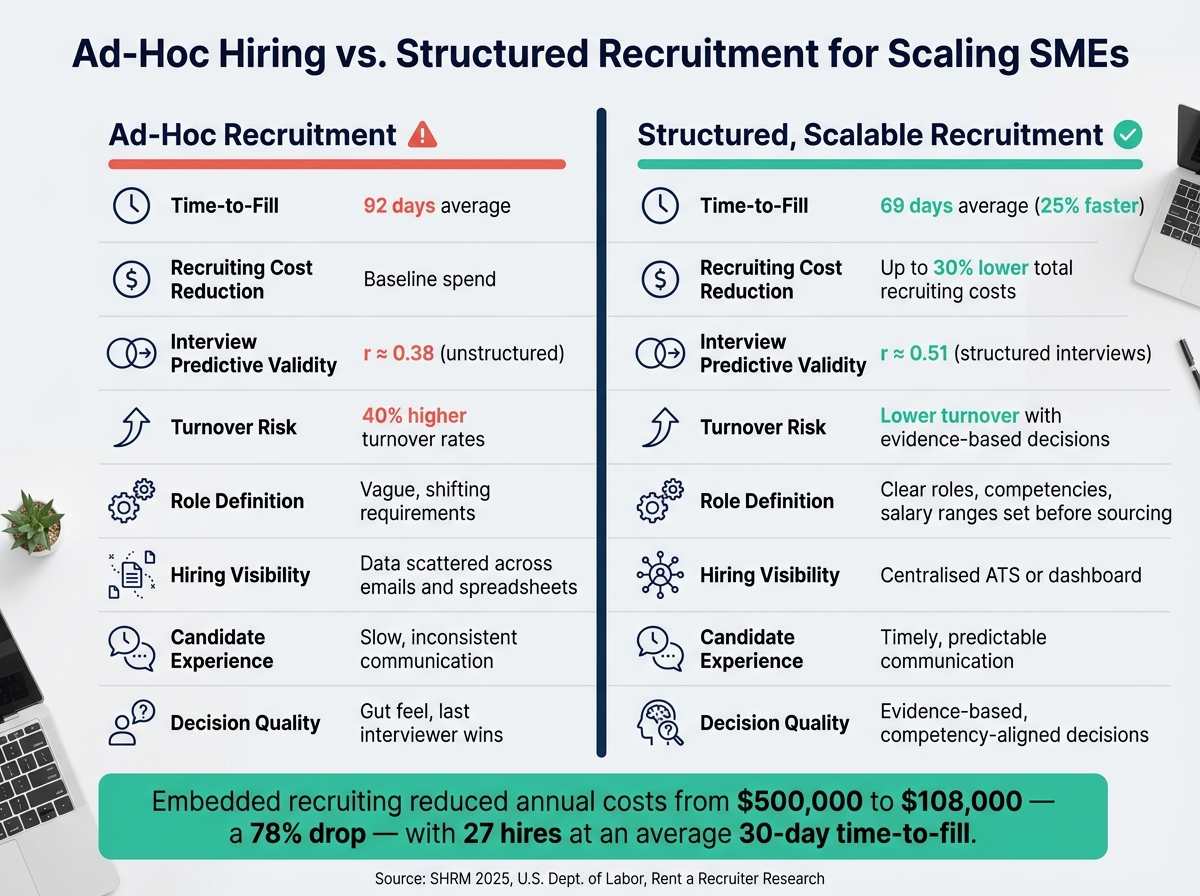
Ad-Hoc vs. Structured Recruitment: Key Metrics for Scaling SMEs
These five challenges come back to one choice: ad-hoc hiring or a structured recruitment process.
This is not just about process for process’s sake. It shows up in speed, hire quality, and cost. When hiring is reactive, every role becomes a one-off job. The team starts from scratch, requirements shift, interviews drift, and decisions slow down. A structured process works differently. You use a repeatable system that gets faster and more dependable over time.
That gap is easy to see when you compare the two models side by side.
Standardising recruitment cut time-to-hire from 92 to 69 days and reduced total recruiting costs by about 30%.[28] Structured interviews also show stronger prediction of job performance, with a predictive validity of r ≈ 0.51, compared with r ≈ 0.38 for unstructured conversations.[25][26][27]
| Dimension | Ad-Hoc Recruitment | Structured, Scalable Recruitment |
|---|---|---|
| Role Definition | Vague, shifting requirements | Clear roles, competencies, and salary ranges set before sourcing |
| Interview Structure | Varies by interviewer, no set questions | Defined stages with consistent questions and scorecards |
| Evaluation Consistency | Informal, subjective feedback | Standardised ratings with documented behavioural evidence |
| Hiring Visibility | Data scattered across emails and spreadsheets | Centralised ATS or dashboard |
| Speed and Reliability | Unpredictable timelines, frequent delays | Stage SLAs and tracked time-to-fill |
| Decision Quality | Gut feel, last interviewer wins | Evidence-based decisions aligned to competencies and business needs |
| Candidate Experience | Slow, inconsistent communication | Timely, predictable communication |
The two biggest gains are repeatability and visibility.
Repeatability means your team does not reinvent hiring every time a new role opens. You reuse what works. That saves time, cuts admin, and makes hiring less dependent on whoever happens to be running the process that week.
Visibility means leaders can see where things are slipping. If sourcing is weak, interviews are backing up, or offers are taking too long, you spot it early. That matters when growth plans depend on hiring staying on track.
And yes, that process gap shows up in the bill too.
What Recruitment Really Costs Growing SMEs
Once hiring picks up, the cost is not just what you pay out. It is vacancy time, manager time, and lost output.
Most SMEs track the easy-to-see spend, job boards and agency fees. What often gets missed is the hidden cost sitting outside the recruiting budget: vacancy loss and manager time. That is where hiring starts to get expensive fast.
The biggest costs are often not the obvious ones. Here is how the main cost areas usually stack up:
| Cost Category | Typical U.S. Range | Notes |
|---|---|---|
| Job board postings (Indeed, LinkedIn, ZipRecruiter) | $200 to $2,000/month | Higher for premium listings or ongoing subscriptions [30][33][38] |
| Tools and screening (ATS software, background checks) | $130 to $700 per hire | Includes recruiting software, often 10 to 15% of total cost per hire, and background checks ($30 to $200 per candidate) [30][31][32][33][38][39] |
| Agency fees | 15 to 25% of first-year salary | A $80,000 hire can cost $12,000 to $24,000 in agency fees alone [35][36][37] |
| Internal hiring time (HR/recruiter) | $1,000 to $3,000 per hire | Typically 30 to 40% of total cost per hire [29][30][39] |
| Manager and interviewer time | $720 to $3,360 per hire | Based on 15 to 70 hours at about $48 to $50/hour [30][33][39] |
| Vacancy and lost productivity | $1,000 to $5,000+ per open role | Higher for revenue-generating or customer-facing positions [34][38] |
Two areas get undercounted again and again: manager time and vacancy loss.
Hiring can eat up 30 to 40% of a manager’s time for two to three months [30]. That time does not come from nowhere. It comes out of delivery, team leadership, customer work, and growth plans. In plain terms, your managers stop doing the work that moves the business forward.
Then there is the open role itself. Every week a seat stays empty in sales, engineering, or operations has a dollar cost attached to it. Not just on paper, and not just in the recruiting budget. Revenue slips, delivery slows, and other team members end up carrying the load.
Weak process makes this worse. Every hire turns into its own cost event, with fresh delays, repeated admin, and more interviews than needed. Recruitment cost is a system cost, not just a hiring expense. Once you add direct spend, internal labor, vacancy loss, and process drag, the gap between a process that looks cheap and one that works well becomes hard to ignore.
And when those costs repeat across several hires, the issue is no longer just budget. It is whether your recruitment model can scale at all. For more insights on optimizing your hiring strategy, explore The Talent Fix Recruitment Blog.
From Short-Term Hiring Pressure to a Scalable Recruitment Function
Lower spend on its own will not fix hiring. If you want to grow, you need a recruitment function that you can repeat, measure, and trust.
A scalable recruitment function rests on six basics: clear ownership, role scorecards, defined interview stages, feedback timelines, basic funnel reporting, and workforce planning.
Clear ownership means one person is accountable for hiring results. No confusion. No gaps. No chasing five people for one decision.
Role scorecards set out what success looks like in the role, so each interviewer judges against the same standard. That cuts mixed signals and helps you make better calls.
Defined interview stages give hiring a repeatable flow. They also keep timelines more predictable, which matters when teams are under pressure to fill roles fast.
Feedback timelines are where many teams fall down. Interview feedback should land within 24 to 48 hours, and final decisions should be made within two business days. When that slips, good people lose interest and pipelines thin out without much warning.
Basic funnel reporting does not need to be fancy. Track applicants, screens, interviews, offers, and acceptances. A spreadsheet is fine if that is where you need to start. The point is simple: if you cannot see the funnel, you cannot spot where time and money are being lost.
Workforce planning links business goals to a quarterly hiring plan. That means you start hiring before a role turns urgent, which usually leads to lower stress, better choices, and less spend on rushed agency support.
Taken together, these basics deal with the five problems above: capacity, inconsistency, competition, cost, and ownership. They turn hiring from a string of one-off fixes into a system your business can use as it grows.
Most SMEs still hire without a formal recruitment function, often choosing between in-house talent vs recruitment agencies as they scale. That is usually why hiring starts to crack when volume goes up. What works for a handful of hires often falls apart once growth picks up.
That gap is exactly why a scalable recruitment function matters.
Rent a Recruiter places experienced recruiters into your team within days, managing hiring end-to-end and putting scorecards, interview stages, and funnel tracking in place while demand is high. The next step is practical: how to make that shift without slowing growth.
Conclusion
These five challenges all point to the same problem: hiring starts to fail when your process cannot keep pace with growth.
In most scaling SMEs, hiring issues come back to weak infrastructure. You may not have enough capacity. The process may vary from role to role. Costs start creeping up. Ownership gets blurry. Those are not one-off hiring issues. They are operating issues, and they need operating fixes.
The problems build on each other. Low capacity leads to inconsistency. Inconsistency slows hiring. Slow hiring pushes costs higher. That is why the answer is not more pressure or more urgency. It is a structured hiring model.
What you need is a recruitment function that stays fast, consistent, and measurable as hiring volume grows. Use fractional recruitment services to add capacity. Standardise the process. Control cost. Give one team or person clear ownership. Companies that scale well put these basics in place before hiring pressure hits its highest point. That makes the next stage of growth far easier to handle.
Rent a Recruiter helps high-growth SMEs add capacity fast, placing experienced recruiters inside your team within days so hiring becomes more repeatable and easier to manage.
FAQs
When should an SME formalize hiring?
Ideally, before a period of rapid growth.
If you wait until hiring demand spikes, things can get messy fast. Interview processes drift. Teams start hiring in different ways. Admin piles up. And delays begin to hit the business.
That usually shows up in a few ways:
- Roles are stacking up
- Time-to-hire is getting longer
- Different teams are using mixed hiring practices
At that point, it’s time to formalise the process.
For sudden hiring spikes, Rent a Recruiter can add the structure and capacity you need to scale, without letting hiring slip into chaos.
What hiring metrics should SMEs track?
SMEs should track the Big Four: cost-per-hire, time-to-fill, offer acceptance rate, and 90-day retention. These four metrics tell you a lot, fast.
They show how well your hiring process runs, how competitive you are in the market, and whether new hires are sticking after they join. Put simply, they help you judge efficiency, hiring strength, and hire quality.
You should also keep an eye on:
- Funnel metrics
- Process metrics
- Capacity metrics
- Quality metrics
These give you a clearer view of what’s going on behind the numbers. They show where candidates drop out, where delays build up, whether your team can cope with growth, and whether moving fast is hurting talent standards.
How do SMEs compete for scarce talent?
SMEs win scarce talent when they stop hiring only when a role opens and start building a pipeline ahead of need.
That shift matters because 70% of the workforce is not actively looking for a new job. If you wait until a vacancy lands on your desk, you’re already behind. Pre-vetted talent pools give your team a head start, so you can engage strong people before the market gets crowded.
Speed matters too. A 15 to 20 business day time-to-hire can make the difference between closing a hire and losing them to another offer. Fewer internal bottlenecks help keep momentum up and cut delays that drag out decision-making.
SMEs also have strengths worth putting front and center. You can offer:
- Meaningful impact from day one
- Real flexibility in how people work
- Direct access to leadership, without layers of process
For hiring leaders, that means a simpler pitch and a better process. You move faster, spend less time stuck in approvals, and give strong candidates a clear reason to choose you.