
Hiring delays cost you time, money, and top talent. Misaligned stakeholders slow decision-making, cause candidate drop-offs, and lead to costly mis-hires. Fixing this is not just a process improvement – it’s a business necessity.
When hiring managers, recruiters, and executives align early, you cut time-to-hire, reduce costs, and avoid bad hires. Here’s how to make it work:
- Identify key stakeholders upfront: Include hiring managers, recruiters, finance, executives, and team leads to avoid delays later.
- Define clear role requirements together: Agree on must-haves vs. nice-to-haves to prevent mid-search changes.
- Set SLAs and deadlines: Commit to feedback within 48 hours and track metrics like time-to-alignment.
- Improve communication: Use structured updates, scorecards, and ATS tools to avoid bottlenecks.
- Review and refine after each hire: Use data to improve processes and avoid repeating mistakes.
Scaling companies that align stakeholders effectively are four times more likely to hire efficiently. Want to speed up your hiring process? Rent a Recruiter embeds recruitment experts directly into your team to eliminate delays and deliver results.
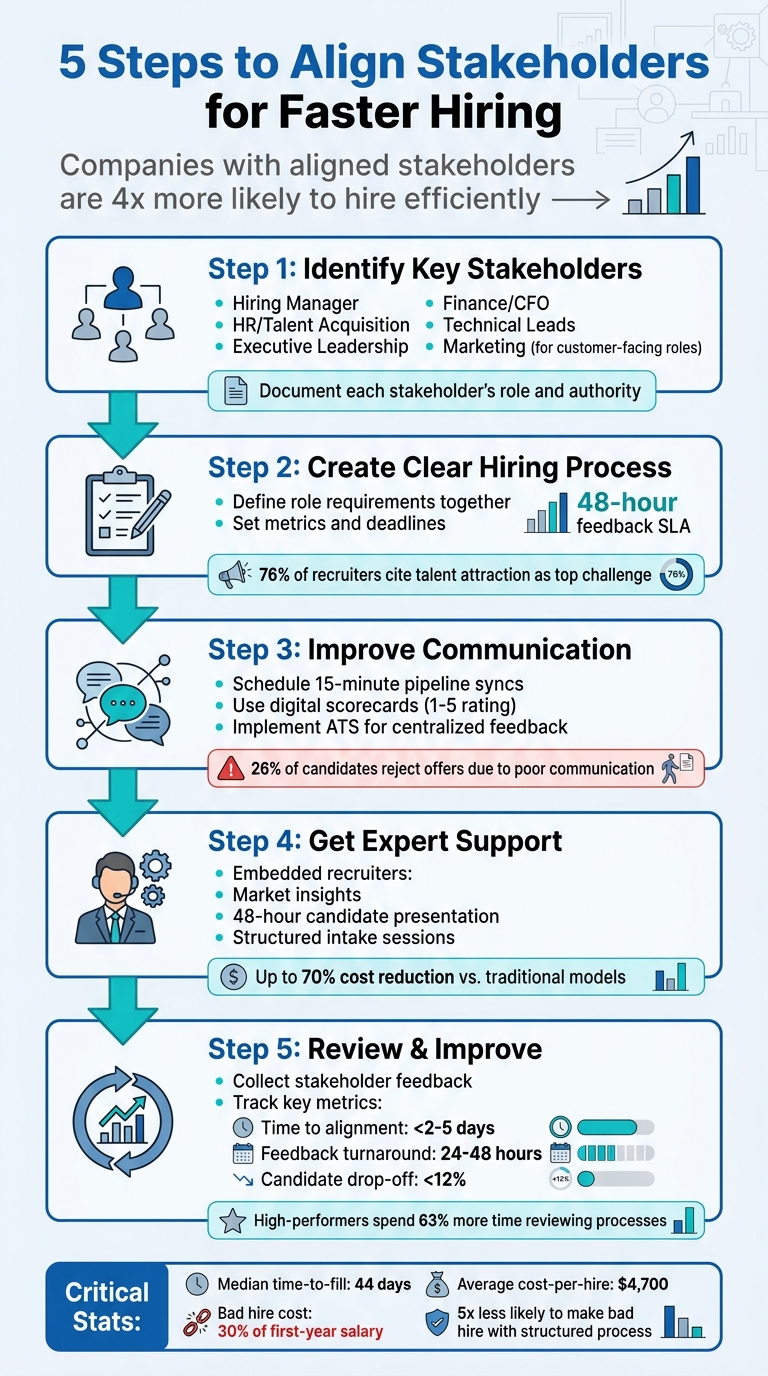
5-Step Process to Align Stakeholders for Faster Hiring Decisions
Step 1: Identify Your Key Stakeholders
Who Needs to Be Involved?
To speed up hiring, it’s critical to identify all decision-makers from the outset. Leaving someone out can lead to delays or even derail the entire process. Getting everyone aligned early ensures smoother decision-making and cuts down on time-to-hire.
Here’s who you’ll typically need:
- Hiring Manager: Defines the role and ensures technical fit.
- HR/Talent Acquisition: Oversees the hiring process and sources candidates. Many organizations use an embedded recruitment service to provide this dedicated support internally.
- Executive Leadership (CEO, CHRO): Focuses on alignment with company goals and culture.
- Finance/CFO: Approves salary budgets and evaluates the return on investment.
- Technical Leads (CTO, IT): Evaluates technical compatibility.
- Marketing (CMO): Maintains the candidate experience for customer-facing roles.
"Missing a stakeholder or selecting the wrong stakeholder poses a potential performance risk." – Heather Colella, VP Analyst, Gartner [4]
Don’t forget to involve team members who will work closely with the new hire. They often have insights into daily operations and can flag potential cultural mismatches. For roles impacting external relations, like customer service or PR, external stakeholders – such as customers or community representatives – might also be key.
Take inspiration from a major U.S. retailer that identified an IT bottleneck by mapping stakeholders. By presenting targeted business cases, they secured the necessary support and streamlined their hiring process by March 2018 [3].
Once you’ve identified your stakeholders, document their roles to avoid confusion and keep things moving.
Document Each Stakeholder’s Role
Clear documentation of each stakeholder’s responsibilities is essential. It prevents bottlenecks and ensures everyone knows who has the final say.
Create a straightforward document outlining each stakeholder’s authority and role. For example, does the CFO simply provide input on salary ranges, or do they need to sign off? Is the hiring manager responsible for the final decision, or does it require CEO approval? This level of clarity avoids unnecessary delays caused by waiting for input from the wrong person.
Companies that formalize stakeholder roles often see faster hiring decisions [1]. A stakeholder matrix can be helpful here – map each person’s influence and stance (e.g., supportive or resistant). This helps you focus your efforts and spot potential obstacles early.
"SLAs for all stakeholder groups should be discussed and agreed upon so that all sides can be held accountable for their part of the hiring process and strategy." – Will Staney, CEO and Founder, Proactive Talent Strategies [1]
Implement Service-Level Agreements (SLAs) for each stakeholder group. Define clear timelines for reviewing candidates, giving feedback, or approving budgets. By setting expectations and holding everyone accountable, you create alignment and pave the way for a faster, more efficient hiring process.
sbb-itb-a23bd6a
Step 2: Create a Clear Hiring Process
Define Role Requirements Together
Once stakeholders are identified, the next step is aligning on what the role truly requires. A structured process keeps everyone focused and avoids unnecessary slowdowns.
Start with a kickoff meeting to develop a unified candidate profile. The goal isn’t to achieve perfect agreement but to ensure shared clarity about the role’s purpose and the outcomes it needs to deliver. Document key details: the role’s immediate objectives, the problem it addresses, and how it supports company growth. Define success metrics for the first 6 and 12 months to avoid shifting expectations mid-search, which can derail progress and force you to start over [5].
Break down requirements into two categories: "non-negotiables" (skills and experience needed from day one) and "trade-offs" (qualities that can be developed over time). This helps the team stay aligned and move quickly when a candidate meets the core needs but lacks secondary skills. With 76% of recruiters citing talent attraction as their top challenge and an average of 250 resumes submitted per opening, clear criteria are essential for effective filtering [6].
Conduct a readiness check where stakeholders rate their confidence on a scale of 1–10. Address any major discrepancies immediately to avoid misalignment later [5]. Assign someone to lead the discussion and document everything in a shared, easily accessible file. This ensures transparency and keeps everyone on the same page throughout the process [6].
Once role expectations are clear, the next step is to establish timelines and accountability measures.
Set Metrics and Deadlines
Clarity on when decisions happen is just as important as clarity on what is decided. Even well-aligned teams can experience delays without defined timelines. High-performing recruitment teams are three times more likely to have a formal, documented process with clear accountability [1].
Set Service Level Agreements (SLAs) between recruiters and hiring managers to establish expectations. For example, hiring managers should provide scored feedback within 48 hours of receiving candidate submissions to keep things moving [1][2]. Weekly 15-minute pipeline syncs are also effective for addressing blockers and maintaining momentum [2].
Different stakeholders care about different metrics, so tailor key performance indicators (KPIs) to their concerns. CEOs often focus on the percentage of roles filled on time, CFOs care about cost-per-hire and ROI, and recruiters prioritize metrics like time-to-fill and conversion rates [1][3]. Tracking "time to alignment" – the number of days between opening a role and agreeing on the candidate profile – can reveal hidden delays in the process [2].
The numbers highlight why speed and structure matter. The median time to fill a role is 44 days, and the average cost per hire is $4,700. A bad hire, however, can cost at least 30% of the employee’s first-year salary. Additionally, 26% of candidates reject offers due to poor communication or slow feedback [2]. To avoid these pitfalls, schedule a calibration session after reviewing the first 10–15 candidates. Use this opportunity to refine criteria based on actual market data [2].
Balancing the needs of hiring managers, recruiters, and candidates is critical. Teams that achieve this balance are four times more likely to perform at a high level [1]. By setting clear metrics and deadlines, you ensure everyone knows their responsibilities and commits to delivering results on time.
Step 3: Improve Communication and Feedback
Schedule Regular Updates
Good communication isn’t just polite – it directly impacts hiring outcomes. 26% of candidates reject offers due to poor communication, and 81% of hiring managers who ghost candidates do so because they lack clarity on decision criteria [2]. The fix? Build consistent, structured updates into your recruitment process.
Start with 15-minute pipeline syncs between recruiters and hiring managers. These quick meetings help resolve decision delays and keep the process moving. Use them to address any blockers and ensure alignment on next steps.
Set clear SLAs (Service Level Agreements) for feedback. For instance, hiring managers should provide scored evaluations within 48 hours of receiving candidate submissions, with final decisions made within 24 hours of the last interview [2]. These deadlines aren’t arbitrary – they prevent candidates from languishing in uncertainty while internal debates drag on.
Track "time to alignment" as a critical metric. This measures how long it takes for stakeholders to agree on the candidate profile after a role opens. A high number here signals a bottleneck. Calibration sessions can help by refining your criteria based on market realities, avoiding the trap of chasing an ideal candidate who doesn’t exist [2].
Use Technology to Stay Aligned
Technology isn’t just a convenience – it’s essential for keeping everyone on the same page. Scattered communication through email or Slack creates confusion and delays. Companies with hiring cycles exceeding 40 days see a 12% rise in candidate drop-offs, often caused by disorganized feedback [7]. Centralizing everything in an Applicant Tracking System (ATS) can solve this.
Leverage digital scorecards with a 1–5 rating system tied to predefined competencies. Avoid vague terms like "not a fit", which, as Steven Lu from Pin puts it, is "the most expensive phrase in recruiting" [2]. Scorecards force clarity, allowing for objective candidate comparisons.
Kamila Kashayeva, Talent Acquisition Partner at Tellent Recruitee, highlights the benefits of an ATS: "Once your hiring managers use [an ATS], they realize it’s the easiest way to coordinate instead of relying on email or Slack for feedback" [7].
Automate evaluation requests to eliminate manual follow-ups and expose any delays [7]. Set up workflows where candidates can’t progress to the next stage until all prior feedback is submitted. This simple rule keeps bottlenecks visible and manageable.
For high-volume roles, enable quick thumbs-up/down evaluations with a brief required comment. This makes it easier for busy stakeholders to provide immediate feedback [7]. Real-time dashboards show where each candidate stands and highlight any process holdups, encouraging faster action through transparency.
Step 4: Get Expert Support for Better Alignment
How Embedded Recruiters Help
Once you’ve streamlined communication and clarified role criteria, the next step is to bring in expert recruiters to ensure alignment across the board. Misalignment is a major reason why 69% of organizations struggle to fill full-time roles [2]. Embedded recruiters address this head-on by becoming an integral part of your team, managing the entire hiring process.
They lead comprehensive intake sessions to define essential role criteria and set clear 30/60/90-day performance benchmarks [2]. This upfront clarity avoids costly mid-search changes, like when stakeholders suddenly realize they never agreed on what "senior" or "qualified" actually means.
Embedded recruiters also work fast. They present candidates within five business days and keep the process moving by ensuring hiring managers provide feedback within 48 hours [2]. Plus, they deliver market insights – such as salary trends and talent availability – to help adjust expectations before a search hits a roadblock [2].
"Misaligned hiring requirements are rarely a talent problem. They’re an alignment problem."
- Christina Stone, Fusion Recruiters [5]
By optimising your recruitment process and communication, embedded recruiters integrate seamlessly into your team, enabling faster and more effective hiring decisions.
Benefits for Growing SMEs
For fast-growing SMEs, embedded recruitment offers measurable results. Companies often cut hiring costs by up to 70% compared to traditional commission-based models, while also saving over 80 hours each month on hiring and admin tasks [8]. Time-to-fill can be reduced by as much as 50%, thanks to the embedded recruiter’s deep understanding of your business and their ability to eliminate unnecessary communication bottlenecks [8].
Rent a Recruiter places experienced recruiters directly into your team within days, bringing the structure and consistency needed to align stakeholders. High-performing companies are four times more likely to succeed when they achieve this alignment [1]. Whether you’re scaling after a funding round or tackling a hiring surge, this model provides the capacity to hit your hiring goals – without the long-term costs of permanent internal hires or the transactional nature of traditional agencies.
This approach isn’t just about improving processes; it’s about aligning recruitment with your strategic goals. Embedded recruiters focus on metrics that matter, like hiring speed and budget alignment, transforming their role from service providers to true strategic partners. They replace vague feedback like "not a fit" with objective, scorecard-based evaluations that reflect agreed-upon competencies [2]. For SMEs navigating rapid growth, this shift from reactive to structured hiring can make the difference between achieving your goals or falling short.
Step 5: Review and Improve After Each Hire
Collect Feedback from All Stakeholders
Hiring doesn’t stop at extending an offer. In fact, high-performing recruitment teams spend 63% more time reviewing their hiring processes compared to their lower-performing counterparts. Yet, only 30% of hiring managers and 22% of recruiters feel satisfied with their current methods [1].
To improve, establish a regular forum where recruiters and hiring managers can openly discuss what worked well and what didn’t during the most recent hiring cycle [1]. These meetings should focus on uncovering patterns and actionable insights. Formal surveys can also help gather objective feedback on the recruitment team’s performance and the overall strategy [1].
"Coming to each of these meetings and being open about challenges, questions about language in a job description, or feedback on candidates is essential… It has to be a two-way street."
- Will Staney, CEO and Founder, Proactive Talent Strategies [1]
It’s worth noting that 26% of candidates reject job offers due to poor communication or delays in internal feedback [2]. Use these insights to streamline your process and avoid unnecessary losses.
Make Changes Based on What You Learn
Feedback isn’t just for discussion – it’s a tool for improvement. Start by addressing unclear feedback on "not a fit" rejections. If rejections lack specific, scorecard-driven reasoning, revisit and refine your "must-have vs. nice-to-have" criteria for future roles [2]. This matters because a bad hire can cost at least 30% of their first-year salary [2].
Check whether hiring stakeholders adhered to agreed timelines, such as providing candidate feedback within 48 hours [2]. If delays occurred, consider implementing automated reminders through your ATS and track metrics like "time to alignment" to pinpoint bottlenecks [2][7].
Calibration sessions can also help ensure consistency in evaluation. For instance, if one interviewer consistently scores candidates lower than others, it might indicate misaligned criteria [2]. Benchmarking new hires against the 30/60/90-day goals discussed during intake meetings can reveal whether the team targeted the right profile. If those milestones aren’t met, it’s a sign the hiring persona needs adjustment [2].
| Metric to Review | What It Reveals | Target Benchmark |
|---|---|---|
| Time to Alignment | Efficiency of intake and profile-setting processes | < 2–5 days [2] |
| Feedback Turnaround | Stakeholder engagement and clarity of criteria | 24–48 hours [7] |
| Candidate Drop-off Rate | Impact of delays on candidate interest | Minimize (aim for < 12%) [7] |
| Quality-of-Hire | Success in identifying top talent | Varies by role [1] |
Every hire offers an opportunity to refine your process. Companies with hiring cycles longer than 40 days see a 12% increase in candidate drop-off rates [7]. On the other hand, organisations that stick to a structured interview process are five times less likely to make a bad hire [2]. By reviewing actual outcomes – not assumptions – you can fine-tune your approach, making each recruitment cycle faster and more effective.
Conclusion
Key Takeaways
Getting stakeholders aligned early in the hiring process saves time, reduces costs, and ensures better hiring decisions. A unified approach can significantly cut time-to-fill and prevent expensive mis-hires [2]. The method? Start with structured intake meetings to clarify role requirements, agree on SLAs with 48-hour feedback windows, rely on scorecard-based evaluations instead of vague rejections, and track "time to alignment" to identify and resolve bottlenecks.
Clear role definitions, fast feedback cycles, and the right expertise are essential for efficient and cost-effective hiring. Research indicates that companies with structured interview processes are five times less likely to make a bad hire [2]. Case studies consistently demonstrate how alignment improves recruitment outcomes [3].
"Misaligned hiring requirements are rarely a talent problem. They’re an alignment problem."
- Christina Stone, Fusion Recruiters [5]
Looking to simplify your hiring process?
Partner with Rent a Recruiter
Rent a Recruiter applies these proven strategies to deliver expert recruitment support when you need it most. Facing hiring delays? Embedded recruitment can streamline your process. Rent a Recruiter embeds experienced recruiters directly into your team within days, bringing the structure and transparency needed to align hiring managers, interviewers, and decision-makers from day one. Most companies see up to a 70% reduction in hiring costs compared to commission-based models while saving over 80 hours per month in internal hiring admin.
Whether you’re scaling after securing funding, launching a new product, or handling a surge in demand, Rent a Recruiter helps your team hire faster and reduce costs. Find out how Rent a Recruiter can transform your hiring process.
Dial In a Strategy that Facilitates Clarity and Alignment in the Hiring Process feat. Gina Thompson
FAQs
Who should be a stakeholder for this role?
Recruiters and hiring managers are the key players in this role. They work closely to align on hiring criteria and expectations, ensuring a smoother process from start to finish. Regular collaboration between these two groups not only speeds up decision-making but also minimizes potential delays, making their partnership critical to achieving hiring goals.
What SLAs should we set for feedback and approvals?
Setting clear Service Level Agreements (SLAs) for feedback and approvals is a game-changer when it comes to cutting hiring delays. By defining specific timeframes – like a 24-48 hour window for feedback – you can keep the process moving. Limiting the number of approvers also helps prevent unnecessary bottlenecks.
A pre-approved hiring plan is another way to streamline things. It minimizes back-and-forth and avoids repeated decision cycles. Make sure everyone involved understands the SLAs and monitor adherence to hold stakeholders accountable. The result? A hiring process that’s faster, more predictable, and easier to manage.
How do we measure ‘time to alignment’?
‘Time to alignment’ measures how long it takes for all key decision-makers involved in the hiring process to agree on the critical elements of a role. This includes reaching consensus on the role’s purpose, the ideal candidate profile, decision-making authority, and hiring priorities. The clock starts ticking from the moment alignment discussions, such as kickoff meetings, begin and stops once everyone involved has a shared understanding of these key factors.