
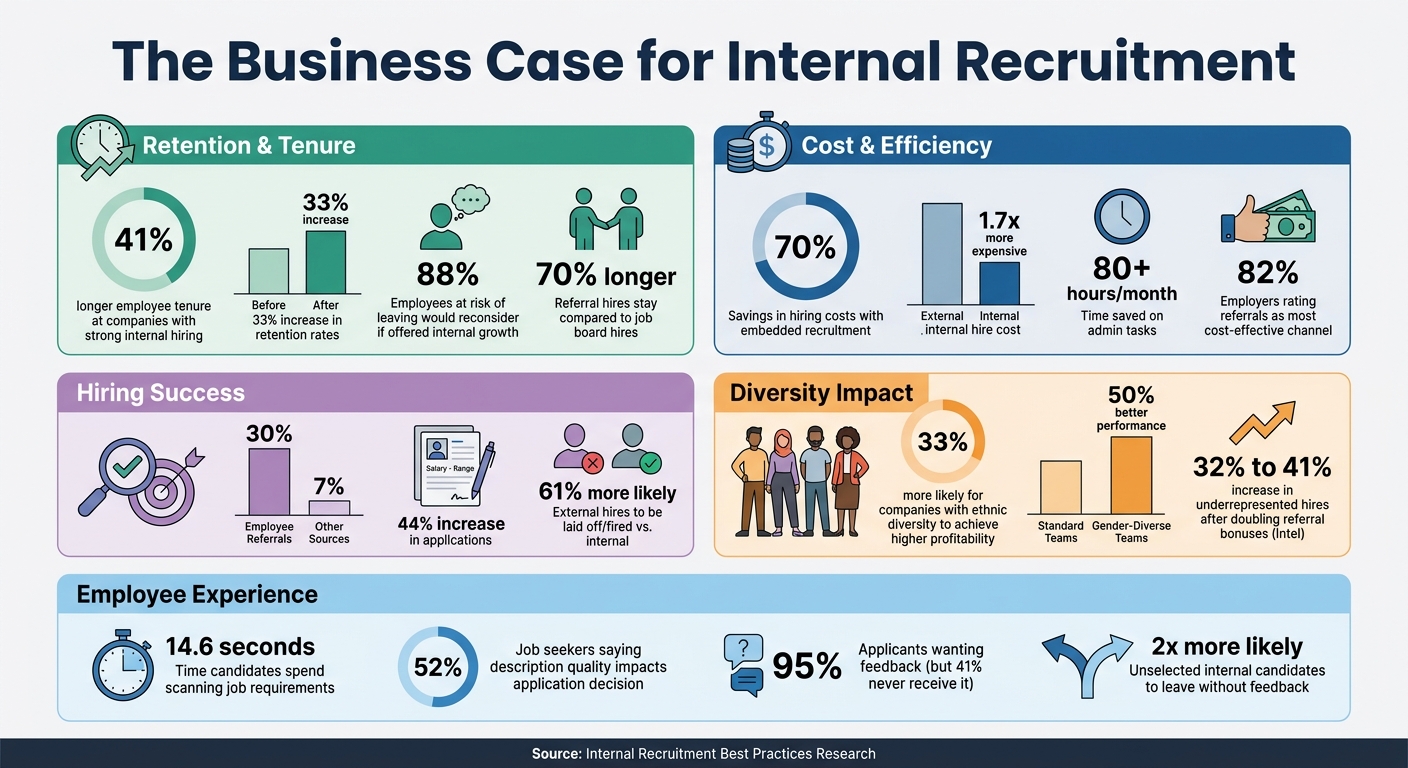
Internal recruitment saves time, cuts costs, and keeps your best talent engaged. Companies that focus on internal hiring see employees stay 41% longer and report a 33% increase in retention. For scaling businesses, this means faster hiring, fewer risks, and lower costs compared to external recruitment.
Here’s how to get it right:
- Write clear job postings: Use concise, results-focused language and include salary ranges to attract internal candidates.
- Standardize processes: Transparent, objective criteria and structured interviews reduce bias and build trust.
- Launch internal mobility programs: Create career portals and skills inventories to align employee goals with company needs.
- Plan for succession: Map critical roles, assess future potential, and develop internal leaders to avoid disruptions.
- Leverage referral programs: Simplify referral processes and incentivize employees to recommend strong candidates.
- Build a talent pipeline: Track skills and aspirations, ensuring employees are ready for new opportunities.
- Give feedback: Provide actionable feedback to unselected candidates to retain engagement and reduce turnover.
Need help building a scalable hiring function? Embedded recruitment integrates directly into your team, saving up to 70% on hiring costs and over 80 hours per month in admin. Whether you’re scaling fast or planning for growth, it’s a smarter way to hire.
Internal Recruitment Statistics: Retention, Cost Savings, and ROI
1. Write Clear Job Postings and Role Profiles
Job postings need to grab attention fast – candidates spend just 14.6 seconds scanning requirements, and over half (52%) of job seekers say the quality of a job description directly impacts their decision to apply [8]. A clear, engaging job description lays the foundation for a smooth internal recruitment process.
Focus on using outcome-based language when describing responsibilities. For example, instead of listing generic tasks like "Write blog posts", aim for results-oriented phrasing such as "Increase organic traffic by 3x." This not only helps candidates understand the role’s impact but also highlights the skills they’ll develop [8]. Keep the responsibilities concise, ideally between 5–7 points, as overly long lists can discourage applicants [4][8].
Make a clear distinction between "must-have" and "nice-to-have" qualifications to attract a broader pool of candidates [3][8]. For internal roles, include company-specific criteria, such as a minimum tenure or performance benchmarks, to ensure fairness [6]. Additionally, provide insight into your department’s mission, current initiatives, and team culture to give candidates a better sense of the role [4][7].
Transparency matters. Including salary ranges can increase applications by 44% [8]. Be upfront about how promotions or transfers might affect compensation, and highlight the career growth opportunities the role offers – whether it’s developing leadership skills or transitioning to a new department [3][5]. Finally, assure employees of confidentiality throughout the application process, so they can apply without fear of immediate disclosure to their current manager [7].
sbb-itb-a23bd6a
2. Build Transparent and Fair Processes
Creating fairness in hiring starts with clear, standardized procedures. Using objective criteria like minimum tenure, performance ratings, and department-specific needs eliminates subjectivity. When employees understand how decisions are made, it reduces guesswork and resentment. For interviews, stick to structured, job-related questions for every candidate. This consistency helps prevent bias from creeping into the process.
Objective scoring systems are another layer of protection. Tools like interview scorecards, which use predetermined scales, ensure candidates are evaluated solely against role requirements. For example, Microsoft uses a private feedback tool where interviewers submit their assessments independently before seeing others’ comments. This avoids groupthink and ensures honest evaluations [10].
"Nothing kills trust faster than the perception that promotions are about who you know, not what you know." – Predictive Index [12]
Diverse hiring panels also play a key role in reducing bias. Including team members from different backgrounds and departments brings multiple perspectives to the table [9]. The impact is clear: companies with executive-level ethnic diversity are 33% more likely to achieve higher profitability, and gender-diverse teams outperform homogeneous ones by 50% [11].
Transparency is critical. Post all internal openings on a centralized job board that every employee can access, and back it up with company-wide emails [12]. Once a hiring decision is made, explain the reasoning based on your predefined criteria. For those who don’t make the cut, provide timely, specific feedback. Focus on skill gaps and offer a clear development plan to help them grow [12].
3. Start Internal Mobility Programs
Internal mobility programs create opportunities for employees to grow through promotions, lateral transfers, and cross-functional roles. This approach not only ensures fair and transparent hiring processes but also taps into the potential of existing talent. Start by building a centralized skills inventory that captures employees’ current capabilities, their learning goals, and their career aspirations. This database becomes the foundation for aligning internal talent with new opportunities [15][16].
With a robust skills inventory in place, introduce a mobile-friendly career portal where employees can easily explore internal job openings and career paths. Surprisingly, only 27% of employees feel their company effectively advertises internal opportunities [18]. Companies like Walmart and Chipotle demonstrate the impact of such initiatives. Walmart’s education and mobility program has doubled participants’ chances of promotion and cut attrition rates by a factor of four. Meanwhile, Chipotle’s upskilling program has made participants six times more likely to advance into management roles as of June 2022 [14].
Encourage lateral movements and job rotations to build diverse skill sets, keep employees engaged, and create an adaptable workforce [16][17]. The Walt Disney Company’s tuition-free education and mobility program, for example, has been a key driver of interest in hourly roles. By August 2022, one in four applicants cited this program as their main reason for applying [14].
Establish clear eligibility guidelines – such as minimum tenure and standardised application processes – to ensure fairness and reduce issues like favoritism or talent hoarding [15][16]. Data shows that employees at companies with strong internal hiring practices stay 41% longer than those at organizations with limited mobility options [17].
"Career mobility connects what employers need – new skills – with what employees want – better pay, stability, & flexibility."
Finally, ensure internal candidates go through structured, unbiased interviews and receive prompt feedback. Offer mentorship and tailored training to bridge skill gaps, addressing the fact that 63% of employees leave due to a lack of advancement opportunities [14].
4. Set Up Succession Planning
Succession planning protects your business from the chaos of unexpected vacancies in key roles. Surprisingly, more than 56% of companies lack a structured approach to this, leaving them exposed when critical positions open up [22]. The stakes are high – poorly managed CEO transitions alone can erase nearly $1 trillion in market value annually for S&P 1500 companies [30, 31].
The first step is identifying roles that are critical at every level, not just in the executive suite. A role is deemed critical if leaving it unfilled for even a few months disrupts operations, impacts revenue, or results in a loss of specialized knowledge [28, 29, 31]. Focus on the top 0.5% of roles that would cause the most disruption if left vacant [20]. Next, map out how these roles will evolve over the next 3–5 years, considering the impact of digital transformation and shifting business priorities [29, 32]. This sets the foundation for assessing both performance and future potential objectively.
Use tools like the 9-box grid to evaluate employees’ current performance alongside their potential for future roles. Supplement this with 360-degree feedback and talent calibration meetings, where managers justify their high-potential nominations [27, 30, 32]. This process differentiates employees who are excelling now from those who have the adaptability and leadership skills needed for more demanding roles. Internal development is key here – external hires are 61% more likely to be laid off or fired and 21% more likely to leave compared to internal hires [19].
Develop Individual Development Plans (IDPs) for high-potential employees. These plans should include stretch assignments, cross-functional rotations, and mentoring from senior leaders. A great example is McCormick & Co.’s CEO Robert Lawless, who allocated part of his compensation in 2008 to a five-year development plan for his successor, Alan Wilson. This initiative helped reduce turnover by 77% [27, 28, 31, 32]. Schedule these plans carefully to ensure smooth leadership transitions.
Classify potential successors into categories like "Ready Now", "Ready Soon" (1–2 years), or "Long-term Potential" [29, 32]. Also, have emergency plans in place to identify interim leaders who can step in during sudden vacancies [21]. Begin knowledge transfer 6–12 months before planned departures through overlapping transition periods and legacy meetings to retain critical institutional knowledge [21].
5. Use Employee Referral Programs
Internal recruitment becomes even more effective with well-designed employee referral programs. The numbers speak for themselves: candidates referred by employees are hired at a rate of 30%, compared to just 7% for other sources [25]. These hires also stay 70% longer than those found through job boards or agencies [26]. Unsurprisingly, 82% of employers consider referrals the most cost-effective hiring model [25].
Simplify the process. A referral form that’s mobile-friendly and takes under two minutes to complete can make a huge difference. Ask only for essential details like the candidate’s name, LinkedIn profile, and their connection to your employee [23]. To keep employees engaged, commit to acknowledging every submission within 48 hours [25].
Take Salesforce as an example. Their policy of reviewing referrals within seven days, paired with an app where employees can track their submissions, has resulted in 41% of their hires coming from referrals [27].
Incentivize smartly. Match rewards to the complexity of the role. For instance, offer $1,000 for entry-level positions and up to $8,000 for technical roles. A split payout model – half at the time of hire and the rest after 90 days – balances immediate rewards with long-term retention [23].
Non-cash incentives can also work wonders. DigitalOcean saw 43% of employees participate in their program by offering a $1,500 charitable donation alongside a $3,500 cash bonus [26].
Address diversity challenges. Referral programs can unintentionally perpetuate a lack of diversity, as employees often refer people similar to themselves. For example, women of color are 35% less likely than white men to receive referrals [25]. Intel tackled this by doubling referral bonuses for underrepresented candidates, boosting their share of underrepresented hires from 32% to 41% [25].
Keep it visible and engaging. Regularly update employees on hiring needs with a "Jobs We Need Filled" digest, clearly outlining what makes a candidate qualified [23][24]. Creative initiatives can also spark interest. GoDaddy, for instance, increased their referral rate from 17% to 33% by giving employees hand-held mirrors engraved with a note encouraging them to "reflect" on their network, even while reducing cash bonuses [27].
When done right, referral programs don’t just fill roles – they bring in high-quality hires who stick around. A transparent, engaging approach ensures employees remain invested in the process.
6. Build and Maintain a Talent Pipeline
Creating and managing a talent pipeline isn’t just about filling roles; it’s about preparing for the future while reducing costs. Internal hires are far more cost-effective – external hires can be up to 1.7 times more expensive [7]. Plus, this approach can improve employee retention by 41% [1]. It’s a win-win when you combine clear processes with ongoing development.
Track skills and aspirations with intention. Microsoft, under CEO Satya Nadella, replaced traditional performance reviews with "Talent Talks." These conversations allow managers to directly explore employees’ career goals and readiness for new opportunities [1]. This proactive approach not only minimizes surprises but also strengthens relationships. Adding technology to the mix can make this process even smoother.
Use technology to connect talent with opportunities. Schneider Electric’s "Open Talent Market" is a prime example. Launched in 2019, this AI-powered platform helps 85,000 employees explore internal roles and mentorships by using a standardized skills framework. By 2026, 85% of eligible employees had engaged with the system, providing visibility into over 14,000 roles and resulting in 1,500 placements [1]. Regularly updating skills inventories and career preferences ensures the system stays relevant, keeping the pipeline active and effective. Explore our recruitment resources for more tools to optimize your hiring strategy.
Keep the pipeline moving through internal mobility. ExxonMobil demonstrates this with over 12,000 internal job rotations annually, supported by an impressive 500,000 training courses delivered in 2022. This constant movement keeps employees engaged and ready for new challenges. For those not immediately selected for roles, offering tailored development plans – like training or mentorship – can prepare them for future opportunities.
The value is undeniable: 88% of employees at risk of leaving would reconsider if presented with internal career growth options [13]. By investing in talent talks, skills assessments, and clear communication, you can transform your workforce into a dynamic, ready-to-go talent pool. Actively managing this pipeline ensures your internal recruitment efforts drive sustained growth and engagement.
7. Provide Feedback and Keep Communication Open
Unselected internal candidates are twice as likely to leave their roles [31]. However, this risk drops significantly when they receive thoughtful feedback and are presented with clear development opportunities. Here’s a striking reality: while 95% of job applicants want feedback after interviews, 41% never hear back at all [29][30]. For internal candidates, the lack of feedback can feel even more disheartening. Imagine watching someone else step into a role you aspired to, all while continuing to show up for work every day.
This is why prompt and meaningful feedback matters. Aim to deliver personalized feedback within 3–5 business days while the interview details are still fresh, avoiding the pitfalls of speed hiring without alignment. [28][29]. Instead of relying solely on email, schedule a private one-on-one meeting or video call. Use specific examples from the interview to explain your decision, avoiding vague comments like "you weren’t the right fit." This approach transforms rejection into a constructive path forward.
When giving feedback, focus on growth opportunities rather than direct comparisons. Instead of saying, "The other candidate was better", offer actionable next steps. Suggest earning a relevant certification, joining a mentorship program, or tackling specific skill-building projects. Companies that offer constructive feedback report candidates being four times more likely to apply for future internal roles [30]. Ozan Cınar from Mercedes-Benz highlighted the impact of this approach:
"We truly felt the speed difference. Everything was smoother, and candidate feedback was much more positive. It made our jobs easier." [30]
Follow up with the candidate one to two weeks later. This follow-up reaffirms their value, clarifies their development plan, and keeps the door open for future opportunities. It’s an effective way to reduce post-rejection turnover while strengthening your internal talent pipeline.
Feedback plays a vital role in shaping the candidate experience. In fact, 53% of employees cite feedback as the most important factor in a positive hiring process [30]. By providing timely, specific, and actionable feedback, you not only retain engagement but also nurture future opportunities for internal growth.
How Embedded Recruitment Support Works
Building an effective internal recruitment function goes beyond setting policies – it requires expertise, structured processes, and forward-thinking talent strategies. This is where embedded recruitment support can make a real difference, especially for companies experiencing rapid growth.
Embedded recruiters become a natural part of your team, working side by side with department heads to fully understand role requirements and identify potential candidates within your current workforce [32]. This hands-on collaboration ensures that internal career paths are highlighted while managing day-to-day hiring tasks like workflow design and stakeholder training [2]. By embedding directly into your team, they create a foundation for proactive talent planning and regular hiring health evaluations.
From Reactive to Strategic Hiring
Talent mapping and recruitment health checks shift hiring from reactive to strategic. Embedded recruiters conduct talent reviews and personal development meetings to spot internal candidates before roles even open [2]. By maintaining a detailed database of team skills, experiences, and career aspirations, they align hiring with long-term workforce planning. A recruitment health check focuses on four critical areas – Employer Branding, Hiring Practices, Candidate Experience, and Diversity & Inclusion [33]. These checks uncover gaps in your processes and provide a clear roadmap for improvement.
Why Choose Rent a Recruiter?
Rent a Recruiter provides embedded recruitment support that integrates seamlessly into your team. Their approach can cut hiring costs by up to 70% and save over 80 hours per month compared to traditional commission-based recruitment models. With a flat monthly fee and no long-term contracts, it’s a cost-effective alternative [33]. As Neil Spellman, Senior Recruiter at Nitro, put it, "Exceeded our expectations" [33].
| Service Plan | Best For | Key Features |
|---|---|---|
| Embedded Recruitment | Scaling teams & long-term growth | Integrated recruiters, talent mapping, health checks, flat monthly fee |
| Contracting & Temp Staffing | Immediate, short-term needs | Skilled professionals for temporary gaps, efficient workforce scaling |
| One-off Placements | Strategic, single hires | Tailored search for specific, high-impact roles |
Conclusion
Developing a strong internal recruitment function isn’t just about filling roles – it’s about creating a long-term advantage for your business. By following these seven best practices, you can lower hiring costs, speed up onboarding, and keep your top talent engaged. As mentioned earlier, internal hiring not only extends employee tenure but also strengthens overall engagement.
Shifting from reactive hiring to a more strategic approach requires a solid framework: clear processes, objective assessments, talent databases, and proper training for stakeholders. For many growing companies, building these systems can feel daunting. That’s where embedded recruitment comes in, offering the expertise and tools needed to simplify and enhance your efforts.
Rent a Recruiter works directly with your team to establish these capabilities. With a fixed monthly fee and no long-term contracts, businesses can cut hiring costs by up to 70% and save over 80 hours a month on administrative tasks. Whether you’re scaling after securing funding, launching a new product, or navigating a surge in hiring needs, embedded recruitment transforms your hiring function into a strategic asset that grows with your business.
FAQs
How do we prevent manager pushback on internal moves?
Fewer managers will resist internal moves if they clearly see the advantages for both the company and their teams. Start by highlighting how internal mobility boosts organizational growth and supports employee career development. Open communication is key – engage managers early, set clear expectations, and show them how these transitions can strengthen their teams.
Having structured policies in place can also make a big difference. Clear guidelines and feedback mechanisms help address concerns before they escalate. Encourage managers to see internal transfers not as a loss but as a chance to grow talent within the organization. This mindset shift can reduce resistance and improve engagement across the board.
What’s the best way to build a skills inventory fast?
To build a skills inventory efficiently, start with a clear plan: pinpoint the essential skills your business needs, evaluate your team’s current strengths, and map everything into a structured skills matrix. Gather details on skills, education, and experience in a methodical way to identify gaps and guide talent strategies. This not only boosts internal mobility but also simplifies recruitment by giving you a clear picture of your workforce’s capabilities and areas for growth.
When should we use embedded recruitment for internal hiring?
Embedded recruitment works best when your business is in a scaling phase, launching a new product, or experiencing a surge in hiring needs. By bringing recruiters directly into your team, you can simplify communication, cut down on time-to-hire, and ensure your recruitment efforts align with your company’s culture and objectives. This method boosts hiring efficiency, strengthens teamwork, and reduces dependence on external agencies, helping you grow faster while securing talent that truly fits.