Employee testimonials are a powerful tool for scaling companies to improve hiring outcomes. They provide potential candidates with an honest view of your workplace, helping you stand out in competitive industries like SaaS and fintech. For SMEs, testimonials can reduce hiring costs by up to 50% and turnover by 69%, offering a cost-effective way to attract and retain top talent.
Key benefits include:
- Improved hiring efficiency: Strong testimonials can cut time-to-fill and cost-per-hire significantly.
- Better candidate alignment: Real stories help candidates self-select, ensuring better cultural fit and long-term retention.
- Enhanced employer brand: Testimonials showcase growth opportunities and employee satisfaction, making your company more appealing to prospective hires.
Formats to consider:
- Written Testimonials: Cost-effective and versatile, ideal for websites, social media, and job boards.
- Video Testimonials: Engaging and personal, perfect for roles where connection matters most.
- Social Media Posts: Quick and relatable, reaching broad audiences on platforms like LinkedIn and Instagram.
Steps to create testimonials:
- Choose employees who represent your company well.
- Use open-ended, reflective questions to capture meaningful stories.
- Keep editing minimal to maintain authenticity.
- Share across multiple platforms, including your careers page and social media.
Measure the impact: Track metrics like cost-per-hire, application volume, and retention rates. Testimonials can boost career page engagement and improve candidate quality, driving measurable recruitment results.
If you’re scaling and need support, Rent a Recruiter offers embedded recruitment services that integrate directly with your team, saving time and cutting costs. Start leveraging employee testimonials to make your recruitment strategy more effective today.
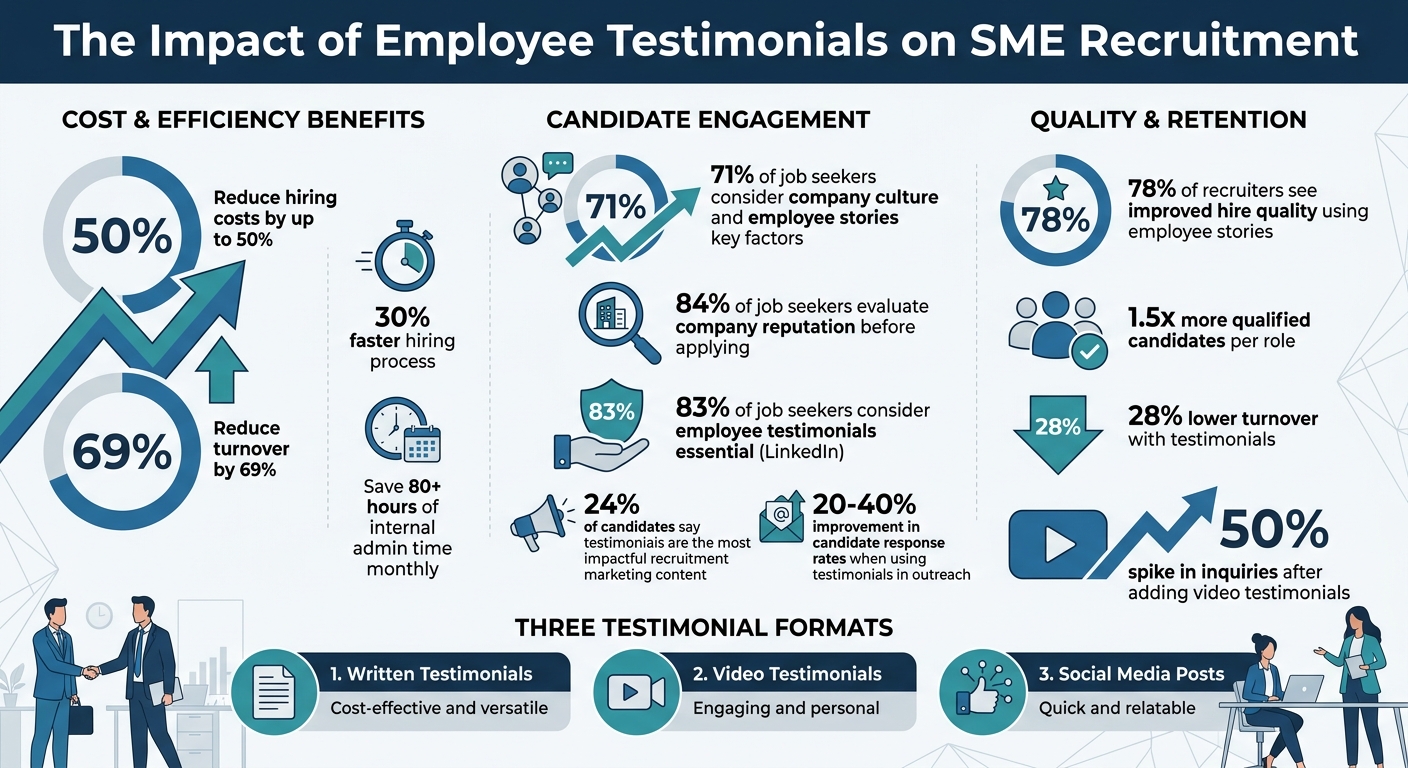
Employee Testimonials Impact on SME Recruitment: Key Statistics and Benefits
The Ultimate Guide to Employee Testimonials
sbb-itb-a23bd6a
Types of Employee Testimonials and When to Use Them
Selecting the right type of testimonial depends on your goals, budget, and the audience you’re trying to reach. Each format has its strengths and serves different purposes, offering creative ways to showcase your company culture and highlight growth opportunities.
Written Testimonials
Written testimonials are cost-effective and easy to adapt. They can take the form of short quotes, personal blogs, or reviews on third-party platforms. Quotes work well as quick, impactful sound bites, especially when paired with employee photos. These are ideal for social media posts, website banners, or job board sections like "Why Us."
Longer formats, such as blog posts or articles, allow employees to dive deeper into their career stories, sharing insights about their professional growth or specific projects. Meanwhile, platforms like Glassdoor add an extra layer of credibility through star ratings and candid reviews.
One of the biggest advantages of written testimonials is their scalability. Quotes can be pulled from quick interviews, making it easy to build a library of content without breaking the bank. For more insights on optimizing your hiring process, explore our recruitment blog. This makes them a smart choice for small to mid-sized companies working with tighter budgets.
Video Testimonials
Video testimonials take storytelling to the next level. They add a personal touch by showcasing facial expressions, tone, and body language, which can help build trust in a way that text alone can’t. Common formats include structured interviews, day-in-the-life videos that show employees in action, and themed montages focusing on topics like "favorite perks" or "onboarding experiences."
Consider examples like Nike‘s career page, where employees share insights such as:
"Innovation is about elevating human potential." [2]
Similarly, FabFitFun‘s video testimonials highlight collaboration and teamwork, with one employee saying:
"As a team, we fail. As a team, we succeed." [2]
While video production requires more investment in terms of filming and editing, the emotional connection it creates can be invaluable – especially for roles where cultural alignment matters most.
Social Media Testimonials
Social media testimonials offer a fast and effective way to reach large audiences on platforms like LinkedIn, Instagram, and TikTok. Formats such as employee takeovers – where team members run the company’s social accounts for a day – give an unfiltered look at workplace life. Image reels and short-form posts are also great for boosting visibility.
For example, Starbucks uses its "Starbucks Partners" account to share videos featuring employees, while Capgemini’s "Life at Capgemini" page combines vibrant photos, short videos, and text reviews to attract IT professionals. These formats resonate particularly well with younger candidates who prioritize authenticity over overly polished corporate messaging.
In fact, 24% of candidates say employee testimonials are the most impactful type of recruitment marketing content. [5]
How to Create Employee Testimonials: Step-by-Step Process
Choosing Employees and Formats
Start by selecting employees who naturally represent your brand and are enthusiastic about their work [4]. Aim for a mix of team members from different departments, levels, and experiences to connect with a broader audience of potential candidates [3]. Include employees with long tenure to highlight retention, as well as those who’ve advanced internally to showcase growth opportunities [4].
Not everyone feels at ease being on camera, so take time to understand their comfort level. Use one-on-one meetings to gauge satisfaction and ask if they’d be open to sharing their story [2]. Alternatively, auditing your recruitment process through quick surveys or post-onboarding feedback can help identify participants [4]. Offer flexibility in formats – video clips, written quotes, or audio snippets – to make participation less daunting [3]. Small incentives like gift cards, public recognition, or extra time off can encourage involvement [7,8].
Always secure formal permission before using any employee’s story, image, or words on any platform [4]. Provide clear timelines, sample questions, and messaging guidance to ease any concerns and make the process straightforward [4].
Once you’ve identified participants and chosen formats, it’s time to craft thoughtful interview questions.
Writing Interview Questions
Steve Norall, CEO of Vocal Video, offers a practical tip:
"A solid rule of thumb is to keep each question to one short sentence." [6]
Keep interviews focused with 3–5 concise questions [6]. Start with the basics ("What is your name and job title?") and build toward more reflective questions about their role and experiences with the company [6]. Use open-ended prompts like "How" or "Why" to encourage detailed, meaningful responses [7,8].
Encourage specific storytelling rather than vague opinions. Ask about moments of mentorship, overcoming challenges, or times they felt proud to be part of the team [3]. For technical roles, include questions about tools, technologies, or collaboration opportunities [4]. Questions that touch on challenges or growth often feel more authentic than overly glowing praise [3].
| Question Category | Sample Question | Purpose |
|---|---|---|
| Growth | "How has this job helped you grow or changed your career trajectory?" | Highlights career development [7,8] |
| Culture | "What is one of your favorite memories or positive experiences at work?" | Reflects a positive workplace environment [15,4] |
| Retention | "What makes you stay with us?" | Demonstrates engagement and loyalty [2] |
Editing and Sharing Testimonials
Once you’ve captured authentic testimonials, focus on editing lightly to retain their original tone and sincerity.
Minimal editing ensures employees’ voices remain genuine [3]. Avoid corporate jargon or over-polishing responses, as this can make testimonials feel scripted. For videos, consider adding text overlays with the employee’s name and title, smooth transitions between questions, and subtle background music to enhance presentation [7]. Include captions and full transcripts for accessibility and SEO benefits [7].
Pair written quotes with professional photos of the employee [4,7]. Always verify the employee’s name and job title during the approval process to maintain trust [3].
To maximise impact, share testimonials across multiple platforms. Embed them in job descriptions and "Why Us" sections on job boards [4,7]. Create a dedicated "Wall of Love" page on your careers site to showcase a variety of testimonials in one visually engaging space [2]. For social media, encourage employees to share their stories on their own accounts, providing suggested hashtags and images to ensure brand consistency [4]. For example, American Express effectively uses vibrant visuals across its platforms to highlight its diverse and engaging workplace [2].
Measuring the Impact of Employee Testimonials
Metrics to Track
Start by setting baseline metrics like cost-per-hire, time-to-fill, and application volume. This helps you measure progress and pinpoint where testimonials are making a difference.
Gather both quantitative data (e.g., application volume, qualified applicant ratio, offer acceptance rates) and qualitative insights (e.g., feedback from candidate surveys). For instance, 78% of recruiters say they’ve seen an improvement in hire quality when using employee stories [8]. You could even ask candidates during interviews if testimonials influenced their decision to apply.
Focus on engagement metrics for your careers page. Tools like Google Analytics can show how long visitors spend on pages with testimonials compared to those without. If dwell time increases, it’s a sign of stronger interest. On social media, track the reach and interactions of posts featuring employee stories versus standard job announcements. LinkedIn reports that 83% of job seekers consider employee testimonials essential when evaluating a potential employer [8].
Incorporating testimonials into your employer branding strategy can also reduce turnover rates by 28% [8]. Combine that with a strong employee value proposition, and annual turnover could drop by as much as 69% [1].
| Metric Category | Key Performance Indicators | Expected Impact |
|---|---|---|
| Recruitment Efficiency | Time-to-hire, Cost-per-hire | 30% faster hiring; 50% lower costs [8] |
| Candidate Quality | Qualified applicants per role, Offer acceptance rate | 1.5x more qualified candidates [8] |
| Brand Engagement | Career page traffic, Social media shares, Time on page | Increased organic reach and social proof |
| Long-term Value | 90-day retention, Annual turnover rate | 28% lower turnover [8]; 69% lower annual turnover [1] |
Once you’ve tracked these metrics, compare them with recruitment data from your ATS and external platforms to measure the direct impact of testimonials.
Comparing Recruitment Performance
Using your metrics as a foundation, dig into how testimonials influence recruitment outcomes. Your ATS can help trace whether high-quality hires interacted with testimonial content. Compare application rates for job postings with employee stories versus those without. This will highlight which formats and placements perform best.
Check your company’s external reputation on platforms like Glassdoor and Indeed. Testimonial campaigns often improve ratings and reviews, which is key since 84% of job seekers evaluate a company’s reputation before applying [8].
For small and medium-sized businesses (SMEs), tools like Rent a Recruiter’s Recruitment Health Check can benchmark your hiring process against industry standards. This can show where testimonials make the biggest impact – whether it’s cutting time-to-fill, attracting better candidates, or reducing costs. Companies with strong employer brands backed by authentic employee stories can slash recruitment costs by up to 50% [8].
Finally, monitor engagement across all candidate touchpoints. Testimonials can affect every stage of the journey, from initial awareness on social media to decision-making on your careers site. Use analytics to determine which formats – video, written, or social posts – convert best at each stage. For example, one report found a 50% spike in inquiries after adding video testimonials [8]. Clearly, multimedia content can be a game-changer.
Conclusion: Using Testimonials to Scale Your Recruitment
Key Takeaways
Employee testimonials are a highly effective way to enhance your recruitment efforts without breaking the bank. With 71% of job seekers considering company culture and employee stories as key factors in their decision-making process [9], it’s clear that authentic testimonials can play a pivotal role in attracting top talent.
The secret lies in authenticity. By strategically sharing these testimonials across your recruitment channels, you can significantly increase engagement. For instance, incorporating testimonials into cold outreach has been shown to improve candidate response rates by 20% to 40% [9].
These insights are invaluable for building a more effective recruitment strategy that resonates with candidates.
Next Steps
Start by auditing your recruitment process to pinpoint where candidates are dropping off or which roles are taking too long to fill. A Recruitment Health Check can help you measure your hiring performance against industry benchmarks and identify where employee testimonials can make the biggest difference.
If you’re scaling after securing funding, launching new products, or tackling a surge in hiring needs, consider partnering with Rent a Recruiter. Our embedded recruiters integrate directly with your team, offering a hands-on approach that typically cuts hiring costs by up to 70% and saves over 80 hours of internal admin time each month. Book a consultation today to discover how structured recruitment, powered by authentic employee stories, can fuel your company’s growth.
FAQs
How many testimonials do we need to start?
Starting with three to five employee testimonials is a smart move. It establishes trust and highlights different viewpoints, offering potential candidates a clearer and more balanced picture of your company culture.
How can we get honest testimonials without pressure?
Gathering honest testimonials from employees works best when approached thoughtfully. Timing is key – asking shortly after someone shares positive feedback increases the likelihood of a genuine response. Use open-ended questions to encourage employees to share meaningful details, and present the request in a positive, appreciative way.
To keep the process seamless, consider automating follow-ups and providing multiple ways for employees to share their thoughts, such as through surveys, emails, or even informal chats. Make it clear that their story matters and will help others, creating an environment where they feel comfortable and valued.
How can we prove testimonials improve hiring?
Employee testimonials play a powerful role in recruitment by acting as social proof. They give candidates a genuine glimpse into your company’s culture and values, helping to build trust and credibility. When compensation is on par with competitors, these testimonials can be the deciding factor for candidates weighing their options.
By showcasing real employee experiences, testimonials help reduce doubts, attract stronger talent, and even speed up hiring. They show that your company delivers on its promises, creating a lasting impression that directly influences candidate decisions. The result? A more effective hiring process with measurable impact.