
If you wait until a role opens to start hiring, you usually pay more, wait longer, and lose control of the process.
I see the same pattern in scaling SaaS, fintech, engineering, security, insurance, and professional services firms. Open roles sit vacant, agency fees stack up, offers miss the market, and internal teams lose time. A talent map helps you cut that waste by giving you a current view of target companies, pay ranges, skill clusters, and pipeline coverage before hiring turns urgent.
In simple terms, talent mapping helps you:
- cut cost-per-hire
- reduce time-to-fill
- lower agency spend
- set pay with more confidence
- build shortlist coverage before a vacancy hits
For hiring leaders, the business case is clear. If a role takes 44 days to fill on average, and non-executive hiring costs around $5,475 per hire, delay gets expensive fast. If you then add agency fees of 15% to 25% of salary, plus the cost of a missed offer or a reopened search, the numbers move in the wrong direction very fast.
The core point is simple: talent mapping turns hiring from a rushed purchase into a planned business process. That means lower spend, less wasted time, and better hiring decisions when growth plans change.
Problem: The real cost of reactive hiring
Reactive hiring creates costs that don’t sit neatly inside the recruiting budget.
For growth-stage companies in SaaS, fintech, engineering, and professional services, the damage often shows up elsewhere: delayed output, lost revenue, more pressure on managers, and extra time spent fixing hiring gaps. And a lot of that cost lands before you even make a hire.
Longer time-to-fill drives up vacancy costs
Every day a key role stays open, your business pays for it, even if that cost never appears on a hiring report.
SHRM estimates that each unfilled position costs companies an average of $4,129 over a 42-day vacancy period, with revenue-generating roles costing as high as $7,000 to $10,000 per month[9][8]. For technical roles, daily vacancy costs for software developers can run from $1,500 to $2,500 per day, depending on seniority[3].
That adds up fast.
A senior engineer role left open for 60 days can represent more than $108,000 in delayed projects and slower releases[3][5]. At the same time, your current team picks up the slack. That can push up burnout risk and make turnover more likely.
This is where reactive hiring starts to hurt twice. You lose time on the open role, and you put more strain on the people you need to keep.
Cold searches raise agency spend and internal admin time
When a role turns urgent and there’s no pipeline in place, your team has to start from scratch.
There is no shortlist. No mapped market. No warm outreach already done.
That usually means more manual research, more back-and-forth between hiring managers and HR, and more time spent getting aligned on what the role should look like. If the pressure builds, teams often turn to traditional recruitment agencies just to get movement.
The result is simple: higher cost-per-hire and more internal admin time.
Instead of running a controlled hiring process, you’re reacting under pressure. And that tends to cost more, both in agency fees and in the hours your internal team loses to coordination.
Poor market data leads to salary overpayment and missed targets
Reactive hiring also puts compensation decisions under pressure.
If you don’t have current benchmarking, it’s easy to guess at salary ranges or rely on market data that doesn’t reflect what’s happening now. LaborIQ found that companies using inaccurate salary benchmarks can overpay by 10% to 20%[7]. A 2026 talent acquisition report found that 68% of job offers are rejected due to compensation misalignment[6].
That creates problems on both sides.
If your offer comes in too low, candidates walk away and the search drags on. If you push compensation higher just to close fast, you risk internal pay gaps and set a higher bar for future hires.
And if that rushed offer leads to a mis-hire, the cost gets even harder to ignore. Replacement cost can reach 1.5x to 3x the role’s annual salary once lost productivity, rehiring, and onboarding are included[2][4][5].
Talent mapping helps avoid that. It gives hiring teams current market data before the role opens, so pay decisions are based on facts, not urgency.
sbb-itb-a23bd6a
What talent mapping changes
Talent mapping cuts out the guesswork that makes reactive hiring expensive. It gives you a live view of the people, skills, pay, and locations that matter before a role opens.
A talent map gives hiring teams a live view of the market
A strong talent map shows which companies employ the talent you need, which skills and experience show up most often, what compensation looks like by location and seniority, and how much talent is available in each market. So instead of hiring blind, you start with market facts.
For example, if the map shows a tight supply of senior data engineers and a $190,000 to $220,000 base salary range, the hiring manager can set budget and timing before the role goes live.[10]
That kind of verified market data cuts out the guesswork that drives up costs in reactive hiring. It also helps your team avoid writing job descriptions that do not match the market, and avoids missed offers because pay was not benchmarked early enough.
Once you have that picture, search gets a lot more focused. And when search gets more focused, waste drops.
Better targeting means fewer wasted searches
One of the clearest ways talent mapping saves money is by narrowing the search before it begins. Instead of broad outreach to broad audiences, recruiters can focus on specific segments, like DevOps engineers in Denver with Kubernetes and AWS experience, and spend time on candidates who are more likely to fit and respond.
When recruiters know which companies to target, which seniority levels are realistic, and which channels a segment actually uses, response rates improve and shortlists come together faster. That means fewer unqualified screens, fewer stalled searches, and less recruiter time spent chasing the wrong market.
The business impact is simple:
- Lower cost-per-hire (calculate your potential savings with an embedded recruitment ROI calculator)
- Less spend on in-house talent vs recruitment agencies
- Fewer offer mistakes
- More control over hiring timelines
That tighter targeting does not just make recruiting cleaner. It reduces wasted effort, protects budget, and improves hiring outcomes.
How talent mapping cuts hiring costs
Lower cost-per-hire through faster, more focused searches
Talent mapping cuts waste at the top of the funnel. Instead of starting from scratch every time a role opens, your team starts with a usable shortlist and a clearer view of the market.
That shows up in cost-per-hire. In the U.S., non-executive cost-per-hire averages $4,700 to $5,475.[16][17] Talent mapping helps teams move faster because the search is already narrowed. Cengage saw that first-hand, cutting time-to-hire by 30% and cost-per-hire by 50% in less than nine months after improving recruiter access to candidates.[15]
There’s also a simple time-saving effect. A warmer pipeline means fewer poor-fit screens, less admin, and less recruiter time spent chasing dead ends. When the map is done well, shortlists come together much faster. And a 14-day drop in time-to-fill can save about $5,600 to $7,000 per hire in vacancy coverage alone.[13]
The knock-on effect is hard to miss. Lower search friction usually means lower hiring spend.
Less dependence on urgent outside recruitment support
When a role opens with no pipeline behind it, teams often end up paying for speed. That usually means using external agencies charging 15% to 25% of base salary.[18]
On a $120,000 hire, that’s an $18,000 to $30,000 fee for one placement.
Talent mapping helps you avoid that last-minute scramble. If your team already has a shortlist for a role you hire often, there’s less pressure to buy emergency support at a premium. You stay in control of the process, and you keep more of the hiring budget inside the business by using a fixed-cost recruitment model.
This is where embedded recruiters can add a lot of value. They help keep that pipeline active, so recurring roles do not become urgent problems.
Better market insight reduces costly offer mistakes
Some hiring costs do not show up until the offer stage. One of the biggest is the rushed-offer premium, overpaying late in the process because the team did not benchmark pay early or because the role stayed open too long.[11][12]
Talent mapping helps stop that. It gives your team current compensation data before outreach starts.[1][14] That matters even more in markets where pay shifts sharply by location.
With better market data up front, teams can price offers with more confidence, stay in line with the market, and avoid failed searches that need to be reopened.
Building and measuring a cost-saving talent map
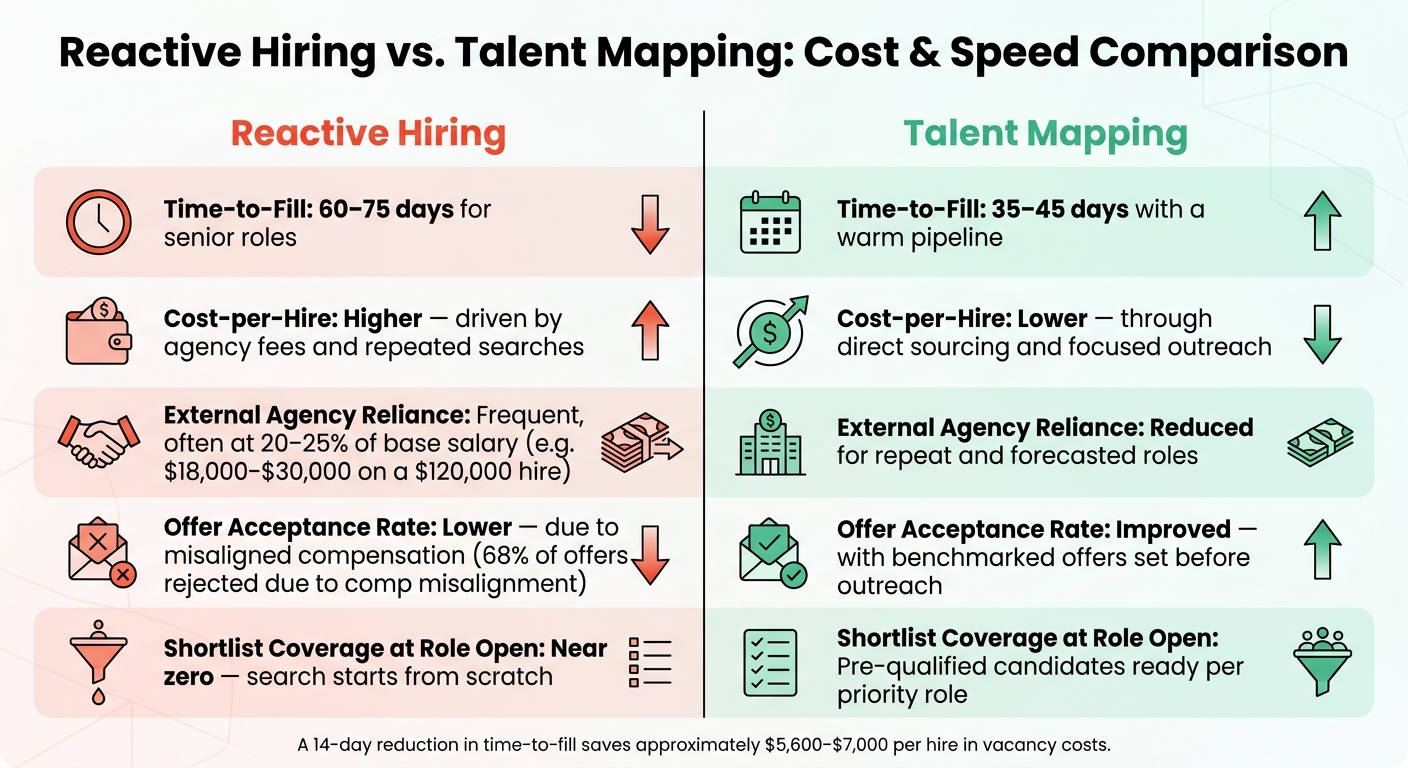
Reactive Hiring vs. Talent Mapping: Cost & Speed Comparison
Build the map around forecasted roles and critical skill gaps
If you want to cut hiring costs, start with the roles that hurt the business most when they sit open.
A strong talent map focuses on the jobs with the biggest vacancy cost. That usually means roles tied to revenue, delivery, product output, or hard-to-find skills.
Start with a 6 to 12 month workforce plan. Then rank roles by:
- hiring volume
- vacancy cost
- search difficulty
Use your own hiring data to sharpen the picture. Look at which roles took the longest to fill, which profiles ramped fastest, and which channels produced the strongest hires.
From there, build target company lists of 20 to 50 organisations per role family, filtered by industry, tech stack, and geography. That gives recruiters a set market to work from, instead of starting from scratch every time.
It also helps you segment people by likely timing:
- ready now
- near-term
- long-term
Add compensation benchmarks before outreach begins, so salary bands are set early and you are not losing time later through misaligned offers.
Refresh the map every quarter. Update sooner if headcount plans change, offer acceptance rates drop, or a funding round or product launch shifts hiring demand.
Once the map is in place, the next step is simple: measure whether it is cutting time, spend, and vacancy risk.
Track ROI with hiring speed, spend, and pipeline coverage
The point of talent mapping is not to make hiring look organised. It is to lower spend and shorten vacancies.
Track cost-per-hire by splitting internal and external costs. Internal costs include recruiter time, tools, and hiring manager hours. External costs include agency fees and job ads.
As talent mapping becomes part of how you hire, external spend should fall, especially for roles you hire again and again.
You should also compare time-to-fill for mapped roles against non-mapped roles. That shows the pipeline effect in a way finance and leadership teams can see clearly.
Then track shortlist coverage and offer acceptance rate. Those numbers show whether your map is producing enough qualified people, and whether your compensation is lined up with the market.
| Factor | Reactive Hiring | Talent Mapping |
|---|---|---|
| Time-to-fill | 60 to 75 days for senior roles | 35 to 45 days with a warm pipeline |
| Cost-per-hire | Higher due to agency fees and repeated searches | Lower through direct sourcing and focused outreach |
| External agency reliance | Frequent, often at 20% to 25% of base salary | Reduced for repeat and forecasted roles |
| Offer acceptance rate | Lower due to misaligned compensation | Improved with benchmarked offers |
| Shortlist coverage | Near zero at role open | Pre-qualified candidates ready per priority role |
Conclusion: Make talent mapping a repeatable cost-control habit
The savings only last when talent mapping becomes part of your normal hiring rhythm, not a one-off exercise.
In practice, that means building it into workforce planning, recruiter workflows, and hiring manager decisions. Done well, it gives you more control over cost, less reliance on external agencies, and a stronger pipeline before pressure builds.
For teams that need hands-on support, Rent a Recruiter embeds recruiters into your team to build talent maps and manage hiring end to end.
FAQs
What is talent mapping?
Talent mapping is a proactive recruitment strategy that ties hiring to long-term business goals, instead of waiting for roles to open and then scrambling to fill them.
In simple terms, it helps you see ahead. You identify the skills your business is likely to need over the next one to three years, review the strengths already inside your team, and study the external talent market.
That gives you a much clearer hiring picture.
Rather than starting from zero every time a role opens, you build a database of pre-qualified candidates in advance. For scaling companies, that can mean faster hiring, up to 50% lower recruitment costs, and less disruption to the business.
If you’re growing in SaaS, Technology, Fintech, Engineering, Security, Insurance, or Professional Services, that matters. Hiring delays don’t just slow recruitment, they slow revenue, delivery, and expansion plans too.
When should we start talent mapping?
Start talent mapping before you have an urgent vacancy. If you wait until a role turns critical, you often lose time you can’t get back.
It works best as a proactive, ongoing approach, usually during growth, workforce planning, or 3 to 12 months before expected hiring demand. That gives you a stronger talent pipeline, shorter search cycles, and lower recruitment costs.
How do we measure talent mapping ROI?
Measure talent mapping ROI by comparing it with reactive hiring across four metrics: cost-per-hire, time-to-fill, quality-of-hire, and attrition.
Use: ((Financial Gain – Total Cost) / Total Cost) × 100.
Financial gain should include agency fees avoided, vacancy costs avoided, and lower replacement costs from better retention. Total cost should include labour, technology, marketing, and operations, annualised for a fair comparison.