
Hiring delays cost companies over $100,000 per unfilled role. In the fast-paced world of Tech and SaaS, waiting until roles open to start recruiting is a losing game. With only 3.9% of the workforce actively job-seeking, most of the talent you need isn’t browsing job boards. That’s why building a talent pipeline – a pool of pre-qualified, engaged candidates – is essential for scaling efficiently.
Key Benefits of Talent Pipelines:
- Fill roles 40–60% faster than reactive hiring.
- Reduce recruitment timelines from 170 days to just 60 days.
- Lower cost-per-hire and minimize lost productivity.
Core Components:
- Workforce Planning: Align hiring with business milestones like funding rounds or product launches.
- Sourcing: Identify candidates before roles open using targeted outreach and tools like GitHub or AI-powered platforms.
- Engagement: Maintain ongoing relationships with potential hires.
- Assessment: Pre-screen candidates to ensure quality.
- Internal Mobility: Promote from within to reduce external hiring needs.
Why It Matters: Companies with structured pipelines save time, cut costs, and avoid the chaos of reactive hiring. For high-growth businesses, embedded recruitment offers a scalable solution to build and manage these pipelines effectively.
Rent a Recruiter specializes in helping Tech and SaaS companies implement scalable hiring processes. Their embedded recruiters can save you up to 70% on hiring costs and over 80 hours per month in admin. Start building your pipeline today to stay ahead of demand and drive growth.
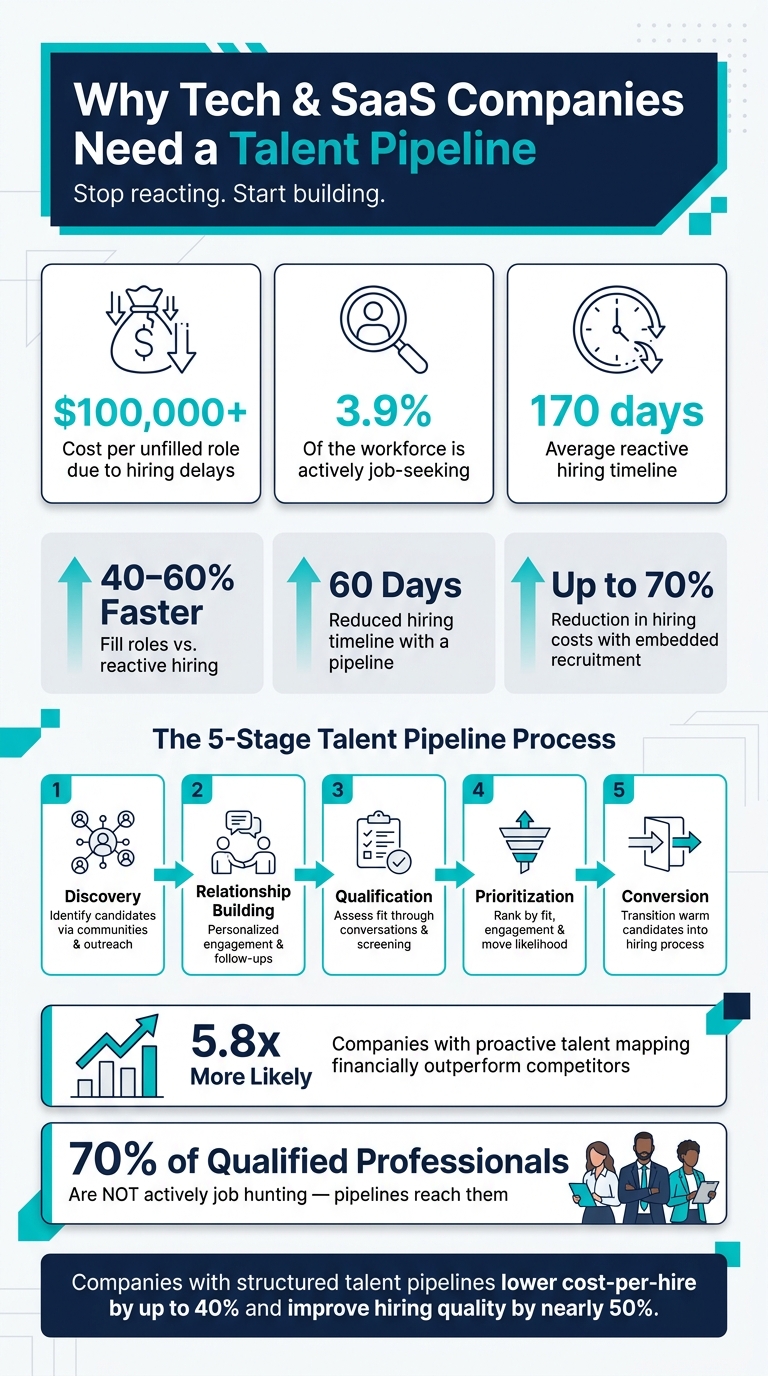
Talent Pipeline Stats: Why Proactive Hiring Wins
Workforce Planning for Tech and SaaS Talent Pipelines
Connecting Hiring Plans to Business Milestones
Workforce planning is at the heart of building scalable talent pipelines in Tech and SaaS. Hiring needs are rarely random – they’re tied to major business events like securing a Series A, launching a product, or expanding into new markets. To avoid scrambling later, recruitment should be part of the conversation early on.
Think of your hiring plan like a product roadmap. Identify what roles you’ll need and when based on your business goals for the next several months or years. For example, if you’re gearing up for a Series B raise, scaling engineering and sales teams will likely be critical once funding comes through. Starting the sourcing process well in advance of these milestones can mean the difference between seamless growth and frustrating delays.
"The most successful companies don’t just ‘fill seats.’ They architect Synchronized Clusters that bridge the gap between financial milestones and technical execution." – Talentus Global [2]
Here’s a striking stat: only 12% of U.S. HR leaders engage in workforce planning with a three-year horizon [5]. That leaves a massive opportunity for companies willing to think ahead and gain a competitive edge.
The next step? Focus on the roles that truly move the needle.
Identifying the Roles and Skills That Matter Most
Not every open position has the same impact on your business. In Tech and SaaS, the roles that matter most often fall into three key areas: engineering (building the product), product management (deciding what gets built), and sales/go-to-market (driving revenue). Delays in these functions can derail product launches or revenue goals entirely.
To prioritise effectively, group roles into three categories:
- Critical: Must be filled immediately to avoid business risks.
- Planned: Needed soon but not urgent.
- Pipeline: Anticipated needs over the next few months.
This approach ensures your team focuses on what’s important, rather than treating every vacancy as equally urgent.
"The strongest hiring teams do not treat every open role as a fresh emergency. They build repeatable channels, sharper role definitions, and a clearer view of candidate fit." – Will Steward, Founder and CEO, The SaaS Jobs [4]
Companies that embrace proactive talent mapping are 5.8 times more likely to financially outperform their competitors [5]. That’s a powerful argument for leaving reactive hiring behind.
Once roles are prioritised, a skills matrix can sharpen your approach even further.
Building a Skills Matrix to Guide Pipeline Targeting
A skills matrix is a practical tool that maps the technical skills and competencies your business needs to the roles you’re hiring for. This eliminates guesswork and gives recruiters a clear, consistent framework to work from.
To create one, collaborate with leaders in engineering, product, and other departments to define the exact skills required for each role and seniority level. For example, a backend engineering team might need varying levels of Python expertise, system design knowledge, or distributed systems experience depending on the role. With these criteria in place, recruiters can target candidates more effectively. In fact, skills-based searches generate candidate pools over six times larger than title-based searches [3], which is vital in a market where passive candidates dominate.
A skills matrix isn’t just for external hiring – it also supports internal mobility. By comparing your team’s current skills with what’s needed, you can identify employees ready to step into new roles. This reduces external hiring costs while boosting retention. Plus, promoting from within strengthens your talent pipeline and builds a more resilient workforce.
How to Design and Run a Talent Pipeline
Pipeline Stages: From Sourcing to Onboarding
Once you’ve prioritized roles and created a skills matrix, the next step is to craft a talent pipeline that seamlessly integrates sourcing, engagement, and conversion. A well-structured pipeline ensures you’re connecting with qualified candidates before roles even open.
"A talent pipeline is a pre-built pool of engaged, qualified candidates ready to fill roles the moment they open." – Taleva Team, Talent Pipeline Guide [1]
Think of your pipeline as a five-stage process, with each layer building on the last:
| Pipeline Stage | What Happens Here |
|---|---|
| Discovery | Identify candidates through communities, referrals, and direct outreach, focusing on work signals rather than just job titles. |
| Relationship Building | Engage candidates with personalized outreach and consistent follow-ups to establish trust and rapport. |
| Qualification | Gather insights about candidates’ fit and capabilities through ongoing conversations and assessments. |
| Prioritization | Rank candidates based on their fit, engagement level, and likelihood of making a move. |
| Conversion | Transition warm candidates into formal hiring processes quickly and efficiently. |
By keeping your pipeline active, you can avoid hiring delays while maintaining access to high-quality candidates. This proactive approach ensures your hiring team stays ahead of demand, rather than scrambling to react.
Sourcing Strategies for Niche Tech and SaaS Roles
Once your pipeline structure is in place, the focus shifts to sourcing the right talent. For specialised tech and SaaS roles – think senior backend engineers or DevOps leads – traditional job boards just won’t cut it. The best candidates are often not actively job hunting.
Start with developer communities. Platforms like GitHub, Stack Overflow, and niche Slack groups allow you to identify talent based on their actual work, not just their resumes. Employee referrals are another goldmine – your team likely knows people who’d excel in these roles. Finally, direct outreach to passive candidates can be incredibly effective, but only if your message is personalized and speaks directly to their work or interests.
AI-powered sourcing tools are also transforming how recruiters find talent. These tools can scan vast databases, score candidates against role criteria, and deliver ranked shortlists in minutes [7]. While AI won’t replace the relationship-building stage, it significantly cuts down on manual searches, freeing up recruiters to focus on meaningful candidate engagement.
"The most consequential shift AI enables is not reach. It is relevance." – Erdem Besler, Talent Pipeline Management in 2026 [6]
Using Embedded Recruitment to Build Your Pipeline
Even with the best sourcing strategies, internal capacity is often a bottleneck. This is where embedded recruitment comes in. Embedded recruiters work directly within your team, gaining a deep understanding of your culture, tech stack, and growth goals. They don’t just help you hire – they build the infrastructure for sustainable, long-term recruitment.
Rent a Recruiter specializes in this approach, embedding experienced recruiters into high-growth tech and SaaS companies within days. This model allows companies to reduce hiring costs by up to 70% compared to traditional agency fees while saving over 80 hours per month on internal hiring admin. Whether you’re scaling after a funding round or responding to a sudden hiring surge, embedded recruitment gives you the capacity to meet your goals without missing a beat.
How to Build Your Talent Pipeline and Hire Better Faster (Small Team Friendly!)
sbb-itb-a23bd6a
Managing and Measuring Your Talent Pipeline
Once your pipeline structure is in place, the next step is ensuring it’s managed effectively and measured consistently. This is what keeps your hiring process running smoothly.
Tools to Automate and Manage Your Pipeline
A strong talent pipeline depends on the right tools. Without them, even the best-designed system can fall apart into chaotic spreadsheets and missed opportunities.
Most tech and SaaS companies rely on three key components. First, an Applicant Tracking System (ATS) like Ashby, Greenhouse, or Lever. This serves as the central hub, tracking every candidate’s progress and keeping data organized. Second, technical assessment platforms such as Codility or TestGorilla, which integrate with the ATS to streamline skill evaluations, avoiding the mess of scattered email threads. Finally, pipeline analytics tools like US Tech Automations provide real-time dashboards, flag bottlenecks, and offer predictive insights, giving hiring teams a clear picture of their pipeline beyond basic updates.
Automating scheduling is another game changer. Tools like Ashby’s Auto Schedule use live calendar data to arrange interviews, cutting out the back-and-forth emails. Research shows this approach is 26% faster than manual scheduling, saving an average of 1.3 hours per interview [8].
Metrics That Show Whether Your Pipeline Is Working
The right metrics reveal whether your pipeline is efficient or just busy. For example:
- Time to First Fill measures how quickly you can fill the first role after it opens, showing how well hiring aligns with business needs.
- Breaking down Time to Hire into smaller stages (like application review, scheduling, and offer approval) helps pinpoint delays in the process.
- Tracking Stage Distribution ensures candidates are moving through the pipeline and not getting stuck at early stages.
- Contact Freshness – the percentage of candidates engaged in the last 60 days – keeps your talent pool active and ready.
"A pipeline that only runs when there is an open role is not a pipeline. It is a delayed version of reactive hiring." – Erdem Besler, TalentRank [6]
Cost-per-hire is another key metric, averaging $4,700 but often higher for specialised tech roles [6]. Comparing this cost against conversion rates can highlight inefficiencies in your spending.
These metrics don’t just reflect performance; they also help guide strategy during high-demand periods.
Planning for Hiring Spikes and Pipeline Gaps
Hiring spikes – whether due to funding, product launches, or rapid growth – can expose weaknesses in your pipeline. The companies that handle these spikes best aren’t reacting faster; they’ve already prepared.
One way to stay ahead is by using Pipeline Health Scoring, a 0–100 metric that evaluates each open role based on factors like pipeline depth, engagement, and conversion rates. According to US Tech Automations, roles scoring below 40 have a 70% chance of missing their target fill date [9]. This gives hiring teams a chance to act before issues escalate.
Here’s a quick guide to health scoring:
| Health Score | Status | Recommended Action |
|---|---|---|
| 80–100 | Healthy | Monitor normally |
| 60–79 | Caution | Review depth; increase sourcing efforts |
| 40–59 | At Risk | Escalate to hiring manager; adjust plans |
| Below 40 | Critical | Launch emergency sourcing; consider agency support |
Another safeguard is setting bottleneck alerts. Configure your ATS to flag candidates stuck in any stage for more than 1.5x the average time for that role [9]. Senior and technical roles typically take 37% longer to fill than junior ones [8], so adjust benchmarks accordingly.
"Most hiring problems are not sourcing problems. They are readiness problems." – Erdem Besler, TalentRank [6]
Finally, schedule monthly data audits. Without regular checks, pipeline data can degrade by 2–3% per month [9], leading to duplicate entries and inconsistent records that skew your metrics.
Conclusion and Next Steps
Key Takeaways for Building a Talent Pipeline That Scales
Creating a talent pipeline that grows with your business requires consistent effort and strategic alignment. Companies that excel in this area link hiring directly to business goals, maintain strong relationships with potential candidates, and focus on meaningful metrics instead of just tracking activity.
Consider this: proactive talent pipelines can lower cost-per-hire by up to 40% and improve hiring quality by nearly 50% [10]. Additionally, with 70% of qualified professionals not actively seeking jobs [6], building connections with passive candidates becomes a game-changer.
"Talent acquisition strategy is not a recruiting plan. It is the firm’s multi-year infrastructure for converting business strategy into hiring outcomes." – Peter Vogel, Founder, peppereffect [10]
Embedded recruitment offers a seamless way to integrate proactive pipelines into your hiring strategy. For tech and SaaS companies, this approach provides scalable hiring capacity without the need for a full in-house recruitment team.
These insights set the stage for immediate action.
Start Building Your Talent Pipeline Today
The first step is to evaluate your hiring performance. Look at metrics like time-to-fill and cost-per-hire to identify recurring challenges. Pinpoint roles that consistently face delays and use this data to target your efforts effectively.
Rent a Recruiter specializes in helping high-growth tech and SaaS companies build scalable, structured hiring processes. Their embedded recruiters become part of your team within days, handling every aspect of recruitment while maintaining transparency and efficiency. By working with Rent a Recruiter, companies can cut hiring costs by up to 70% and save over 80 hours per month. Start with their free Recruitment Health Check to uncover areas for improvement.
Whether you’re scaling after securing funding, preparing for a product launch, or just tired of reactive hiring, building a talent pipeline ensures every future hire is faster, more cost-efficient, and predictably successful.
FAQs
How far ahead should we start building a pipeline for key roles?
Don’t wait until a role is officially approved to start sourcing candidates. For roles that are recurring or business-critical, early preparation can save you from scrambling at the last minute.
Collaborate with hiring managers and finance teams to forecast hiring needs for the next one to two quarters. By starting your sourcing efforts 4–12 weeks ahead of time, you can develop a pool of pre-qualified, engaged candidates. This proactive approach ensures you’re ready to hire quickly when the position is greenlit.
What’s the fastest way to find qualified passive candidates in tech?
The fastest way to connect with skilled passive candidates in tech is by focusing on specific, high-intent platforms instead of broad job boards. Use LinkedIn’s advanced Boolean search capabilities (e.g., ("senior" OR "lead") AND "TypeScript" NOT "sales engineer") to narrow down your results. Check out GitHub to review actual work samples, and tap into specialized communities like Stack Overflow or Kaggle to find active contributors. Don’t forget to revisit your silver medalist candidates – those who were strong contenders in previous hiring rounds often respond quicker to outreach.
Which pipeline metrics should we track first to prove ROI?
To demonstrate ROI, focus on four critical metrics: cost per hire, time to fill, offer acceptance rate, and 90-day retention. Start by collecting precise source-of-hire data to pinpoint the most budget-friendly recruitment channels. Next, evaluate conversion rates at every stage of the hiring funnel – such as applied-to-screen or interview-to-offer – to uncover bottlenecks. Break these metrics down by source and role to cut costs, accelerate hiring, and create a talent pipeline that grows with your business.