
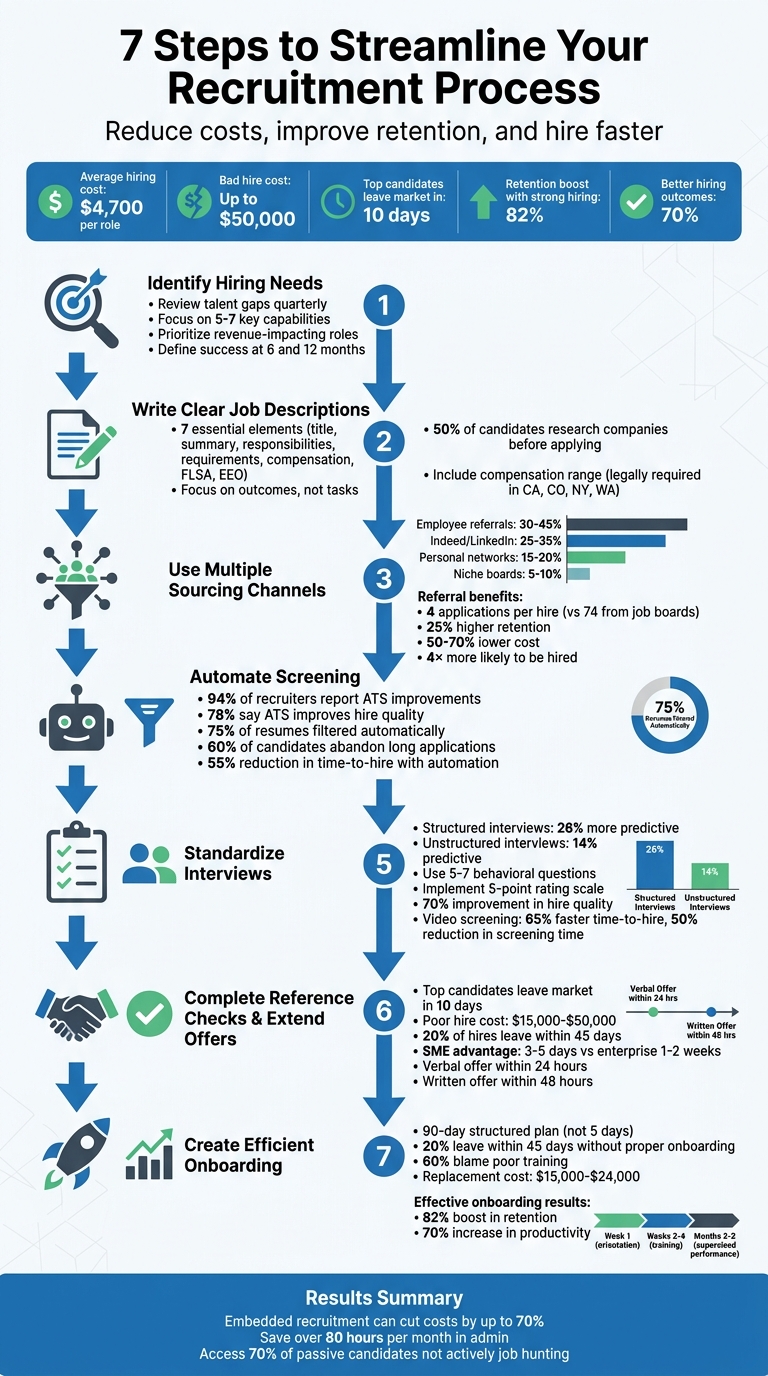
Recruitment is a major challenge for scaling businesses, especially SMEs. The time, cost, and risks associated with hiring can drain resources and hinder growth. On average, hiring costs $4,700 per role, and a bad hire can cost up to $50,000. With top candidates leaving the market in just 10 days, delays or inefficiencies in your process can cost you the best talent.
Here’s how you can fix it: A structured, repeatable hiring process saves time, reduces costs, and improves retention. Companies with strong hiring and onboarding practices report an 82% boost in new hire retention and 70% better hiring outcomes. This guide breaks down the 7 key steps to improve your recruitment process:
- Identify Hiring Needs: Focus on critical skills and roles that impact revenue.
- Write Clear Job Descriptions: Attract the right talent with concise, outcome-focused descriptions.
- Expand Sourcing Channels: Use referrals, niche boards, and embedded recruitment to access better talent pools.
- Automate Screening: Save hours with ATS tools that filter candidates and schedule interviews.
- Standardize Interviews: Use structured questions and scoring to ensure fairness and better hiring decisions.
- Speed Up Offers: Complete reference checks and extend offers in days, not weeks.
- Improve Onboarding: Engage new hires with a 90-day plan to boost retention and productivity.
The result? Faster hiring, lower costs, and a process you control. Whether you’re scaling after funding or tackling a hiring surge, embedding experienced recruiters into your team can cut costs by up to 70% compared to traditional agencies and save over 80 hours a month in admin. Learn more about embedded recruitment or book a free Recruitment Health Check to optimize your hiring process.
7 Steps to Streamline Your Recruitment Process
How to Streamline the Hiring Process | The True Cost of Hiring Webinar Excerpt
sbb-itb-a23bd6a
Step 1: Identify and Prioritize Your Hiring Needs
Before diving into job descriptions, take a step back and define why you’re hiring. Focus on the skills and capabilities your business needs for the next 12–24 months of growth. Mark Loughnane, Lead at Rent a Recruiter, explains it well: "Workforce planning for SMEs has shifted from an annual budgeting exercise to a continuous leadership discipline" [5]. This means you should be reviewing hiring needs quarterly, not just during annual budget discussions.
Review Current and Future Talent Gaps
Start by examining your organizational chart and the projects on the horizon. What’s causing strain right now? What gaps could disrupt operations in the next three months? Shift the focus from simply filling vacancies to addressing capability gaps. For example, instead of saying, “We need another developer,” ask whether your team lacks AI expertise, faster decision-making, or the ability to manage external integrations [5]. Zero in on 5–7 key capabilities your business needs to thrive, then assess whether your current team can deliver them [5].
When evaluating roles, consider their outcomes, urgency, and whether the issue stems from structural challenges. Prioritize hiring for positions that directly impact revenue – roles that generate or protect income should come first. Expansion or leadership hires can follow [5]. Defining these capability gaps clearly will lead to more precise job descriptions, streamlining the recruitment process. Afterward, compare these gaps against your team’s existing strengths to identify where you need reinforcements. You can also rate your recruitment process to identify specific efficiency gaps.
Work with Teams to Clarify Role Requirements
Once you’ve pinpointed a gap, collaborate with the department lead who will oversee the new hire. Together, outline the 5–7 core weekly tasks and separate essential skills from those that are simply nice to have [1][3]. Many SMEs stumble here by creating overly ambitious wish lists instead of practical job requirements. Aligning with team insights ensures the role is clearly defined and realistic.
"If you cannot define the role in one paragraph, you are not ready to hire." – FirstHR [1]
If someone has recently left the role, take the opportunity to update the job description to reflect current business needs [1]. Roles evolve, and what worked two years ago may no longer fit. Define what success looks like at the 6-month and 12-month marks before you even post the job [5]. This clarity will save you hours of unnecessary interviews and help you act quickly when the right candidate appears. By refining and updating roles, you’ll strengthen the entire hiring process, keeping recruitment aligned with your business goals.
Step 2: Write Clear Job Descriptions
Once you’ve nailed down the role’s needs, the next step is crafting a job description that’s clear and concise. Candidates should be able to understand the role, what success looks like, and whether they’re a fit in under 60 seconds. If they can’t, it’s time to rework the description [8]. A well-written job description not only attracts the right talent but also cuts down on unqualified applications, saving you valuable screening time.
Every strong job description should include these seven key elements: a clear title, a role summary, responsibilities, requirements, a compensation range, FLSA classification (exempt vs. non-exempt), and an Equal Employment Opportunity (EEO) statement [1]. These aren’t just boxes to tick – they help set expectations and ensure legal compliance.
Focus on Required Skills and Experience
Be specific about outcomes, not just generic tasks. For instance, instead of saying "managing social media", try "growing the engaged audience from 15,000 to 50,000 in 12 months" [8]. This level of detail helps candidates evaluate whether they have what it takes to deliver.
"Job descriptions that describe tasks instead of outcomes lose strong candidates before they apply." – Jobful [8]
Collaborate with hiring managers to separate the "must-haves" from the "nice-to-haves" before posting [9]. This makes it easier to screen candidates and avoid wasting time on those who don’t meet critical qualifications. Be upfront about challenges – highlighting the tough aspects of a role can attract problem-solvers while filtering out those who might struggle [8]. Also, include essential soft skills like communication or teamwork, as technical qualifications alone don’t guarantee a great hire [2].
Include Your Employer Value Proposition
To stand out and attract top talent, use your job description to showcase what makes your company special. High-quality candidates do their homework – 50% research companies extensively before deciding to apply [10]. Highlight the problems your team solves, the impact they make, and the opportunities for growth within your organization. For SMEs, this could mean emphasizing things like exposure to diverse responsibilities, direct access to leadership, and the chance to see the immediate results of their work [7].
"Your job description is often the first impression candidates have of your company. Craft descriptions that speak directly to your ideal candidates and make them excited to apply." – Jen Dewar, JobScore [10]
Don’t forget to include your compensation range. Transparency isn’t just a good practice, it’s legally required in states like California, Colorado, New York, and Washington [1]. This avoids mismatched salary expectations and saves time for everyone. Use a conversational tone that reflects your company culture and steers clear of jargon [10]. Candidates who understand your value proposition from the start tend to stick around longer – referred candidates, who usually have a better grasp of company culture, stay 25% longer than those hired through job boards [1].
Step 3: Use Multiple Talent Sourcing Channels
Once you’ve nailed down the roles and descriptions, it’s time to diversify your sourcing channels. Why? A broader approach ensures you’re tapping into the right talent pools for every type of role. For small businesses, the typical breakdown looks like this: 30–45% employee referrals, 25–35% Indeed/LinkedIn, 15–20% personal networks, and 5–10% niche boards or specialized services [11]. This mix allows you to balance high-volume hiring with targeted searches for specialized roles.
The secret lies in aligning the channel with the role. Platforms like Indeed are ideal for operational or high-volume positions, while niche platforms cater to specific needs. For instance, Dribbble is a go-to for design talent, Wellfound connects you with startup-focused professionals, and BuiltIn is great for tech positions [11].
Don’t forget about your existing talent pool. Candidates vetted in the past can be a goldmine for current openings [12].
Build an Employee Referral Program
Among all sourcing methods, referrals consistently deliver the best results. Why? Referred candidates are not only easier to hire – requiring just 4 applications per hire compared to 74 from job boards [13] – but they also stay longer, with 25% higher retention rates. Plus, referrals cost 50–70% less to acquire and are 4× more likely to be hired than other candidates [11][13].
A well-structured referral program can amplify these benefits. Offer bonuses (typically $500 to $2,000) but only pay them after the new hire completes 90 days [11]. This ensures employees are invested in referring quality candidates who are likely to stick around. Encourage referrals for every new role and follow up promptly – within a week is ideal. Companies that implement structured referral programs often see referral hires jump from 10% to 40–50% in just a year [11].
Access Targeted Talent Mapping Services
When referrals and other direct methods aren’t delivering results – especially after 60+ days or for senior and highly specialized roles – it’s time to consider targeted strategies. Talent mapping services can be a game-changer in these situations [11]. While traditional recruitment agencies charge 15–25% of a hire’s first-year salary [11], embedded recruitment offers a more budget-friendly solution for ongoing needs.
With Rent a Recruiter, you get dedicated recruiters embedded directly into your team. They handle the entire hiring process, making this model especially effective for high-growth SMEs dealing with hiring surges or post-funding scaling. Companies using this approach typically cut hiring costs by up to 70% compared to commission-based methods. On top of that, they save over 80 hours per month on internal hiring and admin tasks. Another bonus? Embedded recruiters have the tools and capacity to reach passive candidates – the 70% of the global workforce who aren’t actively job hunting [13]. This targeted outreach can make all the difference when internal teams are stretched thin.
Step 4: Automate Screening and Selection
Once your sourcing channels are running efficiently, the next step is to simplify how you assess candidates. A flood of applications can quickly overwhelm your team, but automation can take the load off. With tools like an Applicant Tracking System (ATS), you can centralize tasks like resume scanning and ranking based on predefined criteria. It’s no surprise that 94% of recruiters report improvements in their hiring process with an ATS, and 78% say it has directly improved the quality of their hires [15].
Automation doesn’t just save time; it removes tedious manual work. Modern ATS platforms can parse resumes, rank candidates, and even send follow-up emails automatically. Considering that 60% of candidates abandon applications when the process feels too long [3], speeding things up with Recruitment as a Service automation can keep your hiring process professional and appealing.
Automate Resume Screening
At the screening stage, automation is a game-changer. ATS software filters applications based on the criteria you set, such as specific certifications, years of experience, or technical skills. Around 75% of resumes are filtered out automatically because they don’t meet the hard-skill requirements [14]. This isn’t a flaw – it’s the system doing its job by highlighting the candidates who genuinely meet your needs.
By 2026, ATS technology has advanced beyond simple keyword matching. Modern systems use AI to assess how skills are presented across a candidate’s work history, offering a more nuanced evaluation. For small to medium-sized businesses hiring 15–20 or more people annually, an ATS typically costs $149 to $299 per month, which is a small investment compared to the average cost per hire in the U.S., sitting at roughly $4,700 [1].
Once resumes are filtered, online assessments can help refine your candidate pool even further.
Enhance Screening with Online Assessments
After narrowing down your list of resumes, adding online assessments and pre-recorded video interviews can provide deeper insights before live interviews. Structured interviews, often managed via ATS scorecards, are 26% more predictive of job performance than unstructured conversations, which only predict performance 14% of the time [1]. This level of consistency ensures your team evaluates candidates fairly and objectively.
Automation also simplifies scheduling. Integrated tools allow candidates to book their own interviews, syncing directly with your team’s calendars and cutting out the back-and-forth emails. This is critical, as 55% of recruiting teams report that AI and automation have significantly reduced their time-to-hire [16]. By handling these administrative tasks, automation frees you up to focus on what matters most: selecting the right person for the job.
Step 5: Standardize Your Interview Process
Once you’ve automated screening, the next step is to ensure your interviews are fair, consistent, and grounded in objective data. A standardized interview process does just that, refining candidate evaluation and minimizing bias. Without this structure, interviews often become inconsistent and overly subjective. Research shows that structured interviews with predefined questions and scoring criteria are 26% more predictive of job performance compared to unstructured methods [1]. This is a critical distinction when you consider that the average cost per hire in the U.S. is around $4,700, and a bad hire can cost up to five times their annual salary [19].
Standardization levels the playing field. By asking every candidate the same set of questions and evaluating them against the same criteria, you reduce biases like "first impression bias" or "confirmation bias", where interviewers favor candidates similar to themselves [17]. Instead of relying on intuition, you’re basing decisions on clear, documented data – making your process not only fairer but also defensible from a legal standpoint [18][1]. This approach also provides a foundation for using behavioral questions and modern tools like video interviews effectively.
Create Standard Interview Questions and Scoring
Prepare 5–7 behavioral questions tailored to the role [1]. These should focus on specific past experiences or scenarios relevant to the job. Standardized questions ensure every candidate is assessed on the same criteria. For example, instead of asking, "Are you good at problem-solving?" try, "Can you describe a time when you faced an unexpected challenge at work and how you resolved it?" This method provides concrete examples for evaluation rather than vague self-assessments.
To assess responses consistently, implement a 5-point rating scale [17]. Define what each score represents – for instance, a "3" might indicate a competent answer with relevant examples, while a "5" reflects exceptional insight and measurable impact. As Iris Bohnet, a Harvard Business Review professor, explains:
"Evaluators who wait until the end of the interview to rate answers risk forgetting an early or less-vivid but high-quality answer, or favoring candidates whose speaking style favors storytelling" [18].
Scoring responses in real time prevents memory bias and ensures more accurate evaluations. Companies that follow structured interview processes report a 70% improvement in the quality of hire [19]. Additionally, consistency enhances the candidate experience, as well-organized interviews leave a positive impression on applicants, regardless of the outcome [17].
Use Video Interviewing Platforms
Video interviewing platforms are now essential for modern, efficient hiring – especially for remote or distributed teams. Once you’ve standardized your interview framework, these tools can streamline the process even further. Asynchronous video screening allows candidates to record their answers at a time that suits them. This eliminates scheduling headaches and enables collaborative review and scoring [19]. Companies using video screening report a 65% faster time-to-hire and a 50% reduction in screening time [19].
These platforms also enable side-by-side comparisons of candidate responses. Instead of relying on memory, you can review video answers back-to-back and score them against the same rubric. This makes your final interviews 60% more effective, as you’ve already assessed communication skills and alignment with your team before the live conversation [19]. Additionally, 80% of candidates report a better understanding of job opportunities when video content is part of the hiring process [19], showing that your company values their time and prioritizes efficiency.
Step 6: Complete Reference Checks and Extend Competitive Offers
After wrapping up a structured interview process, the next steps are all about verification and action. In today’s fast-paced hiring environment, speed is your edge. Top candidates often leave the market within just 10 days [1]. On the flip side, a poor hire who departs within 60 days can cost your business anywhere from $15,000 to $50,000 in replacement costs [1]. With around 20% of new hires leaving within their first 45 days [1], balancing thorough vetting with swift decision-making is essential.
For smaller businesses, this is a chance to outmaneuver larger competitors. While enterprises might take 1–2 weeks to finalize offers and background checks, efficient SMEs can wrap this up in just 3–5 days [1]. As FirstHR highlights:
"The founder who interviews on Tuesday, checks references on Wednesday, and makes a verbal offer on Thursday wins the candidate over the enterprise that takes 3 weeks to schedule a panel interview" [1].
Here’s how to combine speed with precision.
Perform Targeted Reference Checks
Focus your reference checks on your top finalist rather than the entire shortlist [1]. This saves time and respects the candidate’s privacy. Use these calls to confirm soft skills that aren’t always evident on a resume, such as their ability to handle pressure, collaborate effectively, or resolve conflicts [2]. These insights can either reinforce your impressions or highlight potential red flags before you proceed with an offer.
Keep the conversation efficient by asking specific, role-based questions. For example, request examples from previous managers or colleagues about the candidate’s reliability, ability to meet deadlines, or adaptability in challenging situations. Targeted questions ensure you gather the insights you need without dragging out the process.
Make Timely, Attractive Offers
Once references check out, act quickly. Aim to make a verbal offer within 24 hours of the final interview and follow up with a formal written offer, sent digitally, within 48 hours [1]. Your offer letter should include all key details: job title, start date, salary, benefits, reporting structure, and an at-will employment statement [1]. To stay compliant with the Fair Credit Reporting Act (FCRA), make the offer contingent on a satisfactory background check [1].
For roles in high-demand fields like tech or sales, consider sweetening the deal with performance bonuses, stock options, or uncapped commissions [20]. If your budget doesn’t allow for top-tier salaries, highlight perks like flexible schedules, remote work, or fast-tracked career growth opportunities [21]. Finally, use digital tools to streamline post-offer paperwork. As Homebase puts it:
"Speed and professionalism matter here – don’t lose great candidates to clunky paperwork delays" [6].
Step 7: Create an Efficient Onboarding Process
Getting onboarding right is the final step to ensuring new hires seamlessly transition into productive team members. A well-structured onboarding process spans 90 days, not just a week. Compressing it into five days often leads to early turnover, with 20% of new hires leaving within their first 45 days. Among those who quit within 90 days, 60% blame poor training or a disorganized onboarding experience [22][1]. The financial impact? Replacing an employee can cost small businesses between $15,000 and $24,000. On the flip side, companies with effective onboarding see an 82% boost in retention and over a 70% increase in productivity [22].
A strong onboarding plan unfolds over 90 days: orientation in week one, training from weeks two to four, and supervised performance during months two and three. The key is preparation – everything should be ready before the new hire’s first day.
Set Up Everything Before Day One
Avoid downtime on Day 1 by ensuring all systems and tools are ready to go. Set up and test access to email, Slack, CRM, and hardware 2–3 days before the start date. For remote hires, ship equipment at least a week in advance to allow time for setup and troubleshooting.
Handle compliance paperwork digitally before Day 1 to free up time for orientation and cultural integration. Use e-signature tools to collect W-4 and I-9 forms in advance. Keep in mind, Section 1 of the I-9 must be completed by the end of Day 1, and Section 2 (employer verification) within three business days to avoid federal fines, which start at $272 per violation [22][1].
Send a welcome email 3–5 days before the start date. Include details like login instructions, start time, key contacts, and the first day’s schedule. This reduces anxiety and shows the new hire that you’re prepared. Assign an onboarding buddy – a peer, not a manager – who can guide them through unwritten rules and team dynamics during their first 30 days. Provide a clear 30-60-90 day plan, outlining:
- Days 1–30: Learning milestones
- Days 31–60: Contribution goals
- Days 61–90: Ownership expectations
Without clear, written goals, new hires may rely on assumptions that don’t align with your expectations. By preparing early and setting the tone with a structured plan, you’ll keep the process running smoothly.
Use Digital Onboarding Tools
Manual paperwork can slow things down and create compliance risks. Digital onboarding tools simplify the process by automating document collection, task tracking, and progress monitoring. These platforms centralize essential items like offer letters, employee handbooks, and training materials, so there’s no need to dig through email threads or scattered files. For more templates and guides, explore our hiring resources.
Automate check-ins to ensure nothing falls through the cracks. Schedule:
- Daily 15-minute meetings during Week 1 to address immediate concerns
- Twice-weekly check-ins during Weeks 2–4 to monitor training progress
- Weekly 30-minute sessions in Months 2–3 to review goals and team integration
Pre-schedule formal reviews at the 30-, 60-, and 90-day marks to measure progress and ensure the transition from "new hire" to "productive team member" is on track. Research shows employees are 3.4 times more likely to rate their onboarding as exceptional when their direct manager is actively involved [22].
Conclusion
Following these seven steps can reshape your recruitment process – reducing time-to-fill, lowering hiring costs, and increasing new hire retention – while freeing up leadership to focus on driving revenue [1].
"Most hiring issues do not begin with the candidates. They begin with the process." – Karen Kirton, Founder, Amplify HR [4]
Incorporating these strategies into your hiring approach sets your organization up for growth and operational efficiency. For example, making a verbal offer within 24 hours of the final interview gives you a competitive edge, while supporting new hires with a thorough 90-day onboarding plan is critical – especially since 20% of employee turnover happens within the first 45 days [1].
If you’re expanding after funding, preparing for a product launch, or navigating a hiring surge, Rent a Recruiter can embed experienced recruiters directly into your team in just days. We provide structure, transparency, and consistency to your hiring efforts while cutting costs by up to 70% compared to traditional agency fees and saving over 80 hours a month in internal hiring admin.
Streamline your hiring process now. Book a free Recruitment Health Check to assess your current performance and uncover ways to improve speed, quality, and cost-effectiveness.
FAQs
Which hiring steps should we fix first for the biggest impact?
Defining the purpose of a role and outlining what success looks like are the first, critical steps in any hiring process. This clarity ensures everyone is on the same page and creates a solid framework for efficient recruitment.
From there, focus on refining how candidates are sourced and screened. By optimizing these early stages, you can attract high-quality talent faster, minimize delays, and avoid expensive missteps. The result? Better hiring outcomes with less hassle and lower costs.
How can we speed up hiring without lowering quality?
To hire faster without compromising on quality, focus on building a structured recruitment process that promotes consistency and minimizes bias. Start by simplifying workflows, leveraging technology such as applicant tracking systems (ATS), and creating standardized interview frameworks.
Another option is to bring in embedded recruiters who can integrate into your team and handle hiring end-to-end. By concentrating on these core strategies and adopting the right tools, you can speed up hiring while keeping your standards intact.
When should we use embedded recruiters from Rent a Recruiter?
When scaling your hiring efforts or establishing long-term recruitment strategies, embedded recruiters from Rent a Recruiter can make all the difference. They work directly within your team, leveraging your tools and processes, to handle every aspect of hiring from start to finish. This model helps streamline recruitment, lower turnover rates, and keep costs under control, all while bringing structure, transparency, and consistency to your hiring operations.