
Recruitment costs can spiral without proper oversight. The average cost per hire is $4,700, but for executive roles, this can climb to $28,000 or more. Poor vendor management not only inflates costs but can also lead to compliance risks, high turnover, and subpar hires. For scaling companies, this is a direct threat to growth.
The solution? Structured vendor monitoring. By setting clear KPIs like time-to-fill, quality of hire, and offer acceptance rates, you can control costs, improve hiring outcomes, and ensure vendor accountability. Companies that reduce time-to-hire to under 3 weeks often cut recruitment costs by up to 50%. (Use our savings calculator to estimate your potential ROI).
Key takeaways:
- Track KPIs like time-to-fill (36–42 days) and submit-to-interview ratios (3:1).
- Use scorecards and automated tools to evaluate vendor performance.
- Conduct regular reviews to address gaps early and reduce risks.
- Consider embedded recruitment for cost-effective, scalable hiring.
Ready to take control of your hiring process? Partner with Rent a Recruiter for embedded recruitment that saves up to 70% on hiring costs. Learn more here.
How to Effectively Evaluate a Vendor’s Performance Webinar
sbb-itb-a23bd6a
Defining and Tracking Key Performance Indicators (KPIs)
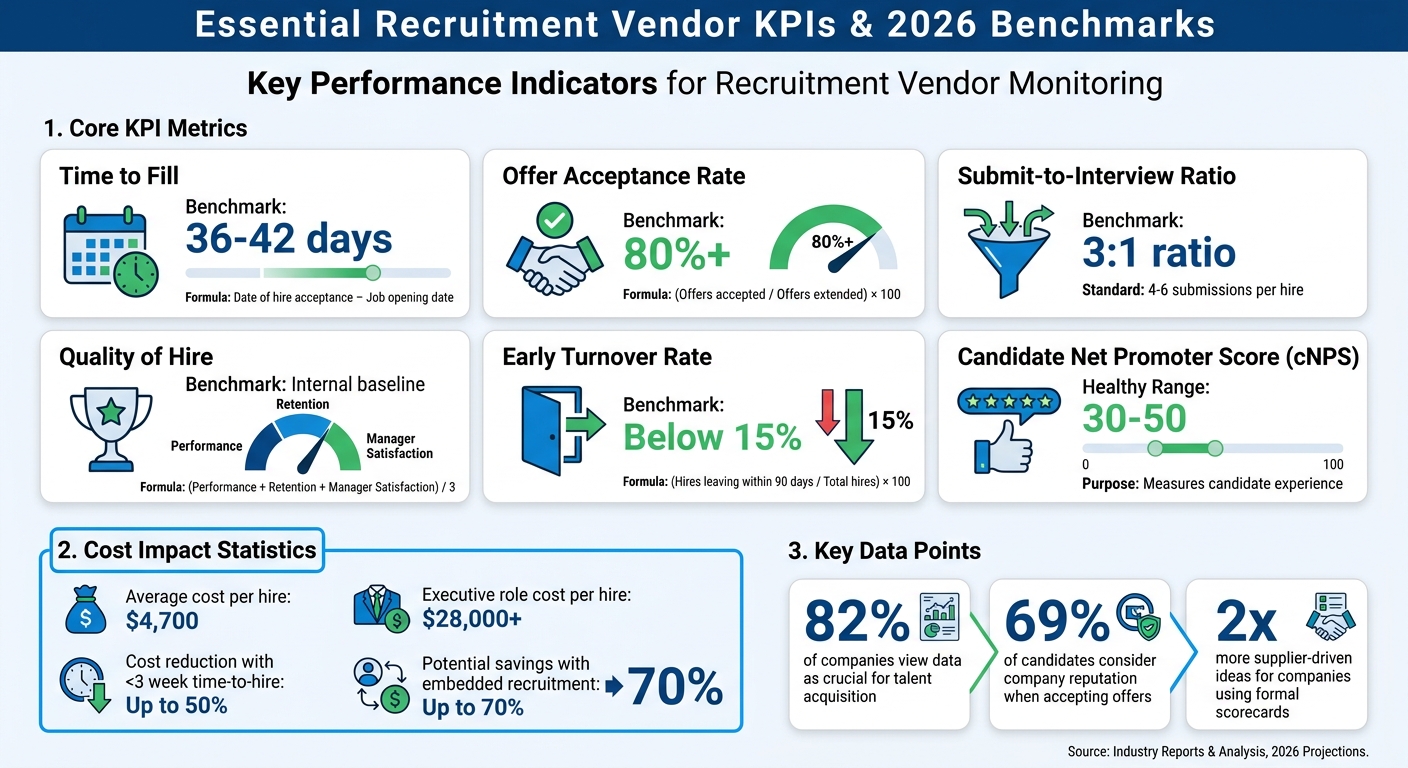
Recruitment Vendor Monitoring KPIs and Benchmarks 2026
The right KPIs transform vendor monitoring into a powerful decision-making tool. By focusing on outcomes rather than activities, you can drive meaningful improvements. In fact, 82% of companies now view data as crucial for talent acquisition decisions [7][2]. Let’s explore the essential KPIs that turn vendor monitoring into actionable insights.
Core KPIs for Recruitment Vendor Performance
To truly assess your recruitment vendors, focus on outcome metrics that directly impact your business. As Anshika from Recruitly highlights:
"Activity metrics feel productive, but they don’t correlate with revenue. I’ve seen agencies where consultants make 80 calls a day and still miss target" [6].
Here are the key metrics to track:
- Time to Fill: This measures the total time from job posting to offer acceptance. The 2026 benchmark is 36 to 42 days [7]. If your process exceeds 35 days, it’s time to pinpoint delays. Break this metric into stages – such as brief to shortlist or interview to offer – to uncover bottlenecks.
- Quality of Hire: This is your most critical metric. Combine performance scores, 90-day retention rates, and hiring manager satisfaction to calculate it [7][2]. Use a brief survey at day 90 to establish a baseline for vendor comparisons.
- Submit-to-Interview Ratio: This shows whether your vendor understands the role requirements. A 3:1 ratio is standard, but higher ratios suggest poor candidate qualification [7]. Efficient vendors typically operate at 4–6 submissions per hire [6].
- Offer Acceptance Rate: Aim for 80% or higher [7]. A low rate often signals issues with vendor briefings or unrealistic salary expectations.
- Candidate Net Promoter Score (cNPS): This measures how candidates perceive your hiring process. A healthy score ranges between 30 and 50 [7], helping to safeguard your employer brand.
| KPI | Formula | 2026 Benchmark |
|---|---|---|
| Time to Fill | Date of hire acceptance – Job opening date | 36–42 days [7] |
| Offer Acceptance Rate | (Offers accepted / Offers extended) × 100 | 80%+ [7] |
| Submit-to-Interview | Candidate submissions / Interviews scheduled | 3:1 ratio [7] |
| Quality of Hire | (Performance + Retention + Manager Satisfaction) / 3 | Internal baseline [2] |
| Early Turnover Rate | (Hires leaving within 90 days / Total hires) × 100 | Below 15% [7] |
Setting Benchmarks and Targets
KPIs only work when definitions are consistent. For example, if your vendor starts measuring Time to Fill from the first candidate call while you start from the job posting date, the data becomes unreliable [7].
Segment your data by factors like role complexity, department, or seniority. This helps identify specific hiring challenges. High-volume roles should fill within 10 days, while executive or niche roles may take 60–90 days [7]. A single average can mask the unique bottlenecks that impact your hiring success [2].
Align KPIs with your top three business goals for the year. If quality is your focus, prioritise metrics like 90-day retention and hiring manager satisfaction. Avoid tracking everything – map metrics directly to your objectives [7].
Adopt a tiered review system to stay on top of both operational and strategic metrics. For example:
- Review operational metrics like pipeline velocity and submission ratios weekly to catch bottlenecks early.
- Review strategic KPIs like cost per hire and quality of hire monthly or quarterly [7].
Using KPIs to Improve Vendor Performance
Defining metrics and setting benchmarks is just the start. Regular reviews are essential for improving vendor performance. Weekly KPI check-ins create accountability and allow for mid-campaign adjustments. Schedule 30-minute reviews on Mondays to discuss pipeline progress, submissions, and scheduled interviews [6]. As RecruitBPM points out:
"Delayed visibility costs more than time. When you don’t know your cost per hire until month-end, you can’t course-correct mid-campaign" [7].
Use vendor scorecards to track 12-month trends instead of relying on one-off snapshots. This approach reveals long-term performance patterns and prevents a single bad month from skewing your analysis [8]. To ensure accountability, tie performance to consequences – such as service credits for missed SLAs – and base renewal decisions on scorecard results.
The ultimate goal of KPIs isn’t just measurement. As Tracker-RMS explains:
"KPIs are only useful when they drive decisions. The right KPI in recruitment tells a recruiter or a hiring manager exactly what to fix next" [2].
Use your data to determine which vendors consistently deliver quality hires, which need further guidance, and which should be replaced. The next section will explore how to integrate these insights into a comprehensive vendor monitoring system.
Building a Vendor Monitoring System
To make informed decisions, you need a system that consistently tracks key performance indicators (KPIs) and turns raw data into actionable insights. Doug Roginson, Head of Supplier Relationship Management at JPMorganChase, puts it well:
"Think of vendor management as your foundation, with supplier relationship management as the valuable structure you build upon it" [9].
Without a solid foundation, even the best KPIs won’t deliver results. Start by evaluating your recruitment health and developing a vendor scorecard that holds your suppliers accountable and ensures clarity in performance expectations.
Your framework should strike a balance between thoroughness and simplicity. 76% of procurement managers list vendor management as a top challenge [9]. A good monitoring system captures both measurable data and qualitative feedback while remaining user-friendly enough for consistent implementation.
Creating a Vendor Scorecard
Once KPIs are clearly defined, a vendor scorecard becomes the tool to enforce them. Begin by gathering key documents such as the RFP, vendor responses, and signed contracts that outline service level agreements (SLAs) and scoring criteria [10]. These form the foundation for evaluating vendor performance.
Break the scorecard into three main categories: Quality, Delivery, and Service [10]. Within each category, limit yourself to three measurable metrics to keep the scorecard focused and actionable. For example, under Quality, you could track:
- Submit-to-interview ratios, aiming for a 3:1 benchmark [7]
- 90-day retention rates, targeting turnover below 15% [7]
- Hiring manager satisfaction scores
Define a clear scoring system before you start. For straightforward metrics like SLA compliance, a simple Yes/No works well. For more nuanced areas, a 1–5 scale can provide flexibility. Most importantly, ensure each score is clearly defined to avoid inconsistencies across reviewers.
Add a section for qualitative notes and stakeholder feedback. Robert J. Trent, writing in Supply Chain Management Review, highlights the importance of this:
"Scorecards should not ignore the voices of internal customers… Managers at manufacturing plants, warehouses, distribution centers, and logistics hubs are often perfectly positioned to evaluate suppliers’ day-to-day performance" [10].
These notes add context – a low score might reflect a one-off issue rather than an ongoing problem.
Focus your efforts where they matter most. Use detailed scorecards for strategic vendors managing high-volume or specialised roles, while keeping it simple for less critical partnerships [10]. This targeted approach ensures your time is spent effectively.
Collecting and Analyzing Performance Data
Manual tracking is prone to errors. Instead, integrate tools like an Applicant Tracking System (ATS) or Vendor Management System (VMS) to automate data collection from application to offer [7]. Automation not only reduces mistakes but also provides real-time visibility into vendor performance.
Pull data from three main sources for a complete picture:
- ATS: Tracks pipeline metrics like submission counts and time-to-fill
- CRM or communication logs: Captures qualitative insights on responsiveness and collaboration
- Financial systems: Tracks costs per hire, including vendor fees and internal labor costs [7]
This combination gives you a 360-degree view of vendor performance. To ensure accuracy, gather input from hiring managers, department heads, and finance teams [9][10]. This cross-functional feedback can highlight gaps between numerical data and real-world experiences.
When reviewing performance, focus on trends rather than isolated incidents. Use rolling averages over 90 days or more to distinguish between temporary setbacks and systemic issues [11]. For example, one bad month might not be significant, but ongoing declines in performance signal a need for action. Weight your metrics based on their impact on your business priorities [11].
Structured scorecards aren’t just for accountability – they drive results. Companies using formal supplier scorecards report twice as many supplier-driven ideas compared to informal methods [11].
Scheduling Regular Performance Reviews
Set up a tiered review schedule that matches the urgency of your metrics. For example:
- Weekly check-ins: Short 30-minute meetings to review operational metrics like submissions, scheduled interviews, and bottlenecks [7].
- Quarterly evaluations: Comprehensive scorecard reviews to assess trends in quality, cost, and responsiveness over the past three months [10]. Follow these with 15-minute discussions to address improvement areas.
- Annual reviews: For strategic vendors, hold a yearly deep dive into long-term opportunities and innovation [10]. Non-strategic vendors can be reviewed semi-annually [11].
Joanne Spencer, an analyst at Gartner, stresses the importance of collaboration:
"When managed badly, large strategic vendors can become complacent, slow moving and intractable" [9].
Use these reviews as a two-way dialogue. Ask vendors if internal issues – like delayed feedback or unclear requirements – are impacting their performance [10]. Sometimes, what seems like vendor underperformance is actually caused by internal bottlenecks.
Leverage modern ATS platforms to generate real-time performance dashboards. This eliminates the need for manual report compilation and helps keep reviews on track, even during busy periods [7].
The purpose of regular reviews isn’t just to hold vendors accountable – it’s about identifying gaps early and driving improvement. A well-structured monitoring system enables you to address performance issues before they affect your hiring goals. From here, focus on closing those gaps and minimising risks in your vendor relationships.
Addressing Performance Gaps and Reducing Risks
Even with strong monitoring systems in place, vendors can still fall short. According to a study by Staffing Industry Analysts, 42% of Recruitment Process Outsourcing (RPO) engagements fail to meet performance expectations within the first 90 days [12]. This highlights the importance of addressing performance gaps early rather than waiting for issues to escalate. Proactive identification of these gaps lays the groundwork for effective interventions, which we’ll explore in the next sections.
Identifying Early Warning Signs of Underperformance
Key performance indicators (KPIs) are essential, but early warning signs often provide deeper insights into a vendor’s performance. For instance, inconsistent communication can be a major red flag. This might include the absence of a dedicated account manager, frequent changes in your point of contact, or delays in responses [12]. As Mayank Pratap Singh, Co-founder & CEO of Supersourcing, puts it:
"A rotating door of account managers is a hidden cost that’s rarely talked about… Each time your point of contact changes, knowledge gaps open, momentum drops, and alignment erodes." [12]
Lack of transparency is another indicator that something might be amiss. Vendors who hesitate to share real-time data, limit access to your Applicant Tracking System (ATS), or provide vague updates could be obscuring operational inefficiencies [12]. Poor targeting is another issue to watch for, often revealed through high candidate drop-off rates between interview stages or declining quality of hires. Metrics like these can give you a clearer picture of where things are going wrong [12][5].
Rigid processes can also signal trouble. For example, reliance on generic job descriptions or resistance to tailoring sourcing strategies could indicate a lack of alignment with your company’s needs [12]. On top of that, compliance issues such as unclear candidate consent practices or missing audit logs for outreach can expose your organization to legal risks [5].
To stay ahead of these problems, request real-time reporting access and track candidate Net Promoter Scores (NPS) to gauge the vendor’s impact on your employer brand [5]. Running pilot programs before committing to a full-scale partnership can also help you measure performance against your benchmarks [5].
Steps to Address Underperformance
If you notice performance gaps, it’s critical to act quickly. Start by using vendor scorecard data to identify and discuss specific discrepancies. Ask the vendor to explain the root causes and collaborate on a corrective action plan with clear milestones and deadlines. Document every step of this process for accountability.
If the initial steps don’t lead to improvement, escalate the issue to senior leadership from both sides. This ensures the problem receives the necessary attention and resources. In some cases, renegotiating contract terms may be required if your needs have shifted since the original agreement.
For example, in April 2026, a fintech company ran a pilot comparing two recruitment vendors for a hiring sprint. One vendor provided full transparency, including data provenance and detailed candidate consent logs, while the other did not. The transparent vendor achieved three times higher candidate conversion and long-term retention rates. As a result, the firm terminated the less transparent vendor, reducing legal risks and improving hiring outcomes [5].
If all corrective actions fail, it’s time to consider replacing the vendor.
When to Replace a Recruitment Vendor
Replacing a vendor becomes necessary when performance gaps persist despite corrective actions, when they fail to adapt to your evolving needs, or when complacency sets in [9]. Specific triggers include repeated SLA breaches, Candidate NPS scores below 50%, or ongoing opacity in data practices [5][14][15].
Before making the final decision, assess whether internal factors – like unclear job requirements or delayed feedback – may have contributed to the issues [10]. If replacement is the best course, create a structured off-boarding plan. This should include settling any outstanding obligations, conducting a final performance review, and ensuring secure data transfer and deletion in line with your Data Processing Agreement [13]. To avoid recruitment downtime, consider running parallel systems during the transition [13]. Documenting the outgoing vendor’s processes and candidate history will also help the new partner or internal team hit the ground running.
Minimizing disruption during transitions is key. Use the "4 P’s" framework – People, Passion, Purpose, and Products – to evaluate whether a vendor still aligns with your organization. If they no longer meet these criteria, it’s time to move forward [15]. With a clear exit strategy and thorough documentation, you can reduce risks and set up your recruitment function for better results.
Using Technology for Vendor Monitoring
Relying on spreadsheets and email for vendor tracking often leads to unnecessary headaches and inefficiencies. By centralizing data and automating repetitive tasks, technology simplifies the process, cutting down on wasted time and effort.
Vendor Management Systems and ATS Integration
A Vendor Management System (VMS) provides a single platform to manage candidate feedback, interview scheduling, and job postings [4]. When paired with your Applicant Tracking System (ATS), vendor-submitted candidates flow directly into your hiring pipeline, complete with real-time tracking and clear attribution. Automated tools can rank candidates based on job requirements, helping to filter out irrelevant submissions. Additionally, these systems enforce pre-set rate agreements by automatically rejecting submissions that exceed agreed markups, preventing unexpected cost increases.
| Essential VMS Feature | Monitoring Benefit |
|---|---|
| Consolidated Invoicing | Simplifies budget tracking and reduces admin workload |
| Centralized Record Keeping | Keeps detailed records for compliance and audits |
| AI Recruiter Matching | Matches requisitions with the most suitable vendors |
| Standardized Onboarding | Speeds up hiring by automating contract processes |
Source: [4]
Key metrics to monitor in a VMS include submission volumes, acceptance rates, interview-to-submission ratios, placement rates, and average placement fees. Companies achieving a time-to-hire of under three weeks can reduce recruiting costs by up to 50% [4].
Automated Alerts and Compliance Tracking
Automated alerts are invaluable for tracking compliance deadlines and missed milestones, helping to avoid fines or legal issues [4]. For example, your system can block vendors from accessing new job requisitions if their insurance certificates or NDAs have expired. Automated onboarding processes also standardize contract terms and monitor certifications, reducing the risk of compliance breaches [4][16].
Modern systems create audit-ready records by continuously tracking contract and NDA statuses, enabling high-growth SMEs to scale their recruitment efforts without adding unnecessary HR staff. These features provide the structure needed for seamless and scalable recruitment management.
Scalability Benefits for High-Growth SMEs
With 65% of global company leaders planning to expand their use of contingent workers by 2027, automated solutions are critical for managing growth [17]. Technology allows SMEs to handle anywhere from a handful to hundreds of agencies without increasing internal HR headcount. Tasks like resume management, compliance tracking, and payments are streamlined, freeing up valuable time.
Self-service portals enable vendors to upload compliance documents – such as NDAs, tax forms, and insurance certificates – reducing the administrative load on HR teams. For urgent projects, bench management tools provide visibility into pre-vetted contractors, allowing businesses to deploy talent quickly and reduce time-to-fill. Mobile approvals let hiring managers approve offers on the go, ensuring swift action to secure top candidates.
Regular reviews of vendor performance data can help identify underperformers by rating your recruitment process, enabling you to offboard the bottom 20% and focus resources on high-performing vendors. Tiered job distribution further optimizes the process by prioritizing top-tier vendors before opening requisitions to others, ensuring quality and efficiency in hiring at scale.
Conclusion
Throughout this guide, we’ve outlined how effective vendor monitoring can align your recruitment efforts with your broader growth goals.
Benefits of Effective Vendor Monitoring
A well-structured monitoring system delivers measurable results. For example, companies achieving a time-to-hire of under three weeks often see recruitment costs drop by up to 50%[4]. Moving from reactive hiring to a data-driven vendor management approach also helps avoid the hidden costs of recruitment, which can reach three to four times a position’s salary when factoring in administrative time and resources[4]. Beyond cost savings, consistent use of scorecards and performance tracking reduces the risk of "fast but wrong" hiring decisions that lead to early turnover and wasted effort[2]. Moreover, protecting your employer brand is critical, as 69% of candidates consider a company’s reputation a key factor when deciding to accept a job offer[3]. These benefits create a strong foundation for actionable steps, especially for SMEs.
Next Steps for SMEs
To streamline your process, centralize vendor data into a single platform, such as a VMS or integrated ATS. Define SMART KPIs (Specific, Measurable, Achievable, Relevant, and Timely) that align with your business priorities rather than relying on generic benchmarks[1]. Conduct quarterly performance reviews with standardized scorecards, and consider running pilot programs with new vendors before entering long-term commitments[5].
If managing multiple agencies feels overwhelming, consider partnering with Rent a Recruiter. Our embedded recruiters integrate into your team within days, offering the structure and oversight you need without the high fees of traditional agencies. Many companies see hiring costs drop by up to 70% compared to commission-based models, while also saving over 80 hours each month on internal administrative tasks. These strategies can help you build a solid vendor management framework that supports your growth.
Call to Action: Take Charge of Vendor Management
The global VMS market is expected to surpass $4 billion by 2026[13], and 82% of companies already acknowledge the importance of data in driving talent acquisition decisions[2]. Now is the time to act. Assess your current processes, identify areas where visibility is lacking, and put the strategies from this guide into practice. Visit Rent a Recruiter to learn how embedded recruitment can enhance your hiring process and reduce your reliance on traditional agencies.
FAQs
Which KPIs should I prioritize first for vendor monitoring?
To truly gauge how well your vendors are performing, focus on metrics that reveal both service quality and overall effectiveness. Here are some of the key performance indicators (KPIs) to keep on your radar:
- Candidate quality: Are the candidates provided by the vendor meeting your expectations and aligning with your hiring needs? This is a direct reflection of their ability to source top talent.
- Time-to-fill: How quickly are roles being filled? A shorter time-to-fill can indicate efficiency in sourcing and screening processes.
- Candidate experience: Metrics like Candidate Net Promoter Score (NPS) can help you understand how candidates perceive the recruitment process. A positive experience boosts your employer brand.
- Sourcing success rate: What percentage of sourced candidates make it to later stages of the hiring process? This highlights the vendor’s ability to identify strong fits early on.
- Candidate retention: Are the candidates staying with your company long-term? Retention rates can reveal the alignment between hires and your company culture or expectations.
- Compliance with data privacy policies: Ensure vendors adhere to legal regulations around data handling. Missteps here can lead to costly compliance issues.
Tracking these KPIs ensures your vendors not only deliver qualified candidates efficiently but also maintain a positive candidate journey and meet legal standards. Together, these metrics provide a solid framework for managing vendor relationships effectively.
How do I set fair benchmarks by role type and seniority?
To establish fair benchmarks, rely on recruiting metrics and industry data that match the specifics of each role and level of seniority. Prioritize metrics such as time-to-fill, quality of hire, and candidate experience. Measure your performance against industry standards or your own historical data, and make it a habit to update these benchmarks regularly. This approach keeps your targets realistic, tailored to each position, and aligned with ongoing improvements in your hiring strategy.
When should I replace a recruitment vendor?
If you’re noticing a drop or stagnation in critical hiring metrics – such as time-to-fill, candidate quality, or hiring manager satisfaction – it might be time to reassess your recruitment vendor. Other warning signs include:
- Poor candidate fit leading to misaligned hires.
- High turnover rates that disrupt team stability.
- Slow hiring processes that delay growth.
- Rising costs without any clear improvement in outcomes.
- Lack of transparency around progress or challenges.
- Ineffective communication that leaves you in the dark.
When these problems persist despite raising concerns, it’s a clear signal to explore alternatives. Your recruitment partner should drive results, not create obstacles.