If you wait until a tech role is open, you usually pay more, wait longer, and put delivery at risk.
I’d sum it up like this: planned hiring gives you more control over time-to-fill, cost, and team workload. Reactive hiring can still work for a one-off backfill, but for scaling SaaS, IT, fintech, engineering, security, insurance, and professional services teams, it often leads to slower hiring, weaker fit, and more pressure on managers.
Here’s the short version:
- Planned hiring starts early, before demand peaks
- Reactive hiring starts late, after the gap already exists
- Hard-to-fill tech roles can take 48 to 89 days to fill
- Vacancy costs can hit $4,129 over 42 days
- Unfilled tech roles can cost about $500 per day
- A 90-day senior engineer gap can cost $60,000 to $120,000 in lost output
- Re-engaging past applicants can drive 2 to 3 times higher response rates than cold outreach
- With embedded recruitment, many companies cut hiring costs by up to 70% and save 80+ hours per month
Proactive v. Reactive: What Kind of Employer Are You?
Whether you are currently reactive or looking to become more proactive, embedded IT recruitment can help you build a sustainable talent pipeline.
sbb-itb-a23bd6a
Quick comparison
| Factor | Planned hiring | Reactive hiring |
|---|---|---|
| Start point | Before the role becomes urgent | After a vacancy opens |
| Candidate pool | Warm, pre-built pipeline | Active applicants and urgent outreach |
| Time-to-fill | Often lower when pipeline work is in place | Often longer due to late start |
| Cost control | Better over time | More risk of agency spend, contractor cover, and delays |
| Hiring pressure | Spread over time | Packed into a short window |
| Best use | Growth plans, specialist hires, product roadmap roles | Low-risk backfills, broad-supply roles |
If you’re hiring against growth targets, product milestones, or known attrition risk, the message is simple: start before the pressure hits. The rest of the article breaks down where each model fits, what it costs, and how to build a pipeline without overloading your team.
Proactive vs. reactive hiring: definitions, triggers, and trade-offs
The main difference is timing. Proactive hiring starts before demand peaks. Reactive hiring starts after a vacancy opens. In pipeline terms, proactive hiring builds supply before demand. Reactive hiring starts with an empty bench.
Both approaches have a place. Reactive hiring can look practical because you only spend recruiting time and budget when there is a confirmed need. On paper, that makes sense. In a competitive tech labour market, though, it often leads to more applicants, weaker fit, and lower response rates.
Proactive hiring: planning ahead for hard-to-fill tech roles
Proactive hiring treats recruiting as an always-on function, not just a reaction to an open req. It starts with forecasting, market mapping, and relationship building. The goal is simple: spot the hardest-to-fill, highest-impact roles before they become urgent. For tech teams, that usually means software engineers, DevOps specialists, data engineers, security hires, and technical product talent.
The big upside is pipeline depth. Instead of starting from zero when a role opens, your team already has warm candidates in motion. These are people who have had an initial conversation, shown interest, and stayed in touch over time.
That changes the economics of hiring.
A "not now" does not have to mean "never". It can be the start of a relationship. Re-engagement campaigns aimed at past applicants can drive 2 to 3 times higher response rates than cold outreach.[2] That means less wasted sourcing effort, less pressure on hiring managers, and a better shot at filling tough roles without a last-minute scramble.
Reactive hiring: filling gaps after demand hits
Reactive hiring starts when a vacancy appears or a requisition gets approved. The search begins under pressure and usually depends on inbound applications, job boards, and immediate outreach, with no existing pipeline to tap into. When you post a role in that situation, you tend to get volume over fit, plus weaker response rates from people who were not already engaged.
Reactive hiring is not wrong by default. It can work for one-off needs or lower-risk hiring. But if it becomes the standard model for a scaling tech team, you end up restarting the process every time. That costs time, adds pressure, and makes hiring outcomes less predictable.
The trade-offs show up most clearly when you compare speed, cost, and predictability side by side, as seen in our talent acquisition case studies.
Side-by-side comparison: where each hiring model performs better
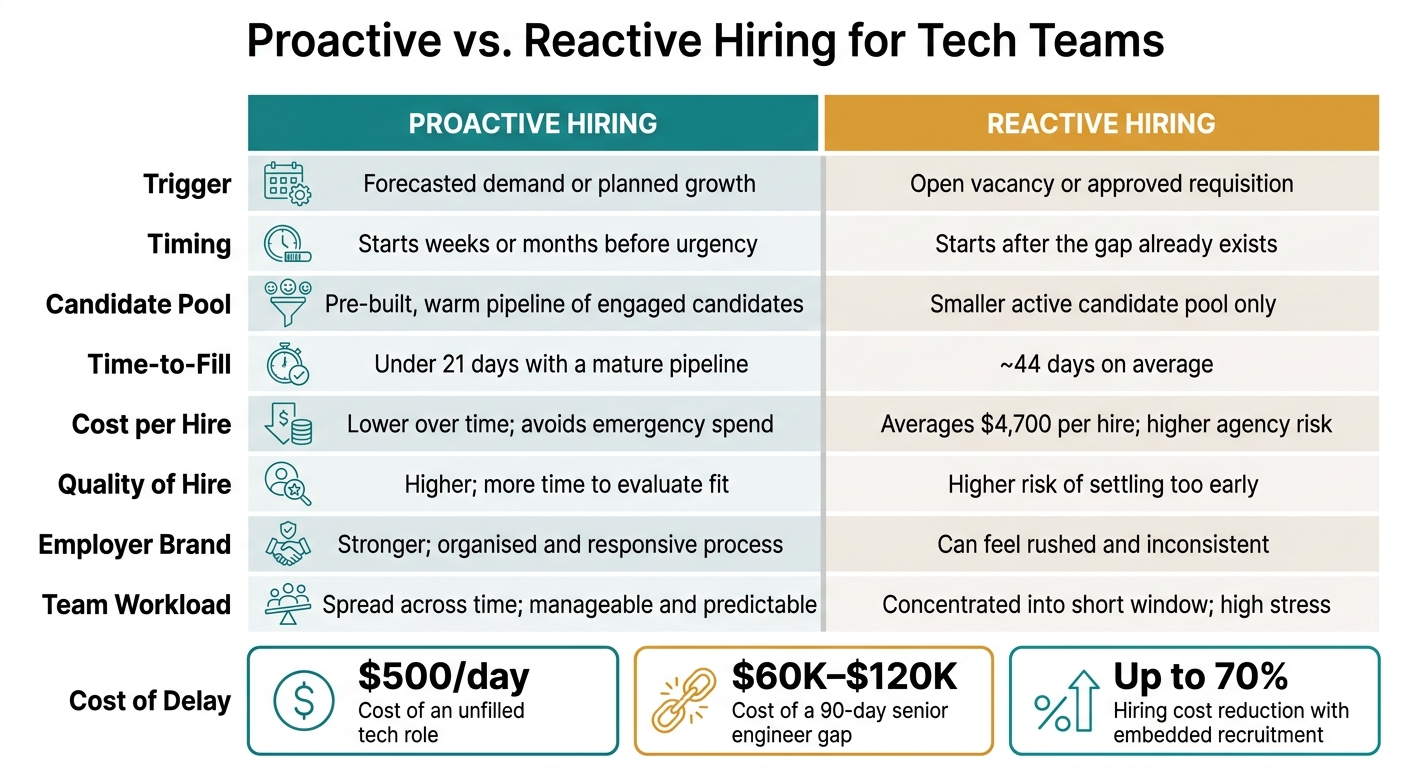
Proactive vs. Reactive Hiring: Cost, Speed & Quality Compared
Comparison table: proactive vs. reactive hiring across 8 business factors
Compare the models on speed, cost, quality, and process control. The table below shows where each model comes out ahead.
| Business Factor | Proactive Hiring | Reactive Hiring |
|---|---|---|
| Trigger | Forecasted demand or planned growth | Open vacancy or approved requisition |
| Timing | Starts weeks or months before a role is urgent | Starts after the gap already exists |
| Candidate pool | Pre-built, warm pipeline of engaged candidates | Smaller active candidate pool |
| Speed / Time-to-fill | Under 21 days with a mature pipeline [5] | Around 44 days on average [3] |
| Cost | Lower over time; avoids emergency spend | Averages $4,700 per hire and can increase agency or contractor spend [3] |
| Quality of hire | Higher; more time to evaluate fit and compare candidates | Higher risk of settling too early |
| Employer brand | Stronger; candidates experience an organised, responsive process | Can feel rushed and inconsistent |
| Hiring-team workload / process control | Spread across time; more manageable, predictable, and visible | Concentrated into a short window; higher internal stress and less process consistency |
This gap gets expensive fast. Unfilled technical roles cost around $500 per day in lost productivity and delayed delivery [4]. A 90-day senior engineer vacancy can cost $60,000 to $120,000 in lost output [1].
That’s the part many teams miss.
Reactive hiring can look simpler at the start because you only act when a role opens. But when hiring waits until the pressure is already on, you often pay for it somewhere else, in slower delivery, more internal stress, extra agency spend, or short-term contractor cover. For scaling companies, that hidden cost often matters more than the upfront effort of building a pipeline early.
Which model fits which hiring situation for tech SMEs
Proactive hiring fits planned demand best. If you’re scaling after a funding round, gearing up for a product launch over the next two quarters, or building an engineering team for a new market, this model gives you more control. It also works well for narrow-supply technical roles, where waiting too long can leave you scrambling for talent at the worst time.
Reactive hiring can work in a small number of cases. Think of an isolated replacement hire, a backfill for a role with broad candidate availability, or a one-off opening where a slower search won’t do much damage to the business.
In plain terms:
- Use proactive hiring for growth plans, specialist roles, and any hire tied to revenue, delivery, or team build-out.
- Use reactive hiring for low-impact backfills or broad-supply roles where timing is less critical.
If reactive hiring is your only option, a little prep goes a long way. A ready-to-use job description, a basic interview scorecard, and a shortlist of sourcing channels can stop the process from turning messy the moment urgency kicks in.
Building that pipeline is what makes proactive hiring work.
How to build a tech talent pipeline
Core pipeline inputs: forecasting, mapping, and outreach
The aim is not more activity. It is a warmer, more accurate candidate pool before hiring demand spikes.
Start with role forecasting. Review your product roadmap, headcount plan, and attrition risk to spot likely openings over the next 3 to 12 months. For senior hires like VP of Engineering or CTO, look further ahead, usually 12 to 18 months. Before you start sourcing, get clear on outcomes, reporting lines, and decision rights.
Once you know which roles matter most, map where those people are likely to come from. Break the market down by function, seniority, domain, and motivator. That keeps outreach focused. A senior engineer moved by technical ownership needs a different message from one driven by pay or scale.
Outreach is where the pipeline starts to work. About 70% of the global workforce isn’t actively seeking a new job but is open to the right opportunity [2]. That matters because waiting for applications leaves too much to chance. Proactive sourcing works best when your message has context, not just a generic pitch. For senior engineers, share technical content such as architecture trade-offs, scaling lessons, or engineering standards. That gives people a reason to reply.
After first contact, keep the relationship alive. Stay in touch with previous finalists and silver medalists on a regular cadence. This is often one of the easiest ways to improve response rates, because re-engagement campaigns can generate 2 to 3x higher response rates than cold outreach [2].
Pipeline health metrics that improve hiring predictability
If you want hiring to feel less reactive, track pipeline health closely. The right metrics show whether your process is getting more predictable or just busier.
| Metric | Target | What It Tells You |
|---|---|---|
| Resume-to-interview ratio | 15 to 20% [2] | Strong sourcing precision and alignment with hiring managers |
| Time-to-hire reduction | Up to 30% [2] | The impact of data-led sourcing and proactive pipeline building |
| Re-engagement response rate | 2 to 3x higher than cold outreach [2] | Whether nurturing past applicants is working |
| Hiring efficiency | 20% improvement [2] | The gain from structured sourcing and better process discipline |
Track these by role family and seniority level. That helps you spot gaps early, before they turn into missed hires, delayed product work, or extra pressure on agency spend.
Adding hiring capacity without losing process control
For most tech SMEs, the main blocker is simple: bandwidth.
Running a talent pipeline on top of day-to-day hiring and team management takes time. When capacity gets tight, proactive sourcing is usually the first thing to drop. So when these metrics stall, the problem is often not intent. It is capacity.
This is where an embedded recruiter can help. Rent a Recruiter places experienced recruiters inside your team within days to manage sourcing, outreach, and pipeline activity, while your team keeps control of hiring decisions. You get more structure, better visibility, and fixed monthly pricing.
For scaling tech companies, the business case is simple. Companies using this model typically reduce hiring costs by up to 70% and save over 80 hours per month in internal hiring and admin time [2]. That means more hiring capacity without losing process control, and a proactive model you can keep running as the business grows.
Conclusion: choosing the right model for speed, cost, and hiring predictability
Reactive hiring still works for one-off backfills. But if you keep hiring for hard-to-fill tech roles, waiting until a role opens usually costs you more and makes planning harder.
Proactive hiring helps you reach passive candidates. Reactive hiring tends to reach active job seekers. In most cases, that means shorter time-to-hire and better hiring efficiency.
The main issue is execution capacity. You may know what needs to happen, but without enough hands on the work, sourcing slows down, pipelines stall, and hiring drifts. That’s where embedded recruiting support comes in. Rent a Recruiter places experienced recruiters directly into your team to run hiring end-to-end with structure, visibility, and a steady process.
If your hiring demand is predictable, recurring, or linked to product milestones, proactive hiring gives you more control over speed and cost. Talk to Rent a Recruiter.
FAQs
When should we start proactive hiring?
Start hiring work before a role is live.
That means building an active talent pipeline now, then matching it to your next 12 months of hiring demand. If you wait until a vacancy appears, you’re already behind. You lose time, put pressure on your team, and often end up paying more to fill the gap.
For niche or senior hires, start even earlier. Relationship-building at that level can take 6 months to 2+ years. The best people are rarely sitting on the market, ready to move the week you need them.
If a new hire needs to be fully productive for a launch, work backward from that date. In most cases, you should begin hiring 2 to 3 months before they need to be up and running.
This is where planning shifts hiring from a scramble to a commercial function. You save time, cut avoidable hiring costs, and give the business a much better shot at landing the right person.
Which tech roles benefit most from a talent pipeline?
Prioritize roles that are mission-critical, hard to fill, or hired often. Put your attention on the positions that have the biggest impact on revenue, product delivery, customer outcomes, or business growth.
That usually includes AI/ML engineers, cybersecurity analysts, DevOps/SRE talent, and senior leadership roles. It’s also worth reviewing the three to five roles you’ve hired most often in the past 24 months.
Why does this matter? Because not every vacancy carries the same business weight. Some roles directly affect how fast you ship, how well you serve customers, and how much pressure your team is under. Those are the hires that deserve the most focus first.
How can a small team hire proactively without adding workload?
Small teams can hire more predictably by keeping a live, segmented talent pool linked to a 12-month headcount plan, with one clear owner and a fixed quarterly review cycle.
Start with the 3 to 5 repeat role families that create the most delay and cost when openings go live. For most scaling companies, that means the roles you hire again and again across SaaS, Technology, IT, Fintech, Engineering, Security, Insurance, or Professional Services.
Keep the setup simple. Tag people by:
- job family
- seniority
- readiness
Then run a plain follow-up rhythm with hot, warm, and cool categories. That gives you a cleaner view of who is ready now, who may be ready soon, and who should stay in light-touch nurture.
Why does this matter? Because when a role opens, you are not starting from zero. You cut search time, reduce internal hiring admin, and give your team a better shot at filling roles without the scramble and cost spikes that often come with reactive hiring.
If your team is stretched, embedded recruitment support can help you keep that pipeline live without adding more strain to HR or leadership time.