
If you are paying 20% agency fees or stretching managers across hiring admin, there is usually a lower-cost way to hire.
I see the same pattern in scaling SaaS, IT, fintech, engineering, security, insurance, and professional services firms. Hiring does not move in a straight line. It comes in spikes. That is why on-demand recruitment can cut hiring spend by up to 70%, save 80+ hours a month, and give you more control without adding full-time recruiter cost.
Here is the short version:
- Lower spend than commission-based agency hiring
- Shorter time-to-fill when hiring demand jumps
- Scale up or down without adding fixed recruiter headcount
- Sector hiring know-how for niche roles
- Better pipeline visibility inside your own process
If you are hiring in bursts and want tighter cost control, this is why Rent a Recruiter and other embedded recruitment models are getting more attention from CEOs, CFOs, HR leaders, and Talent Leaders.
Quick Comparison
| Model | Cost setup | Speed to start | Flexibility | Visibility | Best fit |
|---|---|---|---|---|---|
| Embedded Recruitment | Fixed monthly or project fee | Fast | High | High | Hiring spikes, scale-ups, multi-role growth |
| In-House Recruiter | Salary, benefits, tools | Slower | Lower | High | Steady year-round hiring |
| Traditional Agency | Fee per hire, often 15% to 25% of salary | Varies | Medium | Lower | One-off hires or hard-to-fill gaps |
In simple terms, on-demand recruitment gives you lower cost, more speed, and more control when growth puts pressure on hiring.
sbb-itb-a23bd6a
Why On-Demand Recruitment Matters for Growing SMEs
These benefits matter because SMEs run into a very specific hiring squeeze.
Hiring usually lands with a founder, a generalist, or a manager who is already maxed out. When several roles open at the same time, screening and scheduling can eat up 10 to 15 hours a week that should be spent on sales, delivery, or other revenue work. A funding round, product launch, or new client win can trigger a sudden hiring spike that a fixed in-house team simply cannot handle. Then, when hiring slows, a full-time recruiter starts to look like overhead you do not need.
The cost side is hard to ignore. SHRM‘s 2025 data puts average cost per hire at $5,475 for nonexecutive roles and $35,879 for executive roles, with median time-to-fill at 44 days.[5] For a small team, those numbers add up fast. One slow or mismanaged hiring cycle does not just affect HR. It pulls time from leadership, delays delivery, and can put growth plans on hold.
That is why a flexible embedded recruitment model often makes more sense than a fixed one.
On-demand recruitment gives SMEs access to senior recruiting support when they need it, without adding permanent headcount or paying per-placement fees. It suits growth that comes in bursts, especially when budgets are tight and hiring plans can shift month to month.
The first benefit is cost savings.
1. Cost Savings for SMEs
Agency fees grow in line with salary and hiring volume. In the U.S., contingency agencies often charge 15% to 25% of a candidate’s first-year salary, and 20% is a common benchmark. So if you hire one person on $100,000, you could pay $20,000 in agency fees alone.[9][10]
On-demand recruitment changes that model. Instead of paying per hire, you pay a fixed monthly fee or subscription. That gives you predictable recruiting costs and much tighter budget control.
For many SMEs, that shift starts to pay off at around 15 to 25 hires per year. At that point, embedded recruiting is often less expensive than contingency fees. If your hiring demand comes in bursts, this matters even more. You avoid getting hit with high one-off fees every time growth picks up.[6][7]
The numbers can be hard to ignore.
In one 24-hire scale-up, contingency fees for roles paying $120,000 came to about $633,600. An embedded model priced at $9,500 per hire brought that down to about $228,000. That’s a 64% cut in hiring spend.[8]
There’s also a live client example. NextDC, working with Rent a Recruiter through an embedded model, filled 20 roles and saved $416,086 compared with traditional agency commissions.[3]
Fixed monthly pricing also makes recruitment spend easier to plan. Your finance team gets cleaner forecasting. Your leadership team gets fewer surprises. And when hiring starts ramping up, that cost control becomes even more useful.
2. Faster Hiring When Demand Spikes
Cost control matters. But when hiring demand jumps, speed becomes the next pressure point.
When growth hits all at once, internal teams often can’t keep up. Building in-house recruiting capacity takes time, and hiring an internal recruiter in the U.S. can take 30 to 60 days. By that point, the window may have closed and key roles may still be sitting open.
That is where on-demand support helps. An embedded recruiter can join your team within days and start work straight away, sourcing, screening, and managing pipeline activity from day one.
They work inside your ATS. They fit into your hiring workflow. And they start moving without the usual delay.
In the U.S., internal hiring can take 44 to 100+ days, while embedded recruiters can cut that to 27 to 64 days.[11] That time gap matters when open roles are slowing delivery, stretching managers, or putting revenue plans at risk.
The impact can be sharp. In one case, a manufacturing company cut time-to-fill from 87 days to 29 days after outsourcing recruitment.[12]
They also take the admin load off your team end to end, including:
- Screening
- Scheduling
- Candidate communication
VicReturn is a good example. The business used on-demand support to fill 18 senior roles in four months. Over that period, the team screened 1,481 applicants and saved the internal HR team more than 600 hours of administrative work.[2]
3. Flexible Scaling Without Adding Headcount
Lower cost and faster hiring matter, but there’s another piece senior leaders care about just as much: capacity that matches demand.
Hiring rarely moves in a straight line. It jumps after a funding round, a product launch, a new market entry, or a seasonal spike, then slows again. If you hire a full-time internal recruiter to cover that surge, you can end up carrying a fixed salary cost long after the hiring rush has passed.
That’s where on-demand recruitment makes commercial sense.
You bring in support when you need it, then scale back when you don’t. An embedded recruiter can join your team in as little as 5 days [1]. For scaling companies, that speed gives you room to act fast without adding long-term payroll cost.
Take a SaaS business that has just closed a Series A. You may need to hire across sales, engineering, and customer success over a short period. But that doesn’t mean you need unused recruiting capacity sitting on the books for the rest of the year. On-demand support helps you hit the hiring target without adding fixed headcount.
In simple terms, recruiting capacity follows current demand, not a hiring plan set months earlier. You can scale support up or down without carrying overhead you’re not using.
That kind of flexibility helps most when the recruiter also brings specialist hiring expertise.
4. Access to Specialist Recruitment Expertise
Flexible embedded recruitment gives SMEs access to recruiters who already know the market you’re hiring into. That matters even more when the role sits in a niche area.
Specialist roles need a different approach to sourcing, screening, and assessment. Recruiters focused on tech, SaaS, fintech, or engineering bring that sector knowledge from day one. They know current salary benchmarks, which channels reach passive candidates, and how to shape interviews around the skills that are most linked to strong performance.
That has a direct business impact. You spend less time reviewing weak applicants, your hiring process gets tighter, and your team moves faster.
The pressure is clear in the data. One SME snapshot report found that 80% of businesses that had recruited in the previous six months had difficulty finding suitable staff, and 60% said a lack of appropriate technical skills was the main driver of skills gaps [13][14].
You can see what this looks like in practice. In a 27-month partnership with Mastertech, an embedded Talent Partner from Rent a Recruiter reached 3,000+ passive candidates, kept a 4:1 resume-to-interview ratio, made 29 placements, and saved €123,000 in agency fees [3][4].
"We now only receive top quality CVS that leads to interviews and job placement. It’s as simple as that." – Karen Woulfe, HR Manager, Mastertech [2]
Specialist knowledge is one part of the value. The next gain is better structure and visibility across hiring.
5. More Structure and Visibility in Hiring
Many SMEs still hire in reaction mode, treating each vacancy like a separate project. That usually leads to uneven standards, slow decisions, and more back-and-forth than anyone wants. An embedded recruiter changes that by putting one clear workflow around every hire.
With a defined role intake, sourcing steps, interview stages, feedback deadlines, and approval points, each open role follows the same process. Hiring managers are not making it up as they go. Candidates are not getting a different version of your company in every interview.
Just as important, you get better visibility. When an embedded recruiter manages the pipeline, leadership has a live view of each role through pipeline tracking and regular updates. That means you can spot bottlenecks early, not after a strong candidate drops out.
Say a role is attracting good applicants but interview conversion is weak. You can step in and adjust the criteria, salary, or process before a slow decision cycle costs you the hire. That kind of visibility saves time, cuts waste, and gives you more control over hiring outcomes. You can also rate your recruitment process to identify further gaps in your workflow.
The commercial impact can be clear. A global RPO program cut average time-to-hire by 52%, stabilising at 38 days, and saved $1.8 million in external agency fees[15].
That same level of visibility also makes it much easier to compare on-demand recruitment with in-house hiring and agency support.
On-Demand Recruitment vs. Hiring In-House or Using Agencies
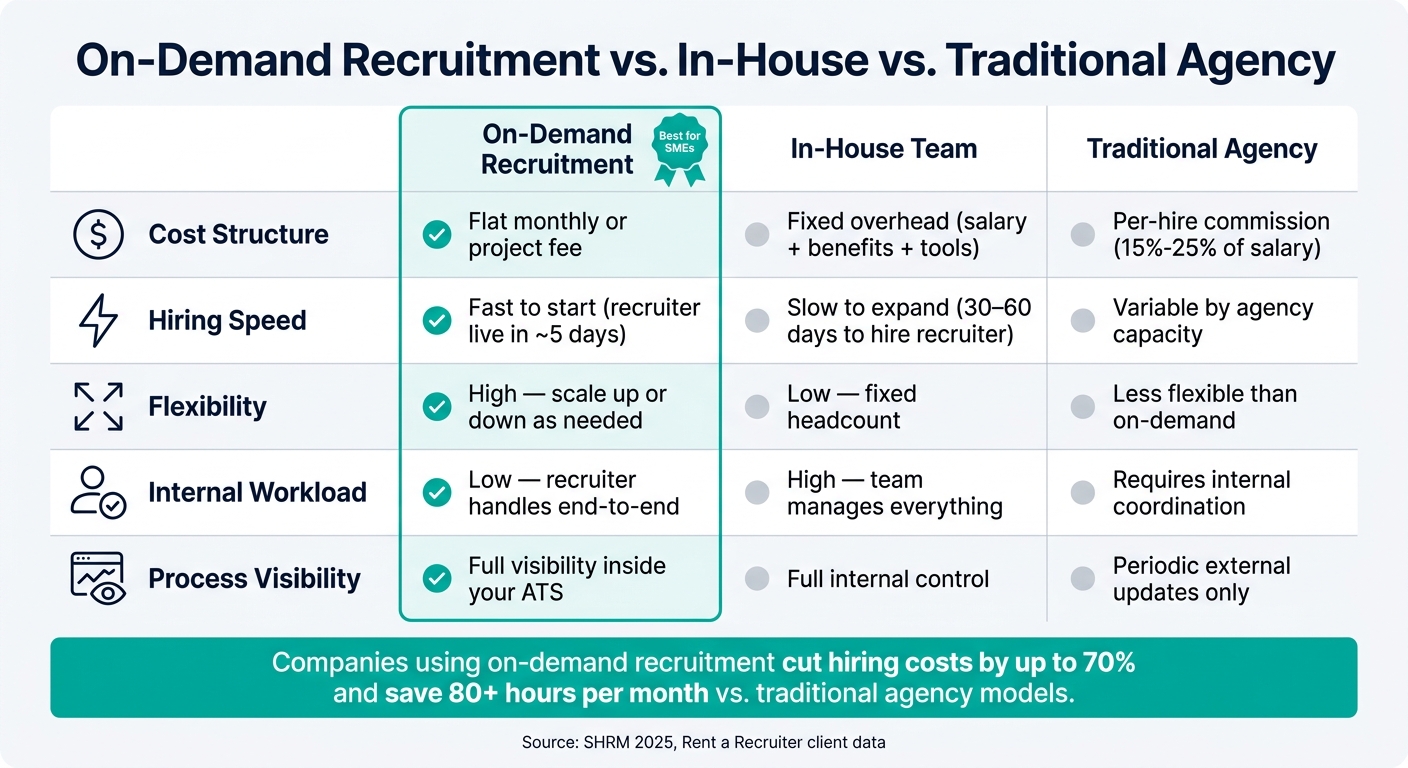
On-Demand vs In-House vs Agency Recruitment: Cost, Speed & Flexibility Compared
Each hiring model comes with real trade-offs. Once you’ve looked at the five benefits, the next step is practical: which model fits your hiring volume, budget, and internal bandwidth right now?
Traditional recruitment agencies often charge 15% to 25% of first-year salary per hire. In-house recruiting removes commission fees, but it adds fixed salary costs, benefits, and tooling. Both models can become hard to manage when hiring demand jumps, or when it drops just as fast.
On-demand recruitment sits in the middle. It usually runs on a fixed fee, project fee, or flat monthly subscription instead of per-hire commissions[2][3]. That gives you a setup that can start fast, then scale back when hiring slows. In practice, the biggest differences show up in cost, speed, flexibility, and visibility.
The simplest comparison is below:
| On-Demand Recruitment | In-House Team | Traditional Agency | |
|---|---|---|---|
| Cost Structure | Flat monthly or project fee | Fixed overhead | Per-hire commission |
| Hiring Speed | Fast to start | Slow to expand | Variable by agency capacity |
| Flexibility | High, scale up or down as needed | Low, fixed headcount | Less flexible than on-demand |
| Internal Workload | Low, recruiter handles end-to-end work | High, team manages everything | Requires internal coordination |
| Process Visibility | Visibility inside your ATS | Full internal control | Periodic external updates |
The biggest gap with agencies is usually visibility. When hiring sits outside your business, you often get status updates instead of live access to the pipeline. That slows decisions. It also makes it harder to spot blockers before they turn into missed hires.
An embedded on-demand recruiter works inside your ATS and communication tools. You can see where every role stands, what is moving, and what needs action. For CEOs, CFOs, and talent leaders, that means more control without adding fixed headcount.
That fit becomes clearer when you look at your growth stage. The next step is to see how this kind of support matches the pace and shape of hiring in high-growth SMEs. This is particularly effective when implementing embedded recruitment for startups looking to scale rapidly.
How On-Demand Recruitment Fits a High-Growth SME
These gains matter most at four common growth points: after funding, before a product launch, when a business-critical role opens, and during seasonal demand spikes.
After a funding round, hiring often jumps across sales, embedded IT recruitment, product, and customer success. That kind of growth can put serious strain on your internal team. An embedded recruiter can step in fast and stay locked on the open roles, so hiring keeps pace with the plan.
The same pressure shows up before a launch, when key hires need to be in place before go-live, not after. New product launches bring a very specific kind of urgency. You need the right people on board 60 to 90 days before launch, product marketing managers, sales engineers, and customer success reps, not once the product is already in market [2]. Miss one of those hires and the rollout can slow down. On-demand recruitment gives you a focused hiring sprint for launch-critical roles, then lets you scale back once the core team is set.
When a critical role opens, delays can hit revenue and delivery fast. An embedded recruiter can help cut down a search that might otherwise stretch to 49 days or more, which is the average time small businesses take to fill an open role [16].
Seasonal spikes are usually predictable, but plenty of SMEs still get caught short. Whether you’re gearing up for a Q4 sales push or a busy stretch in professional services, on-demand recruitment lets you ramp hiring capacity for a set period, then pull it back when demand eases. You get the output you need without carrying full-time overhead all year.
These are the moments when on-demand recruitment should be switched on.
Conclusion
Put simply, these five benefits make on-demand recruitment a strong fit for SMEs that need to grow hiring without adding fixed overhead.
You get a model that makes hiring faster, lower-cost, and easier to control as growth picks up.
Companies using this model can cut hiring costs by up to 70% compared with traditional commission-based models, while saving more than 80 hours per month in internal hiring and admin time [2][3]. That has a direct business impact. Lower spend per hire. Less time lost to coordination and manual admin. More room for your team to focus on delivery and growth.
On-demand support scales up when hiring demand spikes, then scales back when things settle. That matters for SMEs, where hiring plans can change fast and fixed internal cost can become a burden just as fast.
It also brings in experienced recruiters who improve sourcing, process, and candidate management. For lean teams, that added structure and visibility can make the difference between a hiring function that feels reactive and one that runs with control.
Rent a Recruiter embeds experienced recruiters directly into client teams, helping SMEs grow hiring capacity, improve consistency, and reduce reliance on external agencies. If hiring is slowing growth, on-demand recruitment is a practical next step. For hiring as you scale, that flexibility can be the difference between recruitment catching up and growth stalling.
FAQs
When does on-demand recruitment make the most sense for an SME?
On-demand recruitment works best when your hiring needs shift fast, not when they stay flat.
That often happens after funding, during a product launch, when you’re moving into new markets, or when seasonal and short-term hiring spikes hit. In those moments, fixed internal capacity can become a bottleneck. You need hiring support that can move with the business, not slow it down.
It’s also a strong option for urgent or hard-to-fill roles when your internal team is already stretched. You can scale recruiter capacity up fast, then scale it back later without long-term contracts or fixed overhead.
For SMEs, that usually means three clear business gains: lower hiring strain, less delay on key roles, and better control over cost.
How quickly can an embedded recruiter start supporting our team?
Rent a Recruiter embedded recruiters can start supporting your team in as little as 48 hours after kickoff. In most cases, they’re up and running within a few days, depending on onboarding and start-date alignment.
In many cases, an embedded recruiter can be in place in about 5 days, then begin sourcing and delivering candidates straight away.
That means less waiting, less hiring drag, and a faster path to filling key roles.
What types of roles are best suited for on-demand recruitment?
On-demand recruitment works across a wide range of hiring needs, from entry-level roles to executive leadership.
It tends to work especially well when you need to hire at pace, fill hard-to-source roles, or add hiring support without building a full internal team.
That includes:
- High-volume hiring
- Specialist and niche roles
- Short-term project hires
- Urgent vacancies
- Long-term scaling
You’ll often see it used for roles in software engineering, product management, data analysis, sales, marketing, and engineering.
For scaling companies, that matters. You get a hiring model that can support day-to-day recruitment, sudden spikes in demand, and harder searches, without locking you into the cost structure of a full agency model or permanent internal headcount.