When scaling your business, choosing the right recruitment model can directly impact your hiring costs, time-to-fill, and overall efficiency. Internal recruitment teams offer control and alignment with your company’s values but come with fixed costs and limited flexibility. Hybrid models, combining in-house teams with external experts, provide scalability and cost savings, especially during periods of rapid growth or niche hiring needs.
Key Takeaways:
- Internal Teams: Best for steady, predictable hiring needs; fixed costs but limited scalability.
- Hybrid Models: Ideal for fluctuating hiring demands, niche roles, or rapid scaling; reduces costs by up to 70% compared to traditional agency fees.
Quick Comparison:
| Feature | Internal Teams | Hybrid Models |
|---|---|---|
| Cost Structure | Fixed (salaries, tools) | Scalable, monthly fees |
| Cost per Hire | ~$4,700 on average | Up to 70% lower |
| Scalability | Limited by team size | Adjusts with hiring demand |
| Time-to-Fill | Slower during peaks | Up to 50% faster |
To decide, assess your hiring volume and rate your recruitment process to determine your growth trajectory. If you’re facing capacity overload or niche hiring challenges, a hybrid recruitment model might be the solution. Learn how embedded recruitment can save you time and money while meeting your hiring goals. See how this approach helped Unique scale globally in our latest case study.
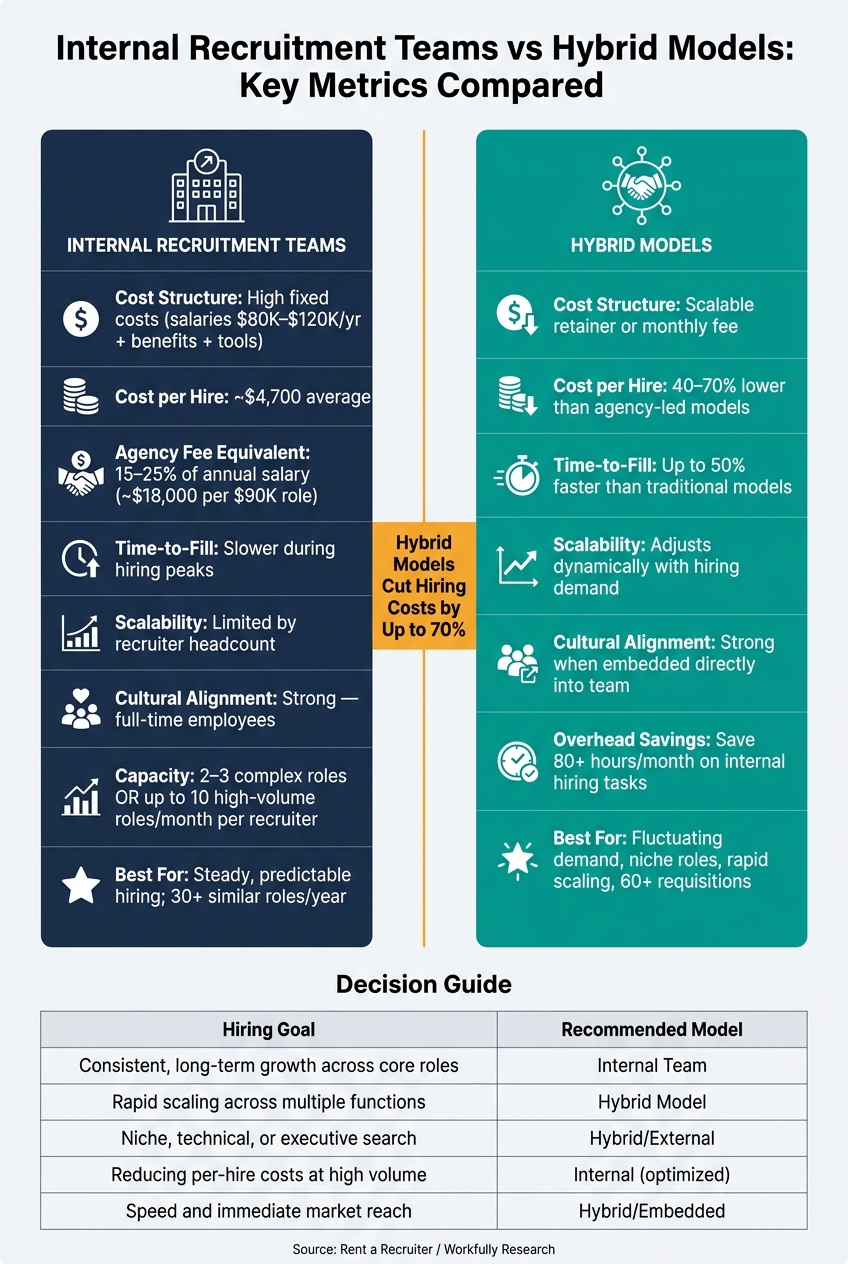
Internal Recruitment Teams vs Hybrid Models: Key Metrics Compared
Internal Recruitment Teams: The Fully In-House Approach
Control Over Employer Brand and Hiring Standards
Having recruiters embedded within your company means they live and breathe your culture. They’re not just hiring; they’re representing your values at every stage of the candidate journey. From the first outreach email to the final offer, internal recruiters ensure your brand voice stays consistent. There’s no external agency prioritizing speed over finding the right fit. Firaz Hameed, Recruitment Director at Airswift, captures this balance well:
"For me, an external recruiter supplements the internal team. We are there to add value and bring candidates not readily available through the normal channels." [5]
Another advantage? Internal teams build institutional knowledge over time. They develop strong relationships with candidates, understand the preferences of hiring managers, and refine sourcing strategies – all of which remain within your company. This alignment with your culture doesn’t just enhance hiring quality; it also ties directly to your financial model, as internal recruiters operate with a fixed cost structure focused on long-term success.
Fixed Costs and Long-Term Financial Commitment
While internal recruitment offers brand control, it comes with a financial commitment that must match your hiring needs. Salaries for in-house recruiters typically range from $80,000 to $120,000 per year, excluding benefits, recruitment tools, and job board costs.
Compare that to agency fees, which usually fall between 15% and 25% of a hire’s annual salary [1]. For a $90,000 position, that’s an $18,000 fee per hire. Over time, these costs can skyrocket if you’re scaling quickly. However, internal costs don’t disappear during hiring slowdowns. That’s the trade-off: fixed, predictable expenses versus variable, per-hire costs.
The challenge grows with hiring volume. Internal teams lack flexibility, so if you double your hiring targets, you often need to double your recruitment team. Instead of scaling efficiently, you’re scaling headcount [1].
When Internal Teams Are the Right Fit
Staying informed through a recruitment blog can help leaders decide if this model aligns with their long-term strategy.
Internal recruitment thrives in environments with steady, predictable hiring needs. If your company consistently hires at high volumes, the fixed cost model starts making sense. On average, one in-house recruiter can handle 2–3 complex roles or up to 10 high-volume roles per month [2]. If your annual hiring targets align with these numbers, an internal team becomes a practical choice.
This model also shines in roles where cultural alignment is non-negotiable. Leadership positions, roles demanding deep product expertise, or teams where a bad hire could cause major disruptions all benefit from recruiters who intimately understand your standards.
However, internal teams can struggle in more dynamic situations – sudden hiring spikes, niche technical roles, or expanding into unfamiliar markets. In these cases, the fixed-cost structure can quickly become a burden, leaving you with limited flexibility and higher risks.
sbb-itb-a23bd6a
Internal Hiring vs External Hiring – What’s Better? Ft. Fit Small Business
Hybrid Models: Mixing In-House and External Resources
A hybrid recruitment model doesn’t replace your internal team – it enhances it. Keep your in-house recruiters focused on roles where their understanding of your company’s culture is critical. Then, bring in external support when hiring demands spike, you need niche expertise, or speed becomes a priority.
Adjusting Hiring Capacity Without Long-Term Commitments
Every internal recruitment team has its limits. When hiring needs exceed that capacity, you’re left with two choices: slow down recruitment or expand your team permanently. Neither option is ideal for businesses experiencing fluctuating growth.
A hybrid model solves this by adding external resources during peak periods. You can scale up quickly to manage surges in hiring demand, then scale back down once the workload stabilizes – without committing to permanent headcount. This flexibility is particularly useful for companies in growth phases, where hiring needs can change drastically from one quarter to the next. It also allows you to tap into specialized external expertise as needed.
Bringing in External Expertise When You Need It
Not every role fits neatly into an internal recruiter’s skill set. Executive searches, highly technical roles, or positions in unfamiliar markets often require a level of expertise or network access that generalist recruiters don’t have. This is where external specialists excel, leveraging their industry connections and passive candidate pipelines to fill those harder-to-reach roles.
The best hybrid setups establish clear boundaries. Your internal team takes charge of roles that are repeatable and culture-centric. Meanwhile, external partners focus on high-stakes, hard-to-fill positions where their expertise has the biggest impact [4].
Lower Per-Hire Costs and Reduced Overhead
From a cost perspective, hybrid models are hard to ignore – especially for companies that don’t have the hiring volume to justify a fully resourced internal team. Internal recruitment teams come with fixed costs, whether you’re hiring five people in a quarter or fifty.
With embedded recruitment, one of the most common hybrid approaches, companies can cut hiring costs by 40% to 70% compared to traditional agency fees [3]. Time-to-fill also improves, often by as much as 50% [3]. For businesses hiring 30 or more roles annually across various functions, the hybrid model offers a compelling return [4]. You keep your core team lean while activating external support only when it’s needed. This approach allows you to scale recruitment efficiently without burdening your long-term finances.
Internal Teams vs. Hybrid Models: A Direct Comparison
Building on earlier insights into internal and hybrid recruitment approaches, this section dives into a side-by-side comparison of key metrics and operational impacts. The main differences lie in cost, flexibility, management effort, and risk exposure.
Comparing Key Hiring Metrics
The numbers make the distinctions clear. Internal teams operate with fixed costs, while hybrid models offer fixed-cost recruitment model. This flexibility allows hybrid models to cut total hiring costs by 40% to 70% compared to traditional agency-led methods.
| Metric | Internal Team | Hybrid Model |
|---|---|---|
| Cost Structure | High fixed costs (salaries, benefits, tools) | Predictable retainer or scalable monthly fee |
| Cost per Hire | ~$4,700 average | 40–70% lower than agency-led models |
| Time-to-Fill | Slower during hiring peaks | Up to 50% faster than traditional models |
| Scalability | Limited by recruiter headcount | Adjusts with hiring demand |
| Cultural Alignment | Strong; recruiters are full-time employees | Strong when embedded into the team directly |
These metrics highlight the practical differences, but there’s more to consider when evaluating the operational and cultural impacts.
Management Load and Business Alignment
The operational demands of running an internal team are significant. Leaders must oversee recruiter training, manage performance, and ensure access to sourcing tools – all while juggling their main responsibilities. Hybrid models ease this burden by shifting much of the operational workload to an external partner, while still allowing your team to retain control over hiring decisions.
Internal recruiters naturally align with company culture, acting as full-time advocates for your brand. However, a well-executed embedded hybrid model can achieve similar alignment. By integrating external recruiters into your systems – using your ATS and adhering to your interview processes – hybrid models deliver a consistent candidate experience. This approach also equips businesses to handle hiring surges more effectively.
Risk Exposure and Flexibility Under Pressure
Internal teams face challenges during periods of rapid growth. When recruiters manage 40 to 60 requisitions, they can quickly become overwhelmed. Additionally, if institutional knowledge is concentrated in one or two individuals, losing a key recruiter can disrupt the entire hiring pipeline.
"Strong recruiters become bottlenecks when the system around them doesn’t scale." – Workfully [1]
Hybrid models mitigate these risks by offering flexibility. They allow companies to scale up during hiring peaks and scale back during quieter periods, without committing to permanent headcount. For businesses with unpredictable hiring needs, this adaptability provides a significant edge in managing risk and maintaining stability.
How to Choose the Right Recruitment Model
Choosing the right recruitment model starts with understanding your business’s current needs. Two essential questions help guide this decision: How predictable is your hiring volume? and How much internal recruitment capacity do you actually have?
Answering these questions allows you to align your recruitment strategy with your operational realities.
When to Build an Internal Recruitment Team
An internal team works best when your hiring needs are steady and predictable. For example, if you’re hiring 30 or more similar roles annually, the fixed costs of maintaining an in-house recruitment team start to make financial sense. This setup offers benefits like stronger alignment with your company’s culture, full control over your employer brand, and a team that deeply understands your business operations.
Additionally, internal teams are ideal when long-term data management is a priority. Keeping recruitment in-house means you can maintain a consistent candidate experience, centralize your hiring history, and gain full visibility into your talent pipeline.
When a Hybrid Model Makes More Sense
If your hiring needs are irregular, scaling quickly, or expanding into new areas, a hybrid recruitment model might be the smarter choice. For instance, if your internal team is managing over 60 requisitions, it’s often a sign of capacity overload [1]. Longer time-to-fill metrics and hiring managers bypassing the talent acquisition team in favor of personal networks are other clear indicators of strain [1].
A hybrid model is particularly useful for niche or executive-level searches where your internal team may lack the necessary market expertise. It also works well for geographic expansions, where local market insights are critical. Instead of committing to permanent recruitment headcount, a hybrid approach allows you to scale resources up or down as needed. For businesses unsure of their long-term hiring needs, testing the waters with a 3–6 month pilot using an embedded recruiter can be an effective way to measure cost and quality impacts [3].
This model also supports businesses during growth phases, helping to manage recruitment peaks without overextending internal resources.
Aligning Your Recruitment Setup With Business Growth
It’s essential to match your recruitment model to your growth goals. The table below highlights how different models align with specific hiring objectives:
| Hiring Goal | Recommended Model |
|---|---|
| Consistent, long-term growth across core roles | Internal Recruitment Team |
| Rapid scaling across multiple functions | Hybrid Model |
| Niche, technical, or executive search | Hybrid/External Support |
| Reducing per-hire costs at high volume | Internal (with optimized tooling) |
| Speed and immediate market reach | Hybrid/Embedded Model |
To ensure efficiency, centralize all hiring data within a unified Applicant Tracking System (ATS). This approach supports both internal and hybrid models by streamlining candidate tracking and decision-making [1][4].
"The internal vs external debate is a false binary: Most scaling companies fail not because they chose the wrong model, but because neither model was designed for the volume they eventually reached." – Workfully [1]
At Rent a Recruiter, we know how critical it is to choose a recruitment model that aligns with your business’s growth stage. Whether you opt for an internal team or a hybrid approach, the key isn’t finding the “perfect” model – it’s finding the one that fits your current needs. A model that works well for predictable, low-volume hiring can quickly become overwhelmed when your business starts to scale. Matching your recruitment strategy to your growth trajectory ensures you stay prepared for whatever comes next.
Conclusion
Both Models Have a Place – Context Determines the Choice
One thing is clear: aligning your recruitment model with your business growth isn’t just a nice-to-have – it’s a necessity. No single recruitment model fits all situations. The right choice depends on your hiring volume, growth trajectory, and internal resources.
If you’re hiring 30 or more roles annually, internal teams often provide the best cultural alignment and cost efficiency. On the other hand, hybrid models, like embedded recruitment, give you the flexibility to scale quickly without committing to permanent headcount. They also help lower costs and speed up hiring in ways that fully internal teams may struggle to match. Since quality of hire remains the top priority for recruiting professionals [1], your model should support that goal – not hinder it.
"Choosing the right recruitment model is no longer just a tactical decision – it’s a strategic lever for talent success." – Rent a Recruiter [3]
As your business grows, your recruitment strategy must grow with it. A setup that works at 50 employees might falter as you scale rapidly. By reviewing your recruitment approach annually, or whenever hiring needs shift significantly, you can avoid bottlenecks that impact quality or timelines.
This is your opportunity to rethink and refine your current approach.
See How Much You Could Save on Hiring
With these insights, it’s worth considering the cost savings a flexible recruitment model could bring. If your current setup is holding you back, it might be time to explore a smarter solution. Rent a Recruiter embeds skilled recruiters directly into your team – often within days – to handle the entire hiring process. Clients typically cut hiring costs by up to 70% compared to traditional commission-driven models and save over 80 hours per month on internal hiring tasks. Whether you need short-term help or a scalable recruitment function, it’s worth seeing how much you could save. You can also explore our embedded recruitment case studies to see real-world results.
FAQs
How do I know if my hiring is “predictable enough” for an internal team?
If your internal team consistently fills roles on schedule, maintains high standards, and adapts to hiring demands without significant delays, your hiring process is likely running smoothly. However, as your company grows, challenges with capacity often emerge. Bottlenecks or workflow gaps can disrupt your ability to hit staffing targets. When this happens, it might be time to assess whether your process needs stronger structure, better scalability, or additional support to keep things predictable.
What roles should stay in-house vs go to an embedded recruiter in a hybrid model?
In a hybrid recruitment model, certain roles are better suited to remain in-house. These often include positions tied to your long-term strategy, company culture, or consistent hiring needs. Think leadership roles or customer service positions – jobs where deep internal knowledge and alignment with the company’s values are critical.
On the other hand, specialized or hard-to-fill roles – like software engineers or niche experts – are typically handled by embedded recruiters. These professionals bring the external expertise and networks needed to scale hiring efficiently without sacrificing quality. Their ability to navigate competitive talent markets ensures these high-demand roles are filled quickly and effectively.
How fast can a hybrid model add recruiting capacity without hurting quality?
A hybrid recruitment model allows companies to ramp up hiring capacity almost instantly – sometimes in just a matter of days – while still maintaining high standards. By blending the strengths of internal teams, who bring deep understanding of your company’s values and long-term goals, with external support that offers flexibility and access to wider talent pools, this approach tackles hiring bottlenecks head-on. With the right systems and clear roles in place, businesses can scale quickly without sacrificing the quality of their hires.