
Slow hiring costs more than recruiting fees, it costs delivery time, team capacity, and revenue.
If you are scaling in SaaS, fintech, engineering, IT, security, insurance, or professional services, the fix is usually not more agencies or more meetings. It is one owned hiring process from role approval to onboarding, backed by clear stages, automation, and reporting. Done well, that can cut time-to-fill from about 65 days to 40 days, reduce hiring manager time from 35 to 40 hours a month to 10 to 15 hours, and lower spend by up to 70% versus agency-led hiring. You can calculate your potential savings using an embedded recruitment ROI calculator.
Here is the short version:
- Hiring slows at handoffs, not just at sourcing
- Admin eats time, with recruiters spending 17.7 hours per vacancy on admin work
- Interview scheduling is a major drag, taking 38% of talent acquisition time in one 2026 report
- Loose interview processes add delay, and extra rounds can stretch hiring by 30% to 50%
- End-to-end ownership fixes this with one workflow, one owner, and stage-by-stage visibility
- Embedded recruitment can remove internal admin load and give you more control than traditional recruitment agencies
- Rent a Recruiter is built for hiring spikes, with fixed monthly pricing and a model that can save time and reduce hiring costs
This is the core point: when you tighten process ownership, you fill roles faster, waste fewer internal hours, and make hiring output easier to plan.
End-to-End Recruitment Process II HR Generalist
sbb-itb-a23bd6a
The Problem: Where SMEs Lose Time in Hiring
In SMEs, the biggest delays usually come from handoffs, not sourcing.
When no one owns the full process, approvals sit idle, handovers get missed, and the same work gets done twice. What you end up with is a hiring process that feels busy, but lacks clear ownership.
Fragmented Workflows Cause Delays at Every Stage
Delays often start before sourcing even begins. If approval chains are handled in email or chat, a role can sit for several business days before it even opens.
Then the interview stage creates another drag. When recruiters and coordinators are not clear on who owns what, scheduling turns into back-and-forth that pushes interviews out by days. Each added approval step or handoff can tack on 1 to 3 days. Across several open roles, that adds up fast.
It gets worse when interview rounds are loose and poorly defined. Moving from 3 to 4 structured steps to 6 to 7 unclear rounds can increase time-to-hire by 30% to 50%. It also pushes dropout rates up, with interview-stage drop-off making up 32% of all candidate drop-off in one funnel analysis [4].
That is not just a process issue. It hits headcount delivery, team capacity, and revenue timelines.
Internal Teams Lose Too Many Hours to Recruiting Admin
The drag is not only in approvals. A big chunk of lost time sits in admin.
A Totaljobs survey of 748 HR leaders found that recruiters spend an average of 17.7 hours per vacancy on admin work alone. That is more than two full working days per hire. The same survey found that 71% cited stakeholder feedback delays as a common blocker, while 61% pointed to manual data entry [3].
Interview coordination is another heavy drain. It takes up 46% of recruiting coordinators’ working time, and manual scheduling takes an average of 243 minutes per candidate compared with just 27 minutes when self-scheduling tools are used [2].
That is time your team could be spending on hiring decisions, pipeline quality, and offer close rates. Instead, it gets swallowed by admin that does nothing to move the hire forward.
No Process Visibility Makes Bottlenecks Hard to Fix
If you cannot see where candidates are getting stuck, you cannot fix the right problem.
Most SMEs do not track stage conversion, time in stage, or drop-off by step. So when hiring slows, the response is often a general push to move faster, not a targeted process change. That usually means more pressure, more noise, and very little improvement.
The commercial cost is easy to miss at first. Forecasts become unreliable. Hiring decisions get delayed. Headcount plans slip. Product delivery slows. Revenue plans take the hit.
The fix is one workflow, one owner, and clear visibility across every stage.
The Solution: How End-to-End Recruitment Cuts Hiring Time
Hiring speeds up when one clear process runs the whole journey. Most delays come from process gaps, not a lack of people. End-to-end recruitment puts one owner in charge from role scoping through to onboarding.
Standardized Hiring Workflows Cut Delays and Rework
When hiring steps are documented and each stage has a clear owner, decisions stop sitting in limbo. SLAs, such as "resume review within 48 hours" or "interview feedback logged within 24 hours", make delays visible as soon as they happen. That means you can fix issues before they snowball.
Role-specific scorecards do the same for evaluation. If a scorecard sets out must-have skills, core competencies, and measurable outcomes, such as "own X feature within 90 days", every interviewer works from the same criteria. That cuts post-interview back-and-forth and stops offers from getting stuck. Standardized workflows reduce extra interview rounds, candidate drop-off, and offer rework.
Once the process is in place, automation takes out the admin that still slows hiring down.
Automation and Integrated Systems Reduce Manual Work
Scheduling, data entry, and status tracking are some of the biggest admin drains. They’re also some of the easiest to automate. A centralised Applicant Tracking System (ATS) replaces spreadsheets and long email threads by keeping candidate profiles, feedback, and offer details in one place. When that system connects with job distribution tools, interview scheduling, and onboarding document collection, manual handoffs between HR, hiring managers, and finance drop sharply.
The impact shows up in hard numbers. Pharmacy2U, after integrating automated scheduling and onboarding workflows, reduced interview scheduling time from 4 to 7 days down to about 18 hours, while automated onboarding removed 238 manual back-office touchpoints [8]. For SMEs hiring across several roles at once, that kind of cycle-time gain helps deliver headcount faster.
With admin stripped back, the next gain comes from tighter screening and interview stages.
Structured Screening and Interviews Speed Up Decisions
A streamlined interview process doesn’t mean cutting corners, it means cutting repetition. In most cases, the structure is simple:
- A recruiter screen to check must-haves
- A hiring manager interview focused on role fit
- One structured assessment or panel round
- A decision
That gives you 3 to 4 purposeful stages instead of 6 or 7 overlapping ones.
When screening criteria match the role brief from the start, only candidates who meet clear thresholds move forward. That keeps the pipeline tight and decisions moving. In practice, Unique.ai‘s embedded recruitment partnership coordinated 291 interviews across five global offices while keeping structured screening in place, which helped the Head of People quickly identify which candidates were worth advancing [6].
Structured stages shorten hiring timelines without lowering hire quality.
Embedded Recruitment: A Practical Model for Fast-Growth Teams
Once workflows are standardised, the next question is simple: who owns hiring each day?
Process and automation help. They cut friction. But they do not solve day-to-day ownership. Fast-growth SMEs still need one person to keep hiring moving, push decisions forward, and stop the process from slowing down.
How Embedded Recruiters Reduce the Load on Internal Teams
An embedded recruiter works inside your team, using your ATS and communication tools to manage scheduling, feedback, candidate updates, and stakeholder follow-up. That removes the admin load, cuts scheduling delays, and keeps feedback from getting stuck.
The result is straightforward. Your internal leaders spend less time chasing interviews and more time making hiring decisions.
Because the embedded recruiter sits inside the business, candidate relationships and process knowledge stay with your company across hiring cycles. [9]
How Rent a Recruiter Fits Hiring Spikes
This is where Rent a Recruiter fits.
Rent a Recruiter places experienced recruiters into client teams in as little as 5 days, managing hiring end to end while bringing structure, visibility, and consistency from the start. [1]
This model fits hiring spikes tied to funding rounds, new product launches, or fast multi-role growth. Rent a Recruiter works with high-growth SMEs across technology, SaaS, fintech, engineering, and professional services, where hiring windows are short and the cost of delay is high.
The numbers make the point clearly.
- NextDC filled 20 roles in 3 months using an embedded recruiter, saving $416,086 compared to commission-based agency fees. [1]
- Kingspan Water & Energy, with more than 50 open roles and no dedicated internal team, embedded a Talent Partner through Rent a Recruiter and completed 37 hires and 146 interviews scheduled, saving €130,000 compared to agency fees. [5]
Time and Cost Outcomes That Matter to Decision-Makers
The business case is hard to ignore.
Companies often cut hiring costs by up to 70% and save more than 80 hours a month in internal hiring and admin time, with fixed monthly pricing that makes spend easier to plan. [1]
If you’re scaling across several open roles at once, that changes the maths fast. Lower spend, less internal drag, and more predictable hiring output can have a direct effect on growth plans.
Measuring Results and Next Steps
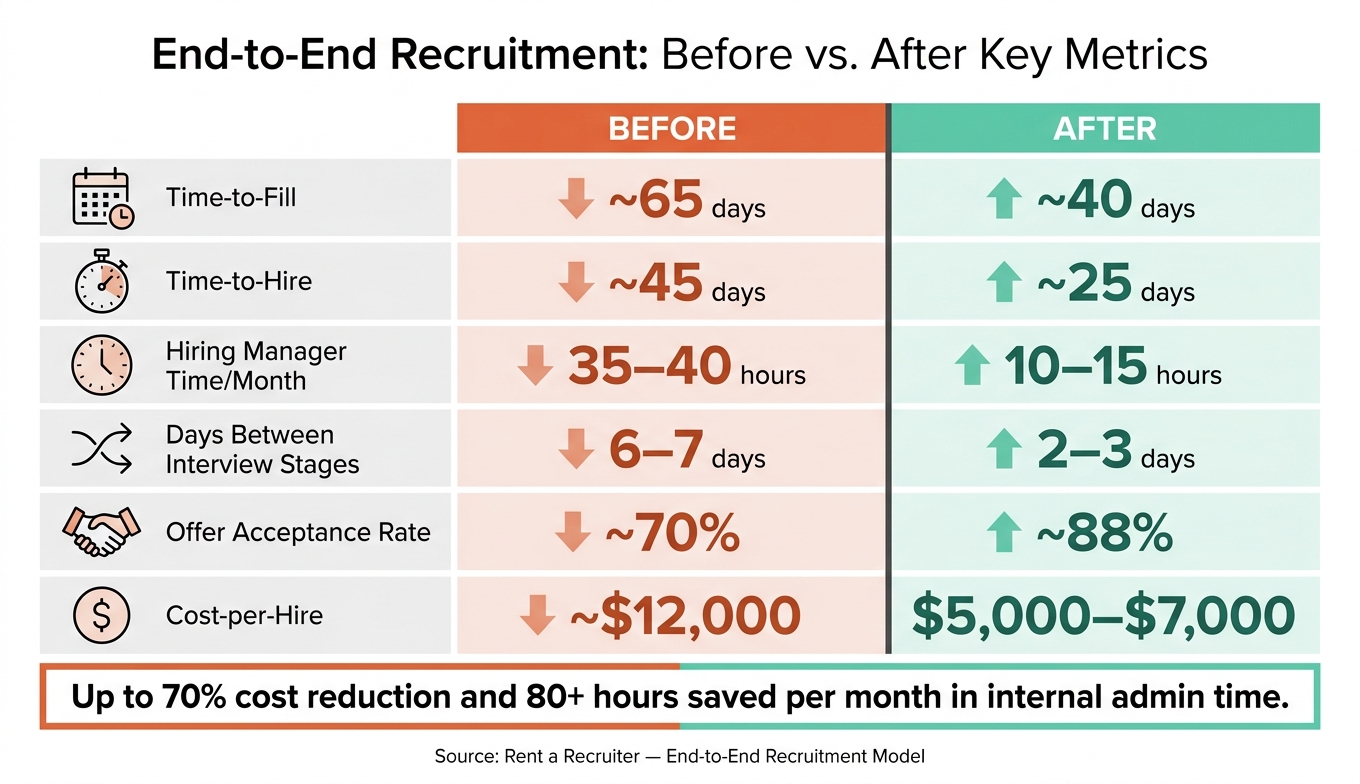
End-to-End Recruitment: Before vs. After Key Metrics
Track the Metrics That Show Time Savings
If you want to know whether end-to-end recruitment is working, you need to track the same six metrics every month, not just when hiring feels slow. The core numbers are time-to-fill, time-to-hire, hiring manager time per month, days between interview stages, offer acceptance rate, and cost-per-hire.[13][12][11]
The key is consistency. Compare the same roles across the same time period before and after each change. That gives you a clean view of what improved, what stalled, and where time is still leaking out of the process.[13][10][7][14][12]
Stage-level data matters most. It shows you the exact handoff slowing the hire, whether that’s interview scheduling, feedback lag, or offer approval. Without that detail, it’s easy to blame the whole process when the hold-up sits in one step.
| Metric | Before | After |
|---|---|---|
| Time-to-fill | ~65 days | ~40 days |
| Time-to-hire | ~45 days | ~25 days |
| Hiring manager time per month | 35-40 hours | 10-15 hours |
| Days between interview stages | 6-7 days | 2-3 days |
| Offer acceptance rate | ~70% | ~88% |
| Cost-per-hire | ~$12,000 | $5,000-$7,000 |
Those shifts matter commercially. Cutting time-to-fill from about 65 days to 40 days means teams get back to full capacity sooner. Dropping hiring manager admin from 35 to 40 hours a month to 10 to 15 hours gives senior people time back for delivery, sales, and team leadership. Lower cost-per-hire has an immediate effect on budget control too.
Track speed and quality together. Faster hiring only helps if the people you hire stay and perform well. Keep an eye on 90-day retention, 6-month retention, and early performance ratings alongside speed metrics. If those stay flat or improve while fill times fall, the process is doing its job. If attrition goes up, your screening process may need tighter controls to address the biggest challenges in recruitment.
Conclusion: Faster Hiring Starts With Better Process Ownership
Once your metrics show where delays sit, clear ownership changes the game. One owner can fix handoffs, tighten workflows, and keep each stage moving.
That is where standardized workflows, embedded ownership, and weekly reporting pay off. You get a hiring process that is faster, lower-cost, and far easier to forecast.
Book a call with Rent a Recruiter to quantify your time and cost savings.
FAQs
What does end-to-end recruitment include?
End-to-end recruitment covers the full hiring process, from hiring strategy through to onboarding. An embedded recruiter handles the day-to-day work that often slows teams down, including sourcing, screening, interview scheduling, candidate follow-up, and reporting.
That also means coordinating interviews, collecting feedback, managing offer negotiations, and supporting onboarding. When one recruiter runs the process from start to finish, you get more consistency, better visibility, and closer alignment with your hiring goals.
For scaling teams, that matters. It cuts handover gaps, saves internal time, and gives you a process you can actually track and manage.
How do I know where our hiring process is slowing down?
Track funnel data like time in stage, stage conversion rates, and how many days people spend at each step. If any stage runs past 48 to 72 hours, that’s often a sign of a bottleneck.
You should also review resume-to-interview ratios and offer acceptance rates. Break that data down by role type and hiring volume so you can see where the hold-up sits, whether that’s sourcing, unclear briefs, or slow feedback loops.
This matters because hiring delays don’t just slow recruitment. They cost time, drain team capacity, and push out time-to-hire, which can hit growth plans hard.
When should a growing team use an embedded recruiter?
A growing team should use an embedded recruiter when your internal hiring capacity is stretched, especially during rapid scaling, product launches, or high-volume hiring.
It also makes sense when you need to keep hiring moving without the admin load of managing multiple traditional recruitment agencies or adding permanent headcount. You may also want more consistent hiring practices across the business, or need to save 80+ hours a month on recruitment admin.
For CEOs, CFOs, HR leaders, and Talent leaders, that usually comes down to a simple business case: more hiring output, less internal drag, and tighter control over cost.